

Iron Range National Park

Encyclopedia
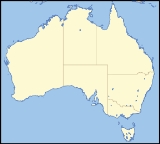
Iron Range is a National Park located in Queensland
, Australia
, 1940 km northwest of Brisbane
and 100 km east of Weipa in the Cape York Peninsula
, Queensland. Within the National Park is the Iron Range (Lockhart River Resources Reserve), Scrubby Creek mining site and the Lockhart River
Aboriginal Reserve. During World War II several Australian Army
units were stationed in the area.
(IBA), identified as such by BirdLife International
because it is one of the few known sites for the endangered Buff-breasted Button-quail. The IBA also supports an isolated population of Southern Cassowaries
as well as populations of Lovely Fairywrens, Silver-crowned Friarbird
s, Yellow
, Yellow-spotted
, White-streaked
and Banded Honeyeater
s, and White-browed Robin
s.
(RAAF). He reported to the RAAF that a suitable all-weather Emergency Landing Ground could be built in the area.
On about 18 April 1942, Walter Maiersperger, the Commanding Officer of 33 Bomb Squadron of the United States Army Air Force's 22nd Bomb Group, carried out an aerial reconnaissance flight over the Iron Range area. He had been tasked with surveying coastal airfields in Queensland that would be suitable for operation of the B-26 Marauder
s used by the 22nd Bomb Group.
 Air Commodore Lukis, Air Officer Commanding, North East Area, reported on 28 May 1942, that Pilot Officer Trench, RAAF had inspected the countryside near Portland Roads (also known as Weymouth Bay), with Colonel Mills and Captain Herman G. Cox of the USAAF. Their first attempt to fly to the Iron Range area from Coen
was not successful. An engine failed in their Rapide and they returned to Coen. After being repaired they took off the next morning and landed on a beach at low tide a few miles south of Portland Roads. As the plane slowed down upon landing on the soft sand the Rapide swung towards the sea. The tips of the propeller started to thrash in the water but the skilful pilot was able to turn the aircraft back onto the beach.
The inspection party reported to Lukis that there were good jetty facilities at Portland Roads but that there was no suitable site for an aerodrome near the jetty. They reported that a fairly extensive site just to the west of Iron Range and east of the Claudie River was suitable for the construction of several airfields.
 On 7 June 1942, an advance party of the US 46 Engineer General Service Regiment and 26 Operational Base Unit RAAF boarded the SS Wandana in Townsville headed for Portland Roads. 26 OBU arrived at Portland Roads and established radio communications with Townsville on the evening of 10 June 1942.
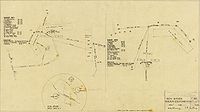
A few weeks after his initial visit, Jim Trench returned to the Iron Range area with Colonel Mills and observed two American Battalions of Pioneer Engineers busily buildings the Iron Range runways. They managed to build two 7,000-feet runways and thirteen miles of sealed taxiways within three months.
On 14 June 1942, Companies A, B and C of the 46th Engineers boarded the MS Dona Nati at Townsville and arrived at Portland Roads on 16 June 1942.
Headquarters and Service Company (H & S Company) of the 46th Engineers left Townsville on 10 July 1942 and arrived at Portland Roads on 12 July 1942.
 On 27 October 1942, Headquarters Detachment of the 46th Engineers left Townsville and arrived at Iron Range on 29 October 1942.
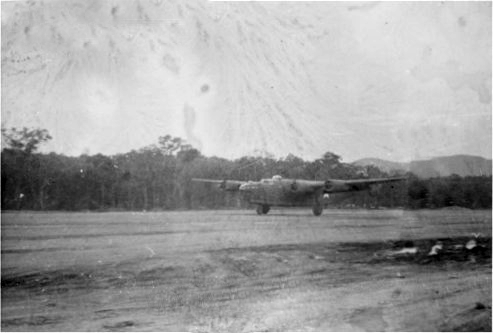
The 90th Bombardment Group arrived in Queensland in early November 1942 with their forty-eight (48) B-24D Liberators (variant D). They were initially based as follows at Iron Range, 16 km inland from the port facility of Portland Roads:
Queensland
Queensland is a state of Australia, occupying the north-eastern section of the mainland continent. It is bordered by the Northern Territory, South Australia and New South Wales to the west, south-west and south respectively. To the east, Queensland is bordered by the Coral Sea and Pacific Ocean...
, Australia
Australia
Australia , officially the Commonwealth of Australia, is a country in the Southern Hemisphere comprising the mainland of the Australian continent, the island of Tasmania, and numerous smaller islands in the Indian and Pacific Oceans. It is the world's sixth-largest country by total area...
, 1940 km northwest of Brisbane
Brisbane
Brisbane is the capital and most populous city in the Australian state of Queensland and the third most populous city in Australia. Brisbane's metropolitan area has a population of over 2 million, and the South East Queensland urban conurbation, centred around Brisbane, encompasses a population of...
and 100 km east of Weipa in the Cape York Peninsula
Cape York Peninsula
Cape York Peninsula is a large remote peninsula located in Far North Queensland at the tip of the state of Queensland, Australia, the largest unspoilt wilderness in northern Australia and one of the last remaining wilderness areas on Earth...
, Queensland. Within the National Park is the Iron Range (Lockhart River Resources Reserve), Scrubby Creek mining site and the Lockhart River
Lockhart River, Queensland
Lockhart River is a coastal Aboriginal community situated on the eastern coast of Cape York Peninsula in Queensland, Australia. The population consists mostly of Aboriginal and Torres Strait Islanders, whose ancestors were forcibly moved to the area beginning in 1924...
Aboriginal Reserve. During World War II several Australian Army
Australian Army
The Australian Army is Australia's military land force. It is part of the Australian Defence Force along with the Royal Australian Navy and the Royal Australian Air Force. While the Chief of Defence commands the Australian Defence Force , the Army is commanded by the Chief of Army...
units were stationed in the area.
Birds
The park is part of the 6205 km2 McIlwraith and Iron Ranges Important Bird AreaImportant Bird Area
An Important Bird Area is an area recognized as being globally important habitat for the conservation of bird populations. Currently there are about 10,000 IBAs worldwide. The program was developed and sites are identified by BirdLife International...
(IBA), identified as such by BirdLife International
BirdLife International
BirdLife International is a global Partnership of conservation organisations that strives to conserve birds, their habitats and global biodiversity, working with people towards sustainability in the use of natural resources...
because it is one of the few known sites for the endangered Buff-breasted Button-quail. The IBA also supports an isolated population of Southern Cassowaries
Southern Cassowary
The Southern Cassowary, Casuarius casuarius, also known as Double-wattled Cassowary, Australian Cassowary or Two-wattled Cassowary, is a large flightless black bird...
as well as populations of Lovely Fairywrens, Silver-crowned Friarbird
Silver-crowned Friarbird
The Silver-crowned Friarbird is a species of bird in the Meliphagidae family.It is endemic to Australia.Its natural habitats are subtropical or tropical dry forests and subtropical or tropical mangrove forests.-References:...
s, Yellow
Yellow Honeyeater
The Yellow Honeyeater is a species of bird in the Meliphagidae family.It is endemic to Australia.Its natural habitats are subtropical or tropical moist lowland forests and subtropical or tropical mangrove forests....
, Yellow-spotted
Yellow-spotted Honeyeater
The Yellow-spotted Honeyeater is a species of bird in the Meliphagidae family.It is endemic to Australia.Its natural habitats are subtropical or tropical moist lowland forests and subtropical or tropical mangrove forests....
, White-streaked
White-streaked Honeyeater
The White-streaked Honeyeater is a species of bird in the Meliphagidae family. It is monotypic within the genus Trichodere.It is endemic to Australia.Its natural habitat is subtropical or tropical dry forests....
and Banded Honeyeater
Banded Honeyeater
The Banded Honeyeater is a species of bird in the Meliphagidae family.It is endemic to Australia.Its natural habitats are subtropical or tropical dry forests, subtropical or tropical mangrove forests, and Mediterranean-type shrubby vegetation.-References:* BirdLife International 2004. . ...
s, and White-browed Robin
White-browed Robin
The White-browed Robin is a species of bird in the family Petroicidae. It is endemic to north-eastern Australia. Its natural habitats are forest, woodland and scrub, often near water...
s.
Airbases
In March 1940, Val Augenson of the Department of Civil Aviation inspected a possible site for an Emergency Landing Ground for the Royal Australian Air ForceRoyal Australian Air Force
The Royal Australian Air Force is the air force branch of the Australian Defence Force. The RAAF was formed in March 1921. It continues the traditions of the Australian Flying Corps , which was formed on 22 October 1912. The RAAF has taken part in many of the 20th century's major conflicts...
(RAAF). He reported to the RAAF that a suitable all-weather Emergency Landing Ground could be built in the area.
On about 18 April 1942, Walter Maiersperger, the Commanding Officer of 33 Bomb Squadron of the United States Army Air Force's 22nd Bomb Group, carried out an aerial reconnaissance flight over the Iron Range area. He had been tasked with surveying coastal airfields in Queensland that would be suitable for operation of the B-26 Marauder
B-26 Marauder
The Martin B-26 Marauder was a World War II twin-engine medium bomber built by the Glenn L. Martin Company. First used in the Pacific Theater in early 1942, it was also used in the Mediterranean Theater and in Western Europe....
s used by the 22nd Bomb Group.
Coen
Coen may refer to:"Coen" - is a Germanic variant of the name "Conrad", most popular in the Dutch language. It is originally spelled as "Coenraad" or "Koenraad", with just the "raad" deleted off. Both variations are made up from two words: "koen" and "raad" ...
was not successful. An engine failed in their Rapide and they returned to Coen. After being repaired they took off the next morning and landed on a beach at low tide a few miles south of Portland Roads. As the plane slowed down upon landing on the soft sand the Rapide swung towards the sea. The tips of the propeller started to thrash in the water but the skilful pilot was able to turn the aircraft back onto the beach.
The inspection party reported to Lukis that there were good jetty facilities at Portland Roads but that there was no suitable site for an aerodrome near the jetty. They reported that a fairly extensive site just to the west of Iron Range and east of the Claudie River was suitable for the construction of several airfields.
A few weeks after his initial visit, Jim Trench returned to the Iron Range area with Colonel Mills and observed two American Battalions of Pioneer Engineers busily buildings the Iron Range runways. They managed to build two 7,000-feet runways and thirteen miles of sealed taxiways within three months.
On 14 June 1942, Companies A, B and C of the 46th Engineers boarded the MS Dona Nati at Townsville and arrived at Portland Roads on 16 June 1942.
Headquarters and Service Company (H & S Company) of the 46th Engineers left Townsville on 10 July 1942 and arrived at Portland Roads on 12 July 1942.
The 90th Bombardment Group arrived in Queensland in early November 1942 with their forty-eight (48) B-24D Liberators (variant D). They were initially based as follows at Iron Range, 16 km inland from the port facility of Portland Roads:
List of the sections/units during World War II
According to Peter Dunn, the following sections were situated at Iron Range:- 2 Section, 2 Australian Survey Company
- 3rd Portable Surgical Hospital (US Army)
- 5th AACS
- 13 Garrison Battalion 1 Aust Army, CMF
- 13 Australian Gun (less A, B & C Company)
- 15th Weather Squadron
- 18th Station Hospital (US)
- 18th Station Hospital (US)
- 22nd Bomb Group
- 26th AA Battery
- 26 OBU (RAAF)
- 28 Service Squadron (US)
- 36 Australian AA Battery Workshops Section, Cape Direction
- 36 Australian Supply Depot Pl
- 43rd Bomb Group
- 46 Engineer Regiment (US)
- 61 Service Group & 46 (EGS)
- 90th Bomb Group
- 197th Coastal Artillery (AA) Regiment
- 387th Port Battalion (US)
- 404 Signal
- 1909 Ordnance
- AASC 4 Australian DID, Cape Direction
- Attached Detachment 200 Supply Depot (AIF)
- Australian 446 - 447 Heavy AA Gun Static
- Australian 136 Coastal Artillery Searchlight Company
- Australian Army Airway Radio Range and Communication Station
- Allied Works Council
- Carrier Pl, 51 Australian Infantry Battalion
- Civil Construction Corps (CCC)
- D Section, 2/4th Australian Dental Unit
- Detachment 1 Australian Army AA Pool Under Command CA Artillery Portland Roads
- Detachment 2/1 Australian Field Butchery Company
- Detachment 2/109 Australian General Transport Company
- Detachment 3 Company Queensland AA & CA Signals
- Detachment 8 Australian Field Baker
- Detachment 19 Australian Field Bakery
- Detachment 21 Australian Field Bakery (AIF)
- Detachment 56 Australian Comp. AA Regiment Workshop (LE)
- Directorate of Air Transport
- HQ 36 Australian AA Battery
- Main Roads Commission (MRC)
- Portland Road Battery
- Port Detachment "A"
- RAAF AASC Station Base and Weather Station
- RAAF Key Communication Centre
- US 5 Air Force Command