

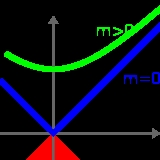
Invariant mass

Encyclopedia
The invariant mass, rest mass, intrinsic mass, proper mass or just mass is a characteristic of the total energy
and momentum
of an object or a system of objects that is the same in all frames of reference related by Lorentz transformation
s. When the system as a whole is at rest (or when it equivalently has zero net momentum), the invariant mass is equal to the total energy of the system divided by c
2. See mass-energy equivalence
for a discussion of definitions of mass. Since the mass of systems must be measured with a weight or mass scale in a reference frame in which the system has zero momentum (the center of momentum frame
), such a scale always measures the system's invariant mass.
Systems whose four-momentum
is a null vector have zero invariant mass and are referred to as massless. There are no physical objects which appear to have space-like four-momenta.
For an isolated massive system, those four-momentum is a time-like vector, the center of mass moves in a straight line with a steady sub-luminal velocity
, and an observer can always move along with it. In this frame, the center of momentum frame
, the total momentum is zero, the system as a whole may be thought of as being "at rest" if it is a bound system (like a bottle of gas), and the invariant mass of the system is equal to the total system energy divided by c2. This total energy in the center of momentum frame, is the minimum energy which the system may be observed to have, when seen by various observers from various inertial frames.
If the system consists of more than one particle, the particles may be moving relative to each other in the center of momentum frame, and they will generally interact through one or more of the fundamental forces. The kinetic energy of the particles and the potential energy of the force fields increase the total energy above the sum of the particle rest masses, and contribute to the invariant mass of the system. The sum of the particle kinetic energies as calculated by an observer is smallest in the center of momentum frame (or rest frame if the system is bound).
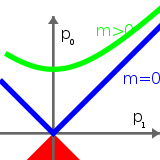
, the invariant mass is a mathematical combination of a particle's energy
E and its momentum
p which is equal to the mass
in the rest frame. This invariant mass is the same in all frames of reference (see Special Relativity
).

or in natural units
where c = 1,

This equation says that the invariant mass is the pseudo-Euclidean length of the four-vector
(E, p), calculated using the relativistic version of the pythagorean theorem which has a different sign for the space and time dimensions. This length is preserved under any Lorentz boost or rotation in four dimensions, just like the ordinary length of a vector is preserved under rotations. In quantum theory the invariant mass is a parameter in the relativistic Dirac equation
for an elementary particle. The Dirac quantum operator corresponds to the particle four-momentum vector.
Since the invariant mass is determined from quantities which are conserved during a decay, the invariant mass calculated using the energy and momentum of the decay products of a single particle is equal to the mass of the particle that decayed.
The mass of a system of particles can be calculated from the general formula:
where
The term invariant mass is also used in inelastic scattering experiments. Given an inelastic reaction with total incoming energy larger than the total detected energy (i.e. not all outgoing particles are detected in the experiment), the invariant mass (also known as the "missing mass") of the reaction is defined as follows:
If there is one dominant particle which was not detected during an experiment, a plot of the invariant mass will show a sharp peak at the mass of the missing particle.
In those cases when the momentum along one direction cannot be measured (i.e. in the case of a neutrino, whose presence is only inferred from the missing energy
) the Transverse mass
is used.
) is
|
|
|-
|
|
|}

has a convenient expression:
|
|
|-
|
|
|-
|
|
|}
 and pseudorapidity
  . Additionally the transverse momentum,
  , is usually measured. In this case if the particles are massless, or highly relativistic (
  ,) then the invariant mass becomes:
|
|
|}
 or rest energy of a particle
is defined as:
 ,
,
where is the speed of light in a vacuum
. In general, only differences in energy
have physical significance.
The concept of rest energy follows from the Special theory of relativity that leads to Einstein's famous conclusion about equivalence of energy and mass. See background for mass-energy equivalence.
On the other hand, the concept of the equivalent Dirac invariant rest mass may be defined in terms of the self energy corresponding to the product of a geometric matter current and a generalized potential as part of a single definition of mass in a geometric unified theory.
Energy
In physics, energy is an indirectly observed quantity. It is often understood as the ability a physical system has to do work on other physical systems...
and momentum
Momentum
In classical mechanics, linear momentum or translational momentum is the product of the mass and velocity of an object...
of an object or a system of objects that is the same in all frames of reference related by Lorentz transformation
Lorentz transformation
In physics, the Lorentz transformation or Lorentz-Fitzgerald transformation describes how, according to the theory of special relativity, two observers' varying measurements of space and time can be converted into each other's frames of reference. It is named after the Dutch physicist Hendrik...
s. When the system as a whole is at rest (or when it equivalently has zero net momentum), the invariant mass is equal to the total energy of the system divided by c
Speed of light
The speed of light in vacuum, usually denoted by c, is a physical constant important in many areas of physics. Its value is 299,792,458 metres per second, a figure that is exact since the length of the metre is defined from this constant and the international standard for time...
2. See mass-energy equivalence
Mass-energy equivalence
In physics, mass–energy equivalence is the concept that the mass of a body is a measure of its energy content. In this concept, mass is a property of all energy, and energy is a property of all mass, and the two properties are connected by a constant...
for a discussion of definitions of mass. Since the mass of systems must be measured with a weight or mass scale in a reference frame in which the system has zero momentum (the center of momentum frame
Center of momentum frame
A center-of-momentum frame of a system is any inertial frame in which the center of mass is at rest . Note that the center of momentum of a system is not a location, but rather defines a particular inertial frame...
), such a scale always measures the system's invariant mass.
Systems whose four-momentum
Four-momentum
In special relativity, four-momentum is the generalization of the classical three-dimensional momentum to four-dimensional spacetime. Momentum is a vector in three dimensions; similarly four-momentum is a four-vector in spacetime...
is a null vector have zero invariant mass and are referred to as massless. There are no physical objects which appear to have space-like four-momenta.
For an isolated massive system, those four-momentum is a time-like vector, the center of mass moves in a straight line with a steady sub-luminal velocity
Velocity
In physics, velocity is speed in a given direction. Speed describes only how fast an object is moving, whereas velocity gives both the speed and direction of the object's motion. To have a constant velocity, an object must have a constant speed and motion in a constant direction. Constant ...
, and an observer can always move along with it. In this frame, the center of momentum frame
Center of momentum frame
A center-of-momentum frame of a system is any inertial frame in which the center of mass is at rest . Note that the center of momentum of a system is not a location, but rather defines a particular inertial frame...
, the total momentum is zero, the system as a whole may be thought of as being "at rest" if it is a bound system (like a bottle of gas), and the invariant mass of the system is equal to the total system energy divided by c2. This total energy in the center of momentum frame, is the minimum energy which the system may be observed to have, when seen by various observers from various inertial frames.
If the system consists of more than one particle, the particles may be moving relative to each other in the center of momentum frame, and they will generally interact through one or more of the fundamental forces. The kinetic energy of the particles and the potential energy of the force fields increase the total energy above the sum of the particle rest masses, and contribute to the invariant mass of the system. The sum of the particle kinetic energies as calculated by an observer is smallest in the center of momentum frame (or rest frame if the system is bound).
Particle physics
In particle physicsParticle physics
Particle physics is a branch of physics that studies the existence and interactions of particles that are the constituents of what is usually referred to as matter or radiation. In current understanding, particles are excitations of quantum fields and interact following their dynamics...
, the invariant mass is a mathematical combination of a particle's energy
Energy
In physics, energy is an indirectly observed quantity. It is often understood as the ability a physical system has to do work on other physical systems...
E and its momentum
Momentum
In classical mechanics, linear momentum or translational momentum is the product of the mass and velocity of an object...
p which is equal to the mass
Mass
Mass can be defined as a quantitive measure of the resistance an object has to change in its velocity.In physics, mass commonly refers to any of the following three properties of matter, which have been shown experimentally to be equivalent:...
in the rest frame. This invariant mass is the same in all frames of reference (see Special Relativity
Special relativity
Special relativity is the physical theory of measurement in an inertial frame of reference proposed in 1905 by Albert Einstein in the paper "On the Electrodynamics of Moving Bodies".It generalizes Galileo's...
).
or in natural units
Natural units
In physics, natural units are physical units of measurement based only on universal physical constants. For example the elementary charge e is a natural unit of electric charge, or the speed of light c is a natural unit of speed...
where c = 1,
This equation says that the invariant mass is the pseudo-Euclidean length of the four-vector
Four-vector
In the theory of relativity, a four-vector is a vector in a four-dimensional real vector space, called Minkowski space. It differs from a vector in that it can be transformed by Lorentz transformations. The usage of the four-vector name tacitly assumes that its components refer to a standard basis...
(E, p), calculated using the relativistic version of the pythagorean theorem which has a different sign for the space and time dimensions. This length is preserved under any Lorentz boost or rotation in four dimensions, just like the ordinary length of a vector is preserved under rotations. In quantum theory the invariant mass is a parameter in the relativistic Dirac equation
Dirac equation
The Dirac equation is a relativistic quantum mechanical wave equation formulated by British physicist Paul Dirac in 1928. It provided a description of elementary spin-½ particles, such as electrons, consistent with both the principles of quantum mechanics and the theory of special relativity, and...
for an elementary particle. The Dirac quantum operator corresponds to the particle four-momentum vector.
Since the invariant mass is determined from quantities which are conserved during a decay, the invariant mass calculated using the energy and momentum of the decay products of a single particle is equal to the mass of the particle that decayed.
The mass of a system of particles can be calculated from the general formula:

where
-
 is the invariant mass of the system of particles, equal to the mass of the decay particle.
 -
 is the sum of the energies of the particles
 -
 is the vector sum of the momentumMomentumIn classical mechanics, linear momentum or translational momentum is the product of the mass and velocity of an object...
of the particles (includes both magnitude and direction of the momenta)
The term invariant mass is also used in inelastic scattering experiments. Given an inelastic reaction with total incoming energy larger than the total detected energy (i.e. not all outgoing particles are detected in the experiment), the invariant mass (also known as the "missing mass")
of the reaction is defined as follows:
If there is one dominant particle which was not detected during an experiment, a plot of the invariant mass will show a sharp peak at the mass of the missing particle.
In those cases when the momentum along one direction cannot be measured (i.e. in the case of a neutrino, whose presence is only inferred from the missing energy
Missing energy
In experimental particle physics, missing energy refers to energy which is not detected in a particle detector, but is not expected due to the laws of Conservation of Mass and Conservation of Momentum...
) the Transverse mass
Transverse mass
The transverse mass is a useful quantity to define for use in particle physics as it is invariant under Lorentz boost along the z direction. In natural units it is:Hadron collider physicists use another definition of transverse mass, in the case of a decay into two particles:-References: - See...
is used.
Example: two-particle collision
In a two-particle collision (or a two-particle decay) the square of the invariant mass (in natural unitsNatural units
In physics, natural units are physical units of measurement based only on universal physical constants. For example the elementary charge e is a natural unit of electric charge, or the speed of light c is a natural unit of speed...
) is
|
|
|-
|
|
|}
Massless particles
The invariant mass of a system made of two massless particles whose momenta form an anglehas a convenient expression:
|
|
|-
|
|
|-
|
|
|}
Collider Experiments
In particle collider experiments, one often defines the angular position of a particle in terms of a azimuthal angle and pseudorapidity . Additionally the transverse momentum, , is usually measured. In this case if the particles are massless, or highly relativistic ( ,) then the invariant mass becomes:|
|
|}
Rest energy
The rest energy or rest energy of a particleElementary particle
In particle physics, an elementary particle or fundamental particle is a particle not known to have substructure; that is, it is not known to be made up of smaller particles. If an elementary particle truly has no substructure, then it is one of the basic building blocks of the universe from which...
is defined as:
,where
is the speed of light in a vacuumSpeed of light
The speed of light in vacuum, usually denoted by c, is a physical constant important in many areas of physics. Its value is 299,792,458 metres per second, a figure that is exact since the length of the metre is defined from this constant and the international standard for time...
. In general, only differences in energy
Energy
In physics, energy is an indirectly observed quantity. It is often understood as the ability a physical system has to do work on other physical systems...
have physical significance.
The concept of rest energy follows from the Special theory of relativity that leads to Einstein's famous conclusion about equivalence of energy and mass. See background for mass-energy equivalence.
On the other hand, the concept of the equivalent Dirac invariant rest mass may be defined in terms of the self energy corresponding to the product of a geometric matter current and a generalized potential as part of a single definition of mass in a geometric unified theory.