


Intramembranous ossification

Encyclopedia
Intramembranous ossification is one of the two essential processes during fetal development of the mammal
ian skeletal system
by which bone tissue is created. Unlike endochondral ossification
, which is the other process by which bone tissue is created, cartilage
is not present during intramembranous ossification. It is also an essential process during the natural healing of bone fractures
and the rudimentary formation of bone
s of the head
.
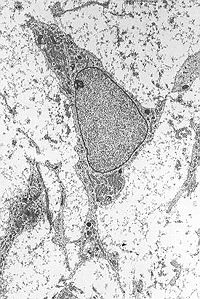 Mesenchymal stem cell
s, or MSCs, within mesenchyme
or the medullary cavity
of a bone fracture initiate the process of intramembranous ossification. A MSC is an unspecialized cell whose morphology
undergoes characteristic changes as it develops into an osteoblast
. Before it begins to develop, the morphological characteristics of a MSC are: a small cell body with a few cell processes that are long and thin; a large, round nucleus
with a prominent nucleolus
that is surrounded by finely dispersed chromatin
particles, giving the nucleus a clear appearance; a small amount of Golgi apparatus
, rough endoplasmic reticulum, mitochondria, and polyribosomes; and the cells are widely dispersed within an extracellular matrix
that is devoid of every type of collagen
except for a few reticular
fibrils.
 Then a small group of adjacent MSCs begin to replicate
until they have formed a small, dense aggregation of cells, a nodule
. Once a nodule has been formed the MSCs within it stop replicating. At this point, changes in the morphology of the MSCs occur: the cell body becomes larger and rounder; the long, thin cell processes are no longer present; and the amount of Golgi apparatus and rough endoplasmic reticulum increases. Eventually, all of the cells within the aggregate display the morphologic characteristics of an osteoprogenitor cell.
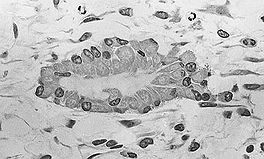 At this stage of development, changes in the morphology of the osteoprogenitor cells occur: their shape becomes more columnar; the amount of Golgi apparatus and rough endoplasmic reticulum increases; and the cells begin to create an extracellular matrix consisting of Type-I collagen
fibrils. This matrix is osteoid
and the cells that created it are osteoblasts. The osteoblasts, while lining the periphery of the nodule, continue to form osteoid at its center and some of them become incorporated within it to become osteocyte
s.
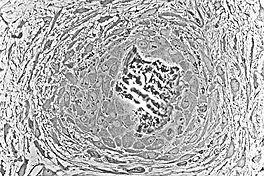 At this point, the osteoid becomes mineralized resulting in a nidus consisting of mineralized osteoid that contains osteocytes and is lined by active osteoblasts. The nidus, that began as a diffuse collection of MSCs, has become rudimentary bone tissue.
is formed and bone growth continues at the surface of trabeculae. Much like spicules, the increasing growth of trabeculae result in interconnection and this network is called woven bone. Eventually, woven bone is replaced by lamellar bone.
logic mesenchymal cells (MSC) condense into layers of vascularized primitive connective tissue
. Certain mesenchymal cells group together, usually near or around blood vessels, and differentiate into osteogenic cells which deposit bone matrix
constitutively
. These aggregates of bony matrix
are called bone spicules. Separate mesenchymal cells differentiate into osteoblast
s, which line up along the surface of the spicule and secrete more osteoid
, which increases the size of the spicule.
e. When osteoblast
s become trapped in the matrix they secrete, they differentiate into osteocyte
s. Osteoblasts continue to line up on the surface which increases the size. As growth continues, trabeculae become interconnected and woven bone is formed. The term primary spongiosa is also used to refer to the initial trabecular network.
is formed around the trabeculae by differentiating mesenchymal cells. The primary center of ossification is the area where bone growth occurs between the periosteum
and the bone. Osteogenic cells that originate from the periosteum increase appositional growth and a bone collar is formed. The bone collar is eventually mineralized and lamellar bone is formed.
s are units or principal structures of compact bone. During the formation of bone spicules, cytoplasm
ic processes from osteoblasts interconnect. This becomes the canaliculi of osteons. Since bone spicules tend to form around blood vessel
s, the perivascular space is greatly reduced as the bone continues to grow. When replacement to compact bone occurs, this blood vessel becomes the central canal of the osteon.
Mammal
Mammals are members of a class of air-breathing vertebrate animals characterised by the possession of endothermy, hair, three middle ear bones, and mammary glands functional in mothers with young...
ian skeletal system
Skeleton
The skeleton is the body part that forms the supporting structure of an organism. There are two different skeletal types: the exoskeleton, which is the stable outer shell of an organism, and the endoskeleton, which forms the support structure inside the body.In a figurative sense, skeleton can...
by which bone tissue is created. Unlike endochondral ossification
Endochondral ossification
Endochondral ossification is one of the two essential processes during fetal development of the mammalian skeletal system by which bone tissue is created. Unlike intramembranous ossification, which is the other process by which bone tissue is created, cartilage is present during endochondral...
, which is the other process by which bone tissue is created, cartilage
Cartilage
Cartilage is a flexible connective tissue found in many areas in the bodies of humans and other animals, including the joints between bones, the rib cage, the ear, the nose, the elbow, the knee, the ankle, the bronchial tubes and the intervertebral discs...
is not present during intramembranous ossification. It is also an essential process during the natural healing of bone fractures
Bone healing
Bone healing, or fracture healing, is a proliferative physiological process in which the body facilitates the repair of a bone fracture....
and the rudimentary formation of bone
Bone
Bones are rigid organs that constitute part of the endoskeleton of vertebrates. They support, and protect the various organs of the body, produce red and white blood cells and store minerals. Bone tissue is a type of dense connective tissue...
s of the head
Human skull
The human skull is a bony structure, skeleton, that is in the human head and which supports the structures of the face and forms a cavity for the brain.In humans, the adult skull is normally made up of 22 bones...
.
Creation of bone tissue
Mesenchymal stem cell
Mesenchymal stem cells, or MSCs, are multipotent stem cells that can differentiate into a variety of cell types, including: osteoblasts , chondrocytes and adipocytes...
s, or MSCs, within mesenchyme
Mesenchyme
Mesenchyme, or mesenchymal connective tissue, is a type of undifferentiated loose connective tissue that is derived mostly from mesoderm, although some are derived from other germ layers; e.g. some mesenchyme is derived from neural crest cells and thus originates from the ectoderm...
or the medullary cavity
Medullary cavity
The medullary cavity is the central cavity of bone shafts where red bone marrow and/or yellow bone marrow is stored; hence, the medullary cavity is also known as the marrow cavity...
of a bone fracture initiate the process of intramembranous ossification. A MSC is an unspecialized cell whose morphology
Morphology (biology)
In biology, morphology is a branch of bioscience dealing with the study of the form and structure of organisms and their specific structural features....
undergoes characteristic changes as it develops into an osteoblast
Osteoblast
Osteoblasts are mononucleate cells that are responsible for bone formation; in essence, osteoblasts are specialized fibroblasts that in addition to fibroblastic products, express bone sialoprotein and osteocalcin.Osteoblasts produce a matrix of osteoid, which is composed mainly of Type I collagen...
. Before it begins to develop, the morphological characteristics of a MSC are: a small cell body with a few cell processes that are long and thin; a large, round nucleus
Cell nucleus
In cell biology, the nucleus is a membrane-enclosed organelle found in eukaryotic cells. It contains most of the cell's genetic material, organized as multiple long linear DNA molecules in complex with a large variety of proteins, such as histones, to form chromosomes. The genes within these...
with a prominent nucleolus
Nucleolus
The nucleolus is a non-membrane bound structure composed of proteins and nucleic acids found within the nucleus. Ribosomal RNA is transcribed and assembled within the nucleolus...
that is surrounded by finely dispersed chromatin
Chromatin
Chromatin is the combination of DNA and proteins that make up the contents of the nucleus of a cell. The primary functions of chromatin are; to package DNA into a smaller volume to fit in the cell, to strengthen the DNA to allow mitosis and meiosis and prevent DNA damage, and to control gene...
particles, giving the nucleus a clear appearance; a small amount of Golgi apparatus
Golgi apparatus
The Golgi apparatus is an organelle found in most eukaryotic cells. It was identified in 1898 by the Italian physician Camillo Golgi, after whom the Golgi apparatus is named....
, rough endoplasmic reticulum, mitochondria, and polyribosomes; and the cells are widely dispersed within an extracellular matrix
Extracellular matrix
In biology, the extracellular matrix is the extracellular part of animal tissue that usually provides structural support to the animal cells in addition to performing various other important functions. The extracellular matrix is the defining feature of connective tissue in animals.Extracellular...
that is devoid of every type of collagen
Collagen
Collagen is a group of naturally occurring proteins found in animals, especially in the flesh and connective tissues of mammals. It is the main component of connective tissue, and is the most abundant protein in mammals, making up about 25% to 35% of the whole-body protein content...
except for a few reticular
Reticular fiber
Reticular fibers or reticulin is a histological term used to describe a type of fiber in connective tissue composed of type III collagen. Reticular fibers crosslink to form a fine meshwork...
fibrils.
Replicate
Replicate may refer to:* In biology, replication is a process by which genetic material, a cell, or an organism reproduces or makes an exact copy or copies...
until they have formed a small, dense aggregation of cells, a nodule
Nodule (medicine)
For use of the term nodule in dermatology, see Nodule In medicine, a nodule refers to a relatively hard, roughly spherical abnormal structure....
. Once a nodule has been formed the MSCs within it stop replicating. At this point, changes in the morphology of the MSCs occur: the cell body becomes larger and rounder; the long, thin cell processes are no longer present; and the amount of Golgi apparatus and rough endoplasmic reticulum increases. Eventually, all of the cells within the aggregate display the morphologic characteristics of an osteoprogenitor cell.
Type-I collagen
Type-I collagen is the most abundant collagen of the human body.It is present in scar tissue, the end product when tissue heals by repair.It is found in tendons, the endomysium of myofibrils and the organic part of bone.- See also :* Collagen...
fibrils. This matrix is osteoid
Osteoid
In histology, osteoid is the unmineralized, organic portion of the bone matrix that forms prior to the maturation of bone tissue. Osteoblasts begin the process of forming bone tissue by secreting the osteoid as several specific proteins...
and the cells that created it are osteoblasts. The osteoblasts, while lining the periphery of the nodule, continue to form osteoid at its center and some of them become incorporated within it to become osteocyte
Osteocyte
An osteocyte, a star-shaped cell, is the most abundant cell found in compact bone. Cells contain a nucleus and a thin ring of cytoplasm. When osteoblasts become trapped in the matrix they secrete, they become osteocytes...
s.
Overview
The first step in the process is the formation of bone spicules which eventually fuse with each other and become trabeculae. The periosteumPeriosteum
Periosteum is a membrane that lines the outer surface of all bones, except at the joints of long bones. Endosteum lines the inner surface of all bones....
is formed and bone growth continues at the surface of trabeculae. Much like spicules, the increasing growth of trabeculae result in interconnection and this network is called woven bone. Eventually, woven bone is replaced by lamellar bone.
Formation of bone spicules
EmbryoEmbryo
An embryo is a multicellular diploid eukaryote in its earliest stage of development, from the time of first cell division until birth, hatching, or germination...
logic mesenchymal cells (MSC) condense into layers of vascularized primitive connective tissue
Connective tissue
"Connective tissue" is a fibrous tissue. It is one of the four traditional classes of tissues . Connective Tissue is found throughout the body.In fact the whole framework of the skeleton and the different specialized connective tissues from the crown of the head to the toes determine the form of...
. Certain mesenchymal cells group together, usually near or around blood vessels, and differentiate into osteogenic cells which deposit bone matrix
Matrix (biology)
In biology, matrix is the material between animal or plant cells, in which more specialized structures are embedded, and a specific part of the mitochondrion that is the site of oxidation of organic molecules. The internal structure of connective tissues is an extracellular matrix...
constitutively
Secretory pathway
The secretory pathway is a series of steps a cell uses to move proteins out of the cell; a process known as secretion. The path of a protein destined for secretion has its origins in the rough endoplasmic reticulum, a membrane-bound compartment in the cell...
. These aggregates of bony matrix
Matrix (biology)
In biology, matrix is the material between animal or plant cells, in which more specialized structures are embedded, and a specific part of the mitochondrion that is the site of oxidation of organic molecules. The internal structure of connective tissues is an extracellular matrix...
are called bone spicules. Separate mesenchymal cells differentiate into osteoblast
Osteoblast
Osteoblasts are mononucleate cells that are responsible for bone formation; in essence, osteoblasts are specialized fibroblasts that in addition to fibroblastic products, express bone sialoprotein and osteocalcin.Osteoblasts produce a matrix of osteoid, which is composed mainly of Type I collagen...
s, which line up along the surface of the spicule and secrete more osteoid
Osteoid
In histology, osteoid is the unmineralized, organic portion of the bone matrix that forms prior to the maturation of bone tissue. Osteoblasts begin the process of forming bone tissue by secreting the osteoid as several specific proteins...
, which increases the size of the spicule.
Formation of woven bone
As the spicules continue to grow, they fuse with adjacent spicules and this results in the formation of trabeculaTrabecula
A trabecula is a small, often microscopic, tissue element in the form of a small beam, strut or rod, generally having a mechanical function, and usually composed of dense collagenous tissue They can be composed of other materials; in the heart, for example, muscles such as trabeculae carneae...
e. When osteoblast
Osteoblast
Osteoblasts are mononucleate cells that are responsible for bone formation; in essence, osteoblasts are specialized fibroblasts that in addition to fibroblastic products, express bone sialoprotein and osteocalcin.Osteoblasts produce a matrix of osteoid, which is composed mainly of Type I collagen...
s become trapped in the matrix they secrete, they differentiate into osteocyte
Osteocyte
An osteocyte, a star-shaped cell, is the most abundant cell found in compact bone. Cells contain a nucleus and a thin ring of cytoplasm. When osteoblasts become trapped in the matrix they secrete, they become osteocytes...
s. Osteoblasts continue to line up on the surface which increases the size. As growth continues, trabeculae become interconnected and woven bone is formed. The term primary spongiosa is also used to refer to the initial trabecular network.
Primary center of ossification
The periosteumPeriosteum
Periosteum is a membrane that lines the outer surface of all bones, except at the joints of long bones. Endosteum lines the inner surface of all bones....
is formed around the trabeculae by differentiating mesenchymal cells. The primary center of ossification is the area where bone growth occurs between the periosteum
Periosteum
Periosteum is a membrane that lines the outer surface of all bones, except at the joints of long bones. Endosteum lines the inner surface of all bones....
and the bone. Osteogenic cells that originate from the periosteum increase appositional growth and a bone collar is formed. The bone collar is eventually mineralized and lamellar bone is formed.
Formation of osteon
OsteonOsteon
The osteon, or Haversian system, is the fundamental functional unit of much compact bone. Osteons, roughly cylindrical structures that are typically several millimeters long and around 0.2mm in diameter, are present in many of the bones of most mammals, birds, reptiles, and amphibians.Each osteon...
s are units or principal structures of compact bone. During the formation of bone spicules, cytoplasm
Cytoplasm
The cytoplasm is a small gel-like substance residing between the cell membrane holding all the cell's internal sub-structures , except for the nucleus. All the contents of the cells of prokaryote organisms are contained within the cytoplasm...
ic processes from osteoblasts interconnect. This becomes the canaliculi of osteons. Since bone spicules tend to form around blood vessel
Blood vessel
The blood vessels are the part of the circulatory system that transports blood throughout the body. There are three major types of blood vessels: the arteries, which carry the blood away from the heart; the capillaries, which enable the actual exchange of water and chemicals between the blood and...
s, the perivascular space is greatly reduced as the bone continues to grow. When replacement to compact bone occurs, this blood vessel becomes the central canal of the osteon.