

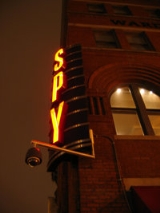
International Spy Museum

Encyclopedia
The International Spy Museum is a privately owned museum
dedicated to the field of espionage
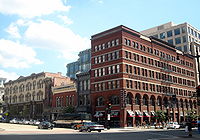
located within the 1875 Le Droit Building in the Penn Quarter
neighborhood of Washington, D.C.
, across the street from the Old Patent Office Building
(which houses the Smithsonian American Art Museum
and the National Portrait Gallery
) and one block south of the Gallery Place Metro
station.
The museum was built by Milton Maltz & the House on F Street, L.L.C. at a cost of approximately $40 million. It is one of the few museums in Washington that charges admission fees.
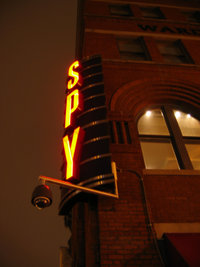
The over 600 artifacts in over 20,000 square feet (1900 m²) of exhibition space relate the history of espionage and spies in real-world practice and in popular culture
. The museum has extensive exhibits on espionage methods and materials dating from the Greek and Roman empires, the British empire, the American Revolutionary War
, the American Civil War
, the World Wars, and the Cold War
years.
Most of the exhibit areas bring visitors into the era's espionage environment. Numerous visitor-interactive stations are located throughout the exhibit areas. At the terminus of the exhibit area an 8-minute feature film updates and describes how modern technology has changed the face of warfare and terrorism
.
 A unique feature of the museum is its controlled entry, where visitors are given 5 minutes to memorize details of one of 16 spy profiles they are to assume (fictitious name, age, place of birth, destination, and so forth) as their "cover" before they are allowed to proceed into the exhibit area. Each "cover" is subtly assigned a mission on the plaque bearing their details, but completion is not required. Later while touring the museum visitors may test themselves at an interactive display on how well they remember the details of their selected spy identity. They may also be stopped occasionally by museum guides acting as "police" and "questioned" about their assumed identity.
television series SpyGames. One trailer and 13 episodes were produced before the series was cancelled.
agents, that it glosses over criticism of the CIA, and generally romanticizes intelligence work. Nevertheless, the collaboration with various members of the intelligence community has imparted authenticity to the exhibits.
Museum
A museum is an institution that cares for a collection of artifacts and other objects of scientific, artistic, cultural, or historical importance and makes them available for public viewing through exhibits that may be permanent or temporary. Most large museums are located in major cities...
dedicated to the field of espionage
Espionage
Espionage or spying involves an individual obtaining information that is considered secret or confidential without the permission of the holder of the information. Espionage is inherently clandestine, lest the legitimate holder of the information change plans or take other countermeasures once it...
located within the 1875 Le Droit Building in the Penn Quarter
Penn Quarter, Washington, D.C.
Penn Quarter is a neighborhood in the East End of Downtown Washington, D.C. north of Pennsylvania Avenue, NW. Its boundaries are not well established, but they appear to extend to 5th and 10th streets NW on the east and west, and approximately H Street on the north where Penn Quarter abuts or...
neighborhood of Washington, D.C.
Washington, D.C.
Washington, D.C., formally the District of Columbia and commonly referred to as Washington, "the District", or simply D.C., is the capital of the United States. On July 16, 1790, the United States Congress approved the creation of a permanent national capital as permitted by the U.S. Constitution....
, across the street from the Old Patent Office Building
Old Patent Office Building
The historic Old Patent Office Building in Washington, D.C. covers an entire city block defined by F and G Streets and 7th and 9th Streets NW in Chinatown. After undergoing extensive renovations, the building reopened on July 1, 2006 and was renamed The Donald W. Reynolds Center for American Art...
(which houses the Smithsonian American Art Museum
Smithsonian American Art Museum
The Smithsonian American Art Museum is a museum in Washington, D.C. with an extensive collection of American art.Part of the Smithsonian Institution, the museum has a broad variety of American art that covers all regions and art movements found in the United States...
and the National Portrait Gallery
National Portrait Gallery (United States)
The National Portrait Gallery is an art gallery in Washington, D.C., administered by the Smithsonian Institution. Its collections focus on images of famous individual Americans.-Building:...
) and one block south of the Gallery Place Metro
Washington Metro
The Washington Metro, commonly called Metro, and unofficially Metrorail, is the rapid transit system in Washington, D.C., United States, and its surrounding suburbs. It is administered by the Washington Metropolitan Area Transit Authority , which also operates Metrobus service under the Metro name...
station.
The museum was built by Milton Maltz & the House on F Street, L.L.C. at a cost of approximately $40 million. It is one of the few museums in Washington that charges admission fees.
Exhibits
The over 600 artifacts in over 20,000 square feet (1900 m²) of exhibition space relate the history of espionage and spies in real-world practice and in popular culture
Popular culture
Popular culture is the totality of ideas, perspectives, attitudes, memes, images and other phenomena that are deemed preferred per an informal consensus within the mainstream of a given culture, especially Western culture of the early to mid 20th century and the emerging global mainstream of the...
. The museum has extensive exhibits on espionage methods and materials dating from the Greek and Roman empires, the British empire, the American Revolutionary War
American Revolutionary War
The American Revolutionary War , the American War of Independence, or simply the Revolutionary War, began as a war between the Kingdom of Great Britain and thirteen British colonies in North America, and ended in a global war between several European great powers.The war was the result of the...
, the American Civil War
American Civil War
The American Civil War was a civil war fought in the United States of America. In response to the election of Abraham Lincoln as President of the United States, 11 southern slave states declared their secession from the United States and formed the Confederate States of America ; the other 25...
, the World Wars, and the Cold War
Cold War
The Cold War was the continuing state from roughly 1946 to 1991 of political conflict, military tension, proxy wars, and economic competition between the Communist World—primarily the Soviet Union and its satellite states and allies—and the powers of the Western world, primarily the United States...
years.
Most of the exhibit areas bring visitors into the era's espionage environment. Numerous visitor-interactive stations are located throughout the exhibit areas. At the terminus of the exhibit area an 8-minute feature film updates and describes how modern technology has changed the face of warfare and terrorism
Terrorism
Terrorism is the systematic use of terror, especially as a means of coercion. In the international community, however, terrorism has no universally agreed, legally binding, criminal law definition...
.
Choosing a "cover"
Operation Spy
The museum also has an interactive exhibition called Operation Spy, where visitors assume the roles of covert agents and participate in a one-hour Hollywood-style spy simulation, in which they move from area to area and are faced with puzzles, tasks, motion simulators, sound effects, and video messages as they work through a mission involving the interception of a secret arms deal involving a nuclear device. This exhibition has a separate admission fee and separate entrance from the museum's permanent exhibit.Spy in the City
In the spring of 2009, the museum began a new interactive called "Spy in the City", where visitors are given a GPS-type device and tasked with finding "clues" near various landmarks in the area surrounding the museum, for the purposes of fulfilling a "mission" of obtaining the password for a secret weapon.Other features
The museum complex includes an extensive gift shop featuring espionage books, DVDs, clothing, and other "memorabilia"; the "Spy City Cafe" snack shop; and an adjacent upscale restaurant, Zola.Television Show
In 2003, the museum provided story ideas, guest spies and on-location sets for the documentaryDocumentary
A documentary is a creative work of non-fiction, including:* Documentary film, including television* Radio documentary* Documentary photographyRelated terms include:...
television series SpyGames. One trailer and 13 episodes were produced before the series was cancelled.
Criticism
Critics have noted that several of the museum's board members are former Central Intelligence AgencyCentral Intelligence Agency
The Central Intelligence Agency is a civilian intelligence agency of the United States government. It is an executive agency and reports directly to the Director of National Intelligence, responsible for providing national security intelligence assessment to senior United States policymakers...
agents, that it glosses over criticism of the CIA, and generally romanticizes intelligence work. Nevertheless, the collaboration with various members of the intelligence community has imparted authenticity to the exhibits.
See also
- Defense Intelligence AgencyDefense Intelligence AgencyThe Defense Intelligence Agency is a member of the Intelligence Community of the United States, and is the central producer and manager of military intelligence for the United States Department of Defense, employing over 16,500 U.S. military and civilian employees worldwide...
- Federal Bureau of InvestigationFederal Bureau of InvestigationThe Federal Bureau of Investigation is an agency of the United States Department of Justice that serves as both a federal criminal investigative body and an internal intelligence agency . The FBI has investigative jurisdiction over violations of more than 200 categories of federal crime...
- Imperial War MuseumImperial War MuseumImperial War Museum is a British national museum organisation with branches at five locations in England, three of which are in London. The museum was founded during the First World War in 1917 and intended as a record of the war effort and sacrifice of Britain and her Empire...
- KGBKGBThe KGB was the commonly used acronym for the . It was the national security agency of the Soviet Union from 1954 until 1991, and was the premier internal security, intelligence, and secret police organization during that time.The State Security Agency of the Republic of Belarus currently uses the...
- National Cryptologic MuseumNational Cryptologic MuseumThe National Cryptologic Museum is an American museum of cryptologic history that is affiliated with the National Security Agency . The first public museum in the U.S. Intelligence Community, NCM is located in the former Colony Seven Motel, just two blocks from the NSA headquarters at Fort...
- National Security AgencyNational Security AgencyThe National Security Agency/Central Security Service is a cryptologic intelligence agency of the United States Department of Defense responsible for the collection and analysis of foreign communications and foreign signals intelligence, as well as protecting U.S...
- The Moscow RulesThe Moscow RulesThe Moscow Rules is the name for rules said to have been developed by the CIA during the Cold War to be used by spies and others working in Moscow....