


Interferon-gamma

Encyclopedia
Interferon-gamma is a dimer
ized soluble cytokine
that is the only member of the type II class of interferon
s. This interferon was originally called macrophage-activating factor, a term now used to describe a larger family of proteins to which IFN-γ belongs. In humans, the IFN-γ protein is encoded by the IFNG gene
.
) and natural killer T (NKT
) cells as part of the innate immune response, and by CD4
and CD8
cytotoxic T lymphocyte (CTL
) effector T cells once antigen
-specific immunity develops.
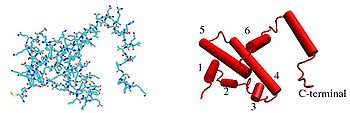
consists of a core of six α-helices and an extended unfolded sequence in the C-terminal region. This is shown in the structural models below. The α-helices in the core of the structure are numbered 1 to 6.
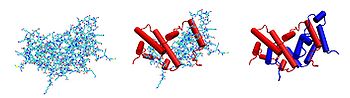
 The biologically active dimer is formed by anti-parallel inter-locking of the two monomers as shown below. In the cartoon model, one monomer is shown in red, the other in blue.
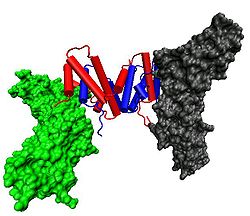 Cellular responses to IFN-γ are activated through its interaction with a heterodimeric receptor consisting of Interferon gamma receptor 1
(IFNGR1) and Interferon gamma receptor 2
(IFNGR2). IFN-γ binding to the receptor activates the JAK-STAT pathway. IFN-γ also binds to the glycosaminoglycan
heparan sulfate
(HS) at the cell surface. However, in contrast to many other heparan sulfate binding proteins, where binding promotes biological activity, the binding of IFN-γ to HS inhibits its biological activity.
The structural models shown in figures 1-3 for IFN-γ are all shortened at their C-termini by 17 amino acids. Full length IFN-γ is 143 amino acids long, the models are 126 amino acids long. Affinity for heparan sulfate resides solely within the deleted sequence of 17 amino acids. Within this sequence of 17 amino acids lie two clusters of basic amino acids termed D1 and D2, respectively. Heparan sulfate interacts with both of these clusters. In the absence of heparan sulfate the presence of the D1 sequence increases the rate at which IFN-γ-receptor complexes form. Interactions between the D1 cluster of amino acids and the receptor may be the first step in complex formation. By binding to D1 HS may compete with the receptor and prevent active receptor complexes from forming.
The biological significance of heparan sulfates interaction with IFN-γ is unclear, however binding of the D1 cluster to HS may protect it from proteolytic cleavage.
and interferon-β
, which can be expressed by all cells, IFN-γ is secreted by T helper cell
s (specifically, Th1 cells), cytotoxic T cell
s (TC cells) and NK cells. Also known as immune interferon, IFN-γ is the only Type II interferon
. It is serologically
distinct from Type I interferons and it is acid-labile, while the type I variants are acid-stable.
IFN-γ has antiviral, immunoregulatory, and anti-tumor properties. It alters transcription in up to 30 genes producing a variety of physiological and cellular responses. Among the effects are:
IFN-γ is the primary cytokine
which defines Th1 cells: Th1 cells secrete IFN-γ, which in turn causes more undifferentiated CD4+ cells (Th0 cells) to differentiate into Th1 cells, representing a positive feedback loop—while suppressing Th2 cell differentiation. (Equivalent defining cytokines for other cells include IL-4 for Th2 cells and IL-17
for Th17 cells
.)
NK cells and CD8+ cytotoxic T cells also produce IFN-γ. IFN-γ suppresses osteoclast
formation by rapidly degrading the RANK
adaptor protein TRAF6
in the RANK
-RANKL
signaling pathway, which otherwise stimulates the production of NF-κB.
The key association between interferon-γ and granulomas is that interferon-γ activates macrophages so that they become more powerful in killing intracellular organisms. Activation of macrophages by Th1 helper cell's hallmark cytokine interferon-γ in mycobacterial infections, allows the macrophages to overcome the inhibition of phagolysosome maturation caused by mycobacteria (to stay alive inside macrophages). So the first step is the activation of Th1 helper cells by macrophages releasing IL-1 and IL-12 in the presence of intracellular pathogens, as well as the presentation of some of antigens in MHC class II surface protein. Next the Th1 helper cells aggregate around the macrophages and release interferon-γ which causes the activation of macrophages. Further activation of macrophages causes a cycle of further killing of intracellular bacteria, further presentation of antigens to Th1 helper cells with further release of interferon-γ. Finally, macrophages surround the Th1 helper cells and become fibroblast-like cells further walling off the infection.
and osteopetrosis
. It is manufactured by InterMune as Actimmune(TM) and costs around USD300 per vial.
with Interferon gamma receptor 1
.
.
There is also evidence that interferon-gamma is regulated either directly or indirectly by the microRNAs: miR-29.
Protein dimer
In biochemistry, a dimer is a macromolecular complex formed by two, usually non-covalently bound, macromolecules like proteins or nucleic acids...
ized soluble cytokine
Cytokine
Cytokines are small cell-signaling protein molecules that are secreted by the glial cells of the nervous system and by numerous cells of the immune system and are a category of signaling molecules used extensively in intercellular communication...
that is the only member of the type II class of interferon
Interferon
Interferons are proteins made and released by host cells in response to the presence of pathogens—such as viruses, bacteria, or parasites—or tumor cells. They allow communication between cells to trigger the protective defenses of the immune system that eradicate pathogens or tumors.IFNs belong to...
s. This interferon was originally called macrophage-activating factor, a term now used to describe a larger family of proteins to which IFN-γ belongs. In humans, the IFN-γ protein is encoded by the IFNG gene
Gene
A gene is a molecular unit of heredity of a living organism. It is a name given to some stretches of DNA and RNA that code for a type of protein or for an RNA chain that has a function in the organism. Living beings depend on genes, as they specify all proteins and functional RNA chains...
.
Function
IFN-γ, or type II interferon, is a cytokine that is critical for innate and adaptive immunity against viral and intracellular bacterial infections and for tumor control. Aberrant IFN-γ expression is associated with a number of autoinflammatory and autoimmune diseases. The importance of IFN-γ in the immune system stems in part from its ability to inhibit viral replication directly, and most importantly from its immunostimulatory and immunomodulatory effects. IFN-γ is produced predominantly by natural killer (NKNatural killer cell
Natural killer cells are a type of cytotoxic lymphocyte that constitute a major component of the innate immune system. NK cells play a major role in the rejection of tumors and cells infected by viruses...
) and natural killer T (NKT
Natural Killer T cell
Natural killer T cells are a heterogeneous group of T cells that share properties of both T cells and natural killer cells. Many of these cells recognize the non-polymorphic CD1d molecule, an antigen-presenting molecule that binds self- and foreign lipids and glycolipids...
) cells as part of the innate immune response, and by CD4
CD4
CD4 is a glycoprotein expressed on the surface of T helper cells, monocytes, macrophages, and dendritic cells. It was discovered in the late 1970s and was originally known as leu-3 and T4 before being named CD4 in 1984...
and CD8
CD8
CD8 is a transmembrane glycoprotein that serves as a co-receptor for the T cell receptor . Like the TCR, CD8 binds to a major histocompatibility complex molecule, but is specific for the class I MHC protein. There are two isoforms of the protein, alpha and beta, each encoded by a different gene...
cytotoxic T lymphocyte (CTL
Cytotoxic T cell
A cytotoxic T cell belongs to a sub-group of T lymphocytes that are capable of inducing the death of infected somatic or tumor cells; they kill cells that are infected with viruses , or are otherwise damaged or...
) effector T cells once antigen
Antigen
An antigen is a foreign molecule that, when introduced into the body, triggers the production of an antibody by the immune system. The immune system will then kill or neutralize the antigen that is recognized as a foreign and potentially harmful invader. These invaders can be molecules such as...
-specific immunity develops.
Structure
The IFN-γ monomerMonomer
A monomer is an atom or a small molecule that may bind chemically to other monomers to form a polymer; the term "monomeric protein" may also be used to describe one of the proteins making up a multiprotein complex...
consists of a core of six α-helices and an extended unfolded sequence in the C-terminal region. This is shown in the structural models below. The α-helices in the core of the structure are numbered 1 to 6.
Receptor binding
Interferon gamma receptor 1
Interferon gamma receptor 1 also known as CD119 , is a human gene.- Function :...
(IFNGR1) and Interferon gamma receptor 2
Interferon gamma receptor 2
Interferon gamma receptor 2 also known as IFNGR2 is a protein which in humans is encoded by the IFNGR2 gene.- Function :This gene encodes the non-ligand-binding beta chain of the gamma interferon receptor...
(IFNGR2). IFN-γ binding to the receptor activates the JAK-STAT pathway. IFN-γ also binds to the glycosaminoglycan
Glycosaminoglycan
Glycosaminoglycans or mucopolysaccharides are long unbranched polysaccharides consisting of a repeating disaccharide unit. The repeating unit consists of a hexose or a hexuronic acid, linked to a hexosamine .-Production:Protein cores made in the rough endoplasmic reticulum are posttranslationally...
heparan sulfate
Heparan sulfate
Heparan sulfate is a linear polysaccharide found in all animal tissues. It occurs as a proteoglycan in which two or three HS chains are attached in close proximity to cell surface or extracellular matrix proteins...
(HS) at the cell surface. However, in contrast to many other heparan sulfate binding proteins, where binding promotes biological activity, the binding of IFN-γ to HS inhibits its biological activity.
The structural models shown in figures 1-3 for IFN-γ are all shortened at their C-termini by 17 amino acids. Full length IFN-γ is 143 amino acids long, the models are 126 amino acids long. Affinity for heparan sulfate resides solely within the deleted sequence of 17 amino acids. Within this sequence of 17 amino acids lie two clusters of basic amino acids termed D1 and D2, respectively. Heparan sulfate interacts with both of these clusters. In the absence of heparan sulfate the presence of the D1 sequence increases the rate at which IFN-γ-receptor complexes form. Interactions between the D1 cluster of amino acids and the receptor may be the first step in complex formation. By binding to D1 HS may compete with the receptor and prevent active receptor complexes from forming.
The biological significance of heparan sulfates interaction with IFN-γ is unclear, however binding of the D1 cluster to HS may protect it from proteolytic cleavage.
Biological activity
In contrast to interferon-αInterferon type I
Human type I interferons comprise a vast and growing group of IFN proteins.All type I IFNs bind to a specific cell surface receptor complex known as the IFN-α receptor that consists of IFNAR1 and IFNAR2 chains....
and interferon-β
Interferon type I
Human type I interferons comprise a vast and growing group of IFN proteins.All type I IFNs bind to a specific cell surface receptor complex known as the IFN-α receptor that consists of IFNAR1 and IFNAR2 chains....
, which can be expressed by all cells, IFN-γ is secreted by T helper cell
T helper cell
T helper cells are a sub-group of lymphocytes, a type of white blood cell, that play an important role in the immune system, particularly in the adaptive immune system. These cells have no cytotoxic or phagocytic activity; they cannot kill infected host cells or pathogens. Rather, they help other...
s (specifically, Th1 cells), cytotoxic T cell
Cytotoxic T cell
A cytotoxic T cell belongs to a sub-group of T lymphocytes that are capable of inducing the death of infected somatic or tumor cells; they kill cells that are infected with viruses , or are otherwise damaged or...
s (TC cells) and NK cells. Also known as immune interferon, IFN-γ is the only Type II interferon
Interferon
Interferons are proteins made and released by host cells in response to the presence of pathogens—such as viruses, bacteria, or parasites—or tumor cells. They allow communication between cells to trigger the protective defenses of the immune system that eradicate pathogens or tumors.IFNs belong to...
. It is serologically
Serology
Serology is the scientific study of blood serum and other bodily fluids. In practice, the term usually refers to the diagnostic identification of antibodies in the serum...
distinct from Type I interferons and it is acid-labile, while the type I variants are acid-stable.
IFN-γ has antiviral, immunoregulatory, and anti-tumor properties. It alters transcription in up to 30 genes producing a variety of physiological and cellular responses. Among the effects are:
- Promotes NK cell activity
- Increase antigen presentation and lysosomeLysosomethumb|350px|Schematic of typical animal cell, showing subcellular components. [[Organelle]]s: [[nucleoli]] [[cell nucleus|nucleus]] [[ribosomes]] [[vesicle |vesicle]] rough [[endoplasmic reticulum]]...
activity of macrophageMacrophageMacrophages are cells produced by the differentiation of monocytes in tissues. Human macrophages are about in diameter. Monocytes and macrophages are phagocytes. Macrophages function in both non-specific defense as well as help initiate specific defense mechanisms of vertebrate animals...
s. - Activate inducible Nitric Oxide Synthase iNOS
- Promotes Th1 differentiation by upregulating the transcription factorTranscription factorIn molecular biology and genetics, a transcription factor is a protein that binds to specific DNA sequences, thereby controlling the flow of genetic information from DNA to mRNA...
T-betTBX21T-box transcription factor TBX21 is a protein that in humans is encoded by the TBX21 gene....
, ultimately leading to cellular immunity: cytotoxic CD8+ T-cells and macrophage activity - while suppressing Th2 differentiation which would cause a humoral (antibody) response - Cause normal cells to increase expression of class I MHC molecules as well as class II MHC on antigen presenting cells—specifically through induction of antigen processingAntigen processingAntigen processing is a biological process that prepares antigens for presentation to special cells of the immune system called T lymphocytes. This process involves two distinct pathways for processing of antigens from an organism's own proteins or intracellular pathogens , or from phagocytosed...
genes, including subunits of the immunoproteasome (MECL1, LMP2, LMP7), as well as TAPTransporter associated with antigen processingTransporter associated with antigen processing is a member of the ATP-binding-cassette transporter family. It delivers cytosolic peptides into the endoplasmic reticulum , where they bind to nascent MHC class I molecules....
and ERAAPARTS-1Type 1 tumor necrosis factor receptor shedding aminopeptidase regulator, also known as ARTS-1, is a protein which in humans is encoded by the ARTS-1 gene.ARTS1 is also known as:* ER aminopeptidase 1...
in addition possibly to the direct upregulation of MHC heavy chains and B2-microglobulin itself - Promotes adhesion and binding required for leukocyte migration
- Induces the expression of intrinsic defense factors—for example with respect to retrovirusRetrovirusA retrovirus is an RNA virus that is duplicated in a host cell using the reverse transcriptase enzyme to produce DNA from its RNA genome. The DNA is then incorporated into the host's genome by an integrase enzyme. The virus thereafter replicates as part of the host cell's DNA...
es, relevant genes include TRIM5alpha, APOBECAPOBEC300px|thumb|upright|alt = Colored dice with checkered background|Example of a member of the APOBEC family, APOBEC-2. A cytidine deaminase from Homo Sapiens....
, and TetherinTetherinTetherin also known as bone marrow stromal antigen 2 is a protein that in humans is encoded by the BST2 gene. In addition tetherin has been designated as CD317 .- Function :...
, representing directly antiviral effects
IFN-γ is the primary cytokine
Cytokine
Cytokines are small cell-signaling protein molecules that are secreted by the glial cells of the nervous system and by numerous cells of the immune system and are a category of signaling molecules used extensively in intercellular communication...
which defines Th1 cells: Th1 cells secrete IFN-γ, which in turn causes more undifferentiated CD4+ cells (Th0 cells) to differentiate into Th1 cells, representing a positive feedback loop—while suppressing Th2 cell differentiation. (Equivalent defining cytokines for other cells include IL-4 for Th2 cells and IL-17
IL-17
IL-17 or IL 17 can refer to:* Interleukin 17* Illinois' 17th congressional district* Illinois Route 17...
for Th17 cells
T helper 17 cell
T helper 17 cells are a subset of T helper cells producing interleukin 17 discovered in 2007. They are considered developmentally distinct from Th1 and Th2 cells and excessive amounts of the cell are thought to play a key role in autoimmune disease such as multiple sclerosis , but also...
.)
NK cells and CD8+ cytotoxic T cells also produce IFN-γ. IFN-γ suppresses osteoclast
Osteoclast
An osteoclast is a type of bone cell that removes bone tissue by removing its mineralized matrix and breaking up the organic bone . This process is known as bone resorption. Osteoclasts were discovered by Kolliker in 1873...
formation by rapidly degrading the RANK
RANK
Receptor Activator of Nuclear Factor κ B , also known as TRANCE Receptor, is a type I membrane protein that is expressed on the surface of osteoclasts and is involved in their activation upon ligand binding...
adaptor protein TRAF6
TRAF6
TRAF6 is a TRAF human protein.-Interactions:TRAF6 has been shown to interact with SDCBP, IRAK2, IRAK1, MAP3K7IP2, MAP3K7IP1, TNFRSF13B, FHL2, CD40, IKBKG, RANK, HSPB2, UBE2N, SIGIRR, TAX1BP1, ASK1, PPP4C, TNFAIP3, Sequestosome 1, MAP3K7 and Ubiquitin C....
in the RANK
RANK
Receptor Activator of Nuclear Factor κ B , also known as TRANCE Receptor, is a type I membrane protein that is expressed on the surface of osteoclasts and is involved in their activation upon ligand binding...
-RANKL
RANKL
Receptor activator of nuclear factor kappa-B ligand , also known as tumor necrosis factor ligand superfamily member 11 , TNF-related activation-induced cytokine , osteoprotegerin ligand , and osteoclast differentiation factor , is a protein that in humans is encoded by the TNFSF11 gene.RANKL is...
signaling pathway, which otherwise stimulates the production of NF-κB.
Activity in Granuloma Formation
A granuloma is the bodies way of dealing with a substance it cannot remove or sterilize. Infectious causes of granulomas (infections are typically the most common cause of granulomas) include tuberculosis, leprosy, histoplasmosis, cryptococcosis, coccidioidomycosis, blastomycosis and cat scratch disease. Examples of non-infectious granulomatous diseases are sarcoidosis, Crohn's disease, berylliosis, giant-cell arteritis, Wegener's granulomatosis, Churg-Strauss syndrome, pulmonary rheumatoid nodules and aspiration of food and other particulate material into the lung. The infectious pathophysiology of granulomas is discussed primarily here.The key association between interferon-γ and granulomas is that interferon-γ activates macrophages so that they become more powerful in killing intracellular organisms. Activation of macrophages by Th1 helper cell's hallmark cytokine interferon-γ in mycobacterial infections, allows the macrophages to overcome the inhibition of phagolysosome maturation caused by mycobacteria (to stay alive inside macrophages). So the first step is the activation of Th1 helper cells by macrophages releasing IL-1 and IL-12 in the presence of intracellular pathogens, as well as the presentation of some of antigens in MHC class II surface protein. Next the Th1 helper cells aggregate around the macrophages and release interferon-γ which causes the activation of macrophages. Further activation of macrophages causes a cycle of further killing of intracellular bacteria, further presentation of antigens to Th1 helper cells with further release of interferon-γ. Finally, macrophages surround the Th1 helper cells and become fibroblast-like cells further walling off the infection.
Therapeutic use
Interferon-γ 1b is used to treat chronic granulomatous diseaseChronic granulomatous disease
Chronic granulomatous disease is a diverse group of hereditary diseases in which certain cells of the immune system have difficulty forming the reactive oxygen compounds used to kill certain ingested pathogens...
and osteopetrosis
Osteopetrosis
Osteopetrosis, literally "stone bone", also known as marble bone disease and Albers-Schonberg disease is an extremely rare inherited disorder whereby the bones harden, becoming denser, in contrast to more prevalent conditions like osteoporosis, in which the bones become less dense and more brittle,...
. It is manufactured by InterMune as Actimmune(TM) and costs around USD300 per vial.
Interactions
Interferon-γ has been shown to interactProtein-protein interaction
Protein–protein interactions occur when two or more proteins bind together, often to carry out their biological function. Many of the most important molecular processes in the cell such as DNA replication are carried out by large molecular machines that are built from a large number of protein...
with Interferon gamma receptor 1
Interferon gamma receptor 1
Interferon gamma receptor 1 also known as CD119 , is a human gene.- Function :...
.
Regulation
There is evidence that interferon-gamma expression is regulated by a pseudoknotted element in its 5' UTRInterferon gamma 5' UTR regulatory element
Interferon gamma 5' UTR regulatory elements are a family of regulatory RNAs. This family represents a pseudoknot containing stem-loop structure found in the 5' UTR of interferon-gamma mRNA. This structure is thought to be involved in translational regulation and the pseudoknot has been found to...
.
There is also evidence that interferon-gamma is regulated either directly or indirectly by the microRNAs: miR-29.