

Glycosaminoglycan

Encyclopedia

Polysaccharide
Polysaccharides are long carbohydrate molecules, of repeated monomer units joined together by glycosidic bonds. They range in structure from linear to highly branched. Polysaccharides are often quite heterogeneous, containing slight modifications of the repeating unit. Depending on the structure,...
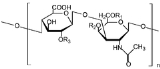
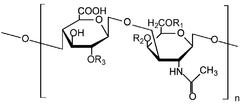
s consisting of a repeating disaccharide
Disaccharide
A disaccharide or biose is the carbohydrate formed when two monosaccharides undergo a condensation reaction which involves the elimination of a small molecule, such as water, from the functional groups only. Like monosaccharides, disaccharides form an aqueous solution when dissolved in water...
unit. The repeating unit consists of a hexose
Hexose
In organic chemistry, a hexose is a monosaccharide with six carbon atoms, having the chemical formula C6H12O6. Hexoses are classified by functional group, with aldohexoses having an aldehyde at position 1, and ketohexoses having a ketone at position 2....
(six-carbon sugar) or a hexuronic acid, linked to a hexosamine (six-carbon sugar containing nitrogen
Nitrogen
Nitrogen is a chemical element that has the symbol N, atomic number of 7 and atomic mass 14.00674 u. Elemental nitrogen is a colorless, odorless, tasteless, and mostly inert diatomic gas at standard conditions, constituting 78.08% by volume of Earth's atmosphere...
).
Production
Protein cores made in the rough endoplasmic reticulumEndoplasmic reticulum
The endoplasmic reticulum is an organelle of cells in eukaryotic organisms that forms an interconnected network of tubules, vesicles, and cisternae...
are posttranslationally modified by glycosyltransferase
Glycosyltransferase
Glycosyltransferases are enzymes that act as a catalyst for the transfer of a monosaccharide unit from an activated nucleotide sugar to a glycosyl acceptor molecule, usually an alcohol....
s in the Golgi apparatus
Golgi apparatus
The Golgi apparatus is an organelle found in most eukaryotic cells. It was identified in 1898 by the Italian physician Camillo Golgi, after whom the Golgi apparatus is named....
, where GAG disaccharides are added to protein cores to yield proteoglycans; the exception is the GAG hyaluronan
Hyaluronan
Hyaluronan is an anionic, nonsulfated glycosaminoglycan distributed widely throughout connective, epithelial, and neural tissues...
, which is uniquely synthesized without a protein core and is "spun out" by enzymes at the cell surface directly into the extracellular space.
Function
This family of carbohydrates is essential or important for life.GAGs form an important component of connective tissue
Connective tissue
"Connective tissue" is a fibrous tissue. It is one of the four traditional classes of tissues . Connective Tissue is found throughout the body.In fact the whole framework of the skeleton and the different specialized connective tissues from the crown of the head to the toes determine the form of...
s. GAG chains may be covalently linked
Covalent bond
A covalent bond is a form of chemical bonding that is characterized by the sharing of pairs of electrons between atoms. The stable balance of attractive and repulsive forces between atoms when they share electrons is known as covalent bonding....
to a protein
Protein
Proteins are biochemical compounds consisting of one or more polypeptides typically folded into a globular or fibrous form, facilitating a biological function. A polypeptide is a single linear polymer chain of amino acids bonded together by peptide bonds between the carboxyl and amino groups of...
to form proteoglycan
Proteoglycan
Proteoglycans are proteins that are heavily glycosylated. The basic proteoglycan unit consists of a "core protein" with one or more covalently attached glycosaminoglycan chain. The point of attachment is a Ser residue to which the glycosaminoglycan is joined through a tetrasaccharide bridge...
s.
Water sticks to GAGs; this is where the resistance to pressure comes from. The density of sugar molecules and the net negative charges attract cations, for example, Na+, which, after the sodium binds, attracts water molecules.
Some examples of glycosaminoglycan uses in nature include heparin
Heparin
Heparin , also known as unfractionated heparin, a highly sulfated glycosaminoglycan, is widely used as an injectable anticoagulant, and has the highest negative charge density of any known biological molecule...
as an anticoagulant
Anticoagulant
An anticoagulant is a substance that prevents coagulation of blood. A group of pharmaceuticals called anticoagulants can be used in vivo as a medication for thrombotic disorders. Some anticoagulants are used in medical equipment, such as test tubes, blood transfusion bags, and renal dialysis...
, hyaluronan
Hyaluronan
Hyaluronan is an anionic, nonsulfated glycosaminoglycan distributed widely throughout connective, epithelial, and neural tissues...
as a component in the synovial fluid
Synovial fluid
Synovial fluid is a viscous, non-Newtonian fluid found in the cavities of synovial joints. With its yolk-like consistency , the principal role of synovial fluid is to reduce friction between the articular cartilage of synovial joints during movement.-Overview:The inner membrane of synovial joints...
lubricant in body joints, and chondroitins
Chondroitin sulfate
Chondroitin sulfate is a sulfated glycosaminoglycan composed of a chain of alternating sugars . It is usually found attached to proteins as part of a proteoglycan. A chondroitin chain can have over 100 individual sugars, each of which can be sulfated in variable positions and quantities...
, which can be found in connective tissues, cartilage
Cartilage
Cartilage is a flexible connective tissue found in many areas in the bodies of humans and other animals, including the joints between bones, the rib cage, the ear, the nose, the elbow, the knee, the ankle, the bronchial tubes and the intervertebral discs...
, and tendon
Tendon
A tendon is a tough band of fibrous connective tissue that usually connects muscle to bone and is capable of withstanding tension. Tendons are similar to ligaments and fasciae as they are all made of collagen except that ligaments join one bone to another bone, and fasciae connect muscles to other...
s.
Classification
Members of the glycosaminoglycan family vary in the type of hexosamine, hexose or hexuronic acid unit they contain (e.g. glucuronic acidGlucuronic acid
Glucuronic acid is a carboxylic acid. Its structure is similar to that of glucose. However, glucuronic acid's sixth carbon is oxidized to a carboxylic acid...
, iduronic acid
Iduronic acid
L-Iduronic acid is the major uronic acid component of the glycosaminoglycans dermatan sulfate, and heparin. It is also present in heparan sulfate although here in a minor amount relative to its carbon-5 epimer glucuronic acid....
, galactose
Galactose
Galactose , sometimes abbreviated Gal, is a type of sugar that is less sweet than glucose. It is a C-4 epimer of glucose....
, galactosamine
Galactosamine
Galactosamine is a hexosamine derived from galactose with the molecular formula C6H13NO5. This amino sugar is a constituent of some glycoprotein hormones such as follicle-stimulating hormone and luteinizing hormone...
, glucosamine
Glucosamine
Glucosamine is an amino sugar and a prominent precursor in the biochemical synthesis of glycosylated proteins and lipids. Glucosamine is part of the structure of the polysaccharides chitosan and chitin, which compose the exoskeletons of crustaceans and other arthropods, cell walls in fungi and...
).
They also vary in the geometry of the glycosidic linkage
Glycosidic bond
In chemistry, a glycosidic bond is a type of covalent bond that joins a carbohydrate molecule to another group, which may or may not be another carbohydrate....
.
Examples of GAGs include:
| Name | Hexuronic acid / Hexose | Hexosamine | Linkage geometry between predominant monomeric units | Unique features >- |-valign="top" | Chondroitin sulfate Chondroitin sulfate Chondroitin sulfate is a sulfated glycosaminoglycan composed of a chain of alternating sugars . It is usually found attached to proteins as part of a proteoglycan. A chondroitin chain can have over 100 individual sugars, each of which can be sulfated in variable positions and quantities... |
GlcUA or GlcUA(2S) | GalNAc or GalNAc(4S) or GalNAc(6S) or GalNAc(4S,6S) | -4GlcUAβ1-3GalNAcβ1- | >- | GlcUA or IdoUA or IdoUA(2S) | GalNAc or GalNAc(4S) or GalNAc(6S) or GalNAc(4S,6S) | -4IdoUAβ1-3GalNAcβ1- | iduronic acid Iduronic acid L-Iduronic acid is the major uronic acid component of the glycosaminoglycans dermatan sulfate, and heparin. It is also present in heparan sulfate although here in a minor amount relative to its carbon-5 epimer glucuronic acid.... , although some hexuronic acid monosaccharides may be glucuronic acid Glucuronic acid Glucuronic acid is a carboxylic acid. Its structure is similar to that of glucose. However, glucuronic acid's sixth carbon is oxidized to a carboxylic acid... . >- |-valign="top" | Keratan sulfate Keratan sulfate Keratan sulfate , also called keratosulfate, is any of several sulfated glycosaminoglycans that have been found especially in the cornea, cartilage, and bone. It is also synthesized in the central nervous system where it participates both in development and in the glial scar formation following an... |
Gal or Gal(6S) | GlcNAc or GlcNAc(6S) | -3Gal(6S)β1-4GlcNAc(6S)β1- | fucosylated Fucose Fucose is a hexose deoxy sugar with the chemical formula C6H12O5. It is found on N-linked glycans on the mammalian, insect and plant cell surface, and is the fundamental sub-unit of the fucoidan polysaccharide... . >- |-valign="top" | Heparin Heparin Heparin , also known as unfractionated heparin, a highly sulfated glycosaminoglycan, is widely used as an injectable anticoagulant, and has the highest negative charge density of any known biological molecule... |
GlcUA or IdoUA(2S) | GlcNAc or GlcNS or GlcNAc(6S) or GlcNS(6S) | -4IdoUA(2S)α1-4GlcNS(6S)α1- | >- | GlcUA or IdoUA or IdoUA(2S) | GlcNAc or GlcNS or GlcNAc(6S) or GlcNS(6S) | -4GlcUAβ1-4GlcNAcα1- | >- | GlcUA | GlcNAc | -4GlcUAβ1-3GlcNAcβ1- | The only GAG that is exclusively non-sulfated |
Abbreviations
- GlcUA = β-D-glucuronic acidGlucuronic acidGlucuronic acid is a carboxylic acid. Its structure is similar to that of glucose. However, glucuronic acid's sixth carbon is oxidized to a carboxylic acid...
- GlcUA(2S) = 2-O-sulfo-β-D-glucuronic acid
- IdoUA = α-L-iduronic acidIduronic acidL-Iduronic acid is the major uronic acid component of the glycosaminoglycans dermatan sulfate, and heparin. It is also present in heparan sulfate although here in a minor amount relative to its carbon-5 epimer glucuronic acid....
- IdoUA(2S) = 2-O-sulfo-α-L-iduronic acid
- Gal = β-D-galactoseGalactoseGalactose , sometimes abbreviated Gal, is a type of sugar that is less sweet than glucose. It is a C-4 epimer of glucose....
- Gal(6S) = 6-O-sulfo-β-D-galactose
- GalNAc = β-D-N-acetylgalactosamineN-AcetylgalactosamineN-Acetylgalactosamine , is an amino sugar derivative of galactose.-Function:In humans it is the terminal carbohydrate forming the antigen of blood group A....
- GalNAc(4S) = β-D-N-acetylgalactosamine-4-O-sulfate
- GalNAc(6S) = β-D-N-acetylgalactosamine-6-O-sulfate
- GalNAc(4S,6S) = β-D-N-acetylgalactosamine-4-O, 6-O-sulfate
- GlcNAc = α-D-N-acetylglucosamineN-AcetylglucosamineN-Acetylglucosamine is a monosaccharide derivative of glucose. It is an amide between glucosamine and acetic acid...
- GlcNS = α-D-N-sulfoglucosamine
- GlcNS(6S) = α-D-N-sulfoglucosamine-6-O-sulfate
External links
- Proteoglycans and Glycosaminoglycans at Lancaster UniversityLancaster UniversityLancaster University, officially The University of Lancaster, is a leading research-intensive British university in Lancaster, Lancashire, England. The university was established by Royal Charter in 1964 and initially based in St Leonard's Gate until moving to a purpose-built 300 acre campus at...
- Illustration at scientificpsychic.com
- The Role of Mucopolysaccharides in good health
- King M. 2005. Glycosaminoglycans. Indiana University School of MedicineIndiana University School of MedicineThe Indiana University School of Medicine is a leading medical school and medical research powerhouse connected to Indiana University. With several teaching campuses in the state, the School of Medicine has its predominant research and medical center at the Indiana University – Purdue University...
Accessed December 31, 2006. - MRI evaluation of glycosaminoglycan loss (dGEMRIC evaluation)