

Institute of Education

Encyclopedia
The Institute of Education (IOE) is a public
research university located in London
, United Kingdom
specialised in postgraduate study and research in the field of education
and a constituent college of the federal University of London
. It is the largest education research body in the United Kingdom
, with over 700 research students in the doctoral school. It also has the largest portfolio of postgraduate programmes in education in the UK, with approximately 4,000 students taking Master's
programmes, and a further 1,200 students doing PGCE
teacher-training courses.
The IOE has long been recognised as a leading centre of educational enquiry. At any one time it hosts over 100 research projects funded by Research Council
s, government departments and other agencies. IOE is generally recognised as one of the best institutions focusing on educational research and offering teacher training and Education studies (for example, it was accorded joint first place, alongside Oxford University, in the 2008 Research Assessment 'Education' subject rankings, according to both Times Higher Education and the Guardian).. The Institute publishes Educate~
– The Journal of Doctoral Research in Education
, called for further provision for the training of teachers in London in universities. The TEB submitted a scheme to the Senate of the University of London
for a new day training college which would train teachers of both sexes when most existing courses were taught in in single sex colleges or departments. The principal of the proposed college was also to act as the Professor of the Theory, History and Practice of Education at the University. The new college was opened on the 6 October 1902 as the London Day Training College under the administration of the LCC
Its first Principal was Sir John Adams, who had previously been the Professor of Education at University of Glasgow
. Adams was joined with a mistress and master of Method (later Vice-Principals). The bulk of the teaching was carried out by the Vice-Principals and other specialists were appointed to teach specific subjects, including Cyril Burt
. Initially the LDTC only provided teacher training courses lasting between 1 and 3 years.
In 1909 the LDTC became a school of the University of London and was wholly transferred to the University and was renamed the University of London, Institute of Education. Gradually the Institute expanded its activities and began to train secondary school teachers and offered higher degrees. It also moved into specific areas of research with its Child Development Department, administered by Susan Sutherland Isaacs
and the training of teachers for the colonial service. At the outbreak of World War II
, the Institute was temporarly transferred to the University of Nottingham
.
As a result of the report of the McNair Committee, which was established by the Board of Education
to examine recruitment and training of teachers and youth leaders a new scheme for teacher training was established in England. ‘Area Training Organisations’ (ATO) were created to coordinate the provision of teacher training and were responsible for the overall administration of all colleges of education within their area. The ATO for the London area was based at the University London under the name University of London, Institute of Education, which was responsible for around 30 existing colleges of education and education departments, including the existing Institute of Education. The colleges (known as 'constituent colleges' of the Institute) prepared students for the 'Certificate in Education' of the Institute, and latterly for the Bachelor of Education
and Bachelor of Humanities degrees of the University. The existing Institute (referred to as the ‘Central Institute’) and the new ATO (referred to as the ‘Wider Institute’) had separate identities, but confusingly were administered from the same building and by the same administrate staff. This dual identity continued until the Wider Institute gradually disappeared and was finally dissolved in 1975, coinciding with the closure (or 'merger' with local polytechnics and other institutions) of many of the colleges of education.
In 1987 the Institute once again became a school of the University of London and was incorporated by Royal Charter.
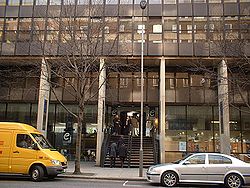 The first home of the Institute of Education (as the London Day Training College) was Passmore Edwards Hall on Clare Market
, which belonged to the London School of Economics
. It moved again in its second year to the Northampton Technical Institute in Finsbury
and the College of Preceptors building in Bloomsbury Square
. In 1907 the College moved to its first purpose built building on Southampton Row
. In 1938, the Institute moved to the Senate House complex
of the University of London
on Malet Street
. After World War II
, the Senate House complex became unworkable due to a sharp increase in numbers of students. The Institute began to expand into other buildings in the neighbouring area, including four houses on Bedford Way which were leased as a residential hall for students in 1946, a building on Tavistock Square
as home of the music department in 1958, and a few 'huts' on Malet Street (formerly belonging to the University of London Student Union) where the library was transferred.
In 1960, plans were prepared for a new building on Bedford Way designed by Denys Lasdun
, though only part of his initial design was completed. The library was one of the aspects dropped from the design and in 1968 it was moved from huts into a converted office block on Ridgemount Street. The Bedford building was completed in 1975 and was officially opened by Queen Elizabeth, The Queen Mother, Chancellor of the University of London in 1977. The library finally moved into an extension of the Bedford Way building in 1992 and was renamed the 'Newsam Library' after Peter Newsam, the Director who oversaw the new construction.
In 2004, the Institute of Education and Birkbeck, University of London
jointly founded London Knowledge Lab
, an interdisciplinary research unit concerned with learning and technology. It is located in Emerald Street, Holborn
.
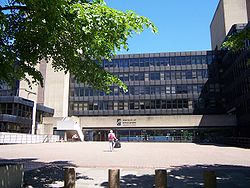 The Institute's Newsam Library is the largest in its field in Europe, containing more than 300,000 volumes and nearly 2,000 periodicals.
:
National Child Development Study
(NCDS)
1970 British Cohort Study
(BCS70)
Millennium Cohort Study
(MCS): 2000 birth cohort
The studies were key sources of evidence for a number of UK Government inquiries such as the Plowden Committee
on Primary Education (1967), the Warnock Committee on Children with Special Educational Needs (1978), the Finer
Committee on One Parent Families (1966–74), the Acheson Independent Inquiry into Inequalities in Health (1998) and the Moser Committee on Adult Basic Skills (1997–99). A study of working mothers and early child development was influential in making the argument for increased maternity leave. Another study on the impact of assets, such as savings and investments on future life chances, played a major part in the development of assets-based welfare policy, including the much-debated 'Baby Bond'
.
Public university
A public university is a university that is predominantly funded by public means through a national or subnational government, as opposed to private universities. A national university may or may not be considered a public university, depending on regions...
research university located in London
London
London is the capital city of :England and the :United Kingdom, the largest metropolitan area in the United Kingdom, and the largest urban zone in the European Union by most measures. Located on the River Thames, London has been a major settlement for two millennia, its history going back to its...
, United Kingdom
United Kingdom
The United Kingdom of Great Britain and Northern IrelandIn the United Kingdom and Dependencies, other languages have been officially recognised as legitimate autochthonous languages under the European Charter for Regional or Minority Languages...
specialised in postgraduate study and research in the field of education
Education
Education in its broadest, general sense is the means through which the aims and habits of a group of people lives on from one generation to the next. Generally, it occurs through any experience that has a formative effect on the way one thinks, feels, or acts...
and a constituent college of the federal University of London
University of London
-20th century:Shortly after 6 Burlington Gardens was vacated, the University went through a period of rapid expansion. Bedford College, Royal Holloway and the London School of Economics all joined in 1900, Regent's Park College, which had affiliated in 1841 became an official divinity school of the...
. It is the largest education research body in the United Kingdom
United Kingdom
The United Kingdom of Great Britain and Northern IrelandIn the United Kingdom and Dependencies, other languages have been officially recognised as legitimate autochthonous languages under the European Charter for Regional or Minority Languages...
, with over 700 research students in the doctoral school. It also has the largest portfolio of postgraduate programmes in education in the UK, with approximately 4,000 students taking Master's
Master's degree
A master's is an academic degree granted to individuals who have undergone study demonstrating a mastery or high-order overview of a specific field of study or area of professional practice...
programmes, and a further 1,200 students doing PGCE
PGCE
PGCE can stand for:* Postgraduate Certificate in Education, an English, Welsh and Northern Irish teacher-training qualification that includes master's credits...
teacher-training courses.
The IOE has long been recognised as a leading centre of educational enquiry. At any one time it hosts over 100 research projects funded by Research Council
Research Council
The UK Research Councils, of which there are currently seven, are publicly-funded agencies responsible for co-ordinating and funding particular areas of research, including the arts, humanities, all areas of science and engineering...
s, government departments and other agencies. IOE is generally recognised as one of the best institutions focusing on educational research and offering teacher training and Education studies (for example, it was accorded joint first place, alongside Oxford University, in the 2008 Research Assessment 'Education' subject rankings, according to both Times Higher Education and the Guardian).. The Institute publishes Educate~
Educate~
Educate~, The Journal of Doctoral Research in Education, is a peer-reviewed academic journal published by the Institute of Education of the University of London.-History:...
– The Journal of Doctoral Research in Education
History
In 1900, a report on the training of teachers, produced by the Higher Education Sub-Committee of the Technical Education Board (TEB) of the London County CouncilLondon County Council
London County Council was the principal local government body for the County of London, throughout its 1889–1965 existence, and the first London-wide general municipal authority to be directly elected. It covered the area today known as Inner London and was replaced by the Greater London Council...
, called for further provision for the training of teachers in London in universities. The TEB submitted a scheme to the Senate of the University of London
University of London
-20th century:Shortly after 6 Burlington Gardens was vacated, the University went through a period of rapid expansion. Bedford College, Royal Holloway and the London School of Economics all joined in 1900, Regent's Park College, which had affiliated in 1841 became an official divinity school of the...
for a new day training college which would train teachers of both sexes when most existing courses were taught in in single sex colleges or departments. The principal of the proposed college was also to act as the Professor of the Theory, History and Practice of Education at the University. The new college was opened on the 6 October 1902 as the London Day Training College under the administration of the LCC
Its first Principal was Sir John Adams, who had previously been the Professor of Education at University of Glasgow
University of Glasgow
The University of Glasgow is the fourth-oldest university in the English-speaking world and one of Scotland's four ancient universities. Located in Glasgow, the university was founded in 1451 and is presently one of seventeen British higher education institutions ranked amongst the top 100 of the...
. Adams was joined with a mistress and master of Method (later Vice-Principals). The bulk of the teaching was carried out by the Vice-Principals and other specialists were appointed to teach specific subjects, including Cyril Burt
Cyril Burt
Sir Cyril Lodowic Burt was an English educational psychologist who made contributions to educational psychology and statistics....
. Initially the LDTC only provided teacher training courses lasting between 1 and 3 years.
In 1909 the LDTC became a school of the University of London and was wholly transferred to the University and was renamed the University of London, Institute of Education. Gradually the Institute expanded its activities and began to train secondary school teachers and offered higher degrees. It also moved into specific areas of research with its Child Development Department, administered by Susan Sutherland Isaacs
Susan Isaacs
Susan Isaacs is an American novelist and screenwriter. She was born in Brooklyn, New York, educated at Queens College, and worked as a senior editor at Seventeen magazine. She married Elkan Abramowitz, a lawyer, in 1968 and in 1970 left work to stay at home with her newborn son, Andrew. Three...
and the training of teachers for the colonial service. At the outbreak of World War II
World War II
World War II, or the Second World War , was a global conflict lasting from 1939 to 1945, involving most of the world's nations—including all of the great powers—eventually forming two opposing military alliances: the Allies and the Axis...
, the Institute was temporarly transferred to the University of Nottingham
University of Nottingham
The University of Nottingham is a public research university based in Nottingham, United Kingdom, with further campuses in Ningbo, China and Kuala Lumpur, Malaysia...
.
As a result of the report of the McNair Committee, which was established by the Board of Education
Ministry of Education (United Kingdom)
The administration of education policy in the United Kingdom began in the 19th century. Official mandation of education began with the Elementary Education Act 1870 for England and Wales, and the Education Act 1872 for Scotland...
to examine recruitment and training of teachers and youth leaders a new scheme for teacher training was established in England. ‘Area Training Organisations’ (ATO) were created to coordinate the provision of teacher training and were responsible for the overall administration of all colleges of education within their area. The ATO for the London area was based at the University London under the name University of London, Institute of Education, which was responsible for around 30 existing colleges of education and education departments, including the existing Institute of Education. The colleges (known as 'constituent colleges' of the Institute) prepared students for the 'Certificate in Education' of the Institute, and latterly for the Bachelor of Education
Bachelor of Education
A Bachelor of Education is an undergraduate academic degree which qualifies the graduate as a teacher in schools.-North America:...
and Bachelor of Humanities degrees of the University. The existing Institute (referred to as the ‘Central Institute’) and the new ATO (referred to as the ‘Wider Institute’) had separate identities, but confusingly were administered from the same building and by the same administrate staff. This dual identity continued until the Wider Institute gradually disappeared and was finally dissolved in 1975, coinciding with the closure (or 'merger' with local polytechnics and other institutions) of many of the colleges of education.
In 1987 the Institute once again became a school of the University of London and was incorporated by Royal Charter.
Campus
Clare Market
Clare Market was an area of London to the west of Lincoln's Inn Fields, between the Strand and Drury Lane, with Vere Street adjoining its western side...
, which belonged to the London School of Economics
London School of Economics
The London School of Economics and Political Science is a public research university specialised in the social sciences located in London, United Kingdom, and a constituent college of the federal University of London...
. It moved again in its second year to the Northampton Technical Institute in Finsbury
Finsbury
Finsbury is a district of central London, England. It lies immediately north of the City of London and Clerkenwell, west of Shoreditch, and south of Islington and City Road. It is in the south of the London Borough of Islington. The Finsbury Estate is in the western part of the district...
and the College of Preceptors building in Bloomsbury Square
Bloomsbury Square
Bloomsbury Square is a garden square in Bloomsbury, Camden, London.- Geography :To the north of the square is Great Russell Street and Bedford Place, leading to Russell Square. To the south is Bloomsbury Way. To the west is the British Museum and Holborn tube station is the nearest underground...
. In 1907 the College moved to its first purpose built building on Southampton Row
Southampton Row
Southampton Row is major thoroughfare running northwest-southeast in Bloomsbury, Camden, central London, England. The road is designated as part of the A4200.- Location :To the north, Southampton Row adjoins the southeast corner of Russell Square...
. In 1938, the Institute moved to the Senate House complex
Senate House (University of London)
Senate House is the administrative centre of the University of London, situated in the heart of Bloomsbury, London between the School of Oriental and African Studies to the north, with the British Museum to the south...
of the University of London
University of London
-20th century:Shortly after 6 Burlington Gardens was vacated, the University went through a period of rapid expansion. Bedford College, Royal Holloway and the London School of Economics all joined in 1900, Regent's Park College, which had affiliated in 1841 became an official divinity school of the...
on Malet Street
Malet Street
Malet Street is a street in Bloomsbury, in the London Borough of Camden, central London, England. It runs between Torrington Place and the British Museum, parallel to Gower Street and Tottenham Court Road...
. After World War II
World War II
World War II, or the Second World War , was a global conflict lasting from 1939 to 1945, involving most of the world's nations—including all of the great powers—eventually forming two opposing military alliances: the Allies and the Axis...
, the Senate House complex became unworkable due to a sharp increase in numbers of students. The Institute began to expand into other buildings in the neighbouring area, including four houses on Bedford Way which were leased as a residential hall for students in 1946, a building on Tavistock Square
Tavistock Square
Tavistock Square is a public square in Bloomsbury, in the London Borough of Camden with a fine garden.-Public art:The centre-piece of the gardens is a statue of Mahatma Gandhi, which was installed in 1968....
as home of the music department in 1958, and a few 'huts' on Malet Street (formerly belonging to the University of London Student Union) where the library was transferred.
In 1960, plans were prepared for a new building on Bedford Way designed by Denys Lasdun
Denys Lasdun
Sir Denys Lasdun CH was an eminent English architect. Probably his best known work is the Royal National Theatre, on London's South Bank of the Thames, which is a Grade II* listed building and one of the most notable examples of Brutalist design in the United Kingdom.Lasdun studied at the...
, though only part of his initial design was completed. The library was one of the aspects dropped from the design and in 1968 it was moved from huts into a converted office block on Ridgemount Street. The Bedford building was completed in 1975 and was officially opened by Queen Elizabeth, The Queen Mother, Chancellor of the University of London in 1977. The library finally moved into an extension of the Bedford Way building in 1992 and was renamed the 'Newsam Library' after Peter Newsam, the Director who oversaw the new construction.
In 2004, the Institute of Education and Birkbeck, University of London
Birkbeck, University of London
Birkbeck, University of London is a public research university located in London, United Kingdom and a constituent college of the federal University of London. It offers many Master's and Bachelor's degree programmes that can be studied either part-time or full-time, though nearly all teaching is...
jointly founded London Knowledge Lab
London Knowledge Lab
London Knowledge Lab is a research centre in Bloomsbury, London. It was founded in 2004 as a collaboration between the Institute of Education and Birkbeck, University of London...
, an interdisciplinary research unit concerned with learning and technology. It is located in Emerald Street, Holborn
Holborn
Holborn is an area of Central London. Holborn is also the name of the area's principal east-west street, running as High Holborn from St Giles's High Street to Gray's Inn Road and then on to Holborn Viaduct...
.
Library
Main collections
- Educational collection of publications covering every aspect of education in the United Kingdom.
- International collection covering aspects of the organisation of education outside the UK
- Reference collection including reference works, indexes, legal guidance, statistics of education in the UK and recent official government publications.
- Other subjects collection containing publications on educational related subjects including psychology, sociology, linguistics etc.
- Large selection of teaching materials for all subjects and stages of the curriculum with children’s fiction and picture books.
Basic Skills Agency Resource Centre
The Basic Skills Agency Resource Centre, which was established in 1993 by the Basic Skills Agency, contains teaching materials for adult education and is available for anyone interested in basic skills. In 2005 the Basic Skills Agency passed responsibility the funding for the collection onto the Institute and the collection now sits within the Newsam library's teaching resources collection.Special collections
There are over 20 special collections of publications held by the Newsam Library. Some of the collections relate to a specific subject area or have been collection by a single source. The collection contains a comprehensive range of documents on education in the UK, the National Textbook Collection, and other unique resources.Archives
The Institute has been amassing archive collections since the 1940s, and now holds over 100 deposited collections as well as the records of the Institute itself. The deposited collections contain the personal of educationalist and other notable people involved with education and the records of educational organisations such as trade unions, and education projects. The Archives are open to both internal and external researchers by appointment only.Centre for Longitudinal Studies
The Centre for Longitudinal Studies (CLS) is an ESRC Resource Centre based at the IoE. CLS houses three of Britain's internationally-renowned birth cohort studiesBritish birth cohort studies
Birth cohort studies in Britain include four long-term medical and social studies, carried out over the lives of a group of participants, from birth. Two of these studies have continued for over 50 years.-Principal cohort studies:...
:
National Child Development Study
National Child Development Study
The National Child Development Study is a continuing, multi-disciplinary longitudinal study which follows the lives of about 17,000 people born in Great Britain in a certain week in 1958.-History:...
(NCDS)
1970 British Cohort Study
1970 British Cohort Study
The 1970 British Cohort Study is a continuing, multi-disciplinary longitudinal survey monitoring the development of babies born in the UK in one particular week in April 1970.-History:...
(BCS70)
Millennium Cohort Study
Millennium Cohort Study
The Millennium Cohort Study is a longitudinal survey conducted by the Centre for Longitudinal Studies at the University of London, following the lives of a sample of about 19,000 babies born in the UK in the year 2000–2001.-History:...
(MCS): 2000 birth cohort
The studies were key sources of evidence for a number of UK Government inquiries such as the Plowden Committee
Plowden Report
The Plowden Report is the unofficial name for the 1967 report of the Central Advisory Council For Education into Primary education in England. The report, entitled Children and their Primary Schools reviewed Primary education in a wholesale fashion. The collation of the report took around 3 years...
on Primary Education (1967), the Warnock Committee on Children with Special Educational Needs (1978), the Finer
Morris Finer
Sir Morris Finer QC was a lawyer and judge.As a young barrister Morris Finer also wrote leaders for the London Evening Standard...
Committee on One Parent Families (1966–74), the Acheson Independent Inquiry into Inequalities in Health (1998) and the Moser Committee on Adult Basic Skills (1997–99). A study of working mothers and early child development was influential in making the argument for increased maternity leave. Another study on the impact of assets, such as savings and investments on future life chances, played a major part in the development of assets-based welfare policy, including the much-debated 'Baby Bond'
Child Trust Fund
A Child Trust Fund is a long-term savings or investment account for children in the United Kingdom. New accounts cannot be created but existing accounts can receive new money...
.
Notable former faculty and staff
- Basil BernsteinBasil BernsteinBasil Bernstein was a British sociologist and linguist, known for his work in the sociology of education.-Biography:...
(1924–2000), sociologist and linguist - Max BlackMax BlackMax Black was a British-American philosopher, who was a leading influential figure in analytic philosophy in the first half of the twentieth century. He made contributions to the philosophy of language, the philosophy of mathematics and science, and the philosophy of art, also publishing studies...
(1909–1988), philosopher - Cyril BurtCyril BurtSir Cyril Lodowic Burt was an English educational psychologist who made contributions to educational psychology and statistics....
(1883–1971), educational psychologist - Rosemary FirthRosemary FirthRosemary, Lady Firth was a British social anthropologist, and wife of Sir Raymond Firth. She specialised in the field of domestic economy.-Life:...
(1912–2001), social anthropologist - Harvey GoldsteinHarvey GoldsteinHarvey Goldstein is a British statistician known for his contributions to multilevel modelling methodology and software, and for applying this to educational assessment and league tables....
(1939–), statistician - Susan Sutherland IsaacsSusan Sutherland IsaacsSusan Sutherland Isaacs, CBE was a Lancashire-born educational psychologist and psychoanalyst. She published studies on the intellectual and social development of children and promoted the nursery school movement...
, (1885–1948), educational psychologist and psychoanalyst - George Barker JefferyGeorge Barker JefferyGeorge Barker Jeffery was a leading mathematical physicist in the early twentieth century. He is probably best known to the scientifically literate public as the translator of papers by Einstein, Lorentz, and other fathers of relativity theory .-Career:Jeffery was born in 1891 and educated at...
(1891–1957), mathematician and educationalist - Leonard John LewisLeonard John LewisLeonard John Lewis was a British academic. He worked as an educationalist in Nigeria and was a lecturer at the Institute of Education of the University of London. He served as Principal of the University of Zimbabwe for the transition to Zimbabwe's independence, despite his somewhat controversial...
, international educationalist - Karl MannheimKarl MannheimKarl Mannheim , or Károly Mannheim in the original writing of his name, was a Jewish Hungarian-born sociologist, influential in the first half of the 20th century and one of the founding fathers of classical sociology and a founder of the sociology of knowledge.-Life:Mannheim studied in Budapest,...
(1893–1947), sociologist - Richard Stanley PetersRichard Stanley PetersRichard Stanley Peters is a British philosopher. His work belongs mainly to the areas of political theory, philosophical psychology, and philosophy of education.- Biography :...
(1919-), philosopher, professor of philosophy of education - Marion RichardsonMarion RichardsonMarion Richardson was British artist, educator and author who published workbooks on penmanship and handwriting.-Biography:...
(1892–1946), artist, educator and author who published workbooks on penmanship and handwriting - Harold RosenHarold RosenHarold A. Rosen is an electrical engineer, known as "the father of the geostationary satellite". He formed and led the team that designed and built the first geosynchronous communications satellite, Syncom, for Hughes Aircraft Company.Rosen graduated from Tulane University in 1947 with a Bachelor...
(1919-2008), educationalist, professor and head of English department - Christian SchillerChristian SchillerLouis Christian Schiller MC , known as Christian Schiller, was HM Inspector of Schools in the United Kingdom and a promoter of progressive ideas in primary education....
(1895–1976), HM Inspector and senior lecturer - Philip E. VernonPhilip E. VernonPhilip Ewart Vernon was a British psychologist. He studied race and intelligence.Born in Oxford, England, he attended St. John's College, Cambridge and received his M.A. and Ph.D. from Cambridge University in 1927. Vernon studied contributions of environmental and genetic factors to intellectual...
, (1905–1987), psychologist
Notable alumni
- Quentin BlakeQuentin BlakeQuentin Saxby Blake, CBE, FCSD, RDI, is an English cartoonist, illustrator and children's author, well-known for his collaborations with writer Roald Dahl.-Education:...
(born 1932), cartoonist, illustrator and children's book author. - Reginald Horace BlythReginald Horace BlythReginald Horace Blyth was an English author and devotee of Japanese culture.-Early life:Blyth was born in Essex, England, the son of a railway clerk...
(1898–1964), author and devotee of Japanese culture. - Valerie DaveyValerie DaveyValerie Davey is a former Labour Member of Parliament for Bristol West in England.-Early life:...
(b. 1940), former Labour Member of Parliament for Bristol West. - Michael DuaneMichael Duane (head teacher)Michael Duane was a British teacher known for his progressive educational views, his belief in inclusivity and a multi-racial approach, his encouragement of informal relationships between staff and pupils and his opposition to corporal punishment...
(1915–1997, controversial head teacher. - Bryan Davies, Baron Davies of OldhamBryan Davies, Baron Davies of OldhamBryan Davies, Baron Davies of Oldham, PC, is a Labour member of the House of Lords. He served as Government Deputy Chief Whip in the House of Lords from 2003 to 2010, and as usual for a holder of that position, also held the position of Captain of the Yeomen of the Guard.He was educated at...
, PC, (b.1939), Labour member of the House of Lords. - U. A. FanthorpeU. A. FanthorpeUrsula Askham Fanthorpe, CBE, FRSL was an English poet. She published as UA Fanthorpe.-Early life:She was educated in Surrey and at St Anne's College, Oxford, where she received a first-class degree in English language and literature, and subsequently taught English at Cheltenham Ladies' College...
(1929–2009), poet. - Beryl GilroyBeryl GilroyBeryl Agatha Gilroy was a novelist...
(née Answick) (1924–2001), novelist. - Sally Morgan, Baroness Morgan of HuytonSally Morgan, Baroness Morgan of HuytonSally Morgan, Baroness Morgan of Huyton is a British Labour Party politician.Morgan was educated at Belvedere School for Girls, Liverpool, and at Durham University, where she graduated in 1980 with a B.A. in geography. After taking a Postgraduate Certificate in Education at King's College London...
(b.1959), British Labour Party politician - William R. Newland (potter)William R. Newland (potter)William Rupert Newland was a New Zealand born studio potter who lived in England after the Second World War.From 1945-1947 he studied painting at the Chelsea School of Art. He studied art education at the Institute of Education, 1947-8 where he learned pottery under Beth Wright, who sent him to...
(1919–1998), New Zealand born studio potter. - Harry Mwaanga Nkumbula (1917?-1983), Zambian nationalist leader who assisted in the struggle for the independence of Northern Rhodesia.
- Harry RéeHarry RéeHarry Alfred Rée DSO OBE was a British educationist and wartime member of the Special Operations Executive.Harry Rée was born in England, the son of Dr Alfred Rée, a chemist who was descended from an illustrious Danish Jewish family, and Lavinia Dimmick, the American-born great granddaughter of...
(1914–1991), British educationalist and member of the Special Operations Executive. - Harold RosenthalHarold RosenthalHarold David Rosenthal OBE was an English music critic, writer, lecturer, and broadcaster about opera. Originally a schoolmaster, he became drawn to music, particularly opera, and began working on musical publications...
(1917–1987), music critic. - Brian SimonBrian SimonProfessor the Hon. Brian Simon , was an English educationist and historian.-Background and early life:The younger son of Ernest Darwin Simon, 1st Baron Simon of Wythenshawe and Shena, Lady Simon, he was the brother of the second Baron Simon of Wythenshawe, Roger Simon, the solicitor and writer on...
(1915–2002), educationalist and historian. - Katherine WeareKatherine WeareKatherine Weare is a Professor of Education at the University of Southampton, England.She was educated at the Grey Coat Hospital, Westminster, the University of Kent at Canterbury, Goldsmiths College, University of London and the Institute of Education, University of London...
(born 1950), Professor of Education - Sir Abubakar Tafawa Balewa (1912–1966), first Prime Minister of independent Nigeria.
Principals of the London Day Training College
- 1902-1922 - John Adams (1857–1934)
- 1922-1932 – Sir Percy Nunn (1870–1944)
Directors of the Institute of Education
- 1932-1936 - Sir Percy Nunn (1870–1944)
- 1936-1945 – Sir Fred Clarke (1880–1952)
- 1945-1957 - George Barker JefferyGeorge Barker JefferyGeorge Barker Jeffery was a leading mathematical physicist in the early twentieth century. He is probably best known to the scientifically literate public as the translator of papers by Einstein, Lorentz, and other fathers of relativity theory .-Career:Jeffery was born in 1891 and educated at...
(1891–1957) - 1958-1973 - Lionel ElvinLionel ElvinHerbert Lionel Elvin was an eminent educationist .Elvin was the son of Herbert Henry Elvin, General Secretary of the National Union of Clerks, and brother of George, who became General Secretary of the Association of Cinematograph Television and Allied Technicians.He studied at Southend High...
(1905–2005) - 1973-1983 - William TaylorWilliam TaylorWilliam Taylor was a British scholar, polyglot, and translator of German romantic literature.-Early life:He was born in Norwich, East Anglia, England on 7 November 1765, the only child of William Taylor , a wealthy Norwich merchant with European trade connections, by his wife Sarah , second...
- 1983-1989 - Denis Lawton
- 1989-1994 – Peter NewsamPeter NewsamSir Peter A. Newsam is an English educationist.Newsam was born at Gloucester and educated at the Dragon School and Clifton College. He then went to Queen's College, Oxford where he read Philosophy, Politics and Economics...
- 1994-2000 - Peter Mortimore
- 2000-2011 Geoff WhittyGeoff WhittyGeoffrey "Geoff" James Whitty CBE is the former Director of the Institute of Education, University of London, in the United Kingdom....
- 2011- Chris Husbands