
All Topics  
Leafhopper

 
Leafhopper

   Email Print
   Bookmark   Link


Leafhopper


Leafhopper is a common name applied to any species from the family
Family (biology)

In biological classification, family is a taxonomic rank. Exact details of formal nomenclature depend on the Nomenclature Codes which applies....
 Cicadellidae. Leafhoppers, also known as hoppers, are minute plant-feeding insect
Insect

Insects are the biggest class of arthropods and the only ones with wings. They are the most diverse group of animals on the planet. They are most diverse at the equator and their diversity declines toward the poles....
s in the superfamily Membracoidea
Membracoidea

The superfamily Membracoidea includes two of the largest families among what used to be the "Homoptera"; the leafhoppers and the treehoppers . The other families in this group are quite small, and have, at various points, generally been included as members within other families, though they are all presently considered to be valid, monophyle...
 in the order Hemiptera
Hemiptera

Hemiptera is an order of insects, comprising around 80,000 species of cicadas, aphids, planthoppers, leafhoppers, shield bugs, and others. They range in size from 1 mm to around 15 cm, and share a common arrangement of sucking mouthparts ....
. Recent classification within the Hemiptera has placed the members of the archaic "Homoptera" into two new suborders: Sternorrhyncha
Sternorrhyncha

The Sternorrhyncha is the suborder of the Hemiptera which contains the aphids, whitefly, and scale insects, groups which were traditionally included in the order Homoptera....
 (aphid
Aphid

Aphids, also known as plant lice , are small plant-eating insects, and members of the Taxonomic rank Aphidoidea. Aphids are among the most destructive insect pests on cultivated plants in temperate regions....
s, whiteflies
Whitefly

The whiteflies, comprising only the family Aleyrodidae, are small hemipterans. More than 1550 species have been described. Whiteflies typically feed on the underside of plant leaves....
, scales
Scale insect

The scale insects are small insects of the order Hemiptera, generally classified as the superfamily Coccoidea. There are about 8,000 species of scale insects....
, psyllid
Jumping plant louse

Psyllids or jumping plant lice are small plant-feeding insects that tend to be very "host specific", i.e. they only feed on one plant species or feed on a few related plants ....
s...) and Auchenorrhyncha
Auchenorrhyncha

The Auchenorrhyncha is the suborder of the Hemiptera which contains most of the familiar members of what was called the Homoptera - groups such as cicadas, leafhoppers, treehoppers, planthoppers, and spittlebugs....
 (cicada
Cicada

A cicada is an insect of the order Hemiptera, suborder Auchenorrhyncha, in the superfamily Cicadoidea, with large eyes wide apart on the head and usually transparent, well-veined wings....
s, leafhoppers, treehopper
Treehopper

Treehoppers and thorn bugs are members of the family Membracidae, a group of insects related to the cicadas and the leafhoppers. There are about 3,200 species of treehoppers in over 600 genera....
s, planthopper
Planthopper

A planthopper is any insect in the infraorder Fulgoromorpha within the Hemiptera. The name comes from their remarkable resemblance to leaves and other plants of their environment and from the fact that they often "hop" for quick transportation in a similar way to that of grasshoppers....
s...). The name Auchenorrhyncha is itself likely to be replaced, as research indicates it is not a monophyletic group.

Leafhoppers are found all over the world, and it is the second largest family in the Hemiptera; there are at least 20,000 described species.


Discussion
Ask a question about 'Leafhopper'
Start a new discussion about 'Leafhopper'
Answer questions from other users
Full Discussion Forum


Recent Posts


Encyclopedia


Leafhopper is a common name applied to any species from the family
Family (biology)

In biological classification, family is a taxonomic rank. Exact details of formal nomenclature depend on the Nomenclature Codes which applies....
 Cicadellidae. Leafhoppers, also known as hoppers, are minute plant-feeding insect
Insect

Insects are the biggest class of arthropods and the only ones with wings. They are the most diverse group of animals on the planet. They are most diverse at the equator and their diversity declines toward the poles....
s in the superfamily Membracoidea
Membracoidea

The superfamily Membracoidea includes two of the largest families among what used to be the "Homoptera"; the leafhoppers and the treehoppers . The other families in this group are quite small, and have, at various points, generally been included as members within other families, though they are all presently considered to be valid, monophyle...
 in the order Hemiptera
Hemiptera

Hemiptera is an order of insects, comprising around 80,000 species of cicadas, aphids, planthoppers, leafhoppers, shield bugs, and others. They range in size from 1 mm to around 15 cm, and share a common arrangement of sucking mouthparts ....
. Recent classification within the Hemiptera has placed the members of the archaic "Homoptera" into two new suborders: Sternorrhyncha
Sternorrhyncha

The Sternorrhyncha is the suborder of the Hemiptera which contains the aphids, whitefly, and scale insects, groups which were traditionally included in the order Homoptera....
 (aphid
Aphid

Aphids, also known as plant lice , are small plant-eating insects, and members of the Taxonomic rank Aphidoidea. Aphids are among the most destructive insect pests on cultivated plants in temperate regions....
s, whiteflies
Whitefly

The whiteflies, comprising only the family Aleyrodidae, are small hemipterans. More than 1550 species have been described. Whiteflies typically feed on the underside of plant leaves....
, scales
Scale insect

The scale insects are small insects of the order Hemiptera, generally classified as the superfamily Coccoidea. There are about 8,000 species of scale insects....
, psyllid
Jumping plant louse

Psyllids or jumping plant lice are small plant-feeding insects that tend to be very "host specific", i.e. they only feed on one plant species or feed on a few related plants ....
s...) and Auchenorrhyncha
Auchenorrhyncha

The Auchenorrhyncha is the suborder of the Hemiptera which contains most of the familiar members of what was called the Homoptera - groups such as cicadas, leafhoppers, treehoppers, planthoppers, and spittlebugs....
 (cicada
Cicada

A cicada is an insect of the order Hemiptera, suborder Auchenorrhyncha, in the superfamily Cicadoidea, with large eyes wide apart on the head and usually transparent, well-veined wings....
s, leafhoppers, treehopper
Treehopper

Treehoppers and thorn bugs are members of the family Membracidae, a group of insects related to the cicadas and the leafhoppers. There are about 3,200 species of treehoppers in over 600 genera....
s, planthopper
Planthopper

A planthopper is any insect in the infraorder Fulgoromorpha within the Hemiptera. The name comes from their remarkable resemblance to leaves and other plants of their environment and from the fact that they often "hop" for quick transportation in a similar way to that of grasshoppers....
s...). The name Auchenorrhyncha is itself likely to be replaced, as research indicates it is not a monophyletic group.

Leafhoppers are found all over the world, and it is the second largest family in the Hemiptera; there are at least 20,000 described species. Leafhoppers have piercing sucking mouthparts, they feed on plant sap and can transmit plant-infecting viruses and bacteria. Species that are significant agricultural pests include the potato leafhopper, beet leafhopper
Beet leafhopper

The beet leafhopper is a species of leafhopper with a longer, thinner build than most. It is found across much of the United States and Mexico, in South Africa and from the countries around the Mediterranean Sea to Central Asia ....
, white apple leafhopper, two-spotted leafhopper, and glassy-winged sharpshooter
Glassy-winged sharpshooter

The glassy-winged sharpshooter is a large leafhopper insect from the family Cicadellidae, similar to other species of sharpshooter . It is about half an inch in length....
. A Leafhoppers' diet commonly consists of plant sap from a wide and diverse range of plants. Leafhoppers mainly consume vegetation but have been known to indulge in small insects such as Aphids.

The Cicadellidae combine the following features:
  • thickened part of the antennae very short and ending with a bristle (arista
    Antenna (biology)

    Antennae are paired appendages connected to the front-most morphogenesis of arthropods. In crustaceans, they are biramous and present on the first two segments of the head, with the smaller pair known as antennules....
    )
  • two simple eyes (ocelli
    Ocellus

    So called 'simple', or 'camera' type eyes are an eye design similar to that found in humans and utilised in cameras. Namely, a single lens collects light and focusses this onto the retina, film , or CCD ....
    ) present on the top or front of the head
  • tarsi made of three segments
  • front femora with at most weak spines
  • hind tibia with one or more distinct keels, with a row of movable spines on each, sometimes on enlarged bases
  • base of middle legs close together where they originate under the thorax
  • front wings not particularly thickened. An additional, unique character of leafhoppers is the production of brochosome
    Brochosome

    Brochosomes are intricately structured microscopic secretory granules produced by leafhoppers and typically found on their body surface and, more rarely, eggs....
    s which are thought to protect egg masses from predation and pathogens. Leafhoppers are susceptible to various pathogens; viruses as in the(Dicistroviridae
    Dicistroviridae

    The Dicistroviridae are a family of RNA virus insect-infecting viruses. Some of the insects commonly infected by dicistroviruses include aphids, leafhoppers, flies, bees, ants, silkworms....
    ), bacteria, fungi, as well as having a host of parasitoids which attack the eggs.


Leafhoppers are often responsible for the spread of plant pathogens
Phytopathology

For the journal, see Plant Pathology .Plant pathology is the scientific study of plant diseases caused by pathogens and environmental conditions ....
 especially viruses
Plant virus

Plant viruses are viruses affecting plants.Plant viruses, like all other viruses, are obligate intracellular parasites that do not have the molecular machinery to replicate without the host....
 and phytoplasma
Phytoplasma

Phytoplasma, formerly known as 'Mycoplasma-like organisms' or MLOs, are specialisedbacterium that are obligate parasites of plant phloem tissue and of some insects....
s. In some cases these plant pathogens are also pathogens of the insect themselves, and can replicate
Replicate

Replicate may refer to:* In biology, replication is a process by which genetic material, a cell, or an organism reproduces or makes an exact copy or copies...
 within the salivary gland
Salivary gland

The salivary glands in mammals are exocrine glands that produce saliva. They also secrete amylase, an enzyme that breaks down starch into glucose. In other organisms such as Insecta, salivary glands are often used to produce biologically important proteins like silk or glues, and fly salivary glands contain polytene chromosomes that have been usefu...
s.

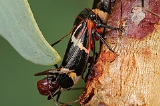
Image:Two-lined gum treehopper03.jpg|Two-lined gum treehopper Image:Common jassid nymph and ant02.jpg|Common jassid nymph (Eurymela fenestrata) tended by ant
Ant

Ants are Eusociality insects of the family Formicidae, and along with the related wasps and bees, they belong to the order Hymenoptera. Ants evolution from wasp-like ancestors in the mid-Cretaceous period between 110 and 130 million years ago and Evolutionary radiation after the rise of flowering plants....
s Image:Green_insect.jpg|Nymph of Neotituria kongosana Image:Common jassid nymph feeding.jpg|Common jassid nymphs feeding

See also

  • Planthopper
    Planthopper

    A planthopper is any insect in the infraorder Fulgoromorpha within the Hemiptera. The name comes from their remarkable resemblance to leaves and other plants of their environment and from the fact that they often "hop" for quick transportation in a similar way to that of grasshoppers....


External links