


Ilarie Voronca

Encyclopedia
Romania
Romania is a country located at the crossroads of Central and Southeastern Europe, on the Lower Danube, within and outside the Carpathian arch, bordering on the Black Sea...
n-French
France
The French Republic , The French Republic , The French Republic , (commonly known as France , is a unitary semi-presidential republic in Western Europe with several overseas territories and islands located on other continents and in the Indian, Pacific, and Atlantic oceans. Metropolitan France...
avant-garde
Avant-garde
Avant-garde means "advance guard" or "vanguard". The adjective form is used in English to refer to people or works that are experimental or innovative, particularly with respect to art, culture, and politics....
poet and essayist.
Voronca was of Jewish
History of the Jews in Romania
The history of Jews in Romania concerns the Jews of Romania and of Romanian origins, from their first mention on what is nowadays Romanian territory....
ethnicity. In his early years, he was connected with Eugen Lovinescu
Eugen Lovinescu
Eugen Lovinescu was a Romanian modernist literary historian, literary critic, academic, and novelist, who in 1919 established the Sburătorul literary club. He was the father of Monica Lovinescu, and the uncle of Horia Lovinescu, Vasile Lovinescu, and Anton Holban...
's Sburătorul
Sburatorul
Sburătorul was a Romanian modernist literary magazine and literary society, established in Bucharest in April 1919. Led by Eugen Lovinescu, the circle was instrumental in developing new trends and styles in Romanian literature, ranging from a new wave of Romanian Symbolism to an urban-themed...
group, making his debut in 1922 in the Sburătorul literar (symbolist
Symbolism (arts)
Symbolism was a late nineteenth-century art movement of French, Russian and Belgian origin in poetry and other arts. In literature, the style had its beginnings with the publication Les Fleurs du mal by Charles Baudelaire...
pieces inspired by the works of George Bacovia
George Bacovia
George Bacovia was a Romanian symbolist poet. While he initially belonged to the local Symbolist movement, his poetry came to be seen as a precursor of Romanian Modernism and eventually established him in critical esteem alongside Tudor Arghezi, Lucian Blaga and Ion Barbu as one of the most...
and Camil Baltazar
Camil Baltazar
Camil Baltazar was a Romanian-Jewish poet.-Selected works:*Vecernii, 1923*Flaute de mătase, 1923...
). Voronca's poems of the period, gloomy and passive in tone, are in marked contrast to his later works.
Only a year later, Voronca adopted a change in style, adhering to the modernist
Modernism
Modernism, in its broadest definition, is modern thought, character, or practice. More specifically, the term describes the modernist movement, its set of cultural tendencies and array of associated cultural movements, originally arising from wide-scale and far-reaching changes to Western society...
manifesto
Manifesto
A manifesto is a public declaration of principles and intentions, often political in nature. Manifestos relating to religious belief are generally referred to as creeds. Manifestos may also be life stance-related.-Etymology:...
published in Contimporanul
Contimporanul
Contimporanul was a Romanian avant-garde literary and art magazine, published in Bucharest between June 1922 and 1932...
and contributing to literary magazine
Literary magazine
A literary magazine is a periodical devoted to literature in a broad sense. Literary magazines usually publish short stories, poetry and essays along with literary criticism, book reviews, biographical profiles of authors, interviews and letters...
s such as Punct and Integral. He and Stephan Roll issued a Constructivism
Constructivism (art)
Constructivism was an artistic and architectural philosophy that originated in Russia beginning in 1919, which was a rejection of the idea of autonomous art. The movement was in favour of art as a practice for social purposes. Constructivism had a great effect on modern art movements of the 20th...
-inspired magazine entitled 75 HP, of which only one number was ever printed.
In 1927
1927 in literature
The year 1927 in literature involved some significant events and new books.-Events:*Random House, book publishers, is founded in New York City by Bennett Cerf and Donald Klopfer.-New books:*James Boyd - Marching On...
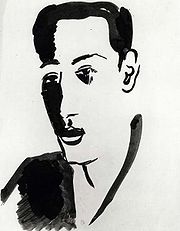
, Voronca published a volume of poetry in Paris. Entitled Colomba after his wife Colomba Voronca, it featured two portraits drawn by Robert Delaunay
Robert Delaunay
Robert Delaunay was a French artist who, with his wife Sonia Delaunay and others, cofounded the Orphism art movement, noted for its use of strong colours and geometric shapes. His later works were more abstract, reminiscent of Paul Klee...
. Colomba marked Voronca's new change in style: he had become a surrealist
Surrealism
Surrealism is a cultural movement that began in the early 1920s, and is best known for the visual artworks and writings of the group members....
. Soon after that, his creations gained a regularity, and he was published frequently — especially after he settled in France (1933) and began writing in the French language
French language
French is a Romance language spoken as a first language in France, the Romandy region in Switzerland, Wallonia and Brussels in Belgium, Monaco, the regions of Quebec and Acadia in Canada, and by various communities elsewhere. Second-language speakers of French are distributed throughout many parts...
. There followed: L'Apprenti fantôme ("The Apprentice Ghost"; 1938), Beauté de ce monde ("This World's Beauty"; 1940), Arbre ("Tree"; 1942). Several of his works were illustrated with drawings by Constantin Brâncuşi
Constantin Brancusi
Constantin Brâncuşi was a Romanian-born sculptor who made his career in France. As a child he displayed an aptitude for carving wooden farm tools. Formal studies took him first to Bucharest, then to Munich, then to the École des Beaux-Arts in Paris...
, Marc Chagall
Marc Chagall
Marc Chagall Art critic Robert Hughes referred to Chagall as "the quintessential Jewish artist of the twentieth century."According to art historian Michael J...
, or Victor Brauner
Victor Brauner
Victor Brauner was a Romanian Jewish painter of surrealistic images.-Early life:He was born in Piatra Neamţ, the son of a timber manufacturer who subsequently settled in Vienna with his family for a few years. It is there that young Victor attended elementary school...
.
A French citizen in 1938, Voronca took part in the French Resistance
French Resistance
The French Resistance is the name used to denote the collection of French resistance movements that fought against the Nazi German occupation of France and against the collaborationist Vichy régime during World War II...
. He visited Romania in January 1946, and was acclaimed for his writings and Anti-fascist
Anti-fascism
Anti-fascism is the opposition to fascist ideologies, groups and individuals, such as that of the resistance movements during World War II. The related term antifa derives from Antifaschismus, which is German for anti-fascism; it refers to individuals and groups on the left of the political...
activities. He never finished his Manuel du parfait bonheur ("Manual for Perfect Happiness"), committing suicide later in the same year.
An edition of selected poems was published in France in 1956; it was followed ten years later by prints of never-published works. Saşa Pană
Sasa Pana
Saşa Pană was a Romanian avant-garde poet, novelist, and short story writer.-Biography:...
oversaw a Romanian edition of many of Voronca's poems in 1972.
External links
- Act of Presence by Ilarie Voronca, in Exquisite Corpse