

Maaseik

Encyclopedia
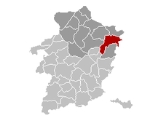
Maaseik is a municipality located in the Belgian
province
of Limburg
. The city is located on the river Meuse
(Maas), bordering the Netherlands
. The Maaseik municipality includes the town of Maaseik and the villages of Neeroeteren and Opoeteren. The town of Maaseik includes the hamlets of Aldeneik
, Heppeneert, Wurfeld, 't Ven and Gremelslo.
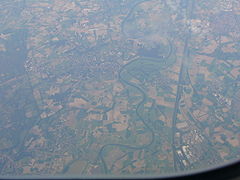
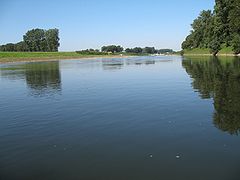 As its name would suggest, Aldeneik is older than Maaseik. Although there are a lot of toponyms referring to the many oaks, the word eyck is similar to the German word 'ecke', which means 'corner'. Old bend may be linked to the fact that historically, the Meuse formed a bend around the village. Throughout the whole Meuse region, the course of the Meuse has always shifted slowly. This happened also in Heppeneert, a hamlet just south of Maaseik. The old course of the Meuse is still clearly seen there.
Aldeneik was established by Adelard, a local Frankish
lord, around 700 AD, as a Benedictine
monastery
. His two daughters, Herlindis
and Relindis
, both became abbesses of the monastery and eventually became saints. The religious center of Aldeneik soon became the focal point of a small community.
The monastery suffered heavy destruction by the Normans
in the 9th century. Around 950, emperor Otto I gave the monastery to the Bishop of Liège
, who delegated the administrative tasks to a local chapter
of canons
.
between Maastricht
and Nijmegen and safe above the valley of the Meuse. Besides, it bordered the County of Loon
in the north; that's why this village got its City charter in 1244. The village began to grow. It became one of the most important trading places of the Meuse region.
Typical are the four main streets beginning on the square market place. On this market place stands a statue of the famous painters Hubert
and Jan van Eyck
, who would be born in Maaseik (1390). On the market stands also the oldest private pharmacy of Belgium. Also typical is the rectangle shape of the walls. In the westside of the city was built a castle against the wall.
Those walls have been dismantled in 1467, when Charles the Bold attacked the Prince-Bishopric of Liège and destructed many cities in the region. Maaseik was also besieged in 1672, by Louis XIV. The city burned in 1650 and 1684; the last one destroyed 1/3 of the entire city, included the historic center. After that the Maaseikenaars built stone houses instead of wooden ones. During the iconoclasm
, Maaseik became almost independent, but Gerard van Groesbeek could calm down the people.
, no less than six religious order
s were still present in the city.
The walls were rebuilt in the 16th century and strengthened by Vauban
in the following century. After the French
retreat in 1815, however, the military installations were gradually taken down. Only in the south the embankement is still remaining. Names of the old city gates (e.g., Bospoort, Maaspoort) remind either to the walls. In 2007, remainings of a tower have been found by digging a parking garage in the underground. This tower was part of the castle.
The Industrial Revolution
of the 19th century seems to have bypassed Maaseik. It last its importance and did not grow, but thanks of that maney houses out the Renaissance
are still existing. Though, there had been constructed a railroad to As. This road has been removed around 1950; it is now part of the famous cicle network in Belgian Limburg.
Before World War I
, the bridge over the Meuse, the Pater Sangersbrug, was built, connecting Maaseik directly with the Netherlands and improving opportunities for trade. This bridge was destroyed several times during both World Wars. The present bridge was built in 1951 and replaced an American bridge from 1944. Today, the city is mostly a regional centre offering shopping, educational, and medical services to the surrounding communities.

Belgium
Belgium , officially the Kingdom of Belgium, is a federal state in Western Europe. It is a founding member of the European Union and hosts the EU's headquarters, and those of several other major international organisations such as NATO.Belgium is also a member of, or affiliated to, many...
province
Provinces of Belgium
Belgium is divided into three regions, two of them are subdivided into five provinces each.The division into provinces is fixed by Article 5 of the Belgian Constitution...
of Limburg
Limburg (Belgium)
Limburg is the easternmost province of modern Flanders, which is one of the three main political and cultural sub-divisions of modern Belgium. It is located west of the river Meuse . It borders on the Dutch provinces of North Brabant and Limburg and the Belgian provinces of Liège, Flemish Brabant...
. The city is located on the river Meuse
Meuse River
The Maas or Meuse is a major European river, rising in France and flowing through Belgium and the Netherlands before draining into the North Sea...
(Maas), bordering the Netherlands
Netherlands
The Netherlands is a constituent country of the Kingdom of the Netherlands, located mainly in North-West Europe and with several islands in the Caribbean. Mainland Netherlands borders the North Sea to the north and west, Belgium to the south, and Germany to the east, and shares maritime borders...
. The Maaseik municipality includes the town of Maaseik and the villages of Neeroeteren and Opoeteren. The town of Maaseik includes the hamlets of Aldeneik
Aldeneik
Aldeneik, founded in 730, is a suburb of the Belgian town of Maaseik. It lies on the banks of the Meuse River, close to the border with the Netherlands, close to where the Bosbeek runs off it. According to legend it sprung up around a monastery set up by the Frankish sisters Herlindis and Relindis,...
, Heppeneert, Wurfeld, 't Ven and Gremelslo.
Religious origins
Aldeneik was established by Adelard, a local Frankish
Franks
The Franks were a confederation of Germanic tribes first attested in the third century AD as living north and east of the Lower Rhine River. From the third to fifth centuries some Franks raided Roman territory while other Franks joined the Roman troops in Gaul. Only the Salian Franks formed a...
lord, around 700 AD, as a Benedictine
Benedictine
Benedictine refers to the spirituality and consecrated life in accordance with the Rule of St Benedict, written by Benedict of Nursia in the sixth century for the cenobitic communities he founded in central Italy. The most notable of these is Monte Cassino, the first monastery founded by Benedict...
monastery
Monastery
Monastery denotes the building, or complex of buildings, that houses a room reserved for prayer as well as the domestic quarters and workplace of monastics, whether monks or nuns, and whether living in community or alone .Monasteries may vary greatly in size – a small dwelling accommodating only...
. His two daughters, Herlindis
Herlindis of Maaseik
Saint Herlindis , sister of Saint Relindis, was a Frankish saint and abbess....
and Relindis
Relindis of Maaseik
Saint Relindis , sister of Saint Herlindis, was the daughter of count Adelard who built a Benedictine monastery at Maaseik for his daughters. Herlindis was abbess of the abbey until her death, after which Relindis was named to succeed her by Saint Boniface.Her feast day is 6 February.-External...
, both became abbesses of the monastery and eventually became saints. The religious center of Aldeneik soon became the focal point of a small community.
The monastery suffered heavy destruction by the Normans
Normans
The Normans were the people who gave their name to Normandy, a region in northern France. They were descended from Norse Viking conquerors of the territory and the native population of Frankish and Gallo-Roman stock...
in the 9th century. Around 950, emperor Otto I gave the monastery to the Bishop of Liège
Bishopric of Liège
The Bishopric of Liège or Prince-Bishopric of Liège was a state of the Holy Roman Empire in the Low Countries in present Belgium. It acquired its status as a prince-bishopric between 980 and 985 when Bishop Notger, who had been the bishop of Liege since 972, acquired the status of Prince-Bishop...
, who delegated the administrative tasks to a local chapter
Chapter (religion)
Chapter designates certain corporate ecclesiastical bodies in the Roman Catholic, Anglican and Nordic Lutheran churches....
of canons
Canon (priest)
A canon is a priest or minister who is a member of certain bodies of the Christian clergy subject to an ecclesiastical rule ....
.
Middle Ages
Maaseik, Nieuw-Eycke ('new oak'), is founded out of Aldeneik, around 1000. It was lying near the Roman roadRoman road
The Roman roads were a vital part of the development of the Roman state, from about 500 BC through the expansion during the Roman Republic and the Roman Empire. Roman roads enabled the Romans to move armies and trade goods and to communicate. The Roman road system spanned more than 400,000 km...
between Maastricht
Maastricht
Maastricht is situated on both sides of the Meuse river in the south-eastern part of the Netherlands, on the Belgian border and near the German border...
and Nijmegen and safe above the valley of the Meuse. Besides, it bordered the County of Loon
County of Loon
The County of Loon was a state of the Holy Roman Empire, lying west of the Meuse river in present-day Flemish-speaking Belgium, and east of the old Duchy of Brabant. The most important cities of the county were Beringen, Bilzen, Borgloon, Bree, Hamont, Hasselt, Herk-de-Stad, Maaseik, Peer and...
in the north; that's why this village got its City charter in 1244. The village began to grow. It became one of the most important trading places of the Meuse region.
Typical are the four main streets beginning on the square market place. On this market place stands a statue of the famous painters Hubert
Hubert van Eyck
Hubert van Eyck was a Flemish painter and older brother of Jan van Eyck. He was probably born in Maaseik, Flanders, now in Belgium....
and Jan van Eyck
Jan van Eyck
Jan van Eyck was a Flemish painter active in Bruges and considered one of the best Northern European painters of the 15th century....
, who would be born in Maaseik (1390). On the market stands also the oldest private pharmacy of Belgium. Also typical is the rectangle shape of the walls. In the westside of the city was built a castle against the wall.
Those walls have been dismantled in 1467, when Charles the Bold attacked the Prince-Bishopric of Liège and destructed many cities in the region. Maaseik was also besieged in 1672, by Louis XIV. The city burned in 1650 and 1684; the last one destroyed 1/3 of the entire city, included the historic center. After that the Maaseikenaars built stone houses instead of wooden ones. During the iconoclasm
Iconoclasm
Iconoclasm is the deliberate destruction of religious icons and other symbols or monuments, usually with religious or political motives. It is a frequent component of major political or religious changes...
, Maaseik became almost independent, but Gerard van Groesbeek could calm down the people.
16th century until now
In the 16th and 17th century the economy reached its highlight, thanks to its advantageous location between Liège and the sea. Its commercial activity remained strong until the second half of the 17th century, when the regional power of Liège started to fade. During all that time, Maaseik was still a dependence of the chapter of canons in Aldeneik. Just before the French RevolutionFrench Revolution
The French Revolution , sometimes distinguished as the 'Great French Revolution' , was a period of radical social and political upheaval in France and Europe. The absolute monarchy that had ruled France for centuries collapsed in three years...
, no less than six religious order
Religious order
A religious order is a lineage of communities and organizations of people who live in some way set apart from society in accordance with their specific religious devotion, usually characterized by the principles of its founder's religious practice. The order is composed of initiates and, in some...
s were still present in the city.
The walls were rebuilt in the 16th century and strengthened by Vauban
Vauban
Sébastien Le Prestre, Seigneur de Vauban and later Marquis de Vauban , commonly referred to as Vauban, was a Marshal of France and the foremost military engineer of his age, famed for his skill in both designing fortifications and breaking through them...
in the following century. After the French
France
The French Republic , The French Republic , The French Republic , (commonly known as France , is a unitary semi-presidential republic in Western Europe with several overseas territories and islands located on other continents and in the Indian, Pacific, and Atlantic oceans. Metropolitan France...
retreat in 1815, however, the military installations were gradually taken down. Only in the south the embankement is still remaining. Names of the old city gates (e.g., Bospoort, Maaspoort) remind either to the walls. In 2007, remainings of a tower have been found by digging a parking garage in the underground. This tower was part of the castle.
The Industrial Revolution
Industrial Revolution
The Industrial Revolution was a period from the 18th to the 19th century where major changes in agriculture, manufacturing, mining, transportation, and technology had a profound effect on the social, economic and cultural conditions of the times...
of the 19th century seems to have bypassed Maaseik. It last its importance and did not grow, but thanks of that maney houses out the Renaissance
Renaissance
The Renaissance was a cultural movement that spanned roughly the 14th to the 17th century, beginning in Italy in the Late Middle Ages and later spreading to the rest of Europe. The term is also used more loosely to refer to the historical era, but since the changes of the Renaissance were not...
are still existing. Though, there had been constructed a railroad to As. This road has been removed around 1950; it is now part of the famous cicle network in Belgian Limburg.
Before World War I
World War I
World War I , which was predominantly called the World War or the Great War from its occurrence until 1939, and the First World War or World War I thereafter, was a major war centred in Europe that began on 28 July 1914 and lasted until 11 November 1918...
, the bridge over the Meuse, the Pater Sangersbrug, was built, connecting Maaseik directly with the Netherlands and improving opportunities for trade. This bridge was destroyed several times during both World Wars. The present bridge was built in 1951 and replaced an American bridge from 1944. Today, the city is mostly a regional centre offering shopping, educational, and medical services to the surrounding communities.
Sights
- The main market square with the city’s most famous sons, JanJan van EyckJan van Eyck was a Flemish painter active in Bruges and considered one of the best Northern European painters of the 15th century....
and Hubert van EyckHubert van EyckHubert van Eyck was a Flemish painter and older brother of Jan van Eyck. He was probably born in Maaseik, Flanders, now in Belgium....
. The market place is also surrounded by medieval houses. - In the nearby FranciscanFranciscanMost Franciscans are members of Roman Catholic religious orders founded by Saint Francis of Assisi. Besides Roman Catholic communities, there are also Old Catholic, Anglican, Lutheran, ecumenical and Non-denominational Franciscan communities....
cloisterCloisterA cloister is a rectangular open space surrounded by covered walks or open galleries, with open arcades on the inner side, running along the walls of buildings and forming a quadrangle or garth...
, a permanent exhibition about the brothers van Eyck and a scale modelScale modelA scale model is a physical model, a representation or copy of an object that is larger or smaller than the actual size of the object, which seeks to maintain the relative proportions of the physical size of the original object. Very often the scale model is used as a guide to making the object in...
of the city as it was in 1672 can be seen. - The Sint-Catharinakerk houses
- The Museactron, another museum, which includes a regional archaeological museum, a pharmacy museum and a bakery museum. The museum holds the oldest Gospel BookGospel BookThe Gospel Book, Evangelion, or Book of the Gospels is a codex or bound volume containing one or more of the four Gospels of the Christian New Testament...
of the BeneluxBeneluxThe Benelux is an economic union in Western Europe comprising three neighbouring countries, Belgium, the Netherlands, and Luxembourg. These countries are located in northwestern Europe between France and Germany...
, the Codex EyckensisCodex EyckensisThe Codex Eyckensis is a manuscript dating from the first half of the 8th century. It is called “Eyckensis” because it was preserved during centuries in the convent of Aldeneik, near Maaseik, Belgium...
, which dates from the 7th or 8th century. In 2008 an exhibit was held containing seventeen original soldiers of the Terracotta ArmyTerracotta ArmyThe Terracotta Army or the "Terra Cotta Warriors and Horses", is a collection of terracotta sculptures depicting the armies of Qin Shi Huang, the first Emperor of China...
of the Chinese city of Xian. - Twelve of the original sixteen watermills around the city are in very good shape and still make flour or saw wood.
- The Sint-Catharinakerk
Notable people
- Saint HerlindisHerlindis of MaaseikSaint Herlindis , sister of Saint Relindis, was a Frankish saint and abbess....
, abbess and saint (d. 745) - Saint RelindisRelindis of MaaseikSaint Relindis , sister of Saint Herlindis, was the daughter of count Adelard who built a Benedictine monastery at Maaseik for his daughters. Herlindis was abbess of the abbey until her death, after which Relindis was named to succeed her by Saint Boniface.Her feast day is 6 February.-External...
, sister of Herlindis, abbess and saint (d. 750) - JanJan van EyckJan van Eyck was a Flemish painter active in Bruges and considered one of the best Northern European painters of the 15th century....
and Hubert van EyckHubert van EyckHubert van Eyck was a Flemish painter and older brother of Jan van Eyck. He was probably born in Maaseik, Flanders, now in Belgium....
, painters, thought to have been born in Maaseik (c. 1385-1441 and c. 1366-1426, respectively) - Vital BorkelmansVital BorkelmansVital Philomene Borkelmans was a Belgian football left fullback who mainly played for Club Brugge . He also played for SV Waregem, Gent and Cercle Brugge. Borkelmans played with Belgium and was in the team for the 1994 and 1998 World Cups...
, footballFootball (soccer)Association football, more commonly known as football or soccer, is a sport played between two teams of eleven players with a spherical ball...
fullback (b. 1963) - Kristof VliegenKristof VliegenKristof Vliegen is a former Belgian tennis player. He plays right-handed and he turned professional in 2001.He was a semi-finalist in Chennai in 2006 and in May of the same year, he reached the final of the ATP tournament in Munich, setting up the first ever all-Belgian men's singles final against...
, tennisTennisTennis is a sport usually played between two players or between two teams of two players each . Each player uses a racket that is strung to strike a hollow rubber ball covered with felt over a net into the opponent's court. Tennis is an Olympic sport and is played at all levels of society at all...
player (b. 1982) - Mohamed Ouali (Martial Artist - 5x world champion Thai-kickboxing) B. 1971
External links
- Official website - Only available in DutchDutch languageDutch is a West Germanic language and the native language of the majority of the population of the Netherlands, Belgium, and Suriname, the three member states of the Dutch Language Union. Most speakers live in the European Union, where it is a first language for about 23 million and a second...