

Hornsea

Encyclopedia
Hornsea is a small seaside resort
, town and civil parish in the East Riding of Yorkshire
, England
at the eastern end of the Trans Pennine Trail
.
, Hornsea parish had a population of 8,243.
It is well known for its former pottery
factory, Hornsea Pottery
, which closed in 2000. The largest display of Hornsea Pottery in the world can be seen at the Hornsea Museum
. The museum, which is located in Newbegin, the main street of Hornsea, also contains local history exhibits. Opposite stands 'Bettison's Folly
', a tower built by a local business man in the 19th century. The tower contains the only fully working retractable flag pole in the country.
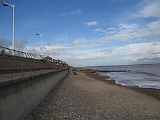
Hornsea has many coastal defences such as sea walls, groynes and beach nourishment. Despite these defences, Hornsea's primarily cliff-based shoreline is eroding at one of the fastest-known rates in Europe. Coastal erosion is very bad at either end of the main esplanade.
Like the larger resorts in the area, (such as Withernsea
, Bridlington
, Filey
and Scarborough), the town has a promenade with shops selling fish and chips
, ice cream
, bucket and spade
sets and other traditional seaside paraphernalia.
Hornsea Mere
, a large lake
and bird
sanctuary, lies near the town and is popular for sailing
. Hornsea Mere
is a natural lake (not manmade) which was created by glacial movement during the Ice Age
.
 From 1864 to 1964 Hornsea had two railway stations, Hornsea Bridge
and Hornsea Town
, on the Hull and Hornsea Railway
which connected it to Hull
. This line was opened by Joseph Armitage Wade, whose house once stood where Hornsea School and Language College
stands today. A cottage close to the school was once visited regularly by Lawrence of Arabia; and Winston Churchill visited, and was photographed in, another house nearby. Other famous visitors to the town are Anne, Princess Royal
who opened the leisure centre, and the Victorian novelist Charlotte Brontë
.
After the railway was recommended for closure by Dr Richard Beeching
(see British Rail
) in his report The Reshaping of British Railways, the trackbed became the final lap of the Trans Pennine Trail
. The old railway line is now a well-maintained walking and cycling (bicycles only) trail. It is a very pleasant trail with appropriate stopping points for picnic lunches.
On the southern edge of Hornsea (near the site of Hornsea Pottery, closed 2000) is a large shopping centre known as Hornsea Freeport, which was the first shopping centre of its kind in this part of the north-east, adapting the original UK theme park set up by Hornsea Pottery in its heyday.
Hornsea Cricket Club play at the Hollis Recreation Ground, just off Atwick Road. The club currently (2011) run 4 senior Saturday sides. The 1st XI are in Division One of the York & District Senior Cricket League.
Hornsea is home to Hornsea Rugby Union Football Club. They play at the Hollis Recreation Ground and nicknamed the 'Hollismen'. They currently play in Yorkshire League Division 5.
Seaside resort
A seaside resort is a resort, or resort town, located on the coast. Where a beach is the primary focus for tourists, it may be called a beach resort.- Overview :...
, town and civil parish in the East Riding of Yorkshire
East Riding of Yorkshire
The East Riding of Yorkshire, or simply East Yorkshire, is a local government district with unitary authority status, and a ceremonial county of England. For ceremonial purposes the county also includes the city of Kingston upon Hull, which is a separate unitary authority...
, England
England
England is a country that is part of the United Kingdom. It shares land borders with Scotland to the north and Wales to the west; the Irish Sea is to the north west, the Celtic Sea to the south west, with the North Sea to the east and the English Channel to the south separating it from continental...
at the eastern end of the Trans Pennine Trail
Trans Pennine Trail
The Trans Pennine Trail is a long distance path running from coast to coast across northern England entirely on surfaced paths and using only gentle gradients ....
.
Overview
According to the 2001 UK CensusUnited Kingdom Census 2001
A nationwide census, known as Census 2001, was conducted in the United Kingdom on Sunday, 29 April 2001. This was the 20th UK Census and recorded a resident population of 58,789,194....
, Hornsea parish had a population of 8,243.
It is well known for its former pottery
Pottery
Pottery is the material from which the potteryware is made, of which major types include earthenware, stoneware and porcelain. The place where such wares are made is also called a pottery . Pottery also refers to the art or craft of the potter or the manufacture of pottery...
factory, Hornsea Pottery
Hornsea Pottery
Hornsea Pottery was a business located in the seaside town of Hornsea in the East Riding of Yorkshire, England.-Overview:The pottery was founded in 1949 in a small terraced house by brothers Colin and Desmond Rawson with initial funding from a friend and local business man, Philip Clappison...
, which closed in 2000. The largest display of Hornsea Pottery in the world can be seen at the Hornsea Museum
Hornsea Museum
Hornsea Museum is a local museum in Hornsea, East Riding of Yorkshire, northern England.The museum was established in 1978. It is housed in an 18th-century farmhouse and two cottages. The museum is a registered charity and is largely run by volunteers...
. The museum, which is located in Newbegin, the main street of Hornsea, also contains local history exhibits. Opposite stands 'Bettison's Folly
Bettisons Folly
Bettisons Folly is a tower in Hornsea, East Riding of Yorkshire, England. It is also referred to as Bettisons Tower and the Forgotten Folly, it was built some time between 1829 and 1853 by William Bettison....
', a tower built by a local business man in the 19th century. The tower contains the only fully working retractable flag pole in the country.
Hornsea has many coastal defences such as sea walls, groynes and beach nourishment. Despite these defences, Hornsea's primarily cliff-based shoreline is eroding at one of the fastest-known rates in Europe. Coastal erosion is very bad at either end of the main esplanade.
Like the larger resorts in the area, (such as Withernsea
Withernsea
Withernsea is a seaside resort town and civil parish in the East Riding of Yorkshire, England, and forms the focal point for a wider community of small villages in Holderness. Its most famous landmark is the white inland lighthouse, rising around above Hull Road...
, Bridlington
Bridlington
Bridlington is a seaside resort, minor sea fishing port and civil parish on the Holderness Coast of the North Sea, in the East Riding of Yorkshire, England. It has a static population of over 33,000, which rises considerably during the tourist season...
, Filey
Filey
Filey is a small town and civil parish in North Yorkshire, England. It forms part of the borough of Scarborough and is located between Scarborough and Bridlington on the North Sea coast. Although it started out as a fishing village, it has a large beach and is a popular tourist resort...
and Scarborough), the town has a promenade with shops selling fish and chips
Fish and chips
Fish and chips is a popular take-away food in the United Kingdom, Australia, New Zealand and Canada...
, ice cream
Ice cream
Ice cream is a frozen dessert usually made from dairy products, such as milk and cream, and often combined with fruits or other ingredients and flavours. Most varieties contain sugar, although some are made with other sweeteners...
, bucket and spade
Bucket and spade
Bucket and spade sets are traditional British seaside paraphernalia that can be bought cheaply from any beachside vendor. They usually consist of a small plastic bucket with a handle and a small shovel, both of which can be decorated with a variety of bright colours and patterns.These are...
sets and other traditional seaside paraphernalia.
Hornsea Mere
Hornsea Mere
Hornsea Mere is generally described as the largest natural freshwater lake in Yorkshireand lies to the west of Hornsea in the East Riding. It covers an area of , is long, ¾ mile at its widest point and at its deepest point....
, a large lake
Lake
A lake is a body of relatively still fresh or salt water of considerable size, localized in a basin, that is surrounded by land. Lakes are inland and not part of the ocean and therefore are distinct from lagoons, and are larger and deeper than ponds. Lakes can be contrasted with rivers or streams,...
and bird
Bird
Birds are feathered, winged, bipedal, endothermic , egg-laying, vertebrate animals. Around 10,000 living species and 188 families makes them the most speciose class of tetrapod vertebrates. They inhabit ecosystems across the globe, from the Arctic to the Antarctic. Extant birds range in size from...
sanctuary, lies near the town and is popular for sailing
Sailing
Sailing is the propulsion of a vehicle and the control of its movement with large foils called sails. By changing the rigging, rudder, and sometimes the keel or centre board, a sailor manages the force of the wind on the sails in order to move the boat relative to its surrounding medium and...
. Hornsea Mere
Hornsea Mere
Hornsea Mere is generally described as the largest natural freshwater lake in Yorkshireand lies to the west of Hornsea in the East Riding. It covers an area of , is long, ¾ mile at its widest point and at its deepest point....
is a natural lake (not manmade) which was created by glacial movement during the Ice Age
Ice age
An ice age or, more precisely, glacial age, is a generic geological period of long-term reduction in the temperature of the Earth's surface and atmosphere, resulting in the presence or expansion of continental ice sheets, polar ice sheets and alpine glaciers...
.
Hornsea Bridge railway station
Hornsea Bridge railway station was a station on the Hull and Hornsea Railway, and served the seaside town of Hornsea in the East Riding of Yorkshire, England.It opened on 28 March 1864, and closed following the Beeching Report on 19 October 1964....
and Hornsea Town
Hornsea Town railway station
Hornsea Town railway station was the terminus of the Hull and Hornsea Railway, and served the seaside town of Hornsea in the East Riding of Yorkshire, England.It opened on 28 March 1864, and was originally named just "Hornsea"...
, on the Hull and Hornsea Railway
Hull and Hornsea Railway
The Hull and Hornsea Railway was a branch line in the East Riding of Yorkshire, England, which connected the city of Kingston upon Hull with the east coast seaside holiday resort of Hornsea.-Early proposals and construction:...
which connected it to Hull
Kingston upon Hull
Kingston upon Hull , usually referred to as Hull, is a city and unitary authority area in the ceremonial county of the East Riding of Yorkshire, England. It stands on the River Hull at its junction with the Humber estuary, 25 miles inland from the North Sea. Hull has a resident population of...
. This line was opened by Joseph Armitage Wade, whose house once stood where Hornsea School and Language College
Hornsea School and Language College
Hornsea School and Language College is situated in the small seaside town of Hornsea in the East Riding of Yorkshire, England. It is a secondary comprehensive and takes pupils from Hornsea and the surrounding area...
stands today. A cottage close to the school was once visited regularly by Lawrence of Arabia; and Winston Churchill visited, and was photographed in, another house nearby. Other famous visitors to the town are Anne, Princess Royal
Anne, Princess Royal
Princess Anne, Princess Royal , is the only daughter of Elizabeth II and Prince Philip, Duke of Edinburgh...
who opened the leisure centre, and the Victorian novelist Charlotte Brontë
Charlotte Brontë
Charlotte Brontë was an English novelist and poet, the eldest of the three Brontë sisters who survived into adulthood, whose novels are English literature standards...
.
After the railway was recommended for closure by Dr Richard Beeching
Richard Beeching
Richard Beeching, Baron Beeching , commonly known as Doctor Beeching, was chairman of British Railways and a physicist and engineer...
(see British Rail
British Rail
British Railways , which from 1965 traded as British Rail, was the operator of most of the rail transport in Great Britain between 1948 and 1997. It was formed from the nationalisation of the "Big Four" British railway companies and lasted until the gradual privatisation of British Rail, in stages...
) in his report The Reshaping of British Railways, the trackbed became the final lap of the Trans Pennine Trail
Trans Pennine Trail
The Trans Pennine Trail is a long distance path running from coast to coast across northern England entirely on surfaced paths and using only gentle gradients ....
. The old railway line is now a well-maintained walking and cycling (bicycles only) trail. It is a very pleasant trail with appropriate stopping points for picnic lunches.
On the southern edge of Hornsea (near the site of Hornsea Pottery, closed 2000) is a large shopping centre known as Hornsea Freeport, which was the first shopping centre of its kind in this part of the north-east, adapting the original UK theme park set up by Hornsea Pottery in its heyday.
Hornsea Cricket Club play at the Hollis Recreation Ground, just off Atwick Road. The club currently (2011) run 4 senior Saturday sides. The 1st XI are in Division One of the York & District Senior Cricket League.
Hornsea is home to Hornsea Rugby Union Football Club. They play at the Hollis Recreation Ground and nicknamed the 'Hollismen'. They currently play in Yorkshire League Division 5.
Governance
Hornsea sits in the Parliamentary constituency of Beverley and Holderness.Further information
- A Brief History of Hornsea www.hornsea.gov.uk (Hornsea Town Council)