

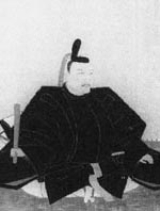
Hojo Ujimasa

Encyclopedia

Late Hojo clan
The ' was one of the most powerful warrior clans in Japan in the Sengoku period and held domains primarily in the Kantō region.The clan is traditionally reckoned to be started by Ise Shinkurō, who came from a branch of the prestigious Ise clan, a family in the direct employment of the Ashikaga...
, and daimyo
Daimyo
is a generic term referring to the powerful territorial lords in pre-modern Japan who ruled most of the country from their vast, hereditary land holdings...
of Odawara
Odawara Castle
is a landmark in the city of Odawara in Kanagawa Prefecture, Japan.-History:Odawara was a stronghold of the Doi clan during the Kamakura period, and a fortified residence was built by their collateral branch, the Kobayakawa clan stood on the approximate site of the present castle...
.
Ujimasa commanded in many battles, consolidating his clan's position, and retired in 1590. His son Hōjō Ujinao
Hojo Ujinao
Hōjō Ujinao was a Japanese daimyo of the late Sengoku period, and the final head of the Late Hōjō clan. An important figure in the history of Azuchi-Momoyama politics, he lost his entire domain following the siege in 1590...
became head of the clan and lord of Odawara, but later that year they failed to hold Odawara against the forces of Toyotomi Hideyoshi
Toyotomi Hideyoshi
was a daimyo warrior, general and politician of the Sengoku period. He unified the political factions of Japan. He succeeded his former liege lord, Oda Nobunaga, and brought an end to the Sengoku period. The period of his rule is often called the Momoyama period, named after Hideyoshi's castle...
(see Siege of Odawara (1590)
Siege of Odawara (1590)
The third ' occurred in 1590, and was the primary action in Toyotomi Hideyoshi's campaign to eliminate the Hōjō clan as a threat to his power. The months leading up to it saw hasty but major improvements in the defense of the castle, as Hideyoshi's intentions became clear...
). Ujimasa was forced to commit suicide
Suicide
Suicide is the act of intentionally causing one's own death. Suicide is often committed out of despair or attributed to some underlying mental disorder, such as depression, bipolar disorder, schizophrenia, alcoholism, or drug abuse...
along with his brother Ujiteru
Hojo Ujiteru
' was a Japanese samurai, who was the son of Hōjō Ujiyasu and lord of Hachiōji Castle in what is now Tokyo.Ujiteru commanded a major force at the battle of Mimasetoge, where he unsuccessfully attempted to prevent Takeda Shingen from withdrawing to his home province of Kai after sieging the Hōjō's...
.
Like many samurai
Samurai
is the term for the military nobility of pre-industrial Japan. According to translator William Scott Wilson: "In Chinese, the character 侍 was originally a verb meaning to wait upon or accompany a person in the upper ranks of society, and this is also true of the original term in Japanese, saburau...
who committed seppuku
Seppuku
is a form of Japanese ritual suicide by disembowelment. Seppuku was originally reserved only for samurai. Part of the samurai bushido honor code, seppuku was either used voluntarily by samurai to die with honor rather than fall into the hands of their enemies , or as a form of capital punishment...
in the face of shameful defeat, Ujimasa composed a death poem
Death poem
A death poem is a poem written near the time of one's own death. It is a tradition for literate people to write one in a number of different cultures, especially in Joseon Korea and Japan.-History:...
:
-
- Autumn wind of eve
- Blow away the clouds that mass
- O'er the moon's pure light.
- And the mists that cloud our mind
- Do thou sweep away as well.
(雨雲の おほへる月も 胸の霧も はらひにけりな 秋の夕風)
-
- Now we disappear
- Well, what must we think of it?
- From the sky we came
- Now we may go back again
- That's at least one point of view.
(我が身今 消ゆとやいかに 思ふべき 空より来たり 空へ帰れば)
(吹きとふく 風な恨みそ 花の春 紅葉も残る 秋あらばこそ)
In popular culture
Hōjō Ujimasa appears in Koei's video games KessenKessen
is a PlayStation 2 launch title produced by Koei and published by Electronic Arts. This was the first DVD-ROM format game for the PS2. It was initially the only real-time wargame game available for the PlayStation 2....
, Samurai Warriors 2
Samurai Warriors 2
is a sequel to the original Samurai Warriors, created by Koei and Omega Force. The game was released in 2006 for the PlayStation 2 and Xbox 360, and received a port to Microsoft Windows in 2008....
, Samurai Warriors 3
Samurai Warriors 3
is the third installment in the Samurai Warriors series, created by Tecmo Koei and Omega Force. The game was released in Japan on December 3, 2009, Europe on May 28, 2010, Australia on June 10, 2010, and in North America on September 27, 2010 for the Wii....
and Warriors Orochi
Warriors Orochi
, is a PlayStation 2 and Xbox 360 hack and slash video game developed by Koei and Omega Force. It is a crossover of two of Koei's popular video game series, Dynasty Warriors and Samurai Warriors...
., also in Capcom
Capcom
is a Japanese developer and publisher of video games, known for creating multi-million-selling franchises such as Devil May Cry, Chaos Legion, Street Fighter, Mega Man and Resident Evil. Capcom developed and published Bionic Commando, Lost Planet and Dark Void too, but they are less known. Its...
's Sengoku Basara
Sengoku Basara
is a series of video games developed and published by Capcom, as well as a bigger media franchise based on it, including two anime series and an animated film...
, Sengoku Basara 2
Sengoku Basara 2
Sengoku Basara 2 is a sequel to the video game Sengoku Basara , released in Japan on July 27, 2006 for the PlayStation 2. A revision with additional features named Sengoku Basara 2 Heroes was released on November 29, 2007...
, and Sengoku Basara 2 Heroes.
He also appears in The Creative Assembly's Total War: Shogun 2.