
The early
history of Siberia is greatly influenced by the sophisticated
nomadNomadic people , commonly known as itinerants in modern-day contexts, are communities of people who move from one place to another, rather than settling permanently in one location. There are an estimated 30-40 million nomads in the world. Many cultures have traditionally been nomadic, but...
ic civilizations of the Scythians (
PazyrykThe Pazyryk culture is an Iron Age archaeological culture identified by excavated artifacts and mummified humans found in the Siberian permafrost in the Altay Mountains. The mummies are buried in long barrows similar to the tomb mounds of western Scythian culture in modern Ukraine...
) and
XiongnuThe Xiongnu were ancient nomadic-based people that formed a state or confederation north of the agriculture-based empire of the Han Dynasty. Most of the information on the Xiongnu comes from Chinese sources...
(Noin-Ula), both flourishing before the Christian era. The steppes of South
SiberiaSiberia is an extensive region constituting almost all of Northern Asia. Comprising the central and eastern portion of the Russian Federation, it was part of the Soviet Union from its beginning, as its predecessor states, the Tsardom of Russia and the Russian Empire, conquered it during the 16th...
saw a succession of nomadic empires, including the Turkic Empire and the
Mongol EmpireThe Mongol Empire , initially named as Greater Mongol State was a great empire during the 13th and 14th centuries...
. In the
late Middle AgesThe Late Middle Ages was the period of European history generally comprising the 14th to the 16th century . The Late Middle Ages followed the High Middle Ages and preceded the onset of the early modern era ....
,
Tibetan BuddhismTibetan Buddhism is the body of Buddhist religious doctrine and institutions characteristic of Tibet and certain regions of the Himalayas, including northern Nepal, Bhutan, and India . It is the state religion of Bhutan...
spread into the areas south of
Lake BaikalLake Baikal is the world's oldest at 30 million years old and deepest lake with an average depth of 744.4 metres.Located in the south of the Russian region of Siberia, between Irkutsk Oblast to the northwest and the Buryat Republic to the southeast, it is the most voluminous freshwater lake in the...
.
A milestone in the history of the region was the arrival of the
RussiansThe Russian people are an East Slavic ethnic group native to Russia, speaking the Russian language and primarily living in Russia and neighboring countries....
in the 16th and 17th centuries, contemporaneous and in many regards analogous to the
European colonization of the AmericasThe start of the European colonization of the Americas is typically dated to 1492. The first Europeans to reach the Americas were the Vikings during the 11th century, who established several colonies in Greenland and one short-lived settlement in present day Newfoundland...
. During the
Russian EmpireThe Russian Empire was a state that existed from 1721 until the Russian Revolution of 1917. It was the successor to the Tsardom of Russia and the predecessor of the Soviet Union...
, Siberia was an agricultural province and served as a place of exile, among others for
AvvakumAvvakum Petrov was a Russian protopope of Kazan Cathedral on Red Square who led the opposition to Patriarch Nikon's reforms of the Russian Orthodox Church...
,
DostoevskyFyodor Mikhaylovich Dostoyevsky was a Russian writer of novels, short stories and essays. He is best known for his novels Crime and Punishment, The Idiot and The Brothers Karamazov....
, and the
DecembristsThe Decembrist revolt or the Decembrist uprising took place in Imperial Russia on 14 December , 1825. Russian army officers led about 3,000 soldiers in a protest against Nicholas I's assumption of the throne after his elder brother Constantine removed himself from the line of succession...
. The 19th century witnessed the construction of the
Trans-Siberian RailwayThe Trans-Siberian Railway is a network of railways connecting Moscow with the Russian Far East and the Sea of Japan. It is the longest railway in the world...
, industrialization and the discovery of vast reserves of Siberian mineral resources.
Prehistory and antiquity
According to the field of
genetic genealogyGenetic genealogy is the application of genetics to traditional genealogy. Genetic genealogy involves the use of genealogical DNA testing to determine the level of genetic relationship between individuals.-History:...
, people first resided in
SiberiaSiberia is an extensive region constituting almost all of Northern Asia. Comprising the central and eastern portion of the Russian Federation, it was part of the Soviet Union from its beginning, as its predecessor states, the Tsardom of Russia and the Russian Empire, conquered it during the 16th...
by
45,000 BCEThe Upper Paleolithic is the third and last subdivision of the Paleolithic or Old Stone Age as it is understood in Europe, Africa and Asia. Very broadly it dates to between 40,000 and 10,000 years ago, roughly coinciding with the appearance of behavioral modernity and before the advent of...
and spread out east and west to populate the
AmericasThe Americas, or America , are lands in the Western hemisphere, also known as the New World. In English, the plural form the Americas is often used to refer to the landmasses of North America and South America with their associated islands and regions, while the singular form America is primarily...
and
EuropeEurope is, by convention, one of the world's seven continents. Comprising the westernmost peninsula of Eurasia, Europe is generally 'divided' from Asia to its east by the watershed divides of the Ural and Caucasus Mountains, the Ural River, the Caspian and Black Seas, and the waterways connecting...
. According to
Vasily RadlovVasily Vasilievich Radlov or Friedrich Wilhelm Radloff was a German-born Russian founder of Turkology, a scientific study of Turkic peoples....
, among the earliest inhabitants of Central Siberia were the
YeniseiansThe Yeniseian language family is spoken in central Siberia.-Family division:0. Proto-Yeniseian...
, who spoke a language different from the later
UralicThe Uralic languages constitute a language family of some three dozen languages spoken by approximately 25 million people. The healthiest Uralic languages in terms of the number of native speakers are Hungarian, Finnish, Estonian, Mari and Udmurt...
and
TurkicThe Turkic languages constitute a language family of at least thirty five languages, spoken by Turkic peoples across a vast area from Eastern Europe and the Mediterranean to Siberia and Western China, and are considered to be part of the proposed Altaic language family.Turkic languages are spoken...
peoples. The
KetsKets are a Siberian people who speak the Ket language. In Imperial Russia they were called Ostyaks, without differentiating them from several other Siberian peoples. Later they became known as Yenisey ostyaks, because they lived in the middle and lower basin of the Yenisei River in the Krasnoyarsk...
are considered the last remainder of this early migration.
The shores of all Siberian lakes which filled the depressions during the Lacustrine period abound in remains dating from the
NeolithicThe Neolithic Age, Era, or Period, or New Stone Age, was a period in the development of human technology, beginning about 9500 BC in some parts of the Middle East, and later in other parts of the world. It is traditionally considered as the last part of the Stone Age...
age. Countless
kurganKurgan is the Turkic term for a tumulus; mound of earth and stones raised over a grave or graves, originating with its use in Soviet archaeology, now widely used for tumuli in the context of Eastern European and Central Asian archaeology....
s (
tumuliA tumulus is a mound of earth and stones raised over a grave or graves. Tumuli are also known as barrows, burial mounds, Hügelgrab or kurgans, and can be found throughout much of the world. A tumulus composed largely or entirely of stones is usually referred to as a cairn...
), furnaces, and other
archaeological artifactsAn artifact or artefact is "something made or given shape by man, such as a tool or a work of art, esp an object of archaeological interest"...
bear witness to a dense population. In fact some of the earliest artifacts found in
Central AsiaCentral Asia is a core region of the Asian continent from the Caspian Sea in the west, China in the east, Afghanistan in the south, and Russia in the north...
derive from Siberia
The Yeniseians were followed by the Uralic
SamoyedesThe term Samoyedic peoples is used to describe peoples speaking Samoyedic languages, which are part of the Uralic family. They are a linguistic grouping, not an ethnic or cultural one. The name derives from the obsolete term Samoyed used in Russia for some indigenous peoples of Siberia...
, who came from the northern
UralThe Ural Mountains , or simply the Urals, are a mountain range that runs approximately from north to south through western Russia, from the coast of the Arctic Ocean to the Ural River and northwestern Kazakhstan. Their eastern side is usually considered the natural boundary between Europe and Asia...
region. Some traces of them, like the
SelkupThe Selkup , until 1930s called Ostyak-Samoyeds are a people in Siberia, Russia. They live in the northern parts of Tomsk Oblast, Krasnoyarsk Krai, Yamalo-Nenets Autonomous Okrug, and Nenets Autonomous Okrug.- Outline :...
, remain in the
SayanThe Sayan Mountains are a mountain range between northwestern Mongolia and southern Siberia, Russia.The Eastern Sayan extends from the Yenisei River at 92° E to the southwest end of Lake Baikal at 106° E...
region. They are credited with leaving behind the very numerous remains dating from the
Bronze AgeThe Bronze Age is a period characterized by the use of copper and its alloy bronze as the chief hard materials in the manufacture of some implements and weapons. Chronologically, it stands between the Stone Age and Iron Age...
which are scattered all over southern Siberia.
IronIron is a chemical element with the symbol Fe and atomic number 26. It is a metal in the first transition series. It is the most common element forming the planet Earth as a whole, forming much of Earth's outer and inner core. It is the fourth most common element in the Earth's crust...
was unknown to them, but they excelled in
bronzeBronze is a metal alloy consisting primarily of copper, usually with tin as the main additive. It is hard and brittle, and it was particularly significant in antiquity, so much so that the Bronze Age was named after the metal...
,
silverSilver is a metallic chemical element with the chemical symbol Ag and atomic number 47. A soft, white, lustrous transition metal, it has the highest electrical conductivity of any element and the highest thermal conductivity of any metal...
, and
goldGold is a chemical element with the symbol Au and an atomic number of 79. Gold is a dense, soft, shiny, malleable and ductile metal. Pure gold has a bright yellow color and luster traditionally considered attractive, which it maintains without oxidizing in air or water. Chemically, gold is a...
work. Their bronze ornaments and implements, often polished, evince considerable artistic taste, and their irrigated fields covered wide areas in the fertile tracts.
Indo-IranianIndo-Iranian peoples are a linguistic group consisting of the Indo-Aryan, Iranian, Dardic and Nuristani peoples; that is, speakers of Indo-Iranian languages, a major branch of the Indo-European language family....
influences in southern Siberia can be dated as far back as the 2300–1000 BCE
Andronovo cultureThe Andronovo culture, is a collection of similar local Bronze Age cultures that flourished ca. 21200–1400 BCE in western Siberia and the west Asiatic steppe. It is probably better termed an archaeological complex or archaeological horizon...
. Between the 7th and 3rd centuries BC the Indo-Iranian Scythians flourished in the Altai region (
Pazyryk cultureThe Pazyryk culture is an Iron Age archaeological culture identified by excavated artifacts and mummified humans found in the Siberian permafrost in the Altay Mountains. The mummies are buried in long barrows similar to the tomb mounds of western Scythian culture in modern Ukraine...
). They were a major influence on all later
steppeIn physical geography, steppe is an ecoregion, in the montane grasslands and shrublands and temperate grasslands, savannas, and shrublands biomes, characterized by grassland plains without trees apart from those near rivers and lakes...
empires.
As early as the first millennium BCE
silkSilk is a natural protein fiber, some forms of which can be woven into textiles. The best-known type of silk is obtained from the cocoons of the larvae of the mulberry silkworm Bombyx mori reared in captivity...
goods began turning up in Siberia having traveled over the
Silk RoadThe Silk Road or Silk Route refers to a historical network of interlinking trade routes across the Afro-Eurasian landmass that connected East, South, and Western Asia with the Mediterranean and European world, as well as parts of North and East Africa...
.
The establishment of the
XiongnuThe Xiongnu were ancient nomadic-based people that formed a state or confederation north of the agriculture-based empire of the Han Dynasty. Most of the information on the Xiongnu comes from Chinese sources...
empire in the 3rd century BCE started a series of population movements. Many peoples were probably driven to the northern borders of the great
Central Siberian PlateauThe Central Siberian Plateau is made up of sharply demarcated surfaces of varying altitudes occupying most of Siberia between the Yenisei and Lena rivers. It extends over an area of 3.5 million km². The highest point is the Putoran Mountains rising to 1701 m. To the north of the plateau are...
. Turkic peoples like the
Yenisei KirghizThe Yenisei Kirghiz, also known as the Khyagas or Khakas, were an ancient people that dwelled along the upper Yenisei River in the southern portion of the Minusinsk Depression from the 3rd century BCE to the 13th century CE...
had already been present in the Sayan region. Various Turkic tribes such as the Khakas and
UyghurThe Uyghur are a Turkic ethnic group living in Eastern and Central Asia. Today, Uyghurs live primarily in the Xinjiang Uyghur Autonomous Region in the People's Republic of China...
migrated north-westwards from their former seats and subdued the Ugric peoples. These new invaders likewise left numerous traces of their stay, and two different periods may be easily distinguished in their remains. They were acquainted with iron, and learned from their subjects the art of bronze-casting, which they used for decorative purposes only, and to which they gave a still higher artistic stamp. Their pottery is more artistic and of a higher quality than that of the Bronze period, and their ornaments are accounted included in the collections at the
Hermitage MuseumThe State Hermitage is a museum of art and culture in Saint Petersburg, Russia. One of the largest and oldest museums of the world, it was founded in 1764 by Catherine the Great and has been opened to the public since 1852. Its collections, of which only a small part is on permanent display,...
in
Saint PetersburgSaint Petersburg is a city and a federal subject of Russia located on the Neva River at the head of the Gulf of Finland on the Baltic Sea...
.
Mongol conquest
The
MongolsMongols ) are a Central-East Asian ethnic group that lives mainly in the countries of Mongolia, China, and Russia. In China, ethnic Mongols can be found mainly in the central north region of China such as Inner Mongolia...
had long maintained intimate relations with the peoples of Siberian forest (
taigaTaiga , also known as the boreal forest, is a biome characterized by coniferous forests.Taiga is the world's largest terrestrial biome. In North America it covers most of inland Canada and Alaska as well as parts of the extreme northern continental United States and is known as the Northwoods...
). They called those in the forest "People of the forest" (Oin irged). Many of them, such as the Barga and
Uriankhai"Uriankhai" , also known as Urianhai or Uryangkhai, is a term applied to several neighboring ethnic groups...
, were little different from the Mongols. While the tribes around
Lake BaikalLake Baikal is the world's oldest at 30 million years old and deepest lake with an average depth of 744.4 metres.Located in the south of the Russian region of Siberia, between Irkutsk Oblast to the northwest and the Buryat Republic to the southeast, it is the most voluminous freshwater lake in the...
were Mongol speaking, those to the west spoke
TurkicThe Turkic languages constitute a language family of at least thirty five languages, spoken by Turkic peoples across a vast area from Eastern Europe and the Mediterranean to Siberia and Western China, and are considered to be part of the proposed Altaic language family.Turkic languages are spoken...
,
SamoyedicThe Samoyedic languages are spoken on both sides of the Ural mountains, in northernmost Eurasia, by approximately 30,000 speakers altogether....
, or
YeniseianThe Yeniseian language family is spoken in central Siberia.-Family division:0. Proto-Yeniseian...
languages.
By 1206,
Genghis KhanGenghis Khan , born Temujin and occasionally known by his temple name Taizu , was the founder and Great Khan of the Mongol Empire, which became the largest contiguous empire in history after his death....
had conquered all Mongol and Turkic tribes in
MongoliaMongolia is a landlocked country in East and Central Asia. It is bordered by Russia to the north and China to the south, east and west. Although Mongolia does not share a border with Kazakhstan, its western-most point is only from Kazakhstan's eastern tip. Ulan Bator, the capital and largest...
and southern Siberia. In 1207 his eldest son
JochiJochi was the eldest of the Mongol chieftain Genghis Khan's four sons by his principal wife Börte. An accomplished military leader, he participated in his father's conquest of Central Asia, along with his brothers and uncles.-Early life:...
subjugated the Siberian forest people, the
Uriankhai"Uriankhai" , also known as Urianhai or Uryangkhai, is a term applied to several neighboring ethnic groups...
, the
OiratsOirats are the westernmost group of the Mongols who unified several tribes origin whose ancestral home is in the Altai region of western Mongolia. Although the Oirats originated in the eastern parts of Central Asia, the most prominent group today is located in the Republic of Kalmykia, a federal...
, Barga, Khakas,
BuryatsThe Buryats or Buriyads , numbering approximately 436,000, are the largest ethnic minority group in Siberia and are mainly concentrated in their homeland, the Buryat Republic, a federal subject of Russia...
,
TuvansTuvans or Tuvinians are Turkic peoples living in southern Siberia. They are historically known as one of the Uriankhai, from the Mongolian designation...
, Khori-Tumed, and Kyrgyz. He then organized the Siberians into three
tumenTumen or Tümen was a part of the decimal system used by Turkic and Mongol peoples to organize their armies. Tumen is an army unit of 10,000 soldiers...
s. Genghis Khan gave the
TelengitTelengits or Telengut are a Turkic people people primarily found in Altai Republic, Russia. Telengits mainly live in a territory of Kosh-Agach District of the Altai Republic. They are part of a larger cultural group of the Southern Altaians...
and Tolos along the Irtysh River to an old companion, Qorchi. While the Barga, Tumed, Buriats, Khori, Keshmiti, and
BashkirsThe Bashkirs are a Turkic people indigenous to Bashkortostan extending on both parts of the Ural mountains, on the place where Europe meets Asia. Groups of Bashkirs also live in the republic of Tatarstan, Perm Krai, Chelyabinsk, Orenburg, Tyumen, Sverdlovsk, Kurgan, Samara and Saratov Oblasts of...
were organized in separate thousands, the Telengit, Tolos, Oirats and Yenisei Kirghiz were numbered as tumens. Genghis settled a colony of Chinese craftsmen and farmers at Kem-kemchik after the first phase of the
Mongol-Jin Dynasty WarMongol-Jin Dynasty War lasted over 23 years and the Jin Dynasty finally fell in the year 1234; the year that the Mongols had claimed the total conquest of Jin Dynasty in whole northern China.- Background :...
. The Great Khans favored
gyrfalconThe Gyrfalcon — Falco rusticolus — is the largest of the falcon species. The Gyrfalcon breeds on Arctic coasts and the islands of North America, Europe, and Asia. It is mainly resident there also, but some Gyrfalcons disperse more widely after the breeding season, or in winter.Individual vagrancy...
s, furs, women and Kyrgyz horses for tribute.
Western Siberia came under the
Golden HordeThe Golden Horde was a Mongol and later Turkicized khanate that formed the north-western sector of the Mongol Empire...
. The descendants of
Orda KhanOrda Ichen was a Mongol Khan and military strategist who ruled eastern part of the Ulus of Jochi during the 13th century.-First Khan of the Blue Horde:...
, the eldest son of Jochi, directly ruled the area. In the swamps of western Siberia,
dog sledA dog sled is a sled pulled by one or more sled dogs used to travel over ice and through snow. Numerous types of sleds are used, depending on their function. They can be used for dog sled racing.-History:...
YamYam is a supply point route messenger system employed and extensively used and expanded by Genghis Khan and used by subsequent Great Khans and Khans.Relay stations were used to give food, shelter and spare horses for Mongol armies messengers...
stations were set up to facilitate collection of tribute.
In 1270,
Kublai KhanKublai Khan , born Kublai and also known by the temple name Shizu , was the fifth Great Khan of the Mongol Empire from 1260 to 1294 and the founder of the Yuan Dynasty in China...
sent a Chinese official, with a new batch of colonists, to serve as judge of the Kyrgyz and Tuvan basin areas. Ogedei's grandson
KaiduKaidu was the leader of the House of Ogedei and the de facto khan of the Chagatai Khanate. He ruled part of modern-day Xinjiang and Central Asia during the 13th century, and actively opposed his uncle, Kublai Khan, who established the Yuan Dynasty in China until his death in 1301...
occupied portions of Central Siberia from 1275 on. The
Yuan armyThe Yuan Dynasty , or Great Yuan Empire was a ruling dynasty founded by the Mongol leader Kublai Khan, who ruled most of present-day China, all of modern Mongolia and its surrounding areas, lasting officially from 1271 to 1368. It is considered both as a division of the Mongol Empire and as an...
under Kublai's Kipchak general Tutugh reoccupied the Kyrgyz lands in 1293. From then on the Yuan Dynasty controlled large portions of Central and Eastern Siberia.
Novgorod and Muscovy
As early as the 11th century the
NovgorodiansThe Novgorod Republic was a large medieval Russian state which stretched from the Baltic Sea to the Ural Mountains between the 12th and 15th centuries, centred on the city of Novgorod...
had occasionally penetrated into Siberia. In the 14th century the Novgorodians explored the
Kara SeaThe Kara Sea is part of the Arctic Ocean north of Siberia. It is separated from the Barents Sea to the west by the Kara Strait and Novaya Zemlya, and the Laptev Sea to the east by the Severnaya Zemlya....
and the West-Siberian river
ObThe Ob River , also Obi, is a major river in western Siberia, Russia and is the world's seventh longest river. It is the westernmost of the three great Siberian rivers that flow into the Arctic Ocean .The Gulf of Ob is the world's longest estuary.-Names:The Ob is known to the Khanty people as the...
(1364). After the fall of the
Novgorod RepublicThe Novgorod Republic was a large medieval Russian state which stretched from the Baltic Sea to the Ural Mountains between the 12th and 15th centuries, centred on the city of Novgorod...
its communications between Northern Russia and Siberia have been inherited by the
Grand Duchy of MoscowThe Grand Duchy of Moscow or Grand Principality of Moscow, also known in English simply as Muscovy , was a late medieval Rus' principality centered on Moscow, and the predecessor state of the early modern Tsardom of Russia....
. On May, 9, 1483 the Moscow troops of princes Feodor Kurbski-Cherny and Ivan Saltyk-Travin moved to West Siberia. The troops moved on the rivers
TavdaThe Tavda River is a Siberian river that drains part of the central Ural mountains into the Tobol River. It is north of the Tura River and south of the Konda River. It is located in Sverdlovsk Oblast and Tyumen Oblast. It is formed by the confluence of the Lozva and Sosva Rivers. The length of...
, Tura, Irtysh up to the river Ob. In 1499 Muscovites and Novgorodians skied to West Siberia up to the river Ob and subdued some local tribes.
Khanate of Sibir
With the breakup of the Golden Horde late in the 14th century, the Khanate of Sibir was founded with its center at
TyumenTyumen is the largest city and the administrative center of Tyumen Oblast, Russia, located on the Tura River east of Moscow. Population: Tyumen is the oldest Russian settlement in Siberia. Founded in 16th century to support Russia's eastward expansion, the city has remained one of the most...
. The non-
BorjiginBorjigin , also known as the Altan urug , were the imperial clan of Genghis Khan and his successors....
Taybughid dynasty vied for rule with the descendants of
ShibanShiban or Shayban was one of the Left Wing princes. He was Jöchi's fifth son and a grandson of Genghis Khan. Because he was too young when his father died in 1227, he did not receive any lands at that time....
, a son of Jochi.
In the beginning of the 16th century
TatarTatars are a Turkic speaking ethnic group , numbering roughly 7 million.The majority of Tatars live in the Russian Federation, with a population of around 5.5 million, about 2 million of which in the republic of Tatarstan.Significant minority populations are found in Uzbekistan, Kazakhstan,...
fugitives from
TurkestanTurkestan, spelled also as Turkistan, literally means "Land of the Turks".The term Turkestan is of Persian origin and has never been in use to denote a single nation. It was first used by Persian geographers to describe the place of Turkish peoples...
subdued the loosely associated tribes inhabiting the lowlands to the east of the
Ural MountainsThe Ural Mountains , or simply the Urals, are a mountain range that runs approximately from north to south through western Russia, from the coast of the Arctic Ocean to the Ural River and northwestern Kazakhstan. Their eastern side is usually considered the natural boundary between Europe and Asia...
. Agriculturists, tanners, merchants, and
mullahMullah is generally used to refer to a Muslim man, educated in Islamic theology and sacred law. The title, given to some Islamic clergy, is derived from the Arabic word مَوْلَى mawlā , meaning "vicar", "master" and "guardian"...
s (Islamic clerics) were called from Turkestan, and small principalities sprang up on the Irtysh and the
ObThe Ob River , also Obi, is a major river in western Siberia, Russia and is the world's seventh longest river. It is the westernmost of the three great Siberian rivers that flow into the Arctic Ocean .The Gulf of Ob is the world's longest estuary.-Names:The Ob is known to the Khanty people as the...
. These were united by Khan Yadegar Mokhammad of Kazan. Conflicts with the Russians, who were then colonising the Urals, brought him into collision with Muscovy. Khan Yadegar's envoys came to
MoscowMoscow is the capital, the most populous city, and the most populous federal subject of Russia. The city is a major political, economic, cultural, scientific, religious, financial, educational, and transportation centre of Russia and the continent...
in 1555 and consented to a yearly tribute of a thousand sables.
Yermak and the Cossacks
In the mid-16th century the
Tsardom of RussiaThe Tsardom of Russia was the name of the centralized Russian state from Ivan IV's assumption of the title of Tsar in 1547 till Peter the Great's foundation of the Russian Empire in 1721.From 1550 to 1700, Russia grew 35,000 km2 a year...
conquered the Tatar khanates of
KazanThe Khanate of Kazan was a medieval Tatar state which occupied the territory of former Volga Bulgaria between 1438 and 1552. Its khans were the patrilineal descendants of Toqa Temür, the thirteenth son of Jochi and grandson of Genghis Khan. The khanate covered contemporary Tatarstan, Mari El,...
and
AstrakhanThe Khanate of Astrakhan was a Tatar feudal state that appeared after the collapse of the Golden Horde. The Khanate existed in the 15th and 16th centuries in the area adjacent to the mouth of the Volga river, where the contemporary city of Astrakhan/Hajji Tarkhan is now located...
, thus annexing the entire
Volga RegionVolga Region is a historical region of Russia that encompasses the territories adjacent to the flow of Volga River. According to the flow of the river, it is usually classified into the Middle Volga Region and Lower Volga Region...
and making the way to the
Ural MountainsThe Ural Mountains , or simply the Urals, are a mountain range that runs approximately from north to south through western Russia, from the coast of the Arctic Ocean to the Ural River and northwestern Kazakhstan. Their eastern side is usually considered the natural boundary between Europe and Asia...
open. The colonisation of the new easternmost lands of Russia and further onslaught eastward was led by the rich merchants Stroganovs.
TsarTsar is a title used to designate certain European Slavic monarchs or supreme rulers. As a system of government in the Tsardom of Russia and Russian Empire, it is known as Tsarist autocracy, or Tsarism...
Ivan IV granted large estates near the Urals as well as tax privileges to
Anikey StroganovAnikey Stroganov was a founder of numerous salterns in Solvychegodsk and Perm, a colonizer of the basin of the Kama and Chusovaya Rivers. He was the progenitor of the family of highly successful Russian merchants, industrialists, landowners, and statesmen.Anikey Stroganov was the fourth and...
, who organized large scale migration to these lands. Stroganovs developed farming, hunting, saltworks, fishing, and ore mining on the Urals and established trade with
SiberiaSiberia is an extensive region constituting almost all of Northern Asia. Comprising the central and eastern portion of the Russian Federation, it was part of the Soviet Union from its beginning, as its predecessor states, the Tsardom of Russia and the Russian Empire, conquered it during the 16th...
n tribes.
In the 1570s the entrepreneur
Semyon StroganovSemyon Stroganov was a Russian merchant from the family of Stroganov who financed Yermak's Siberian campaign in 1581.Semyon was the younger son of Anikey Stroganov. His date of birth is unknown, but most likely he reached adulthood before 1559...
and other sons of
Anikey StroganovAnikey Stroganov was a founder of numerous salterns in Solvychegodsk and Perm, a colonizer of the basin of the Kama and Chusovaya Rivers. He was the progenitor of the family of highly successful Russian merchants, industrialists, landowners, and statesmen.Anikey Stroganov was the fourth and...
enlisted many cossacks for protection of the Ural settlements against attacks by the Tatars of the Siberian Khanate, led by
KhanKhan is an originally Altaic and subsequently Central Asian title for a sovereign or military ruler, widely used by medieval nomadic Turko-Mongol tribes living to the north of China. 'Khan' is also seen as a title in the Xianbei confederation for their chief between 283 and 289...
KuchumKuchum khan Kuchum khan (Tatar: Küçüm, Күчүм, Russian: Кучум; in Sybyr Küçüm is pronounced approximately as /kytsym/ - Күцүм, English name comes from standard Tatar pronunciation)Kuchum khan (Tatar: Küçüm, Күчүм, Russian: Кучум; in Sybyr Küçüm is pronounced approximately as /kytsym/ - Күцүм,...
. Stroganov suggested to their chief
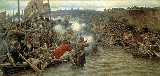
YermakYermak Timofeyevich , Cossack leader, Russian folk hero and explorer of Siberia. His exploration of Siberia marked the beginning of the expansion of Russia towards this region and its colonization...
, hired in 1577, to conquer the Khanate of Sibir, promising to help him with supplies of food and arms.
In 1581 Yermak began his voyage into the depths of
SiberiaSiberia is an extensive region constituting almost all of Northern Asia. Comprising the central and eastern portion of the Russian Federation, it was part of the Soviet Union from its beginning, as its predecessor states, the Tsardom of Russia and the Russian Empire, conquered it during the 16th...
with a band of 1,636 men, following the
TagilTagil is a river in Sverdlovsk Oblast, Russia. It is 414 km long, with a drainage basin of 10 100 km². The average discharge is 40 m³/s. The river has its sources on the eastern slopes of the Ural Mountains, east of Verkhny Tagil...
and
Tura RiverTura River , also known as Dolgaya River ) is a historically important Siberian river which flows eastward from the central Ural Mountains into the Tobol River, a part of the Ob River basin. The main town is Tyumen....
s. The following year they were on the
TobolTobol is a river in Kurgan and Tyumen Oblasts in Russia and Kazakhstan, left tributary of the Irtysh. The length of the Tobol River is 1591 km. The area of its drainage basin is 426,000 km². Average discharge at mouth is 805 m³/s. The lower reaches of the river freeze up in late October -...
, and 500 men successfully laid siege to
QashliqQashliq, Isker or Sibir was a medieval Siberian Tatar fortress, in the 16th century the capital of the Khanate of Sibir, located on the right bank of the Irtysh River at its confluence with the Sibirka rivulet, some 17 km from the modern city of Tobolsk.The fortress is first mentioned in...
, the residence of Khan
KuchumKuchum khan Kuchum khan (Tatar: Küçüm, Күчүм, Russian: Кучум; in Sybyr Küçüm is pronounced approximately as /kytsym/ - Күцүм, English name comes from standard Tatar pronunciation)Kuchum khan (Tatar: Küçüm, Күчүм, Russian: Кучум; in Sybyr Küçüm is pronounced approximately as /kytsym/ - Күцүм,...
, near what is now
TobolskTobolsk is a town in Tyumen Oblast, Russia, located at the confluence of the Tobol and Irtysh Rivers. It is a historic capital of Siberia. Population: -History:...
. After a few victories over the khan's army, Yermak's people defeated the main forces of
KuchumKuchum khan Kuchum khan (Tatar: Küçüm, Күчүм, Russian: Кучум; in Sybyr Küçüm is pronounced approximately as /kytsym/ - Күцүм, English name comes from standard Tatar pronunciation)Kuchum khan (Tatar: Küçüm, Күчүм, Russian: Кучум; in Sybyr Küçüm is pronounced approximately as /kytsym/ - Күцүм,...
on Irtysh River after a 3-day battle
Battle of Chuvash CapeThe Battle of Chuvash Cape led to the victory of a Russian expedition under Yermak Timofeyevich and the fall of Siberia Khanate and the end of Khan Kuchum's power. The battle took place near Qashliq .-Context:...
in 1582. The remains of the khan's army retreated to the steppes, abandoning his domains to Yermak, who, according to tradition, by presenting Siberia to tsar
Ivan IVIvan IV Vasilyevich , known in English as Ivan the Terrible , was Grand Prince of Moscow from 1533 until his death. His long reign saw the conquest of the Khanates of Kazan, Astrakhan, and Siberia, transforming Russia into a multiethnic and multiconfessional state spanning almost one billion acres,...
achieved his own restoration to favour.
Kuchum still was strong and suddenly attacked Yermak in 1585 in the dead of night, killing most of his people. Yermak was wounded and tried to swim across the Wagay River (
IrtyshThe Irtysh River is a river in Siberia and is the chief tributary of the Ob River. Its name means White River. Irtysh's main affluent is the Tobol River...
's tributary), but drowned under the weight of his own
chain mailMail is a type of armour consisting of small metal rings linked together in a pattern to form a mesh.-History:Mail was a highly successful type of armour and was used by nearly every metalworking culture....
. Yermak's Cossacks had to withdraw from Siberia completely, but every year new bands of hunters and adventurers, supported by Moscow, poured into the country. Thanks to Yermak's having explored all the main river routes in West
SiberiaSiberia is an extensive region constituting almost all of Northern Asia. Comprising the central and eastern portion of the Russian Federation, it was part of the Soviet Union from its beginning, as its predecessor states, the Tsardom of Russia and the Russian Empire, conquered it during the 16th...
, Russians successfully reclaimed all Yermak's conquests just several years later.
Russian exploration and settlement
In the early 17th century the eastward movement of Russians was slowed by the internal problems in the country during the
Time of TroublesThe Time of Troubles was a period of Russian history comprising the years of interregnum between the death of the last Russian Tsar of the Rurik Dynasty, Feodor Ivanovich, in 1598, and the establishment of the Romanov Dynasty in 1613. In 1601-1603, Russia suffered a famine that killed one-third...
. However, very soon the exploration and colonisation of the huge territories of Siberia was resumed, led mostly by Cossacks hunting for valuable furs and
ivoryIvory is a term for dentine, which constitutes the bulk of the teeth and tusks of animals, when used as a material for art or manufacturing. Ivory has been important since ancient times for making a range of items, from ivory carvings to false teeth, fans, dominoes, joint tubes, piano keys and...
. While Cossacks came from the Southern Urals, another wave of Russians came by the
Arctic OceanThe Arctic Ocean, located in the Northern Hemisphere and mostly in the Arctic north polar region, is the smallest and shallowest of the world's five major oceanic divisions...
. These were
PomorsPomors or Pomory are Russian settlers and their descendants on the White Sea coast. It is also term of self-identification for the descendants of Russian, primarily Novgorod, settlers of Pomorye , living on the White Sea coasts and the territory whose southern border lies on a watershed which...
from the Russian North, who already had been making
furFur is a synonym for hair, used more in reference to non-human animals, usually mammals; particularly those with extensives body hair coverage. The term is sometimes used to refer to the body hair of an animal as a complete coat, also known as the "pelage". Fur is also used to refer to animal...
trade with
MangazeyaMangazeya was a Northwest Siberian trans-Ural trade colony and later city in the 16-17th centuries. Founded in 1600, it was situated on the Taz River, between the lower courses of the Ob and Yenisei Rivers flowing into the Arctic Ocean....
in the north of the Western Siberia for quite a long time. In 1607 the settlement of
TurukhanskTurukhansk is a village in Krasnoyarsk Krai, Russia. It is located 1474 km north of Krasnoyarsk, at the confluence of the Yenisei and Lower Tunguska rivers. The Turukhan River joins the Yenisei about 20 km northwest. Population: 4,849 ; 8,900 ; 200...
was founded on the northern Yenisey River, near the mouth of the
Lower TunguskaNizhnyaya Tunguska — is a river in Siberia, Russia, flows through the Irkutsk Oblast and the Krasnoyarsk Krai. The river is a right tributary of the Yenisei joining it at Turukhansk . Settlements on the river include Tura, Yukti and Simenga...
, and in 1619
YeniseyskYeniseysk is a town in Krasnoyarsk Krai, Russia, located on the Yenisei River. Population: 20,000 .Yeniseysk was founded in 1619 as a stockaded town—the first town on the Yenisei River. It played an important role in Russian colonization of East Siberia in the 17th–18th centuries...
y
ostrogOstrog was a Russian term for a small fort, typically wooden and often non-permanently manned. Ostrogs were encircled by 4-6 metres high palisade walls made from sharpened trunks. The name derives from the Russian word строгать , "to shave the wood". Ostrogs were smaller and exclusively military...
was founded on the mid-Yenisey at the mouth of the Upper Tunguska.
In 1620 a group of fur hunters led by the semi-legendary
Demid PyandaDemid Sofonovich Pyanda or, according to some sources, Panteley Demidovich Pyanda , also spelled Penda was among the first and most important Russian explorers of Siberia...
started out from
TurukhanskTurukhansk is a village in Krasnoyarsk Krai, Russia. It is located 1474 km north of Krasnoyarsk, at the confluence of the Yenisei and Lower Tunguska rivers. The Turukhan River joins the Yenisei about 20 km northwest. Population: 4,849 ; 8,900 ; 200...
on what would became a very protracted journey. According to folk tales related a century after the fact, in the three and a half years from 1620 to 1624 Pyanda allegedly traversed the total of 4950 miles (7,966.2 km) of hitherto unknown large Siberian rivers. He explored some 1430 miles (2,301.4 km) of the
Lower TunguskaNizhnyaya Tunguska — is a river in Siberia, Russia, flows through the Irkutsk Oblast and the Krasnoyarsk Krai. The river is a right tributary of the Yenisei joining it at Turukhansk . Settlements on the river include Tura, Yukti and Simenga...
(Nizhnyaya Tunguska in
RussianRussian is a Slavic language used primarily in Russia, Belarus, Uzbekistan, Kazakhstan, Tajikistan and Kyrgyzstan. It is an unofficial but widely spoken language in Ukraine, Moldova, Latvia, Turkmenistan and Estonia and, to a lesser extent, the other countries that were once constituent republics...
) and, having reached the upper part of the Tunguska, he came upon the great Siberian river
LenaThe Lena is the easternmost of the three great Siberian rivers that flow into the Arctic Ocean . It is the 11th longest river in the world and has the 9th largest watershed...
and explored some 1500 miles (2,414 km) of its length. By doing this, he may have become the first Russian to reach Yakutia and meet
YakutsYakuts , are a Turkic people associated with the Sakha Republic.The Yakut or Sakha language belongs to the Northern branch of the Turkic family of languages....
. He returned up the Lena until it became too rocky and shallow, and by land reached
AngaraThe Angara River is a long river in Irkutsk Oblast and Krasnoyarsk Krai, south-east Siberia, Russia. It is the only river flowing out of Lake Baikal, and is the headwater tributary of the Yenisei River....
. In this way, Pyanda may have become the first Russian to meet
BuryatsThe Buryats or Buriyads , numbering approximately 436,000, are the largest ethnic minority group in Siberia and are mainly concentrated in their homeland, the Buryat Republic, a federal subject of Russia...
. He built new boats and explored some 870 miles (1,400.1 km) of the Angara, finally reaching
YeniseyskYeniseysk is a town in Krasnoyarsk Krai, Russia, located on the Yenisei River. Population: 20,000 .Yeniseysk was founded in 1619 as a stockaded town—the first town on the Yenisei River. It played an important role in Russian colonization of East Siberia in the 17th–18th centuries...
and discovering that the Angara (a
BuryatBuryat is a Mongolic variety spoken by the Buryats that is either classified as a language or as a major dialect group of Mongolian. The majority of Buryat speakers live in Russia along the northern border of Mongolia where it is an official language in the Buryat Republic, Ust-Orda Buryatia and...
name) and Upper Tunguska (Verkhnyaya Tunguska, as initially known by the Russians) were one and the same river.
In 1627
Pyotr BeketovPyotr Beketov was a prominent Cossack explorer of Siberia and founder of many cities such as Yakutsk, Chita, and Nerchinsk.Beketov started his military service as a guardsman in 1624 and was sent to Siberia in 1627. He was appointed Enisei voevoda and proceeded on his first voyage in order to...
was appointed Enisey voevoda in
SiberiaSiberia is an extensive region constituting almost all of Northern Asia. Comprising the central and eastern portion of the Russian Federation, it was part of the Soviet Union from its beginning, as its predecessor states, the Tsardom of Russia and the Russian Empire, conquered it during the 16th...
. He successfully carried out the voyage to collect taxes from Zabaykalye
BuryatsThe Buryats or Buriyads , numbering approximately 436,000, are the largest ethnic minority group in Siberia and are mainly concentrated in their homeland, the Buryat Republic, a federal subject of Russia...
, becoming the first Russian to enter Buryatia. There he founded the first Russian settlement, Rybinsky
ostrogOstrog was a Russian term for a small fort, typically wooden and often non-permanently manned. Ostrogs were encircled by 4-6 metres high palisade walls made from sharpened trunks. The name derives from the Russian word строгать , "to shave the wood". Ostrogs were smaller and exclusively military...
. Beketov was sent to the
Lena RiverThe Lena is the easternmost of the three great Siberian rivers that flow into the Arctic Ocean . It is the 11th longest river in the world and has the 9th largest watershed...
in 1631, where in 1632 he founded
YakutskWith a subarctic climate , Yakutsk is the coldest city, though not the coldest inhabited place, on Earth. Average monthly temperatures range from in July to in January. The coldest temperatures ever recorded on the planet outside Antarctica occurred in the basin of the Yana River to the northeast...
and sent his Cossacks to explore the
AldanThe Aldan River is the second-longest tributary of the Lena River in the Sakha Republic in eastern Siberia. The river is 2,273 km long, of which around 1,600 km is navigable. It was part of the River Route to Okhotsk...
and further down the Lena, to found new fortresses, and to collect taxes.
YakutskWith a subarctic climate , Yakutsk is the coldest city, though not the coldest inhabited place, on Earth. Average monthly temperatures range from in July to in January. The coldest temperatures ever recorded on the planet outside Antarctica occurred in the basin of the Yana River to the northeast...
soon turned into a major base for further Russian expeditions eastward, southward and northward.
Maksim PerfilyevMaksim Perfilyev was a Cossack explorer of Eastern Siberia and the first Russian to reach Transbaikalia. He was renowned for his diplomatic skills in negotiations with Tunguses, Mongols and Chinese....
, who earlier had been one of the founders of
YeniseyskYeniseysk is a town in Krasnoyarsk Krai, Russia, located on the Yenisei River. Population: 20,000 .Yeniseysk was founded in 1619 as a stockaded town—the first town on the Yenisei River. It played an important role in Russian colonization of East Siberia in the 17th–18th centuries...
, founded
BratskBratsk is a city in Irkutsk Oblast, Russia, located on the Angara River near the vast Bratsk Reservoir. Population: Although the name sounds like the Russian word for 'brother' , it actually comes from 'bratskiye lyudi', an old name for the Buryats.-History:The first Europeans in the area arrived...
y ostrog in 1631, and in 1638 he became the first Russian to enter Transbaikalia. In 1639 a group led by
Ivan MoskvitinIvan Yuryevich Moskvitin was a Russian explorer, presumably a native of Moscow, who led a Russian reconnaissance party to the Pacific Ocean, becoming the first Russian to reach the Sea of Okhotsk....
became the first Russian to reach the
Pacific OceanThe Pacific Ocean is the largest of the Earth's oceanic divisions. It extends from the Arctic in the north to the Southern Ocean in the south, bounded by Asia and Australia in the west, and the Americas in the east.At 165.2 million square kilometres in area, this largest division of the World...
and to discover the
Sea of OkhotskThe Sea of Okhotsk is a marginal sea of the western Pacific Ocean, lying between the Kamchatka Peninsula on the east, the Kuril Islands on the southeast, the island of Hokkaidō to the far south, the island of Sakhalin along the west, and a long stretch of eastern Siberian coast along the west and...
, having built a winter camp on its shore at the
Ulya RiverUlya River is a river in northern Khabarovsk Krai in Russia. The length of the river is 325 km, the area of its drainage basin is 15,500 km². The Ulya originates in the Dzhugdzhur Mountains, flows northeast parallel to the coast and turns east to reach the Sea of Okhotsk about 100km southwest of...
mouth. The Cossacks learned from the locals about the proximity of the Amur River. In 1640 they apparently sailed south, explored the south-eastern shores of the Okhotsk Sea, maybe even reaching the mouth of the Amur River and discovering the
Shantar IslandsThe Shantar Islands are a group of fifteen islands that lie in Uda Bay, in the southwestern zone of the Sea of Okhotsk. These islands are located close to the shores of the Siberian mainland...
on their return voyage. Based on Moskvitin's account,
Kurbat IvanovKurbat Afanasyevich Ivanov was among the greatest Cossack explorers of Siberia. He was the first Russian to discover Lake Baikal, and to create the first map of the Russian Far East...
draw the first Russian map of the
Far EastThe Far East is an English term mostly describing East Asia and Southeast Asia, with South Asia sometimes also included for economic and cultural reasons.The term came into use in European geopolitical discourse in the 19th century,...
in 1642. He led a group of Cossacks himself in 1643 to the south of the
Baikal Mountainsthumb|right|300px|The mountains and lake in the summer, as seen from [[Bolshiye Koty]] on the southwest shoreThe Baikal Mountains or Baikal Range rise steeply over the northwestern shore of Lake Baikal in southern Siberia, Russia...
and discovered
Lake BaikalLake Baikal is the world's oldest at 30 million years old and deepest lake with an average depth of 744.4 metres.Located in the south of the Russian region of Siberia, between Irkutsk Oblast to the northwest and the Buryat Republic to the southeast, it is the most voluminous freshwater lake in the...
, visiting its Olkhon Island. Subsequently Ivanov made the first chart and description of
BaikalBaykal commonly refers to Lake Baikal in southern Siberia, Russia.Baykal or Baikal may also refer to:-Russia:*Baykal, Irkutsk Oblast, an urban-type settlement*Baykal, Aurgazinsky District, Republic of Bashkortostan, a village...
.
In 1643, Vasily Poyarkov crossed the Stanovoy Range and reached the upper
Zeya RiverZeya River , 1,242 km long, is a northern tributary of the Amur River. It rises in the Tokiysky Stanovik mountain ridge, a part of the Stanovoy Range. The first Russian to enter the area was Vassili Poyarkov....
in the country of the Daurs, who were paying tribute to
ManchuThe Manchu people or Man are an ethnic minority of China who originated in Manchuria . During their rise in the 17th century, with the help of the Ming dynasty rebels , they came to power in China and founded the Qing Dynasty, which ruled China until the Xinhai Revolution of 1911, which...
ChineseChinese civilization may refer to:* China for more general discussion of the country.* Chinese culture* Greater China, the transnational community of ethnic Chinese.* History of China* Sinosphere, the area historically affected by Chinese culture...
. After wintering, in 1644 Poyarkov pushed down the Zeya and became the first Russian to reach the Amur River. He sailed down the Amur and finally discovered the mouth of that great river from land. Since his Cossacks provoked the enmity of the locals behind, Poyarkov chose a different way back. They built boats and in 1645 sailed along the
Sea of OkhotskThe Sea of Okhotsk is a marginal sea of the western Pacific Ocean, lying between the Kamchatka Peninsula on the east, the Kuril Islands on the southeast, the island of Hokkaidō to the far south, the island of Sakhalin along the west, and a long stretch of eastern Siberian coast along the west and...
coast to the
Ulya RiverUlya River is a river in northern Khabarovsk Krai in Russia. The length of the river is 325 km, the area of its drainage basin is 15,500 km². The Ulya originates in the Dzhugdzhur Mountains, flows northeast parallel to the coast and turns east to reach the Sea of Okhotsk about 100km southwest of...
and spent the next winter in the huts that had been built by
Ivan MoskvitinIvan Yuryevich Moskvitin was a Russian explorer, presumably a native of Moscow, who led a Russian reconnaissance party to the Pacific Ocean, becoming the first Russian to reach the Sea of Okhotsk....
six years earlier. In 1646 they returned to Yakutsk.
In 1644
Mikhail StadukhinMikhail Vasilyevich Stadukhin was a Russian explorer of far northeast Siberia, one of the first to reach the Kolyma, Anadyr, Penzhina and Gizhiga Rivers and the northern Sea of Okhotsk. He was a Pomor, probably born in the village of Pinega, and the nephew of a Moscow merchant...
discovered the
Kolyma RiverThe Kolyma River is a river in northeastern Siberia, whose basin covers parts of the Sakha Republic, Chukotka Autonomous Okrug, and Magadan Oblast of Russia. Itrises in the mountains north of Okhotsk and Magadan, in the area of and...
and founded
SrednekolymskSrednekolymsk is a town and the administrative center of Srednekolymsky District of the Sakha Republic, Russia, located northeast of Yakutsk on the left bank of the Kolyma River. Population: -History:...
. A merchant named
Fedot Alekseyev PopovFedot Alekseyevich Popov , date of birth unknown, died between 1648 and 1654) was a Russian explorer who organized the first European expedition through the Bering Strait.He was normally known as Fedot Alekseyev. Only a few sources call him the son of Popov...
organized a further expedition eastward, and Dezhnyov became a captain of one of the
kochiThe Koch was a special type of small one or two mast wooden sailing ships designed and used in Russia for transpolar voyages in ice conditions of the Arctic seas, popular among the Pomors....
. In 1648 they sailed from
SrednekolymskSrednekolymsk is a town and the administrative center of Srednekolymsky District of the Sakha Republic, Russia, located northeast of Yakutsk on the left bank of the Kolyma River. Population: -History:...
down to the
ArcticThe Arctic is a region located at the northern-most part of the Earth. The Arctic consists of the Arctic Ocean and parts of Canada, Russia, Greenland, the United States, Norway, Sweden, Finland, and Iceland. The Arctic region consists of a vast, ice-covered ocean, surrounded by treeless permafrost...
and after some time they rounded Cape Dezhnyov, thus becoming the first explorers to pass through
Bering StraitThe Bering Strait , known to natives as Imakpik, is a sea strait between Cape Dezhnev, Chukotka Autonomous Okrug, Russia, the easternmost point of the Asian continent and Cape Prince of Wales, Alaska, USA, the westernmost point of the North American continent, with latitude of about 65°40'N,...
and to discover
ChukotkaThe Chukchi Peninsula, Chukotka Peninsula or Chukotski Peninsula , at about 66° N 172° W, is the northeastern extremity of Asia. Its eastern end is at Cape Dezhnev near the village of Uelen. It is bordered by the Chukchi Sea to the north, the Bering Sea to the south, and the Bering Strait to the...
and the
Bering SeaThe Bering Sea is a marginal sea of the Pacific Ocean. It comprises a deep water basin, which then rises through a narrow slope into the shallower water above the continental shelves....
. All their kochi and most of their men (including Popov) were lost in storms and clashes with the natives. A small group led by Dezhnyov reached the mouth of the
Anadyr RiverAnadyr is a river in the far northeast Siberia which flows into Anadyr Bay of the Bering Sea and drains much of the interior of Chukotka Autonomous Okrug. Its basin corresponds to the Anadyrsky District of Chukotka....
and sailed up it in 1649, having built new boats out of the wreckage. They founded
Anadyrskthumb|Anadyrsk was on the east-west part of the Anadyr River at the point where it swings northAnadyrsk was an important Russian ostrog in far northeastern Siberia from 1649 to 1764...
and were stranded there, until Stadukhin found them, coming from Kolyma by land. Later Stadukhin set off to the south in 1651 and discovered Penzhin Bay on the northern side of the Okhotsk Sea. He also may have explored the western shores of Kamchatka as early as the 1650s.
In 1649-50
Yerofey KhabarovYerofey Pavlovich Khabarov or Svyatitsky Erofej Pavlovič Chabarov , was a Russian entrepreneur and adventurer, best known for his exploring the Amur river region and his attempts to colonize the area for Russia...
became the second Russian to explore the Amur River . Through the Olyokma, Tungur and
Shilka RiverShilka is a river in Zabaykalsky Krai, south-eastern Russia. It has a length . It originates as a confluence of the Onon and Ingoda rivers. Its confluence with the Ergune on the Russia-China border gives rise to the Amur River. The river is navigable for its entire length....
s he reached the Amur (Dauria), returned to Yakutsk and then went back to the Amur with a larger force in 1650-53. This time he
was met with armed resistanceThe Russian–Manchu border conflicts were a series of intermittent skirmishes between the Manchus and the Cossacks in which the Cossacks tried and failed to gain the land north of the Amur River...
. He built winter quarters at
AlbazinAlbazino is a village in Skovorodinsky District of Amur Oblast, Russia, noted as the site of Albazin , the first Russian settlement on the Amur River....
, then sailed down the Amur and found Achansk, which preceded the present-day
KhabarovskKhabarovsk is the largest city and the administrative center of Khabarovsk Krai, Russia. It is located some from the Chinese border. It is the second largest city in the Russian Far East, after Vladivostok. The city became the administrative center of the Far Eastern Federal District of Russia...
, defeating or evading large armies of Daurian
ManchuThe Manchu people or Man are an ethnic minority of China who originated in Manchuria . During their rise in the 17th century, with the help of the Ming dynasty rebels , they came to power in China and founded the Qing Dynasty, which ruled China until the Xinhai Revolution of 1911, which...
ChineseChinese civilization may refer to:* China for more general discussion of the country.* Chinese culture* Greater China, the transnational community of ethnic Chinese.* History of China* Sinosphere, the area historically affected by Chinese culture...
and Koreans on his way. He charted the Amur in his
Draft of the Amur river.
In 1659-65
Kurbat IvanovKurbat Afanasyevich Ivanov was among the greatest Cossack explorers of Siberia. He was the first Russian to discover Lake Baikal, and to create the first map of the Russian Far East...
was the next head of
Anadyrskthumb|Anadyrsk was on the east-west part of the Anadyr River at the point where it swings northAnadyrsk was an important Russian ostrog in far northeastern Siberia from 1649 to 1764...
y ostrog after Semyon Dezhnyov. In 1660 he sailed from Anadyr Bay to Cape Dezhnyov. Atop his earlier pioneering charts, he is credited with creation of the early map of
ChukotkaThe Chukchi Peninsula, Chukotka Peninsula or Chukotski Peninsula , at about 66° N 172° W, is the northeastern extremity of Asia. Its eastern end is at Cape Dezhnev near the village of Uelen. It is bordered by the Chukchi Sea to the north, the Bering Sea to the south, and the Bering Strait to the...
and
Bering StraitThe Bering Strait , known to natives as Imakpik, is a sea strait between Cape Dezhnev, Chukotka Autonomous Okrug, Russia, the easternmost point of the Asian continent and Cape Prince of Wales, Alaska, USA, the westernmost point of the North American continent, with latitude of about 65°40'N,...
, which was the first to show on paper (very schematically) the yet undiscovered
Wrangel IslandWrangel Island is an island in the Arctic Ocean, between the Chukchi Sea and East Siberian Sea. Wrangel Island lies astride the 180° meridian. The International Date Line is displaced eastwards at this latitude to avoid the island as well as the Chukchi Peninsula on the Russian mainland...
, both
Diomede IslandsThe Diomede Islands , also known in Russia as Gvozdev Islands , consist of two rocky, tuya-like islands:* The U.S. island of Little Diomede or, in its native language, Ignaluk , and* The Russian island of Big Diomede , also known as Imaqliq,...
and
AlaskaAlaska is the largest state in the United States by area. It is situated in the northwest extremity of the North American continent, with Canada to the east, the Arctic Ocean to the north, and the Pacific Ocean to the west and south, with Russia further west across the Bering Strait...
.
So, by the mid-17th century the Russians had established the borders of their country close to the modern ones, and explored almost the whole of Siberia, except eastern Kamchatka and some regions north of the
Arctic CircleThe Arctic Circle is one of the five major circles of latitude that mark maps of the Earth. For Epoch 2011, it is the parallel of latitude that runs north of the Equator....
. The conquest of Kamchatka would be completed later, in the early 18th century by
Vladimir AtlasovVladimir Vasilyevich Atlasov or Otlasov was a Siberian Cossack who was the first Russian to explore the Kamchatka Peninsula. Atlasov Island, an uninhabited volcanic island off the southern tip of Kamchatka, is named after him....
, while the discovery of the Arctic coastline and
AlaskaAlaska is the largest state in the United States by area. It is situated in the northwest extremity of the North American continent, with Canada to the east, the Arctic Ocean to the north, and the Pacific Ocean to the west and south, with Russia further west across the Bering Strait...
would be nearly completed by the
Great Northern ExpeditionThe Great Northern Expedition or Second Kamchatka expedition was one of the largest organised exploration enterprises in history, resulting in mapping of the most of the Arctic coast of Siberia and some parts of the North America coastline, greatly reducing the "white areas" on the maps...
in 1733-1743. The expedition allowed cartograhers to create a map of most of the northern coastline of Russia, thanks to the results brought by a series of voyages led by
Fyodor MininFyodor Alekseyevich Minin was a Russian Arctic explorer.In 1730s, Minin participated in the Second Kamchatka expedition. In 1736, he joined the unit led by Dmitry Ovtsyn. In 1738, he was in charge of a group of explorers, that would chart the Arctic Ocean coastline east of the Yenisei river...
,
Dmitry OvtsynDmitry Leontiyevich Ovtsyn was a Russian hydrographer and Arctic explorer.In 1734-1738, Ovtsyn led one of the units of the Second Kamchatka expedition that charted the coastline of the Kara Sea east of the river Ob. In summer of 1737, his unit made its way from Ob to Yenisei and made the first...
,
Vasili PronchishchevVasili Vasilyevich Pronchishchev was a Russian explorer.In 1718, Vasili Pronchishchev graduated from Moscow School of Mathematics and Navigation and was promoted to naval cadet...
, Semyon Chelyuskin,
Dmitry LaptevDmitry Yakovlevich Laptev was a Russian Arctic explorer and Vice Admiral .Dmitry Laptev was born in the village of Bolotovo, near Velikie Luki, in 1701. Bolotovo was the estate of his father, Yakov Laptev...
and
Khariton LaptevKhariton Prokofievich Laptev was a Russian naval officer and Arctic explorer.Khariton Laptev was born in a gentry family in the village of Pokarevo near Velikiye Luki , just a year before his cousin Dmitry Laptev was born in the nearby village of Bolotovo.Khariton Laptev started his career in the...
. At the same time, some of the members of the newly founded
Russian Academy of SciencesThe Russian Academy of Sciences consists of the national academy of Russia and a network of scientific research institutes from across the Russian Federation as well as auxiliary scientific and social units like libraries, publishers and hospitals....
traveled extensively through Siberia, forming the so called Academic Squad of the Expedition. They were
Johann Georg GmelinJohann Georg Gmelin was a German naturalist, botanist and geographer.- Early life and education :Gmelin was born in Tübingen, the son of an professor at the University of Tübingen. He was a gifted child and begun attending university lectures at the age of 14. In 1727, he graduated with a medical...
,
Daniel Gottlieb MesserschmidtDaniel Gottlieb Messerschmidt was a German physician, naturalist and geographer. He was born in Danzig and studied medicine in Jena and Halle, obtained his doctorate degree in the latter in 1713 and settled as a medical doctor in Danzig. In 1716, he came into contact with Russian emperor Peter...
and others, who became the first scientific explorers of Siberia.
Russians and Siberian natives
The main treasure to attract Cossacks to Siberia was the fur of
sableThe sable is a species of marten which inhabits forest environments, primarily in Russia from the Ural Mountains throughout Siberia, in northern Mongolia and China and on Hokkaidō in Japan. Its range in the wild originally extended through European Russia to Poland and Scandinavia...
s,
foxFox is a common name for many species of omnivorous mammals belonging to the Canidae family. Foxes are small to medium-sized canids , characterized by possessing a long narrow snout, and a bushy tail .Members of about 37 species are referred to as foxes, of which only 12 species actually belong to...
es, and
ermineErmine has several uses:* A common name for the stoat * The white fur and black tail end of this animal, which is historically worn by and associated with royalty and high officials...
s. Explorers brought back many furs from their expeditions. Local people, submitting to the Russian Empire, received defense from the southern nomads. In exchange they were obliged to pay
yasakYasak or yasaq, sometimes iasak, is a Turkic word for "tribute" that was used in Imperial Russia to designate fur tribute exacted from the indigenous peoples of Siberia.- Origin :...
(tribute) in the form of furs. There was a set of
yasachnaya roads, used to transport yasak to Moscow.
A number of peoples showed open resistance to Russians. Others submitted and even requested to be subordinated, though sometimes they later refused to pay yasak, or not admitted to the Russian authority.
Zuyev A. S.
Russian Policy Towards the Aborigines of the Extreme North-East of Russia (18th century) // Vestnik NGU. History and Philosophy, vol. 1, issue 3: History /
Novosibirsk State UniversityNovosibirsk State University was founded in May 1959 in the USSR by Soviet academicians Mikhail Alekseevich Lavrentiev, Sergei Lvovich Sobolev and Sergey Alekseyevich Khristianovich in a program of establishing a Siberian branch of the USSR Academy of Sciences...
, 2002. P. 14-24.
Online version
There is evidence of collaboration and assimilation of Russians with the local peoples in Siberia. Though the more Russians advanced to the East, the less developed the local people were, and the more resistance they offered. In 1607–1610, the
TungusThe Evenks are a Tungusic people of Northern Asia. In Russia, the Evenks are recognized as one of the Indigenous peoples of the Russian North, with a population of 35,527...
fought strenuously for their independence, but were subdued around 1623. The
BuryatsThe Buryats or Buriyads , numbering approximately 436,000, are the largest ethnic minority group in Siberia and are mainly concentrated in their homeland, the Buryat Republic, a federal subject of Russia...
also offered some opposition, but were swiftly pacified. The most resistance was offered by the
KoryakKoryak may refer to:*Koryak Autonomous Okrug, a federal subject of Russia*Koryaks, a people of northeastern Siberia*Koryak language, language of the Koryaks*Koryak, the illegitimate son of Aquaman, a fictional character in DC Comics...
(on the
Kamchatka PeninsulaThe Kamchatka Peninsula is a peninsula in the Russian Far East, with an area of . It lies between the Pacific Ocean to the east and the Sea of Okhotsk to the west...
) and
ChukchiThe Chukchi, or Chukchee , ) are an indigenous people inhabiting the Chukchi Peninsula and the shores of the Chukchi Sea and the Bering Sea region of the Arctic Ocean within the Russian Federation. They speak the Chukchi language...
(on the
Chukchi PeninsulaThe Chukchi Peninsula, Chukotka Peninsula or Chukotski Peninsula , at about 66° N 172° W, is the northeastern extremity of Asia. Its eastern end is at Cape Dezhnev near the village of Uelen. It is bordered by the Chukchi Sea to the north, the Bering Sea to the south, and the Bering Strait to the...
), the latter still being at the
Stone AgeThe Stone Age is a broad prehistoric period, lasting about 2.5 million years , during which humans and their predecessor species in the genus Homo, as well as the earlier partly contemporary genera Australopithecus and Paranthropus, widely used exclusively stone as their hard material in the...
level of development.Zuyev A. S.
Unpeaceful Chukchi are to be Eradicated... //
Rodina, #1, 1998.
Online version Resistance by local people may have been the result of forced unfair terms, that imperial recorders would have benefitted from omitting.
The Manchu resistanceThe Russian–Manchu border conflicts were a series of intermittent skirmishes between the Manchus and the Cossacks in which the Cossacks tried and failed to gain the land north of the Amur River...
, however, obliged the Russian Cossacks to quit Albazin, and by the
Treaty of NerchinskThe Treaty of Nerchinsk of 1689 was the first treaty between Russia and China. The Russians gave up the area north of the Amur River as far as the Stanovoy Mountains and kept the area between the Argun River and Lake Baikal. This border along the Argun River and Stanovoy Mountains lasted until...
(1689) Russia abandoned her advance into the basin of the river, instead concentrating on the colonisation of the vast expanses of Siberia and trading with China via the Siberian trakt. In 1852 a Russian military expedition under
Nikolay MuravyovNikolay Nikolayevich Muravyov-Amursky was a Russian statesman and diplomat, who played a major role in the expansion of the Russian Empire into the Amur River basin and to the shores of the Sea of Japan.-Surname spelling:The surname Muravyov has also been transcribed as Muravyev or Murav'ev.-Early...
explored the Amur, and by 1857 a chain of Russian Cossacks and peasants were settled along the whole course of the river. The accomplished fact was recognised by China in 1860 by the
Treaty of AigunThe Treaty of Aigun was a 1858 treaty between the Russian Empire, and the empire of the Qing Dynasty, the sinicized-Manchu rulers of China, that established much of the modern border between the Russian Far East and Manchuria , which is now known as Northeast China...
.
Scientists in Siberia
The scientific exploration of Siberia, commenced in the period of 1720 to 1742 by
Daniel Gottlieb MesserschmidtDaniel Gottlieb Messerschmidt was a German physician, naturalist and geographer. He was born in Danzig and studied medicine in Jena and Halle, obtained his doctorate degree in the latter in 1713 and settled as a medical doctor in Danzig. In 1716, he came into contact with Russian emperor Peter...
,
Johann Georg GmelinJohann Georg Gmelin was a German naturalist, botanist and geographer.- Early life and education :Gmelin was born in Tübingen, the son of an professor at the University of Tübingen. He was a gifted child and begun attending university lectures at the age of 14. In 1727, he graduated with a medical...
, and Louis de l'Isle de la Croyere, was followed up by
Gerhardt Friedrich MüllerGerhard Friedrich Müller was a historian and pioneer ethnologist.-Biography:He was educated at Leipzig.In 1725, he was invited to St. Petersburg to co-found the Imperial Academy of Sciences...
, Fischer, and
Johann Gottlieb GeorgiJohann Gottlieb Georgi was a German geographer and chemist.Georgi was professor of chemistry at St Petersburg. He accompanied both Johann Peter Falck and Peter Simon Pallas on their respective journeys through Siberia. Gergi was particularly interested in Lake Baikal...
.
Peter Simon PallasPeter Simon Pallas was a German zoologist and botanist who worked in Russia.- Life and work :Pallas was born in Berlin, the son of Professor of Surgery Simon Pallas. He studied with private tutors and took an interest in natural history, later attending the University of Halle and the University...
, with several Russian students, laid the first foundation of a thorough exploration of the topography, fauna, flora, and inhabitants of the country. The journeys of
Christopher HansteenChristopher Hansteen was a Norwegian geophysicist, astronomer and physicist, best known for his mapping of Earth's magnetic field.-Early life and career:...
and
Georg Adolf ErmanGeorg Adolf Erman was a German physicist.Erman was born in Berlin as the son of Paul Erman. He studied natural science at the universities of Berlin and Königsberg, spent from 1828 to 1830 in a journey round the world, an account of which he published in Reise um die Erde durch Nordasien und die...
were the most important step in the exploration of the territory.
Alexander von HumboldtFriedrich Wilhelm Heinrich Alexander Freiherr von Humboldt was a German naturalist and explorer, and the younger brother of the Prussian minister, philosopher and linguist Wilhelm von Humboldt...
,
Christian Gottfried EhrenbergChristian Gottfried Ehrenberg , German naturalist, zoologist, comparative anatomist, geologist, and microscopist, was one of the most famous and productive scientists of his time.- Early collections :...
, and
Gustav RoseGustav Rose was a German mineralogist who was a native of Berlin. He was a brother of mineralogist Heinrich Rose , the son of pharmacologist Valentin Rose , and the father of noted surgeon Edmund Rose and the classicist Valentin Rose.He was a graduate of the University of Berlin, where he was a...
also paid short visits to Siberia, which gave a new impulse to the accumulation of scientific knowledge; while
Carl RitterCarl Ritter was a German geographer. Along with Alexander von Humboldt, he is considered one of the founders of modern geography. From 1825 until his death, he occupied the first chair in geography at the University of Berlin.-Biography:Ritter was born in Quedlinburg, one of the six children of a...
elaborated in his
Asien (1832–1859) the foundations of a sound knowledge of the structure of Siberia. Aleksandr Fyodorovich Middendorf's journey (1843–1845) to north-eastern Siberia—contemporaneous with
Matthias CastrénMatthias Alexander Castrén was a Finnish ethnologist and philologist.Castrén was born at Tervola, in Northern Finland, on the 20th of November...
's journeys for the special study of the Ural-Altaic languages—directed attention to the far north and awakened interest in the Amur, the basin of which soon became the scene of the expeditions of Akhte and Schwarz (1852), and later on of the Siberian expedition, advanced knowledge of East Siberia.
The Siberian branch of the
Russian Geographical SocietyThe Russian Geographical Society is a learned society, founded on 6 August 1845 in Saint Petersburg, Russia.-Imperial Geographical Society:Prior to the Russian Revolution of 1917, it was known as the Imperial Russian Geographical Society....
was founded at the same time in Irkutsk, and afterwards became a permanent centre for the exploration of Siberia; while the opening of the Amur and
SakhalinSakhalin or Saghalien, is a large island in the North Pacific, lying between 45°50' and 54°24' N.It is part of Russia, and is Russia's largest island, and is administered as part of Sakhalin Oblast...
attracted
Richard MaackRichard Otto Maack was a 19th century Russian naturalist, geographer, and anthropologist. He is most known for his exploration of the Russian Far East and Siberia, particularly the Ussuri and Amur River valleys...
, Schmidt, Glehn,
Gustav RaddeGustav Ferdinand Richard Radde was a German naturalist and explorer.Radde was born in Danzig, the son of a schoolmaster. He had little formal education, and began a career as an apothecary...
, and
Leopold von SchrenckLeopold Ivanovich von Schrenck was a Russian zoologist, geographer and ethnographer.-Biography:Schrenck was a Baltic German born and brought up near Chotenj, south-west of St Petersburg. He received his doctorate from the University of Tartu, and then studied natural science in Berlin and Königsberg...
, who created works on the flora, fauna, and inhabitants of Siberia.
Russian settlement
In the 17th and 18th centuries, the Russians that migrated into Siberia were hunters, and those who had escaped from Central Russia: fugitive peasants in search for life free of
serfdomThe origins of serfdom in Russia are traced to Kievan Rus in the 11th century. Legal documents of the epoch, such as Russkaya Pravda, distinguished several degrees of feudal dependency of peasants, the term for an unfree peasant in the Russian Empire, krepostnoi krestyanin , is translated as serf.-...
, fugitive convicts, and
Old BelieversIn the context of Russian Orthodox church history, the Old Believers separated after 1666 from the official Russian Orthodox Church as a protest against church reforms introduced by Patriarch Nikon between 1652–66...
. The new settlements of Russians and the existing local peoples required defence from nomads, for which forts were founded. This way forts of
TomskTomsk is a city and the administrative center of Tomsk Oblast, Russia, located on the Tom River. One of the oldest towns in Siberia, Tomsk celebrated its 400th anniversary in 2004...
and
BerdskBerdsk is a town in Novosibirsk Oblast, Russia, a satellite of Novosibirsk, situated on a bank of the Berd River. Population: It was founded in 1716 as a fortress. Town status was granted to it in 1944...
were founded.
In the beginning of the 18th century the threat of the nomads' attacks weakened; thus the region became more and more populated; normal civic life was established in the cities.
In the 18th century in Siberia, a new administrative
guberniyaA guberniya was a major administrative subdivision of the Russian Empire usually translated as government, governorate, or province. Such administrative division was preserved for sometime upon the collapse of the empire in 1917. A guberniya was ruled by a governor , a word borrowed from Latin ,...
was formed with
IrkutskIrkutsk is a city and the administrative center of Irkutsk Oblast, Russia, one of the largest cities in Siberia. Population: .-History:In 1652, Ivan Pokhabov built a zimovye near the site of Irkutsk for gold trading and for the collection of fur taxes from the Buryats. In 1661, Yakov Pokhabov...
, then in the 19th century the territory was several times re-divided with creation of new guberniyas: Tomsk (with center in
TomskTomsk is a city and the administrative center of Tomsk Oblast, Russia, located on the Tom River. One of the oldest towns in Siberia, Tomsk celebrated its 400th anniversary in 2004...
) and Yenisei (
YeniseyskYeniseysk is a town in Krasnoyarsk Krai, Russia, located on the Yenisei River. Population: 20,000 .Yeniseysk was founded in 1619 as a stockaded town—the first town on the Yenisei River. It played an important role in Russian colonization of East Siberia in the 17th–18th centuries...
, later
KrasnoyarskKrasnoyarsk is a city and the administrative center of Krasnoyarsk Krai, Russia, located on the Yenisei River. It is the third largest city in Siberia, with the population of 973,891. Krasnoyarsk is an important junction of the Trans-Siberian Railway and one of Russia's largest producers of...
).
In the 1730, the first large industrial project—the metallurgical production found by
DemidovThe Demidov family, also Demidoff, were an influential Russian merchant, industrialist and later chivalry family, possibly second only to the Tsar himself in wealth during the late 18th and early 19th centuries.-History:...
family—gave birth to the city of
Barnaul-Russian Empire:Barnaul was one of the earlier cities established in Siberia. Originally chosen for its proximity to the mineral-rich Altai Mountains and its location on a major river, the site was founded by the wealthy Demidov family in the 1730s. In addition to the copper which had originally...
. Later, the enterprise organized social institutions like library, club, theatre.
Pyotr Semenov-Tyan-ShanskyPyotr Petrovich Semenov-Tyan-Shansky was a Russian geographer and statistician who managed the Russian Geographical Society for more than 40 years....
, who stayed in Barnaul in 1856–1857 wrote: "The richness of mining engineers of Barnaul expressed not merely in their households and clothes, but more in their educational level, knowledge of science and literature. Barnaul was undoubtedly the most cultured place in Siberia, and I've called it Siberian Athenes, leaving
SpartaSparta or Lacedaemon, was a prominent city-state in ancient Greece, situated on the banks of the River Eurotas in Laconia, in south-eastern Peloponnese. It emerged as a political entity around the 10th century BC, when the invading Dorians subjugated the local, non-Dorian population. From c...
for Omsk".
The same events took place in other cities; public libraries, museums of local lore, colleges, theatres were being built, although the first university in Siberia was opened as late as 1880 in Tomsk.
Siberian
peasantA peasant is an agricultural worker who generally tend to be poor and homeless-Etymology:The word is derived from 15th century French païsant meaning one from the pays, or countryside, ultimately from the Latin pagus, or outlying administrative district.- Position in society :Peasants typically...
s more than those in European Russia relied on their own force and abilities. They had to fight against the harder climate without outside help. Lack of serfdom and landlords also contributed to their independent character. Unlike peasants in European Russia, Siberians had no problems with land availability; the low population density gave them the ability to intensively cultivate a plot for several years in a row, then to leave it fallow for a long time and cultivate other plots. Siberian peasants had an abundance of food, while Central Russian peasantry had to moderate their families' appetites. Leonid Blummer noted that the culture of alcohol consumption differed significantly; Siberian peasants drank frequently but moderately: "For a Siberian vodka isn't a wonder, unlike for a Russian peasant, which, having reached it after all this time, is ready to drink a sea." The houses, according to the travellers' notes, were unlike the typical Russian
izbaAn izba is a traditional Russian countryside dwelling. A type of log house, it forms the living quarters of a conventional Russian farmstead. It is generally built close to the road and inside a yard, which also encloses a kitchen garden, hayshed, and barn within a simple woven stick fence...
s: the houses were big, often two-floored, the ceilings were high, the walls were covered with boards and painted with oil-paint.
Старцев А. В. Homo Sibiricus // Земля Сибирь. Новосибирск. 1992. № 5–6.
Startsev A. V. Homo Sibiricus // Zemlya Sibir'. Novosibirsk, 1992. #5-6.!
Administrative divisions
The
Siberia GovernorateSiberia Governorate was an administrative division of the Russian Empire, which existed from 1708 until 1782. Its seat was in Tobolsk . The governorate was located in the east of Russian Empire and bordered China in the south, Kazan Governorate in the south-west, and Archangelgorod Governorate in...
was established in 1708 as part of the administrative reforms of
Peter IPeter the Great, Peter I or Pyotr Alexeyevich Romanov Dates indicated by the letters "O.S." are Old Style. All other dates in this article are New Style. ruled the Tsardom of Russia and later the Russian Empire from until his death, jointly ruling before 1696 with his half-brother, Ivan V...
.
In 1719, the governorate was divided into into three provinces, Vyatka, Solikamsk and Tobolsk.
In 1762, it was renamed to
Tsardom of Siberia (Сибирское царство).
In 1782, under the impression of
Pugachev's RebellionPugachev's Rebellion of 1774-75 was the principal revolt in a series of popular rebellions that took place in Russia after Catherine II seized power in 1762...
, the Siberian kingdom was divided into three separate viceregencies (наместничество), centered at
TobolskTobolsk is a town in Tyumen Oblast, Russia, located at the confluence of the Tobol and Irtysh Rivers. It is a historic capital of Siberia. Population: -History:...
,
IrkutskIrkutsk is a city and the administrative center of Irkutsk Oblast, Russia, one of the largest cities in Siberia. Population: .-History:In 1652, Ivan Pokhabov built a zimovye near the site of Irkutsk for gold trading and for the collection of fur taxes from the Buryats. In 1661, Yakov Pokhabov...
and
KolyvanKolyvan may refer to:*Kolyvan, Novosibirsk Oblast, an urban-type settlement in Novosibirsk Oblast, Russia*Kolyvan, Altai Krai, a village in Altai Krai, Russia*Kolyvan, an ancient Russian name of today's Tallinn....
. These viceregencies were downgraded to the status of governorate in 1796 (Tobolsk Governorate, Irkutsk Governorate,
Vyatka GovernorateVyatka Governorate was a governorate of Russian Empire and USSR, with its capital in city Vyatka . Existed since 1796 to 1929...
).
Tomsk Governorate was split off Tobolsk governorate in 1804. Yakutsk Oblast was split off Irkutsk Governorate in 1805.
In 1822, the subdivision of Siberia was reformed again. It was divided into two governorates general, West Siberia and East Siberia.
West Siberia comprised the Tobolsk and Tomsk governorates, and East Siberia comprised Irkutsk Governorate, and the newly-formed Yeniseysk Governorate.
Decembrists and other exiles
Siberia was deemed a good place to exile for political reasons, as it was far from any foreign country. A
St. PetersburgSaint Petersburg is a city and a federal subject of Russia located on the Neva River at the head of the Gulf of Finland on the Baltic Sea...
citizen would not wish to escape in vast Siberian countryside as the peasants and criminals did. Even the larger cities such as Irkutsk, Omsk, and Krasnoyarsk, lacked that intensive social life and luxurious high life of the capital.
About eighty people involved in the
Decembrist revoltThe Decembrist revolt or the Decembrist uprising took place in Imperial Russia on 14 December , 1825. Russian army officers led about 3,000 soldiers in a protest against Nicholas I's assumption of the throne after his elder brother Constantine removed himself from the line of succession...
were sentenced to obligatory work in Siberia and perpetual settlement here. Eleven wives followed them and settled near the labour camps. In their memoirs, they noted the benevolence and the prosperity of rural Siberians and severe treatment by the soldiers and officers.
- "Travelling through Siberia, I was wondered and fascinated at every step by the cordiality and hospitality I met everywhere. I was fascinated by the richness and the abundance, with which the people live until today (1861), but that time there was even more expanse in everything. The hospitality was especially developed in Siberia. Everywhere we were received like being in friendly countries, everywhere we were fed well, and when I asked how much I owed them, they didn't want to take anything, saying "Put a candle to the God"."
- "...Siberia is extremely rich country, the land is ususually fruitful, and a few work is needed to get a plentiful harvest."
Polina Annenkova, Notes of a Decembrist's Wife
A number of Decembrists died of diseases, some suffered psychological shock and even went out of their mind.
After completing the term of obligatory work, they were sentenced to settle in specific small towns and villages. There, some started doing business, which was well permitted. Only several years later, in the 1840s, they were allowed to move to big cities or to settle anywhere in Siberia. Only in 1856, 31 years after the revolt,
Alexander IIAlexander II , also known as Alexander the Liberator was the Emperor of the Russian Empire from 3 March 1855 until his assassination in 1881...
pardoned and restituted the Decembrists in honour of his coronation.
Living in the cities of Omsk, Krasnoyarsk, and Irkutsk, the Decembrists contributed extensively to the social life and culture. In Irkutsk, their houses are now the museums. In many places, memorial plaques with their names have been installed.
Yet, there were exceptions: Vladimir Raevskiy was arrested for participation in Decembrists' circles in 1822, and in 1828 was exiled to Olonki village near Irkutsk. There he married and had nine children, traded with bread, and founded a school for children and adults to teach arythmetics and grammar. Being pardoned by Alexander II, he visited his native town, but returned to Olonki.
Despite the wishes of the central authorities, the exiled revolutioners unlikely felt outcast in Siberia. Quite the contrary, Siberians having lived all the time on their own, "didn't feel tenderness" to the authorities. In many cases, the exiled were cordially received and got paid positions.
Fyodor DostoevskyFyodor Mikhaylovich Dostoyevsky was a Russian writer of novels, short stories and essays. He is best known for his novels Crime and Punishment, The Idiot and The Brothers Karamazov....
was exiled to
katorgaKatorga was a system of penal servitude of the prison farm type in Tsarist Russia...
near Omsk and to military service in Semipalatinsk. In the service he also had to make trips for
Barnaul-Russian Empire:Barnaul was one of the earlier cities established in Siberia. Originally chosen for its proximity to the mineral-rich Altai Mountains and its location on a major river, the site was founded by the wealthy Demidov family in the 1730s. In addition to the copper which had originally...
and
KuznetskNovokuznetsk is a city in Kemerovo Oblast, Russia. It serves as the administrative center of Novokuznetsky District, but it is not administratively a part of it...
, where he married.
Anton ChekhovAnton Pavlovich Chekhov was a Russian physician, dramatist and author who is considered to be among the greatest writers of short stories in history. His career as a dramatist produced four classics and his best short stories are held in high esteem by writers and critics...
was not exiled, but in 1890 made a trip on his own to Sakhalin through Siberia and visited a katorga there. In his trip, he visited Tomsk, speaking disapprovingly about it, then Krasnoyarsk, which he called "the most beautiful Siberian city". He noted that despite being more a place of criminal rather than political exile, the moral atmosphere was much better: he did not face any case of theft. Blummer suggested to prepare a gun, but his attendant replied:
What for?! We are not in Italy, you know. Chekhov observed that besides of the evident prosperity, there was an urgent demand for cultural development.
Many
Polesthumb|right|180px|The state flag of [[Poland]] as used by Polish government and diplomatic authoritiesThe Polish people, or Poles , are a nation indigenous to Poland. They are united by the Polish language, which belongs to the historical Lechitic subgroup of West Slavic languages of Central Europe...
were also exiled to Siberia (see
SybiraksThe Polish term sybirak is synonymous to the Russian counterpart sibiryak and generally refers to all people resettled to Siberia, it is in most cases used to refer to Poles who have been imprisoned or exiled to Siberia-History:Many Poles were exiled to Siberia, starting with the 18th-century...
). In 1866 they incited
rebellion in SiberiaSiberian Uprising or Baikal Insurrection was a short-lived uprising of about 700 Polish political prisoners and exiles in Siberia, Russian Empire, that started on 24 June 1866 and lasted for a few days, till their defeat on 28 June....
.
Trans-Siberian Railway
The development of the Siberia was hampered by poor transportation links within the region as well as between Siberia and the rest of the country. Aside from the Sibirsky trakt, good roads suitable for wheeled transport were few and far apart. For about five months of the year, rivers were the main means of transportation; during the cold half of the year, cargo and passengers travelled by horse-drawn
sledA sled, sledge, or sleigh is a land vehicle with a smooth underside or possessing a separate body supported by two or more smooth, relatively narrow, longitudinal runners that travels by sliding across a surface. Most sleds are used on surfaces with low friction, such as snow or ice. In some cases,...
s over the winter roads, many of which were the same rivers, now ice-covered.
The first steamboat on the
ObThe Ob River , also Obi, is a major river in western Siberia, Russia and is the world's seventh longest river. It is the westernmost of the three great Siberian rivers that flow into the Arctic Ocean .The Gulf of Ob is the world's longest estuary.-Names:The Ob is known to the Khanty people as the...
, Nikita Myasnikov's "Osnova", was launched in 1844; but the early starts were difficult, and it was not until 1857 that steamboat shipping started developing in the Ob system in the serious way. Steamboats started operating on the Yenisei in 1863, on the
LenaThe Lena is the easternmost of the three great Siberian rivers that flow into the Arctic Ocean . It is the 11th longest river in the world and has the 9th largest watershed...
and Amur in the 1870s.
While the comparably flat Western Siberia was at least fairly well served by the gigantic
Ob-
IrtyshThe Irtysh River is a river in Siberia and is the chief tributary of the Ob River. Its name means White River. Irtysh's main affluent is the Tobol River...
-Tobol-
ChulymThe Chulym is a river in Krasnoyarsk Krai and Tomsk Oblast in Russia, a right tributary of the Ob River. The length of the river is . The area of its basin is . The Chulym flows into the Ob in Ust-Chulym...
river system, the mighty rivers of Eastern Siberia --
Yenisei, Upper Angara River (
Angara RiverThe Angara River is a long river in Irkutsk Oblast and Krasnoyarsk Krai, south-east Siberia, Russia. It is the only river flowing out of Lake Baikal, and is the headwater tributary of the Yenisei River....
below
BratskBratsk is a city in Irkutsk Oblast, Russia, located on the Angara River near the vast Bratsk Reservoir. Population: Although the name sounds like the Russian word for 'brother' , it actually comes from 'bratskiye lyudi', an old name for the Buryats.-History:The first Europeans in the area arrived...
was not easily navigable because of the rapids),
LenaThe Lena is the easternmost of the three great Siberian rivers that flow into the Arctic Ocean . It is the 11th longest river in the world and has the 9th largest watershed...
-- were mostly navigable only in the north-south direction. An attempt to somewhat
remedy the situation by building the
Ob-Yenisei CanalOb-Yenisei Canal, also known as Ket-Kas Canal is a disused waterway that connected the basins of the rivers Ob and Yenisei in Siberia.-Location:...
were not particularly successful.
Only a railroad could be a real solution to the region's transportation problems.
The first projects of railroads in Siberia emerged since the creation of the
MoscowMoscow is the capital, the most populous city, and the most populous federal subject of Russia. The city is a major political, economic, cultural, scientific, religious, financial, educational, and transportation centre of Russia and the continent...
–
St. PetersburgSaint Petersburg is a city and a federal subject of Russia located on the Neva River at the head of the Gulf of Finland on the Baltic Sea...
railroad. One of the first was
IrkutskIrkutsk is a city and the administrative center of Irkutsk Oblast, Russia, one of the largest cities in Siberia. Population: .-History:In 1652, Ivan Pokhabov built a zimovye near the site of Irkutsk for gold trading and for the collection of fur taxes from the Buryats. In 1661, Yakov Pokhabov...
–Chita project, intended to connect the former to the Amur River and, consequently, to the
Pacific OceanThe Pacific Ocean is the largest of the Earth's oceanic divisions. It extends from the Arctic in the north to the Southern Ocean in the south, bounded by Asia and Australia in the west, and the Americas in the east.At 165.2 million square kilometres in area, this largest division of the World...
.
Prior to 1880 the central government seldom responded to such projects, due to the weakness of Siberian enterprises, fear of Siberian territories' integration with the Pacific region rather than with Russia, and thus falling under the influence of the
United StatesThe United States of America is a federal constitutional republic comprising fifty states and a federal district...
and
Great BritainThe United Kingdom of Great Britain and Northern IrelandIn the United Kingdom and Dependencies, other languages have been officially recognised as legitimate autochthonous languages under the European Charter for Regional or Minority Languages...
. The heavy and clumsy bureaucracy and the fear of financial risks also contributed to the inaction: the financial system always underestimated the effects of the railway, assuming that it would take only the existing traffic.
Namely the fear of losing Siberia convinced
Alexander IIAlexander II , also known as Alexander the Liberator was the Emperor of the Russian Empire from 3 March 1855 until his assassination in 1881...
in 1880 to make a decision to build the railway. Construction started in 1891.
Trans-Siberian Railroad gave a great boost to Siberian agriculture, allowing for increased exports to Central Russia and European countries. It pushed not only the territories closest to the railway, but also those connected with meridional rivers, such as the
ObThe Ob River , also Obi, is a major river in western Siberia, Russia and is the world's seventh longest river. It is the westernmost of the three great Siberian rivers that flow into the Arctic Ocean .The Gulf of Ob is the world's longest estuary.-Names:The Ob is known to the Khanty people as the...
(
AltaiAltai Krai is a federal subject of Russia . It borders with, clockwise from the south, Kazakhstan, Novosibirsk and Kemerovo Oblasts, and the Altai Republic. The krai's administrative center is the city of Barnaul...
) and the Yenisei (
MinusinskMinusinsk is a historic town in Krasnoyarsk Krai, Russia. It serves as the administrative center of Minusinsky District, although it is not administratively a part of it. Population: 44,500 ....
and
AbakanAbakan is the capital city of the Republic of Khakassia, Russia, located in the central part of Minusinsk Depression, at the confluence of the Yenisei and Abakan Rivers. Population: -History:...
regions).
Siberian agriculture exported a lot of cheap
grainGRAIN is a small international non-profit organisation that works to support small farmers and social movements in their struggles for community-controlled and biodiversity-based food systems. Our support takes the form of independent research and analysis, networking at local, regional and...
to the West. The agriculture in Central Russia was still under pressure of serfdom, formally abandoned in 1861.
Thus, to defend it and to prevent possible social destabilization, in 1896 (when the eastern and western parts of the Trans-Siberian did not close up yet), the government introduced Chelyabinsk tariff break —a tariff barrier for grain in
ChelyabinskChelyabinsk is a city and the administrative center of Chelyabinsk Oblast, Russia, located in the northwestern side of the oblast, south of Yekaterinburg, just to the east of the Ural Mountains, on the Miass River. Population: -History:...
, and a similar barrier in
ManchuriaManchuria is a historical name given to a large geographic region in northeast Asia. Depending on the definition of its extent, Manchuria usually falls entirely within the People's Republic of China, or is sometimes divided between China and Russia. The region is commonly referred to as Northeast...
. This measure changed the form of cereal product export: mills emerged in Altai,
NovosibirskNovosibirsk is the third-largest city in Russia, after Moscow and Saint Petersburg, and the largest city of Siberia, with a population of 1,473,737 . It is the administrative center of Novosibirsk Oblast as well as of the Siberian Federal District...
, and Tomsk; many farms switched to
butterButter is a dairy product made by churning fresh or fermented cream or milk. It is generally used as a spread and a condiment, as well as in cooking applications, such as baking, sauce making, and pan frying...
production. From 1896 to 1913 Siberia on average exported 30.6 million
poodPood , is a unit of mass equal to 40 funt . It is approximately 16.38 kilograms . It was used in Russia, Belarus and Ukraine. Pood was first mentioned in a number of documents of the 12th century....
s (~500,000 tonnes) of cereal products (grain, flour) annually.
Khramkov A. A. Railroad Transportation of Cereal Products from Siberia to the West in the Late 19th — Early 20th Centuries. //
Entrepreneurs and Business Undertakings in Siberia. 3rd issue. Collection of scientific articles. Barnaul: Altai State University publishing house, 2001. ISBN 5-7904-0195-3
Stolypin's resettlement programme
One early significant settlement campaign was carried out under
Nicholas IINicholas II was the last Emperor of Russia, Grand Prince of Finland, and titular King of Poland. His official short title was Nicholas II, Emperor and Autocrat of All the Russias and he is known as Saint Nicholas the Passion-Bearer by the Russian Orthodox Church.Nicholas II ruled from 1894 until...
by Prime Minister Stolypin in 1906–1911.
The rural areas of Central Russia were overcrowded, while the East was still lightly populated despite having fertile lands. On May 10, 1906, by the decree of the Tsar, agriculturalists were granted the right to transfer, without any restrictions, to the Asian territories of Russia, and to obtain cheap or free land. A large advertising campaign was conducted: six million copies of brochures and banners entitled
What the resettlement gives to peasants, and
How the peasants in Siberia live were printed and distributed in rural areas. Special propaganda trains were sent throughout the countryside, and transport trains were provided for the migrants. The State gave loans to the settlers for farm construction.
Not all the settlers decided to stay; 17.8% migrated back. All in all, more than three million people officially resettled in Siberia, and 750,000 came as foot-messengers. From 1897 to 1914 Siberian population increased 73%, and the area of land under cultivation doubled.
Tunguska event
The Tunguska Event, or Tunguska explosion, was a powerful
explosionAn explosion is a rapid increase in volume and release of energy in an extreme manner, usually with the generation of high temperatures and the release of gases. An explosion creates a shock wave. If the shock wave is a supersonic detonation, then the source of the blast is called a "high explosive"...
that occurred near the
Podkamennaya (Lower Stony) TunguskaThe Podkamennaya Tunguska is a river in Krasnoyarsk Krai, Russia; it is an eastern tributary of the Yenisei and has a length of . The name of the river comes from the fact that it flows under pebble fields without open water...
River in what is now
Krasnoyarsk KraiKrasnoyarsk Krai is a federal subject of Russia . It is the second largest federal subject after the Sakha Republic, and Russia's largest krai, occupying an area of , which is 13% of the country's total territory. The administrative center of the krai is the city of Krasnoyarsk...
of
RussiaRussia or , officially known as both Russia and the Russian Federation , is a country in northern Eurasia. It is a federal semi-presidential republic, comprising 83 federal subjects...
, at around 7:14 a.m. (0:14 UT, 7:02 a.m. local solar time) on June 30, 1908 (June 17 in the
Julian calendarThe Julian calendar began in 45 BC as a reform of the Roman calendar by Julius Caesar. It was chosen after consultation with the astronomer Sosigenes of Alexandria and was probably designed to approximate the tropical year .The Julian calendar has a regular year of 365 days divided into 12 months...
, in use locally at the time).
The cause of the explosion is controversial, and still much disputed to this day. Although the cause of the explosion is the subject of debate, it is commonly believed to have been caused by the
air burstAn air burst is the detonation of an explosive device such as an anti-personnel artillery shell or a nuclear weapon in the air instead of on contact with the ground or target or a delayed armor piercing explosion....
of a large
meteoroidA meteoroid is a sand- to boulder-sized particle of debris in the Solar System. The visible path of a meteoroid that enters Earth's atmosphere is called a meteor, or colloquially a shooting star or falling star. If a meteoroid reaches the ground and survives impact, then it is called a meteorite...
or
cometA comet is an icy small Solar System body that, when close enough to the Sun, displays a visible coma and sometimes also a tail. These phenomena are both due to the effects of solar radiation and the solar wind upon the nucleus of the comet...
fragment at an altitude of 5–10 kilometres (3–6 miles) above the
EarthEarth is the third planet from the Sun, and the densest and fifth-largest of the eight planets in the Solar System. It is also the largest of the Solar System's four terrestrial planets...
's surface. Different studies have yielded varying estimates of the object's size, with general agreement that it was a few tens of metres across.
Although the Tunguska event is believed to be the largest
impact eventAn impact event is the collision of a large meteorite, asteroid, comet, or other celestial object with the Earth or another planet. Throughout recorded history, hundreds of minor impact events have been reported, with some occurrences causing deaths, injuries, property damage or other significant...
on land in
EarthEarth is the third planet from the Sun, and the densest and fifth-largest of the eight planets in the Solar System. It is also the largest of the Solar System's four terrestrial planets...
's recent history, impacts of similar size in remote ocean areas would have gone unnoticed before the advent of global satellite monitoring in the 1960s and 1970s. Because the event occurred in a remote area, there was little damage to human life or property, and it was in fact some years until it was properly investigated.
The first recorded expedition arrived at the scene more than a decade after the event. In 1921, the Russian
mineralogistMineralogy is the study of chemistry, crystal structure, and physical properties of minerals. Specific studies within mineralogy include the processes of mineral origin and formation, classification of minerals, their geographical distribution, as well as their utilization.-History:Early writing...
Leonid KulikLeonid Alekseyevich Kulik was a Russian mineralogist who is noted for his research into meteorites....
, visiting the Podkamennaya Tunguska River basin as part of a survey for the
Soviet Academy of SciencesThe Russian Academy of Sciences consists of the national academy of Russia and a network of scientific research institutes from across the Russian Federation as well as auxiliary scientific and social units like libraries, publishers and hospitals....
, deduced from local accounts that the explosion had been caused by a giant
meteorite impactAn impact event is the collision of a large meteorite, asteroid, comet, or other celestial object with the Earth or another planet. Throughout recorded history, hundreds of minor impact events have been reported, with some occurrences causing deaths, injuries, property damage or other significant...
. He persuaded the
SovietThe Soviet Union , officially the Union of Soviet Socialist Republics , was a constitutionally socialist state that existed in Eurasia between 1922 and 1991....
government to fund an expedition to the Tunguska region, based on the prospect of meteoric iron that could be salvaged to aid Soviet industry.
Kulik's party reached the site in 1927. To their surprise, no
craterIn the broadest sense, the term impact crater can be applied to any depression, natural or manmade, resulting from the high velocity impact of a projectile with a larger body...
was to be found. There was instead a region of scorched trees about 50 kilometres (31.1 mi) across. A few near
ground zeroThe term ground zero describes the point on the Earth's surface closest to a detonation...
were still strangely standing upright, their branches and bark stripped off. Those farther away had been knocked down in a direction away from the center.
Russian Civil War
By the time of the
revolutionThe Russian Revolution is the collective term for a series of revolutions in Russia in 1917, which destroyed the Tsarist autocracy and led to the creation of the Soviet Union. The Tsar was deposed and replaced by a provisional government in the first revolution of February 1917...
Siberia was an agricultural region of Russia, with weak entrepreneur and industrial class. The
intelligentsiaThe intelligentsia is a social class of people engaged in complex, mental and creative labor directed to the development and dissemination of culture, encompassing intellectuals and social groups close to them...
had vague political ideas. Only 13%
Shilovsky M. V. The Political Processes in Siberia in the Period of Social Cataclysms of 1917-1920s. — Novosibirsk, "Sova" publishing house, 2003. ISBN 5-87550-150-2 of the region's population lived in the cities and possessed some political knowledge. The lack of strong social difference, scarcity of urban population and intellectuals led to uniting of formally different political parties under ideas of regionalism.
Shilovsky M. V. Consolidation of the "Democratic" Counter-Revolution in Siberia in the Spring-Summer 1919 // Questions of Siberian History of Current Importance. The Second Scientific Conference devoted to prof. A. P. Borodavkin. — Barnaul, Altai State University, 2000. ISBN 5-7904-0149-X
The anti-Bolsheviks forces failed to offer a united resistance. While
Kolchak fought against the Bolsheviks intending to eliminate them in the capital of the Empire, the local
Socialists-Revolutionersthumb|right|200px|Socialist-Revolutionary election poster, 1917. The caption in red reads "партия соц-рев" , short for Party of the Socialist Revolutionaries...
and Mensheviks tried to sign a peaceful treaty with Bolsheviks, on terms of independence. The foreign allies, though being able to make a decisive effort, preferred to stay neutral, although Kolchak himself rejected the offer of help from
JapanJapan is an island nation in East Asia. Located in the Pacific Ocean, it lies to the east of the Sea of Japan, China, North Korea, South Korea and Russia, stretching from the Sea of Okhotsk in the north to the East China Sea and Taiwan in the south...
.
- For more detailed chronology of the civil war in Siberia, see articles on Siberian separatism
Siberian regionalism , is a political movement to form an autonomous Siberian polity. It originated in the mid-19th century and reached a high tide with the military activities of Aleksandr Kolchak and Viktor Pepelyayev during the Russian Civil War....
, Aleksandr KolchakAleksandr Vasiliyevich Kolchak was a Russian naval commander, polar explorer and later - Supreme ruler . Supreme ruler of Russia , was recognized in this position by all the heads of the White movement, "De jure" - Kingdom of Serbs, Croats and Slovenes, "De facto" - Entente States...
and Siberian InterventionThe ', or the Siberian Expedition, of 1918–1922 was the dispatch of troops of the Entente powers to the Russian Maritime Provinces as part of a larger effort by the western powers and Japan to support White Russian forces against the Bolshevik Red Army during the Russian Civil War...
After a series of defeats in the Central Russia, Kolchak's forces had to retreat to Siberia. The resistance of SR-s and waning support from the allies, the Whites had to evacuate from Omsk to Irkutsk, and finally Kolchak resigned under pressure of SR-s, who soon submitted to Bolsheviks.
1920s and 1930s
By the 1920s the agriculture in Siberia was in decline. With the large number of immigrants, land was used very intensively, which led to exhaustion of the land and frequent bad harvests.
Mikhalin V. A. From the History of Siberian Agriculture Studies in the Early 1920-s (N. Ya. Novombergskiy's Note) // Siberia in the XVII-XX centuries: Problems of the Political and Social History. — Novosibirsk State University, Novosibirsk, 2002.
Agriculture wasn't destroyed by the civil war, but the disorganization of the exports destroyed the food industry and reduced the peasants' incomes. Furthermore,
prodrazvyorstkaProdrazvyorstka , translated as food apportionment or surplus appropriation system, was a governmental program in Russia which obliged peasantry to surrender the surpluses of almost any kind of agricultural produce for a fixed price...
and then the natural food tax contributed to growing discontent. In 1920-1924 there was a number of anti-communistic riots in rural areas, with up to 40,000 people involved.
Shishkin V. I. Partisan-Rebellious Movement in Siberia in the Early 1920s //The Civil War in Siberia. — Krasnoyarsk, 1999. P. 161-172. Both old Whites (Cossacks) and old "Reds" partisans, who earlier fought against Kolchak, the marginals, who were the major force of the Communists, took part in the riots. According to a survey of 1927 in
Irkutsk OblastIrkutsk Oblast is a federal subject of Russia , located in southeastern Siberia in the basins of Angara River, Lena, and Nizhnyaya Tunguska Rivers. The administrative center is the city of Irkutsk. Population: -History:...
, the peasants openly said they'd participate in anti-Soviet rebel and hoped for the foreign help.
Isayev V. I. Militarization of the Youth and Youth Extremism in Siberia (1920s - early 1930s). // Vestnik NGU. History and philosophy series. Vol. 1, Issue 3: History. / Novosibirsk State University, Novosibirsk, 2002. It should be noticed also that the Soviet authorities declared by a special order the KVZhD builders and workers enemies of the people.
The youth, that had socialized in the age of war, was highly militarized, and the Soviet government pushed the further military propaganda by
KomsomolThe Communist Union of Youth , usually known as Komsomol , was the youth division of the Communist Party of the Soviet Union. The Komsomol in its earliest form was established in urban centers in 1918. During the early years, it was a Russian organization, known as the Russian Communist Union of...
. There are many documented evidences of "red banditism", especially in the countryside, such as desecration of churches and Christian graves, and even murders of priests and believers. Also in many cases a Komsomol activist or an authority representative, speaking with a person opposed to the Soviets, got angry and killed him/her and anybody else. The Party faintly counteracted this.
In 1930s, the Party started the collectivization, which automatically put the "
kulakKulaks were a category of relatively affluent peasants in the later Russian Empire, Soviet Russia, and early Soviet Union...
" label on the well-off families living in Siberia for a long time. Naturally,
raskulachivanie applied to everyone who protested. From the Central Russia many families were exiled in low-populated, forest or swampy areas of Siberia, but those who lived here, had either to escape anywhere, or to be exiled in the Northern regions (such as
EvenkEvenk Autonomous Okrug , or Evenkia, was a federal subject of Russia . It had been created in 1930. Its administrative center was the urban-type settlement of Tura...
and
Khanty-Mansi Autonomous OkrugKhanty–Mansi Autonomous Okrug , also known as Yugra, is a federal subject of Russia . Population: The people native to the region are the Khanty and the Mansi, known collectively as Ob Ugric people...
s and the northern parts of
Tomsk OblastTomsk Oblast is a federal subject of Russia . It lies in the southeastern West Siberian Plain, in the southwest of the Siberian Federal District. Its administrative center is the city of Tomsk. Population:...
). Collectivization destroyed the traditional and most effective stratum of the peasants in Siberia and the natural ways of development, and its consequences are still persisting.
Karlov S. V. On the Liquidation of Kulaks in Khakassia (Early 1930s) // Questions of Siberian History of Current Importance. The Second Scientific Conference devoted to prof. A. P. Borodavkin. — Barnaul, Altai State University, 2000. ISBN 5-7904-0149-X
In the cities, during the
New Economic PolicyThe New Economic Policy was an economic policy proposed by Vladimir Lenin, who called it state capitalism. Allowing some private ventures, the NEP allowed small animal businesses or smoke shops, for instance, to reopen for private profit while the state continued to control banks, foreign trade,...
and later, the new authorities, driven by the romantic socialistic ideas made attempts to build new socialistic cities, according to the fashionable
constructivismConstructivism was an artistic and architectural philosophy that originated in Russia beginning in 1919, which was a rejection of the idea of autonomous art. The movement was in favour of art as a practice for social purposes. Constructivism had a great effect on modern art movements of the 20th...
movement, but after all have left only numbers of square houses. For example, the
Novosibirsk theatreNovosibirsk opera and ballet theatre is the most important theatre of Novosibirsk and Siberia. It was completed in February 1944, the first performance being held on May 12, 1945....
was initially designed in pure constructivistic style. It was an ambitious project of exiled architects. In the mid-1930s with introduction of
new classicismStalinist architecture , also referred to as Stalinist Gothic, or Socialist Classicism, is a term given to architecture of the Soviet Union between 1933, when Boris Iofan's draft for Palace of the Soviets was officially approved, and 1955, when Nikita Khrushchev condemned "excesses" of the past...
, it was significantly redesigned.
After the Trans-Siberian was built, Omsk soon became the largest Siberian city, but in 1930s Soviets favoured
NovosibirskNovosibirsk is the third-largest city in Russia, after Moscow and Saint Petersburg, and the largest city of Siberia, with a population of 1,473,737 . It is the administrative center of Novosibirsk Oblast as well as of the Siberian Federal District...
. In the 1930s the first heavy industrialization took place in the
Kuznetsk BasinThe Kuznetsk Basin in southwestern Siberia, Russia, is one of the largest coal mining areas in the world, covering an area of around . It lies in the Kuznetsk Depression between Tomsk and Novokuznetsk in the basin of the Tom River...
(
coal miningThe goal of coal mining is to obtain coal from the ground. Coal is valued for its energy content, and since the 1880s has been widely used to generate electricity. Steel and cement industries use coal as a fuel for extraction of iron from iron ore and for cement production. In the United States,...
and
ferrousFerrous , in chemistry, indicates a divalent iron compound , as opposed to ferric, which indicates a trivalent iron compound ....
metallurgyMetallurgy is a domain of materials science that studies the physical and chemical behavior of metallic elements, their intermetallic compounds, and their mixtures, which are called alloys. It is also the technology of metals: the way in which science is applied to their practical use...
) and at
NorilskNorilsk is an industrial city in Krasnoyarsk Krai, Russia, located between the Yenisei River and the Taymyr Peninsula. Population: It was granted city status in 1953. It is the northernmost city in Siberia and the world's second largest city north of the Arctic Circle...
(
nickelNickel is a chemical element with the chemical symbol Ni and atomic number 28. It is a silvery-white lustrous metal with a slight golden tinge. Nickel belongs to the transition metals and is hard and ductile...
and other rare-earth metals). The
Northern Sea RouteThe Northern Sea Route is a shipping lane officially defined by Russian legislation from the Atlantic Ocean to the Pacific Ocean specifically running along the Russian Arctic coast from Murmansk on the Barents Sea, along Siberia, to the Bering Strait and Far East. The entire route lies in Arctic...
saw industrial application. The same time, with growing number of prisoners,
GulagThe Gulag was the government agency that administered the main Soviet forced labor camp systems. While the camps housed a wide range of convicts, from petty criminals to political prisoners, large numbers were convicted by simplified procedures, such as NKVD troikas and other instruments of...
established a large network of labour camps in Siberia.
World War II
In 1941, many enterprises and people were evacuated into Siberian cities by the railroads. In urgent need of ammunition and military equipment, they started working right after being unloaded near the stations. The workshops' buildings were built simultaneously with work.
Most of the evacuated enterprises remained at their new sites after the war. They increased industrial production in Siberia to a great extent, and became constitutive for many cities, like
RubtsovskRubtsovsk is a city in Altai Krai, Russia, located on the Aley River southwest of Barnaul. Population: 167,000 ; 111,000 ; 38,000 ....
. The most Eastern city to receive them was
Ulan-UdeUlan-Ude is the capital city of the Republic of Buryatia, Russia, located about southeast of Lake Baikal on the Uda River at its confluence with the Selenga...
, since Chita was considered dangerously close to
ChinaChinese civilization may refer to:* China for more general discussion of the country.* Chinese culture* Greater China, the transnational community of ethnic Chinese.* History of China* Sinosphere, the area historically affected by Chinese culture...
and
JapanJapan is an island nation in East Asia. Located in the Pacific Ocean, it lies to the east of the Sea of Japan, China, North Korea, South Korea and Russia, stretching from the Sea of Okhotsk in the north to the East China Sea and Taiwan in the south...
.
On August 28, 1941 the Supreme Soviet stated an order "About the Resettlement of the
Germans of Volga regionThe Volga Germans were ethnic Germans living along the River Volga in the region of southern European Russia around Saratov and to the south. Recruited as immigrants to Russia in the 18th century, they were allowed to maintain German culture, language, traditions and churches: Lutherans, Reformed,...
", by which many of them were deported into different rural areas of Kazakhstan and Siberia.
By the end of war, thousands of captive soldiers and officers of German and Japanese armies were sentenced to several years of work in labour camps in all the regions of Siberia. These camps were directed by a different administration than
GulagThe Gulag was the government agency that administered the main Soviet forced labor camp systems. While the camps housed a wide range of convicts, from petty criminals to political prisoners, large numbers were convicted by simplified procedures, such as NKVD troikas and other instruments of...
. Though, Soviet camps hadn't the purpose to lead prisoners to death, the death rate was significant, especially in winters. The range of works differed from vegetable farming to construction of the
Baikal Amur Mainline.
Industrial expansion
In the second half of the 20th century, the exploration of mineral and hydroenergetic resources continued. Many of these projects were planned, but were delayed due to wars and the ever changing opinions of Soviet policans.
The most famous project is
Baikal Amur Mainline. It was planned simultaneously with Trans-Siberian, but the construction began just before World War II, was put on hold during the war and restarted after. After
Joseph StalinJoseph Vissarionovich Stalin was the Premier of the Soviet Union from 6 May 1941 to 5 March 1953. He was among the Bolshevik revolutionaries who brought about the October Revolution and had held the position of first General Secretary of the Communist Party of the Soviet Union's Central Committee...
's death, it was again suspended for years to be continued under
Leonid BrezhnevLeonid Ilyich Brezhnev – 10 November 1982) was the General Secretary of the Central Committee of the Communist Party of the Soviet Union , presiding over the country from 1964 until his death in 1982. His eighteen-year term as General Secretary was second only to that of Joseph Stalin in...
.
The cascade of
hydroelecric powerplantsHydroelectricity is the term referring to electricity generated by hydropower; the production of electrical power through the use of the gravitational force of falling or flowing water. It is the most widely used form of renewable energy...
was built in 1960s–1970s on the
Angara RiverThe Angara River is a long river in Irkutsk Oblast and Krasnoyarsk Krai, south-east Siberia, Russia. It is the only river flowing out of Lake Baikal, and is the headwater tributary of the Yenisei River....
, a project similar to
Tennessee Valley AuthorityThe Tennessee Valley Authority is a federally owned corporation in the United States created by congressional charter in May 1933 to provide navigation, flood control, electricity generation, fertilizer manufacturing, and economic development in the Tennessee Valley, a region particularly affected...
in the United States. The powerplants allowed the creation and support of large production facilities, such as the aluminium plant in
BratskBratsk is a city in Irkutsk Oblast, Russia, located on the Angara River near the vast Bratsk Reservoir. Population: Although the name sounds like the Russian word for 'brother' , it actually comes from 'bratskiye lyudi', an old name for the Buryats.-History:The first Europeans in the area arrived...
,
Ust-IlimskUst-Ilimsk is a town in Irkutsk Oblast, Russia, located on the Angara River. Population: 53,000 .-History:An ostrog was built on the present site of the town in the 17th century; however, the modern town was not founded until 1966, during the construction of the Ust-Ilimsk Hydroelectric Power...
, rare-earth mining in Angara basin, and those associated with the timber industry. The price of electricity in Angara basin is the lowest in Russia. But the Angara cascade is not fully finished yet: the
Boguchany power plantThe Boguchany Dam is a large hydroelectric dam currently under construction on the Angara River in Kodinsk, Russia.- History :Preparatory works for construction started in 1974. The design was performed by Hydroproject in 1976. Construction of the power station started in 1980 but was suspended in...
waits to be finished, and a series of enterprises will be set up.
The downside of this development is the ecological damage due to the low standards of production and excessive sizes of dams (the bigger projects were favoured by the industrial authorities and received more funding), the increased humidity sharpened the already hard climate. Another powerplant project on Katun River in Altai mountains in the 1980s, which was widely protested publicly, was cancelled.
There are a number of military-oriented centers like the
NPO VektorKoltsovo is an urban locality in Novosibirsky District of Novosibirsk Oblast, Russia, located from Novosibirsk. Population: Municipally, Koltsovo is incorporated as Koltsovo Urban Okrug...
and closed cities like
SeverskSeversk is a closed city in Tomsk Oblast, Russia, located northwest of Tomsk on the right bank of the Tom River. Population: Founded in 1949, it was known as Pyaty Pochtovy until 1954 and as Tomsk-7 until 1992. Town status was granted to it in 1956.The current Chair of the City Duma and Mayor...
. By the end of 1980s a large portion of the industrial production of
Omsk-History:The wooden fort of Omsk was erected in 1716 to protect the expanding Russian frontier along the Ishim and the Irtysh rivers against the Kyrgyz nomads of the Steppes...
and
NovosibirskNovosibirsk is the third-largest city in Russia, after Moscow and Saint Petersburg, and the largest city of Siberia, with a population of 1,473,737 . It is the administrative center of Novosibirsk Oblast as well as of the Siberian Federal District...
(up to 40%) was composed of military and aviation output. The collapse of state-funded military orders began an economic crisis.
The Siberian Branch of
Russian Academy of SciencesThe Russian Academy of Sciences consists of the national academy of Russia and a network of scientific research institutes from across the Russian Federation as well as auxiliary scientific and social units like libraries, publishers and hospitals....
unites a lot of research institutes in the biggest cities, the biggest being the
Budker Institute of Nuclear PhysicsThe Budker Institute of Nuclear Physics is one of the major centres of advanced study of nuclear physics in Russia. It is located in the Siberian town Akademgorodok, on Academician Lavrentiev Avenue. The institute was founded by Gersh Itskovich Budker in 1959...
in
AkademgorodokAkademgorodok , is a part of the Russian city Novosibirsk, located 20 km south of the city center. It is the educational and scientific centre of Siberia...
(a scientific town) near
NovosibirskNovosibirsk is the third-largest city in Russia, after Moscow and Saint Petersburg, and the largest city of Siberia, with a population of 1,473,737 . It is the administrative center of Novosibirsk Oblast as well as of the Siberian Federal District...
. Other scientific towns or just districts composed by research institutes, also named "Akademgorodok", are in the cities of
TomskTomsk is a city and the administrative center of Tomsk Oblast, Russia, located on the Tom River. One of the oldest towns in Siberia, Tomsk celebrated its 400th anniversary in 2004...
,
KrasnoyarskKrasnoyarsk is a city and the administrative center of Krasnoyarsk Krai, Russia, located on the Yenisei River. It is the third largest city in Siberia, with the population of 973,891. Krasnoyarsk is an important junction of the Trans-Siberian Railway and one of Russia's largest producers of...
and
IrkutskIrkutsk is a city and the administrative center of Irkutsk Oblast, Russia, one of the largest cities in Siberia. Population: .-History:In 1652, Ivan Pokhabov built a zimovye near the site of Irkutsk for gold trading and for the collection of fur taxes from the Buryats. In 1661, Yakov Pokhabov...
. These sites are the centers of the newly developed IT industry, especially in that of Novosibirsk, nicknamed "
Silicon TaigaSilicon Taiga is a nickname for Akademgorodok, a Russian research and development center that is located near Novosibirsk. The nickname is a reference to Silicon Valley, a renowned IT region found in Northern California...
", and in Tomsk.
A number of Siberian-based companies extended their businesses of various consumer products to meta-regional and an All-Russian level. Various Siberian artists and industries, have created communities that are not centralized in Moscow anymore, like the
Idea (annual low-budged ads festival),
Golden Capital (annual prize in architecture).
Recent history
Until the completion of the Chita-
KhabarovskKhabarovsk is the largest city and the administrative center of Khabarovsk Krai, Russia. It is located some from the Chinese border. It is the second largest city in the Russian Far East, after Vladivostok. The city became the administrative center of the Far Eastern Federal District of Russia...
highway, the Transbaikalia was a dead end for automobile transport. While this recently constructed through road will at first benefit mostly the transit travel to and from the Pacific provinces, it will also boost settlement and industrial expansion in the scarsely populated regions of
Zabaykalsky Krai and
Amur OblastAmur Oblast is a federal subject of Russia , situated about east of Moscow on the banks of the Amur and Zeya Rivers. It shares its border with the Sakha Republic in the north, Khabarovsk Krai and the Jewish Autonomous Oblast in the east, People's Republic of China in the south, and Zabaykalsky...
.
Expansion of transportation networks will continue to define the directions of Siberian regional development. The next project to be carried out is the completion of the railroad branch to
YakutskWith a subarctic climate , Yakutsk is the coldest city, though not the coldest inhabited place, on Earth. Average monthly temperatures range from in July to in January. The coldest temperatures ever recorded on the planet outside Antarctica occurred in the basin of the Yana River to the northeast...
. Another large project, proposed already in the 19th century as a northern option for the Transsiberian railroad, is the Northern-Siberian Railroad between
NizhnevartovskNizhnevartovsk is the second largest city in Khanty–Mansi Autonomous Okrug, Russia, located along the right bank of the Ob River. Population: 251,860 ; 239,044 ;...
,
Belyi Yar,
LesosibirskLesosibirsk is a town in Krasnoyarsk Krai, Russia, located on the Yenisei River. Population:...
and
Ust-IlimskUst-Ilimsk is a town in Irkutsk Oblast, Russia, located on the Angara River. Population: 53,000 .-History:An ostrog was built on the present site of the town in the 17th century; however, the modern town was not founded until 1966, during the construction of the Ust-Ilimsk Hydroelectric Power...
. The Russian Railroads instead suggest an ambitious project of a railway to
MagadanMagadan is a port town on the Sea of Okhotsk and gateway to the Kolyma region. It is the administrative center of Magadan Oblast , in the Russian Far East. Founded in 1929 on the site of an earlier settlement from the 1920s, it was granted the status of town in 1939...
, Chukchi Penunsula and then the supposed
Bering Strait TunnelA Bering Strait crossing is a hypothetical bridge or tunnel spanning the relatively narrow and shallow Bering Strait between the Chukotka Peninsula in Russia and the Seward Peninsula in the U.S. state of Alaska...
to
AlaskaAlaska is the largest state in the United States by area. It is situated in the northwest extremity of the North American continent, with Canada to the east, the Arctic Ocean to the north, and the Pacific Ocean to the west and south, with Russia further west across the Bering Strait...
.
While the Russians continue to migrate from the
SiberianSiberian Federal District is one of the eight federal districts of Russia. Its population was 19,254,300 according to the 2010 Census, living on an area of...
and
Far Eastern Federal DistrictThe Far Eastern Federal District is the largest of the eight federal districts of Russia, while being also the least populated, with a population of 6,291,900 . The Far Eastern Federal District was established in 2000 by then-President Vladimir Putin and is currently being governed by presidential...
s to Western Russia, the Siberian cities attract labour (legal or illegal) from the Central Asian republics and from China. While the natives are aware of the situation, in Western Russia myths about
thousands and millions of ChineseEthnic Chinese in Russia officially numbered 34,578 according to the 2002 census. However, this figure is contested, with the Overseas Chinese Affairs Commission of the Republic of China on Taiwan claiming 998,000 in 2004 and 2005, and Russian demographers generally accepting estimates in the...
living in the Transbaikalia and the Far East are widespread. Thus it is not uncommon in the Russian society, especially to the West of the
UralThe Ural Mountains , or simply the Urals, are a mountain range that runs approximately from north to south through western Russia, from the coast of the Arctic Ocean to the Ural River and northwestern Kazakhstan. Their eastern side is usually considered the natural boundary between Europe and Asia...
s, to be anxious about a supposed Chinese annexation of the South-East Siberia.
See also
- List of Sibir khans
- Russian conquest of Siberia
The Russian conquest of Siberia took place in the 16th and 17th centuries, when the Siberian Khanate had become a loose political structure of vassalages which were becoming undermined by the activities of Russian explorers who, though numerically outnumbered, pressured the various family-based...
- Explorers of Siberia
- Ket people
Kets are a Siberian people who speak the Ket language. In Imperial Russia they were called Ostyaks, without differentiating them from several other Siberian peoples. Later they became known as Yenisey ostyaks, because they lived in the middle and lower basin of the Yenisei River in the Krasnoyarsk...
- Age of Discovery
The Age of Discovery, also known as the Age of Exploration and the Great Navigations , was a period in history starting in the early 15th century and continuing into the early 17th century during which Europeans engaged in intensive exploration of the world, establishing direct contacts with...
- Education in Siberia
Education in Siberia expanded greatly after the Trans-Siberian Railway was completed in the 19th century. While Siberia became part of Russia in the 18th century it was not until the 20th century under the Soviet Union that education was transformed Siberia to economic importance. This was aimed at...
- Trans-Siberian railway
The Trans-Siberian Railway is a network of railways connecting Moscow with the Russian Far East and the Sea of Japan. It is the longest railway in the world...
External links