

Heptameron

Encyclopedia

French language
French is a Romance language spoken as a first language in France, the Romandy region in Switzerland, Wallonia and Brussels in Belgium, Monaco, the regions of Quebec and Acadia in Canada, and by various communities elsewhere. Second-language speakers of French are distributed throughout many parts...
by Marguerite of Navarre
Marguerite de Navarre
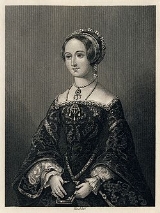
Marguerite de Navarre , also known as Marguerite of Angoulême and Margaret of Navarre, was the queen consort of Henry II of Navarre...
, published in 1558. It has the form of a frame narrative and was inspired by The Decameron
The Decameron
The Decameron, also called Prince Galehaut is a 14th-century medieval allegory by Giovanni Boccaccio, told as a frame story encompassing 100 tales by ten young people....
of Giovanni Boccaccio
Giovanni Boccaccio
Giovanni Boccaccio was an Italian author and poet, a friend, student, and correspondent of Petrarch, an important Renaissance humanist and the author of a number of notable works including the Decameron, On Famous Women, and his poetry in the Italian vernacular...
. It was originally intended to contain one hundred stories covering ten days just as The Decameron does, but at Marguerite’s death it was only completed as far as the second story of the eighth day. Many of the stories deal with love, lust, infidelity and other romantic and sexual matters. One was based on the life of Marguerite de La Rocque
Marguerite de La Rocque
Marguerite de La Rocque de Roberval was a French noblewoman who spent some years marooned on the Île des Démons in the Gulf of Saint Lawrence, off the coast of Quebec...
, a French noblewoman abandoned, as punishment, with her lover on an island off Quebec
Quebec
Quebec or is a province in east-central Canada. It is the only Canadian province with a predominantly French-speaking population and the only one whose sole official language is French at the provincial level....
.
The collection first appeared in print in 1558 under the title Histoires des amans fortunez edited by Pierre Boaistuau
Pierre Boaistuau
Pierre Boaistuau, also known as Pierre Launay or Sieur de Launay was a French humanist. 'Boaistuau' is the manner of spelling followed by the majority of secondary works in which he has been mentioned...
, who took considerable liberties with the original version, using only 67 of the stories, many in abbreviated form, and omitting much of the significant material between the stories. He also transposed stories and ignored their grouping into days as envisaged by the authoress. A second edition by Claude Gruget appeared only a year later in which the editor claimed to have “restored the order previously confused in the first impression”. Also the prologues and epilogues to each short story left out by Boaistuau were put back and the work was given, for the first time, the title Heptaméron (from the Greek
Greek language
Greek is an independent branch of the Indo-European family of languages. Native to the southern Balkans, it has the longest documented history of any Indo-European language, spanning 34 centuries of written records. Its writing system has been the Greek alphabet for the majority of its history;...
έπτά – “seven” and ημέρα – “day”) due to the seven-day time frame into which the first 70 short stories are grouped.
Summary of the "Prologue"
In the "Prologue" to The Heptameron, Parlamente, having obtained her husband Hircan's permission to do so, makes bold to ask Lady Oisille to devise an appropriate means by which the company of stranded guests, who are waiting for the building of a bridgeBridge
A bridge is a structure built to span physical obstacles such as a body of water, valley, or road, for the purpose of providing passage over the obstacle...
to be completed and who are beset by a series of natural calamities and criminal actions that keeps them virtual prisoners in an abbey
Abbey
An abbey is a Catholic monastery or convent, under the authority of an Abbot or an Abbess, who serves as the spiritual father or mother of the community.The term can also refer to an establishment which has long ceased to function as an abbey,...
, may amuse themselves. A devout Christian
Christian
A Christian is a person who adheres to Christianity, an Abrahamic, monotheistic religion based on the life and teachings of Jesus of Nazareth as recorded in the Canonical gospels and the letters of the New Testament...
, the lady suggests that they read the Bible
Bible
The Bible refers to any one of the collections of the primary religious texts of Judaism and Christianity. There is no common version of the Bible, as the individual books , their contents and their order vary among denominations...
. However, Hircan says that they are young enough to need other diversions as well. Parlamente suggests that those who want to write stories after the manner of Boccaccio, do so, sharing them with the others in the afternoon
Afternoon
Afternoon is the time of day from noon to about 18:00.The term should not be confused with "after noon" , which is a translation of the Latin "post meridiem" as used in the 12-hour clock, meaning a time of day from noon to midnight.In Australia and New Zealand, the word "arvo" is a slang term for...
, after Scriptures are read in the morning
Morning
The word morning originally referred to the sunrise. Morning precedes midday, afternoon, and night in the sequence of a day.Morning is the part of the day usually reckoned from dawn to noon...
. (Marguerite herself was a protector of François Rabelais
François Rabelais
François Rabelais was a major French Renaissance writer, doctor, Renaissance humanist, monk and Greek scholar. He has historically been regarded as a writer of fantasy, satire, the grotesque, bawdy jokes and songs...
, who dedicated the third volume of his book, Gargantua and Pantagruel
Gargantua and Pantagruel
The Life of Gargantua and of Pantagruel is a connected series of five novels written in the 16th century by François Rabelais. It is the story of two giants, a father and his son and their adventures, written in an amusing, extravagant, satirical vein...
, to her.) It will take 10 days to complete the bridge, and, each day
Day
A day is a unit of time, commonly defined as an interval equal to 24 hours. It also can mean that portion of the full day during which a location is illuminated by the light of the sun...
, in a shady grove in a meadow, the writers will share 10 tales, telling a total of 100 stories. The stories will be published, if the audience likes them, and be presented to the listeners as presents.
Lady Oisille agrees to Parlamente's recommendation, provided that the stories are true.
Sample story summarized
Saffrendent tells the third story, which is set in Naples, Italy, during the reign of King Alfonso.During a carnival, the king visits his subjects’ homes as they vie to provide him the best hospitality. As he visits a happily married young couple, he is smitten by the wife’s beauty, and he sends her husband to Rome for a couple weeks on trumped-up business. While the husband is away, the king succeeds in seducing the wife. After a while, the husband becomes suspicious of his wife’s fidelity. He bides his time in silence, hoping for the opportunity to avenge himself.
He convinces the queen that he loves her and that she deserves to be treated better by her husband, who dishonors her in cuckolding him. They agree to an adulterous affair between themselves, so that the nobleman cuckolds the king who has cuckolded him. Whenever the nobleman visits his country estates, the king visits his wife. Instead of going to his estates, the nobleman now goes to the castle to dally with the queen, while the king commits adultery with his wife. The affairs continue for years, well into the couples’ old age.
Like many stories of this sort, Saffredent’s tale deals with the theme of cuckold
Cuckold
Cuckold is a historically derogatory term for a man who has an unfaithful wife. The word, which has been in recorded use since the 13th century, derives from the cuckoo bird, some varieties of which lay their eggs in other birds' nests...
ry and depends on both dramatic irony and situational irony for its plot and effects.
External links
- Illustrated Edition of the Heptameron
- English translation of the Heptameron
- English translation of the Heptameron at Project GutenbergProject GutenbergProject Gutenberg is a volunteer effort to digitize and archive cultural works, to "encourage the creation and distribution of eBooks". Founded in 1971 by Michael S. Hart, it is the oldest digital library. Most of the items in its collection are the full texts of public domain books...
: