
Home      Discussion      Topics      Dictionary      Almanac
Signup       Login
Marguerite de Navarre

Marguerite de Navarre

Overview
Marguerite de Navarre (French: Marguerite d'Angoulême, Marguerite d'Alençon, Marguerite de Valois or Marguerite de France) (11 April 149221 December 1549), also known as Marguerite of Angoulême and Margaret of Navarre, was the queen consort of Henry II of Navarre
Henry II of Navarre
Henry II was the eldest son of John III of Navarre and Catherine I of Navarre, sister and heiress of Francis Phoebus, King of Navarre; he was born at Sangüesa.-King of Navarre:...

. Her brother became king of France
France
The French Republic , The French Republic , The French Republic , (commonly known as France , is a unitary semi-presidential republic in Western Europe with several overseas territories and islands located on other continents and in the Indian, Pacific, and Atlantic oceans. Metropolitan France...

, as Francis I
Francis I of France
Francis I was King of France from 1515 until his death. During his reign, huge cultural changes took place in France and he has been called France's original Renaissance monarch...

 and the two siblings were responsible for the celebrated intellectual and cultural court and salons of their day in France.
Discussion
Ask a question about 'Marguerite de Navarre'
Start a new discussion about 'Marguerite de Navarre'
Answer questions from other users
Full Discussion Forum
 
Unanswered Questions
Encyclopedia
Marguerite de Navarre (French: Marguerite d'Angoulême, Marguerite d'Alençon, Marguerite de Valois or Marguerite de France) (11 April 149221 December 1549), also known as Marguerite of Angoulême and Margaret of Navarre, was the queen consort of Henry II of Navarre
Henry II of Navarre
Henry II was the eldest son of John III of Navarre and Catherine I of Navarre, sister and heiress of Francis Phoebus, King of Navarre; he was born at Sangüesa.-King of Navarre:...

. Her brother became king of France
France
The French Republic , The French Republic , The French Republic , (commonly known as France , is a unitary semi-presidential republic in Western Europe with several overseas territories and islands located on other continents and in the Indian, Pacific, and Atlantic oceans. Metropolitan France...

, as Francis I
Francis I of France
Francis I was King of France from 1515 until his death. During his reign, huge cultural changes took place in France and he has been called France's original Renaissance monarch...

 and the two siblings were responsible for the celebrated intellectual and cultural court and salons of their day in France.

Marguerite is the ancestress of the Bourbon kings of France, being the mother of Jeanne d'Albret, whose son, Henry of Navarre, succeeded as Henry IV of France
Henry IV of France
Henry IV , Henri-Quatre, was King of France from 1589 to 1610 and King of Navarre from 1572 to 1610. He was the first monarch of the Bourbon branch of the Capetian dynasty in France....

, the first Bourbon king.

As an author
Author
An author is broadly defined as "the person who originates or gives existence to anything" and that authorship determines responsibility for what is created. Narrowly defined, an author is the originator of any written work.-Legal significance:...

 and a patron of humanists and reformers, she was an outstanding figure of the French Renaissance
French Renaissance
French Renaissance is a recent term used to describe a cultural and artistic movement in France from the late 15th century to the early 17th century. It is associated with the pan-European Renaissance that many cultural historians believe originated in northern Italy in the fourteenth century...

. Samuel Putnam
Samuel Putnam
Samuel Putnam was an American translator and scholar of Romance languages.His most famous work is his 1949 English translation of Miguel de Cervantes' Don Quixote...

 called her "The First Modern Woman".

Early life


Marguerite was born in Angoulême
Angoulême
-Main sights:In place of its ancient fortifications, Angoulême is encircled by boulevards above the old city walls, known as the Remparts, from which fine views may be obtained in all directions. Within the town the streets are often narrow. Apart from the cathedral and the hôtel de ville, the...

 on 11 April 1492, the eldest child of Louise of Savoy
Louise of Savoy
Louise of Savoy was a French noble, Duchess regnant of Auvergne and Bourbon, Duchess of Nemours, the mother of King Francis I of France...

 and Charles, Count of Angoulême
Charles, Count of Angoulême
Charles d'Orléans, Count of Angoulême was a member of the French Orléans family descended from Louis I de Valois, Duke of Orléans, who was the son of Charles V of France. He was the son of John, Count of Angoulême and Marguerite de Rohan, and was Count of Angoulême from 1467-1496...

. Her father was a descendant of Charles V
Charles V of France
Charles V , called the Wise, was King of France from 1364 to his death in 1380 and a member of the House of Valois...

, and was thus the successor to the French crown by masculine primogeniture
Primogeniture
Primogeniture is the right, by law or custom, of the firstborn to inherit the entire estate, to the exclusion of younger siblings . Historically, the term implied male primogeniture, to the exclusion of females...

, if both Charles VIII
Charles VIII of France
Charles VIII, called the Affable, , was King of France from 1483 to his death in 1498. Charles was a member of the House of Valois...

 and the presumptive heir, Louis, Duke of Orléans, failed to produce male offspring.

When Marguerite was ten, Louise tried to marry her to the Prince of Wales, who would later become Henry VIII of England
Henry VIII of England
Henry VIII was King of England from 21 April 1509 until his death. He was Lord, and later King, of Ireland, as well as continuing the nominal claim by the English monarchs to the Kingdom of France...

, but the alliance was courteously rebuffed. On 16 February 1488, her father, Charles, married eleven-year old
Child marriage
Child marriage and child betrothal customs occur in various times and places, whereby children are given in matrimony - before marriageable age as defined by the commentator and often before puberty. Today such customs are fairly widespread in parts of Africa, Asia, Oceania and South America: in...

 Louise, the daughter of Philip II of Savoy and Margaret of Bourbon
Margaret of Bourbon
Marguerite de Bourbon was the daughter of Charles I, Duke of Bourbon and Agnes of Burgundy , who was the daughter of John the Fearless ....

, who was the sister of the Duke of Beaujeu. Louise was considered one of the most brilliant feminine minds in France and she named their first-born, "Marguerite", after her own mother.

Two years after Marguerite's birth, the family moved from Angoulême to Cognac
Cognac
Cognac is a commune in the Charente department in southwestern France. It is a sub-prefecture of the department.-Geography:Cognac is situated on the river Charente between the towns of Angoulême and Saintes. The majority of the town has been built on the river's left bank, with the smaller right...

, "where the Italian influence reigned supreme, and where Boccaccio was looked upon as a little less than a god". Marguerite's brother, Francis, later to be King Francis I of France
Francis I of France
Francis I was King of France from 1515 until his death. During his reign, huge cultural changes took place in France and he has been called France's original Renaissance monarch...

, was born there on 12 September 1494.

She had several half-siblings, from illegitimate relationships of her father, who were raised alongside Marguerite and her brother. Two girls, Jeanne of Angoulême
Jeanne of Angouleme
Jeanne d'Angoulême, Countess of Bar-sur-Seine , Dame de Givry, Baroness of Pagny and of Mirebeau, was the illegitimate half-sister of King Francis I of France. She was created suo jure Countess of Bar-sur-Seine in 1522. She was the wife of Jean de Longwy, Seigneur of Givry, Baron of Pagny and of...

 and Madeleine, were born of her father's long relationship with his châtelain
Châtelain
Châtelain was originally merely the French equivalent of the English castellan, i.e. the commander of a castle....

e, Antoinette de Polignac
Polignac
Polignac is the name of several communes in France:* Polignac, Charente-Maritime* Polignac, Haute-Loire, in the Haute-Loire département, dominated by the fortress Château de Polignac with its square donjon tower, 32 m tall...

, Dame de Combronde, who later became Louise's lady-in-waiting
Lady-in-waiting
A lady-in-waiting is a female personal assistant at a royal court, attending on a queen, a princess, or a high-ranking noblewoman. Historically, in Europe a lady-in-waiting was often a noblewoman from a family highly thought of in good society, but was of lower rank than the woman on whom she...

 and confidante. Another half-sister, Souveraine, was born to Jeanne le Conte, also one of her father's mistresses.

Her father died when she was nearly four; her year-old brother became heir presumptive
Heir Presumptive
An heir presumptive or heiress presumptive is the person provisionally scheduled to inherit a throne, peerage, or other hereditary honour, but whose position can be displaced by the birth of an heir or heiress apparent or of a new heir presumptive with a better claim to the position in question...

 to the throne of France. Thanks to her mother, who was only nineteen when widowed, Marguerite was carefully tutored from her earliest childhood and given a classical education that included Latin
Latin
Latin is an Italic language originally spoken in Latium and Ancient Rome. It, along with most European languages, is a descendant of the ancient Proto-Indo-European language. Although it is considered a dead language, a number of scholars and members of the Christian clergy speak it fluently, and...

. The young princess was to be called "Maecenas to the learned ones of her brother's kingdom".

"Never", she wrote, "shall a man attain to the perfect love of God who has not loved to perfection some creature in this world." Perhaps the one real love in her life was Gaston de Foix, Duc de Nemours, nephew of King Louis XII
Louis XII of France
Louis proved to be a popular king. At the end of his reign the crown deficit was no greater than it had been when he succeeded Charles VIII in 1498, despite several expensive military campaigns in Italy. His fiscal reforms of 1504 and 1508 tightened and improved procedures for the collection of taxes...

. Gaston went to Italy, however, and died a hero at Ravenna
Ravenna
Ravenna is the capital city of the Province of Ravenna in the Emilia-Romagna region of Italy and the second largest comune in Italy by land area, although, at , it is little more than half the size of the largest comune, Rome...

, when the French defeated Spanish and Papal
Papal States
The Papal State, State of the Church, or Pontifical States were among the major historical states of Italy from roughly the 6th century until the Italian peninsula was unified in 1861 by the Kingdom of Piedmont-Sardinia .The Papal States comprised territories under...

 forces.

First marriage


At the age of seventeen Marguerite was married to Charles IV of Alençon
Charles IV of Alençon
Charles IV of Alençon was the son of René of Alençon and the Blessed Margaret of Vaudémont.He succeeded his father in 1492 as Duke of Alençon and Count of Perche, and was also Count of Armagnac, Fézensac, Viscount of Rodez, Count of Fezensaguet, l'Isle-Jourdain, and Perdiac.In 1509 he married...

, aged twenty, by the decree of King Louis XII (who also arranged the marriage of his ten year old daughter, Claude
Claude of France
Claude of France was a princess and queen consort of France and ruling Duchess of Brittany. She was the eldest daughter of Louis XII of France and Anne, Duchess of Brittany....

, to Francis). With this decree, Marguerite was forced to marry a generally kind, but practically-illiterate man for political expediency—"the radiant young princess of the violet-blue eyes... had become the bride of a laggard and a dolt". She had been bartered to save the royal pride of Louis, by keeping the County of Armagnac in the family. There were no offspring from this marriage.

After the death of Queen Claude, she took in her two nieces Madeleine and Marguerite
Margaret of France, Duchess of Berry
Margaret of Valois, Duchess of Berry was the daughter of King Francis I of France and Claude, Duchess of Brittany.-Early life:Margaret was born at the Château de Saint-Germain-en-Laye...

, for whom she would continue to care during her second marriage.

Second marriage and recognition


After the death of her first husband in 1525, Marguerite married Henry II of Navarre
Henry II of Navarre
Henry II was the eldest son of John III of Navarre and Catherine I of Navarre, sister and heiress of Francis Phoebus, King of Navarre; he was born at Sangüesa.-King of Navarre:...

. Ferdinand II of Aragon
Ferdinand II of Aragon
Ferdinand the Catholic was King of Aragon , Sicily , Naples , Valencia, Sardinia, and Navarre, Count of Barcelona, jure uxoris King of Castile and then regent of that country also from 1508 to his death, in the name of...

 had invaded the Kingdom of Navarre
Kingdom of Navarre
The Kingdom of Navarre , originally the Kingdom of Pamplona, was a European kingdom which occupied lands on either side of the Pyrenees alongside the Atlantic Ocean....

 in 1512 and Henry ruled only Lower Navarre
Lower Navarre
Lower Navarre is a part of the present day Pyrénées Atlantiques département of France. Along with Navarre of Spain, it was once ruled by the Kings of Navarre. Lower Navarre was historically one of the kingdoms of Navarre. Its capital were Saint-Jean-Pied-de-Port and Saint-Palais...

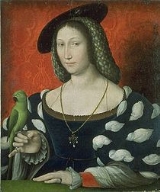
. Approximately a year after the lead image (in the information box) that was painted by Jean Clouet, on 16 November 1528, Marguerite gave birth to a daughter by Henry, the future Jeanne III of Navarre
Jeanne III of Navarre
Jeanne d'Albret , also known as Jeanne III or Joan III, was the queen regnant of Navarre from 1555 to 1572. She married Antoine de Bourbon, Duke of Vendôme, and was the mother of Henry of Bourbon, who became King of Navarre and of France as Henry IV, the first Bourbon king...

, who became the mother of the future Henry IV of France
Henry IV of France
Henry IV , Henri-Quatre, was King of France from 1589 to 1610 and King of Navarre from 1572 to 1610. He was the first monarch of the Bourbon branch of the Capetian dynasty in France....

.

A Venetian
Venice
Venice is a city in northern Italy which is renowned for the beauty of its setting, its architecture and its artworks. It is the capital of the Veneto region...

 ambassador of that time praised Marguerite as knowing all the secrets of diplomatic art, hence to be treated with deference and circumspection. Marguerite's most remarkable adventure involved freeing her brother, King Francis I, who had been held prisoner in Spain by Charles V, Holy Roman Emperor
Charles V, Holy Roman Emperor
Charles V was ruler of the Holy Roman Empire from 1519 and, as Charles I, of the Spanish Empire from 1516 until his voluntary retirement and abdication in favor of his younger brother Ferdinand I and his son Philip II in 1556.As...

 after being captured in the Battle of Pavia
Battle of Pavia
The Battle of Pavia, fought on the morning of 24 February 1525, was the decisive engagement of the Italian War of 1521–26.A Spanish-Imperial army under the nominal command of Charles de Lannoy attacked the French army under the personal command of Francis I of France in the great hunting preserve...

, Italy, 1525. During a critical period of the negotiations, Queen Marguerite rode horseback through wintry woods, twelve hours a day for many days, to meet a safe-conduct deadline, while writing her diplomatic letters at night.

Her only son, Jean, was born in Blois
Blois
Blois is the capital of Loir-et-Cher department in central France, situated on the banks of the lower river Loire between Orléans and Tours.-History:...

 on 7 July 1530, when Marguerite was thirty-eight, an age considered old by sixteenth century standards. The child died on Christmas Day the same year. Scholars believe that her grief motivated Marguerite to write her most controversial work, Miroir de l'âme pécheresse, in 1531.

Sorbonne theologians condemned the work as heresy. A monk said Marguerite should be sewn into a sack and thrown into the Seine
Seine
The Seine is a -long river and an important commercial waterway within the Paris Basin in the north of France. It rises at Saint-Seine near Dijon in northeastern France in the Langres plateau, flowing through Paris and into the English Channel at Le Havre . It is navigable by ocean-going vessels...

. Students at the Collège de Navarre
Collège de Navarre
The College of Navarre was one of the colleges of the historic University of Paris, rivaling the Sorbonne and renowned for its library. It was founded by Queen Joan I of Navarre in 1305, who provided for three departments, the arts with 20 students, philosophy with 30 and theology with 20...

satirized her in a play as "a Fury from Hell". Her brother forced the charges to be dropped, however, and obtained an apology from the Sorbonne.

Legacy


Following the example set by her mother, Marguerite became the most influential woman in France during her lifetime when her brother acceded to the crown as Francis I in 1515. Her salon
Salon (gathering)
A salon is a gathering of people under the roof of an inspiring host, held partly to amuse one another and partly to refine taste and increase their knowledge of the participants through conversation. These gatherings often consciously followed Horace's definition of the aims of poetry, "either to...

, known as the "New Parnassus", became famous internationally.

Pierre Brantôme said of her: "She was a great princess. But in addition to all that, she was very kind, gentle, gracious, charitable, a great dispenser of alms and friendly to all."

The Dutch humanist Desiderius Erasmus
Desiderius Erasmus
Desiderius Erasmus Roterodamus , known as Erasmus of Rotterdam, was a Dutch Renaissance humanist, Catholic priest, and a theologian....

 wrote to her: "For a long time I have cherished all the many excellent gifts that God bestowed upon you; prudence worthy of a philosopher; chastity; moderation; piety; an invincible strength of soul, and a marvelous contempt for all the vanities of this world. Who could keep from admiring, in a great king's sister, such qualities as these, so rare even among the priests and monks?"

Marguerite wrote many poems and plays. Her most notable works are a classic collection of short stories, the Heptameron
Heptameron
The Heptameron is a collection of 72 short stories written in French by Marguerite of Navarre, published in 1558. It has the form of a frame narrative and was inspired by The Decameron of Giovanni Boccaccio...

, and a remarkably intense religious poem, Miroir de l'âme pécheresse (Mirror of the Sinful Soul). This poem is a first-person, mystical narrative of the soul as a yearning woman calling out to Christ as her father-brother-lover. Her work was passed to the royal court of England, suggesting that Marguerite had influence on the Protestant Reformation
Protestant Reformation
The Protestant Reformation was a 16th-century split within Western Christianity initiated by Martin Luther, John Calvin and other early Protestants. The efforts of the self-described "reformers", who objected to the doctrines, rituals and ecclesiastical structure of the Roman Catholic Church, led...

 in England.

Role in the Reformation


Anne Boleyn
Anne Boleyn
Anne Boleyn ;c.1501/1507 – 19 May 1536) was Queen of England from 1533 to 1536 as the second wife of Henry VIII of England and Marquess of Pembroke in her own right. Henry's marriage to Anne, and her subsequent execution, made her a key figure in the political and religious upheaval that was the...

, future second wife and Queen to Henry VIII of England
Henry VIII of England
Henry VIII was King of England from 21 April 1509 until his death. He was Lord, and later King, of Ireland, as well as continuing the nominal claim by the English monarchs to the Kingdom of France...

, had been a lady-in-waiting to Queen Claude during her years in France before returning to England. There is conjecture that the court of Queen Claude and the court of Marguerite overlapped and that, perhaps, Anne was in service to Marguerite rather than to Claude, as well as that Anne Boleyn may have become a friend, admirer, and disciple to Marguerite, who absorbed Marguerite's radical views about Christianity. A written letter by Anne Boleyn after she became queen exists in which the Boleyn makes strong expressions of affection to Marguerite.

It is conjectured that Marguerite gave Anne the original manuscript of Miroir de l'âme pécheresse at some point. It is certain that in 1545, nine years after Anne Boleyn's execution by her husband Henry VIII
Henry VIII of England
Henry VIII was King of England from 21 April 1509 until his death. He was Lord, and later King, of Ireland, as well as continuing the nominal claim by the English monarchs to the Kingdom of France...

, that Anne's daughter, who would become Elizabeth I
Elizabeth I of England
Elizabeth I was queen regnant of England and Ireland from 17 November 1558 until her death. Sometimes called The Virgin Queen, Gloriana, or Good Queen Bess, Elizabeth was the fifth and last monarch of the Tudor dynasty...

 (1533–1603), translated this very same poem by Marguerite into English when she was twelve years old and presented it, written in her own hand, to her then-stepmother, the English Queen Katherine Parr. This literary connection among Marguerite, Anne, Katherine Parr, and the future Queen Elizabeth I suggests a direct mentoring link between the legacy of reformist religious convictions and Marguerite.


As a generous patron of the arts, Marguerite befriended and protected many artists and writers, among them François Rabelais
François Rabelais
François Rabelais was a major French Renaissance writer, doctor, Renaissance humanist, monk and Greek scholar. He has historically been regarded as a writer of fantasy, satire, the grotesque, bawdy jokes and songs...

 (1483–1553), Clément Marot
Clément Marot
Clément Marot was a French poet of the Renaissance period.-Youth:Marot was born at Cahors, the capital of the province of Quercy, some time during the winter of 1496-1497. His father, Jean Marot , whose more correct name appears to have been des Mares, Marais or Marets, was a Norman from the Caen...

 (1496–1544), Claude de Bectoz
Claude de Bectoz
-Life:Both her mother, Michelette de Salvaing, and father, Jacques de Bactoz, were from well-known families in the Dauphiné. Denys Fauchier taught her to write Latin and verse...

 (d. 1547) and Pierre de Ronsard
Pierre de Ronsard
Pierre de Ronsard was a French poet and "prince of poets" .-Early life:...

 (1524–1585). Also, Marguerite served as a mediator between Roman Catholics and Protestants
Protestantism
Protestantism is one of the three major groupings within Christianity. It is a movement that began in Germany in the early 16th century as a reaction against medieval Roman Catholic doctrines and practices, especially in regards to salvation, justification, and ecclesiology.The doctrines of the...

 (including John Calvin
John Calvin
John Calvin was an influential French theologian and pastor during the Protestant Reformation. He was a principal figure in the development of the system of Christian theology later called Calvinism. Originally trained as a humanist lawyer, he broke from the Roman Catholic Church around 1530...

). Although Marguerite espoused reform within the Catholic Church, she was not a Calvinist
Calvinism
Calvinism is a Protestant theological system and an approach to the Christian life...

. She did, however, do her best to protect the reformers and dissuaded Francis I from intolerant measures as long as she could. After her death, eight religious wars
French Wars of Religion
The French Wars of Religion is the name given to a period of civil infighting and military operations, primarily fought between French Catholics and Protestants . The conflict involved the factional disputes between the aristocratic houses of France, such as the House of Bourbon and House of Guise...

 occurred in France, marked notably by the notorious St. Bartholomew's Day Massacre
St. Bartholomew's Day massacre
The St. Bartholomew's Day massacre in 1572 was a targeted group of assassinations, followed by a wave of Roman Catholic mob violence, both directed against the Huguenots , during the French Wars of Religion...

 of 1572.

Eminent American historian Will Durant
Will Durant
William James Durant was a prolific American writer, historian, and philosopher. He is best known for The Story of Civilization, 11 volumes written in collaboration with his wife Ariel Durant and published between 1935 and 1975...

 wrote: "In Marguerite the Renaissance and the Reformation
Protestant Reformation
The Protestant Reformation was a 16th-century split within Western Christianity initiated by Martin Luther, John Calvin and other early Protestants. The efforts of the self-described "reformers", who objected to the doctrines, rituals and ecclesiastical structure of the Roman Catholic Church, led...

 were for a moment one. Her influence radiated throughout France. Every free spirit looked upon her as protectoress and ideal .... Marguerite was the embodiment of charity. She would walk unescorted in the streets of Navarre
Navarre
Navarre , officially the Chartered Community of Navarre is an autonomous community in northern Spain, bordering the Basque Country, La Rioja, and Aragon in Spain and Aquitaine in France...

, allowing any one to approach her and would listen at first hand to the sorrows of the people. She called herself 'The Prime Minister of the Poor'. Henri, her husband, King of Navarre, believed in what she was doing, even to the extent of setting up a public works system that became a model for France. Together he and Marguerite financed the education of needy students."

Jules Michelet
Jules Michelet
Jules Michelet was a French historian. He was born in Paris to a family with Huguenot traditions.-Early life:His father was a master printer, not very prosperous, and Jules assisted him in the actual work of the press...

 (1798–1874), the most celebrated historian of his time, wrote of her: "Let us always remember this tender Queen of Navarre, in whose arms our people, fleeing from prison or the pyre, found safety, honor, and friendship. Our gratitude to you, Mother of our [French] Renaissance! Your hearth was that of our saints, your heart the nest of our freedom."

Pierre Bayle
Pierre Bayle
Pierre Bayle was a French philosopher and writer best known for his seminal work the Historical and Critical Dictionary, published beginning in 1695....

 (1647–1706), French philosopher and critic, whose Dictionnaire historique et critique (Historical and Critical Dictionary, 1697) greatly influenced the French Encyclopedists
Encyclopédie
Encyclopédie, ou dictionnaire raisonné des sciences, des arts et des métiers was a general encyclopedia published in France between 1751 and 1772, with later supplements, revised editions, and translations. It was edited by Denis Diderot and Jean le Rond d'Alembert...

 and the rationalist philosophers of the eighteenth century, such as Voltaire
Voltaire
François-Marie Arouet , better known by the pen name Voltaire , was a French Enlightenment writer, historian and philosopher famous for his wit and for his advocacy of civil liberties, including freedom of religion, free trade and separation of church and state...

 and Diderot, esteemed her highly, writing: "... for a queen to grant her protection to people persecuted for opinions which she believes to be false; to open a sanctuary to them; to preserve them from the flames prepared for them; to furnish them with a subsistence; liberally to relieve the troubles and inconveniences of their exile, is an heroic magnanimity
Magnanimity
Magnanimity is the virtue of being great of mind and heart. It encompasses, usually, a refusal to be petty, a willingness to face danger, and actions for noble purposes. Its antithesis is pusillanimity...

 which has hardly any precedent ..."


Leonardo da Vinci
Leonardo da Vinci
Leonardo di ser Piero da Vinci was an Italian Renaissance polymath: painter, sculptor, architect, musician, scientist, mathematician, engineer, inventor, anatomist, geologist, cartographer, botanist and writer whose genius, perhaps more than that of any other figure, epitomized the Renaissance...

 (1452–1519) died while guest of Marguerite and her brother, Francis I. They had been raised at Château d'Amboise
Château d'Amboise
The royal Château at Amboise is a château located in Amboise, in the Indre-et-Loire département of the Loire Valley in France.-Origins and royal residence:...

, which belonged to their mother, Louise of Savoy. The king maintained his residence there and Marguerite maintained a residence nearby. During the first few years of the reign of Franics the château in which he lived reached the pinnacle of its glory. da Vinci had been the architect of a large château for them, among many other projects, and they provided quarters for him when he left Italy and joined her court. As a guest of the king, who provided him with a comfortable stipend, Leonardo da Vinci came to Château Amboise in December 1515 and lived and worked in the nearby Clos Lucé, connected to the château by an underground passage. Tourists are told that he is buried in the Chapel of Saint-Hubert, adjoining the Château, which had been built in 1491–96.

In 1550, one year after Marguerite's death, a tributary poem, Annae, Margaritae, Ianae, sororum virginum heroidum Anglarum, in mortem Diuae Margaritae Valesiae, Nauarrorum Reginae, Hecatodistichon, was published in England. It was written by the nieces of Jane Seymour
Jane Seymour
Jane Seymour was Queen of England as the third wife of King Henry VIII. She succeeded Anne Boleyn as queen consort following the latter's execution for trumped up charges of high treason, incest and adultery in May 1536. She died of postnatal complications less than two weeks after the birth of...

 (1505–1537), third wife of King Henry VIII.

Ancestry


Marguerite de Navarre's ancestors in three generations are,

Issue


Marguerite was married twice, first to Charles IV of Alençon
Charles IV of Alençon
Charles IV of Alençon was the son of René of Alençon and the Blessed Margaret of Vaudémont.He succeeded his father in 1492 as Duke of Alençon and Count of Perche, and was also Count of Armagnac, Fézensac, Viscount of Rodez, Count of Fezensaguet, l'Isle-Jourdain, and Perdiac.In 1509 he married...

, but the marriage was childless.

Her next marriage was to Henry II of Navarre
Henry II of Navarre
Henry II was the eldest son of John III of Navarre and Catherine I of Navarre, sister and heiress of Francis Phoebus, King of Navarre; he was born at Sangüesa.-King of Navarre:...

. The children of Marguerite and Henry were,
  • Jeanne III of Navarre
    Jeanne III of Navarre
    Jeanne d'Albret , also known as Jeanne III or Joan III, was the queen regnant of Navarre from 1555 to 1572. She married Antoine de Bourbon, Duke of Vendôme, and was the mother of Henry of Bourbon, who became King of Navarre and of France as Henry IV, the first Bourbon king...

     (16 November 1528– 9 June 1572), the mother of the future Henry IV of France
    Henry IV of France
    Henry IV , Henri-Quatre, was King of France from 1589 to 1610 and King of Navarre from 1572 to 1610. He was the first monarch of the Bourbon branch of the Capetian dynasty in France....

    , also known as Henry III of Navarre. She became Queen regnant
    Queen regnant
    A queen regnant is a female monarch who reigns in her own right, in contrast to a queen consort, who is the wife of a reigning king. An empress regnant is a female monarch who reigns in her own right over an empire....

     of Navarre
    Kingdom of Navarre
    The Kingdom of Navarre , originally the Kingdom of Pamplona, was a European kingdom which occupied lands on either side of the Pyrenees alongside the Atlantic Ocean....

     from 1555 to 1572. She was the wife of Antoine de Bourbon, Duke of Vendôme, and mother of Henry of Bourbon
    Henry IV of France
    Henry IV , Henri-Quatre, was King of France from 1589 to 1610 and King of Navarre from 1572 to 1610. He was the first monarch of the Bourbon branch of the Capetian dynasty in France....

    , who became King of Navarre and also of France as the first Bourbon king. She was the acknowledged spiritual and political leader of the French Huguenot movement.
  • Jean (7 July 1530- 25 December 1530), who died as an infant

External links