

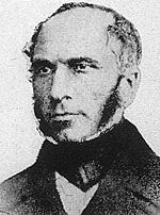
Henry Darcy

Encyclopedia
Henry Philibert Gaspard Darcy (June 10, 1803 – January 3, 1858) was a French
engineer
who made several important contributions to hydraulics
.
, France. Despite his father's death in 1817 when he was 14, his mother was able to borrow money to pay for his tutors. In 1821 he enrolled at the École Polytechnique
(Polytechnic School) in Paris
, and transferred two years later to the École des Ponts et Chaussées
(School of Bridges and Roads), which lead to employment in the Corps of Bridges and Roads
.
Henry met an English woman, Henriette Carey, whose family had been living in Dijon, and married her in 1828.
As a member of the Corps, he built an impressive pressurized water distribution system in Dijon following the failure of attempts to supply adequate fresh water by drilling wells. The system carried water from Rosoir Spring
12.7 km away through a covered aqueduct
to reservoirs near the city, which then fed into a network of 28,000 meters of pressurized pipes delivering water to much of the city. The system was fully closed and pressurized by gravity, and thus required no filters or pumps. He was also involved in many other public works in and around Dijon, as well as in the politics of the Dijon city government.
During this period he modified the Prony equation
for calculating head loss due to friction, which after further modification by Julius Weisbach
would become the well-known Darcy–Weisbach equation still in use today.
In 1848 he became Chief Engineer for the département Côte-d'Or
(of which Dijon is the capital). Soon thereafter he left Dijon due to political pressure, but was promoted to Chief Director for Water and Pavements and took up office in Paris. While in that position, he was able to focus more on his hydraulics research, especially on flow and friction losses in pipes. During this period he improved the design of the Pitot tube
, into essentially the form used today.
He resigned his post in 1855 due to poor health, but was permitted to continue his research in Dijon. In 1855 and 1856 he conducted column experiments that established what has become known as Darcy's law
; initially developed to describe flow through sands, it has since been generalized to a variety of situations and is in widespread use today. The unit
of fluid permeability
, darcy
, is named in honor of his work.
He died of pneumonia
while on a trip to Paris in 1858, and is buried in Cimetière de Dijon (formerly known as Péjoces) in Dijon.
France
The French Republic , The French Republic , The French Republic , (commonly known as France , is a unitary semi-presidential republic in Western Europe with several overseas territories and islands located on other continents and in the Indian, Pacific, and Atlantic oceans. Metropolitan France...
engineer
Engineer
An engineer is a professional practitioner of engineering, concerned with applying scientific knowledge, mathematics and ingenuity to develop solutions for technical problems. Engineers design materials, structures, machines and systems while considering the limitations imposed by practicality,...
who made several important contributions to hydraulics
Hydraulics
Hydraulics is a topic in applied science and engineering dealing with the mechanical properties of liquids. Fluid mechanics provides the theoretical foundation for hydraulics, which focuses on the engineering uses of fluid properties. In fluid power, hydraulics is used for the generation, control,...
.
Biography
He was born in DijonDijon
Dijon is a city in eastern France, the capital of the Côte-d'Or département and of the Burgundy region.Dijon is the historical capital of the region of Burgundy. Population : 151,576 within the city limits; 250,516 for the greater Dijon area....
, France. Despite his father's death in 1817 when he was 14, his mother was able to borrow money to pay for his tutors. In 1821 he enrolled at the École Polytechnique
École Polytechnique
The École Polytechnique is a state-run institution of higher education and research in Palaiseau, Essonne, France, near Paris. Polytechnique is renowned for its four year undergraduate/graduate Master's program...
(Polytechnic School) in Paris
Paris
Paris is the capital and largest city in France, situated on the river Seine, in northern France, at the heart of the Île-de-France region...
, and transferred two years later to the École des Ponts et Chaussées
École Nationale des Ponts et Chaussées
Founded in 1747, the École nationale des ponts et chaussées , often referred to as les Ponts, is the world's oldest civil engineering school...
(School of Bridges and Roads), which lead to employment in the Corps of Bridges and Roads
Corps of Bridges and Roads (France)
The Corps of Bridges is a great technical corps of the French state. It is formed of the State Engineers of the Bridges.People entering the Corps are educated at the École Nationale des Ponts et Chaussées...
.
Henry met an English woman, Henriette Carey, whose family had been living in Dijon, and married her in 1828.
As a member of the Corps, he built an impressive pressurized water distribution system in Dijon following the failure of attempts to supply adequate fresh water by drilling wells. The system carried water from Rosoir Spring
Spring (hydrosphere)
A spring—also known as a rising or resurgence—is a component of the hydrosphere. Specifically, it is any natural situation where water flows to the surface of the earth from underground...
12.7 km away through a covered aqueduct
Aqueduct
An aqueduct is a water supply or navigable channel constructed to convey water. In modern engineering, the term is used for any system of pipes, ditches, canals, tunnels, and other structures used for this purpose....
to reservoirs near the city, which then fed into a network of 28,000 meters of pressurized pipes delivering water to much of the city. The system was fully closed and pressurized by gravity, and thus required no filters or pumps. He was also involved in many other public works in and around Dijon, as well as in the politics of the Dijon city government.
During this period he modified the Prony equation
Prony equation
The Prony equation is a historically important equation in hydraulics, used to calculate the head loss due to friction within a given run of pipe...
for calculating head loss due to friction, which after further modification by Julius Weisbach
Julius Weisbach
Julius Ludwig Weisbach was a German mathematician and engineer.-Life and work:...
would become the well-known Darcy–Weisbach equation still in use today.
In 1848 he became Chief Engineer for the département Côte-d'Or
Côte-d'Or
Côte-d'Or is a department in the eastern part of France.- History :Côte-d'Or is one of the original 83 departments created during the French Revolution on 4 March 1790. It was formed from part of the former province of Burgundy.- Geography :...
(of which Dijon is the capital). Soon thereafter he left Dijon due to political pressure, but was promoted to Chief Director for Water and Pavements and took up office in Paris. While in that position, he was able to focus more on his hydraulics research, especially on flow and friction losses in pipes. During this period he improved the design of the Pitot tube
Pitot tube
A pitot tube is a pressure measurement instrument used to measure fluid flow velocity. The pitot tube was invented by the French engineer Henri Pitot Ulo in the early 18th century and was modified to its modern form in the mid-19th century by French scientist Henry Darcy...
, into essentially the form used today.
He resigned his post in 1855 due to poor health, but was permitted to continue his research in Dijon. In 1855 and 1856 he conducted column experiments that established what has become known as Darcy's law
Darcy's law
Darcy's law is a phenomenologically derived constitutive equation that describes the flow of a fluid through a porous medium. The law was formulated by Henry Darcy based on the results of experiments on the flow of water through beds of sand...
; initially developed to describe flow through sands, it has since been generalized to a variety of situations and is in widespread use today. The unit
Units of measurement
A unit of measurement is a definite magnitude of a physical quantity, defined and adopted by convention and/or by law, that is used as a standard for measurement of the same physical quantity. Any other value of the physical quantity can be expressed as a simple multiple of the unit of...
of fluid permeability
Permeability (fluid)
Permeability in fluid mechanics and the earth sciences is a measure of the ability of a porous material to allow fluids to pass through it.- Units :...
, darcy
Darcy
A darcy and millidarcy are units of permeability, named after Henry Darcy. They are not SI units, but they are widely used in petroleum engineering and geology. Like other measures of permeability, a darcy has the same units as area.-Definition:Permeability measures the ability of fluids to...
, is named in honor of his work.
He died of pneumonia
Pneumonia
Pneumonia is an inflammatory condition of the lung—especially affecting the microscopic air sacs —associated with fever, chest symptoms, and a lack of air space on a chest X-ray. Pneumonia is typically caused by an infection but there are a number of other causes...
while on a trip to Paris in 1858, and is buried in Cimetière de Dijon (formerly known as Péjoces) in Dijon.
External links
- Darcy and His Law by Glenn Brown
- Freeze, R. A. (1994), Henry Darcy and the Fountains of Dijon. Ground Water, 32: 23–30. doi: 10.1111/j.1745-6584.1994.tb00606.x