

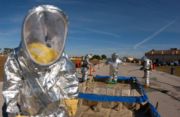
Hazmat suit

Encyclopedia
Firefighter
Firefighters are rescuers extensively trained primarily to put out hazardous fires that threaten civilian populations and property, to rescue people from car incidents, collapsed and burning buildings and other such situations...
s, emergency personnel responding to toxic spills, researchers, specialists cleaning up contaminated facilities, or workers in toxic environments. It is sometimes confused with, or referred to as, an NBC (nuclear, biological, and chemical) suit
NBC suit
An NBC suit is a type of military personal protective equipment designed to provide protection against direct contact with and contamination by radioactive, biological or chemical substances, and provides protection from contamination with radioactive materials and some types of radiation,...
, which is a military version intended to be usable in combat.
Overview

United States Department of Homeland Security
The United States Department of Homeland Security is a cabinet department of the United States federal government, created in response to the September 11 attacks, and with the primary responsibilities of protecting the territory of the United States and protectorates from and responding to...
defines a hazmat suit as "an overall garment worn to protect people from hazardous materials or substances, including chemicals, biological agents, or radioactive materials." More generally, Hazmat suits may provide protection from:
Chemical agents: through the use of appropriate barrier materials like teflon
Polytetrafluoroethylene
Polytetrafluoroethylene is a synthetic fluoropolymer of tetrafluoroethylene that finds numerous applications. PTFE is most well known by the DuPont brand name Teflon....
, heavy PVC
Polyvinyl chloride
Polyvinyl chloride, commonly abbreviated PVC, is a thermoplastic polymer. It is a vinyl polymer constructed of repeating vinyl groups having one hydrogen replaced by chloride. Polyvinyl chloride is the third most widely produced plastic, after polyethylene and polypropylene. PVC is widely used in...
or rubber
Rubber
Natural rubber, also called India rubber or caoutchouc, is an elastomer that was originally derived from latex, a milky colloid produced by some plants. The plants would be ‘tapped’, that is, an incision made into the bark of the tree and the sticky, milk colored latex sap collected and refined...
and Tyvek
Tyvek
Tyvek is a brand of flashspun high-density polyethylene fibers, a synthetic material; the name is a registered trademark of DuPont. The material is very strong; it is difficult to tear but can easily be cut with scissors or a knife...
Nuclear agents: possibly through radiation shielding in the lining, but more importantly by preventing direct contact with or inhalation of radioactive particles
Nuclear fallout
Fallout is the residual radioactive material propelled into the upper atmosphere following a nuclear blast, so called because it "falls out" of the sky after the explosion and shock wave have passed. It commonly refers to the radioactive dust and ash created when a nuclear weapon explodes...
or gas
Biological agents: through fully sealed systems (often at overpressure to prevent contamination even if the suit is damaged)
Fire/high temperatures: usually by a combination of insulating and reflective materials which reduce or retard the effects
The hazmat suit generally includes breathing air supplies to provide clean, uncontaminated air for the wearer. In laboratory
Laboratory
A laboratory is a facility that provides controlled conditions in which scientific research, experiments, and measurement may be performed. The title of laboratory is also used for certain other facilities where the processes or equipment used are similar to those in scientific laboratories...
use, clean air may be supplied through attached hoses. This air is usually pumped into the suit at positive pressure with respect to the surroundings as an additional protective measure against the introduction of dangerous agents into a potentially ruptured or leaking suit.
Working in a hazmat suit is very strenuous, as the suits tend to be less flexible than conventional work garments. With the exception of laboratory versions, hazmat suits can be hot and poorly ventilated (if at all). Therefore, use is usually limited to short durations of up to 2 hours, depending on the difficulty of the work. Level A (United States) suits, for example, are limited by their air supply to around 15–20 minutes of very strenuous work (such as a firefighting rescue in a building).
However, OSHA/EPA protective level A suits/ensembles are not typically used in firefighting rescue, especially during a building/structure fire. National Fire Protection Association (NFPA) compliant "turnout gear", and NIOSH-certified SCBA, or CBRN SCBA, are the primary protection technologies for structure firefighting in the US.
In the United States
Hazmat protective clothing is classified as either Level A, B, C, or D, based upon the degree of protection they provide.Level A: The highest level of protection against vapors, gases, mists, and particles is Level A, which consists of a fully encapsulating chemical entry suit with a full-facepiece self-contained breathing apparatus (SCBA) or a supplied air respirator (SAR) with an escape cylinder. A crew member must also wear boots with steel toes and shanks on the outside of the suit and specially selected chemical-resistant gloves for this level of protection. The breathing apparatus is worn inside (encapsulated within) the suit. To qualify as Level A protection, an intrinsically safe two-way radio is also worn inside the suit, often incorporating voice-operated microphones and an earpiece speaker for monitoring the operations channel.
Level B: Level B protection requires a garment (including SCBA) that provides protection against splashes from a hazardous chemical. Since the breathing apparatus is worn on the outside of the garment, Level B protection is not vapor-protective. It is worn when vapor-protective clothing (Level A) is not required. Wrists, ankles, facepiece and hood, and waist are secured to prevent any entry of splashed liquid. Depending on the chemical being handled, specific types of gloves and boots are donned. These may or may not be attached to the garment. The garment itself may be one piece or a two-piece hooded suit. Level B protection also requires the wearing of chemical-resistant boots with steel toes and shanks on the outside of the garment. As with Level A, chemical-resistant gloves and two-way radio communications are also required.
Level C: Level C protection differs from Level B in the area of equipment needed for respiratory protection. The same type of garment used for Level B protection is worn for Level C. Level C protection allows for the use of respiratory protection equipment other than SCBA. This protection includes any of the various types of air-purifying respirators. Crew members should not use this level of protection unless the specific hazardous material is known and its concentration can be measured. Level C equipment does not offer the protection needed in an oxygen deficient atmosphere.
Level D: Level D protection does not protect the crew member from chemical exposure. Therefore, this level of protection can only be used in situations where a crew member has no possibility of contact with chemicals. A pair of coveralls or other work-type garment along with chemical-resistant footwear with steel toes and shanks are all that is required to qualify as Level D protection. Most firefighter turnout gear is considered to be Level D.
In Europe
Most suits used in Europe are covered by a set EU NormsEuropean Committee for Standardization
The European Committee for Standardization or Comité Européen de Normalisation , is a non-profit organisation whose mission is to foster the European economy in global trading, the welfare of European citizens and the environment by providing an efficient infrastructure to interested parties for...
, and divided into a total of six types (levels) of protection:
- Type 1: Protects against liquid and gaseous chemicals. Gas tight. (prEN 943 part 1). More or less equivalent to US level A.
- Type 2: Protects against liquid and gaseous chemicals. Non gas tight. (prEN 943 part 1). More or less equivalent to US level B.1
- Type 3: Protects against liquid chemicals for a limited period. Liquid tight. (prEN 1511)
- Type 4: Protects against liquid chemicals for a limited period. Spray tight. (prEN 1512). More or less equivalent to US level C.
- Type 5: Protects against liquid chemicals for a limited period. Only covers body partially. (prEN 1513). More or less equivalent to US level D.
- Type 6: Protects parts of body against liquid chemicals (prEN 13034)
1: Can be used in places where the chemical in gaseous form isn't harmful to the body exterior.
Types
Hazmat suits come basically in two variations: splash protection and gastight suits. As the name implies the splash protection suits are designed to prevent the wearer from coming into contact with a liquid. These suits do not protect against gasses or dust. Gastight suits protect the wearer from basically any outside influence apart from heat and radiation.Gas/vapor protection
Such suits (level A in the US) are gasGas
Gas is one of the three classical states of matter . Near absolute zero, a substance exists as a solid. As heat is added to this substance it melts into a liquid at its melting point , boils into a gas at its boiling point, and if heated high enough would enter a plasma state in which the electrons...
or vapor
Vapor
A vapor or vapour is a substance in the gas phase at a temperature lower than its critical point....
-tight, providing total encapsulation and the highest level of protection against direct and airborne chemical contact. They are typically worn with a self-contained breathing apparatus (SCBA) enclosed within the suit.
These suits are typically constructed of several layers and, being airtight, include a release valve so the suit does not overinflate from air exhaled by the SCBA. The release valve does retain some air to keep some positive pressure ("overpressure") inside the suit. As noted, such suits are usually limited to just 15–20 minutes of use by their mobile air supply.
With each suit described here, there is a manufactured device designed to protect the respiratory system of the wearer while the suit/ensemble is used to protect skin exposed to potential, or actual dermal, hazardous agents. That device is a respirator. A respirator may be something as simple as a headband strap filtering facepiece respirator (FFR), to a headharness negative pressure fullface respirator (air-purifying respirator/APR), to a full face, tight fitting, closed breathing air, or open circuit, self-contained breathing apparatus (CC-SCBA or SCBA).
Splash protection
Such suits (level B in the US) are not vapor-tight and thus provide a lesser level of protection. They are, however, worn with an SCBA, which may be located inside or outside of the suit, depending on the type of suit (encapsulating or non-encapsulating). They more closely resemble the one-piece TyvekTyvek
Tyvek is a brand of flashspun high-density polyethylene fibers, a synthetic material; the name is a registered trademark of DuPont. The material is very strong; it is difficult to tear but can easily be cut with scissors or a knife...
coveralls often seen used in construction and demolition work. Yet, Level B splash suits may also be fully encapsulating suits which are simply not airtight.
Lesser protection (level C in the US) suits may be coveralls of treated material, or multi-piece combinations, sealed with tape. This kind of protection is still "proof" against many non-invasive substances, such as anthrax
Anthrax
Anthrax is an acute disease caused by the bacterium Bacillus anthracis. Most forms of the disease are lethal, and it affects both humans and other animals...
.
In fiction
Hazmat suits have long been used as an important device found in fiction, especially science fictionScience fiction
Science fiction is a genre of fiction dealing with imaginary but more or less plausible content such as future settings, futuristic science and technology, space travel, aliens, and paranormal abilities...
, to dramatize the deadliness of lethal environments. Common dramatic situations usually involve a suit failure leading to rapid death in films such as The Andromeda Strain
The Andromeda Strain (film)
The Andromeda Strain is a 1971 American science-fiction film, based on the novel published in 1969 by Michael Crichton. The film is about a team of scientists who investigate a deadly organism of extraterrestrial origin that causes rapid, fatal blood clotting. Directed by Robert Wise, the film...
or Outbreak
Outbreak (film)
Outbreak is a 1995 American disaster film starring Dustin Hoffman, Rene Russo, Morgan Freeman, and Kevin Spacey. The film was directed by Wolfgang Petersen. In addition, Outbreak features Cuba Gooding, Jr., Donald Sutherland, and Patrick Dempsey....
and also the new Argentina movie Fase 7, where the protagonist and his neighbor wear type A Hazmat suits to protect their families from the H1N1 virus. The Hazmat suit has also been used as a comedic prop in Back to the Future wherein the protagonist is initially mis-identified as an Extra Terrestrial after traveling to a time where the Suit was an uncommon sight. Plot resolutions usually make the removal of a suit a pivotal moment, signifying the end of the threat.
The anonymity provided by hazmat suits has often been used to accentuate sinister motives. The scientists in E.T. the Extra-Terrestrial
E.T. the Extra-Terrestrial
E.T. the Extra-Terrestrial is a 1982 American science fiction film co-produced and directed by Steven Spielberg, written by Melissa Mathison and starring Henry Thomas, Dee Wallace, Robert MacNaughton, Drew Barrymore, and Peter Coyote...
are a good example of this, as are the farcical squad of hazmat-suited characters in the animation Monsters, Inc.
Monsters, Inc.
Monsters, Inc. is a 2001 American computer-animated film and the fourth feature-length film produced by Pixar Animation Studios. It was directed by Pete Docter, co-directed by Lee Unkrich and David Silverman, and written by Jill Culton, Peter Docter, Ralph Eggleston, Dan Gerson, Jeff Pidgeon, Rhett...
and Toxic.
Hazmat suits are also commonly found in video games, used to navigate otherwise dangerous areas. Popular game series which feature hazmat-like suits include Maniac Mansion
Maniac Mansion
Maniac Mansion is a 1987 graphic adventure game developed and published by Lucasfilm Games. It was Lucasfilm's first published video game, and it was initially released for the Commodore 64 and Apple II. A comedy horror parody of B movies, it follows teenager Dave Miller as he ventures...
, Half-Life
Half-Life (series)
The Half-Life series of video games share a science fiction alternate history. Nearly all of the games are first-person shooters on the GoldSource or Source engines, and most are linear, narrative, single-player titles....
, Hitman: Contracts
Hitman: Contracts
Hitman: Contracts is a stealth game developed by IO Interactive and published by Eidos Interactive. It is the third entry in the Hitman series, followed by Hitman: Blood Money....
, Saints Row 2
Saints Row 2
Saints Row 2 is an open world action-adventure video game developed by Volition, Inc. and published by THQ for the Microsoft Windows, PlayStation 3, and Xbox 360 systems. It is the second title in the Saints Row series, after the release of Saints Row in 2006. It is succeeded by Saints Row: The...
, The Conduit
The Conduit
The Conduit is a first-person shooter video game developed by High Voltage Software for the Wii console. The Conduit was first revealed by the developer on the video game website IGN on April 17, 2008, and on October 29, 2008, the developer announced that Sega had signed on to be the game's...
, Doom, Fallout 3
Fallout 3
Fallout 3 is an action role-playing game released by Bethesda Game Studios, and the third major installment in the Fallout series. The game was released in North America, Europe and Australia in October 2008, and in Japan in December 2008 for Microsoft Windows, PlayStation 3 and Xbox 360...
, Deus Ex
Deus Ex
Deus Ex is an action role-playing game developed by Ion Storm Inc. and published by Eidos Interactive in 2000, which combines gameplay elements of first-person shooters with those of role-playing video games...
, S.T.A.L.K.E.R.: Shadow of Chernobyl
S.T.A.L.K.E.R.: Shadow of Chernobyl
S.T.A.L.K.E.R.: Shadow of Chernobyl is a first-person shooter video game by the Ukrainian developer GSC Game World, published in 2007.It features an alternate reality theme, where a second nuclear disaster occurs at the Chernobyl Nuclear Power Plant Exclusion Zone in the near future and causes...
, its prequel S.T.A.L.K.E.R.: Clear Sky
S.T.A.L.K.E.R.: Clear Sky
S.T.A.L.K.E.R.: Clear Sky, is the prequel to S.T.A.L.K.E.R.: Shadow of Chernobyl, a first-person shooter video game by Ukrainian developer GSC Game World. The game consists of a roughly 50/50 mix of new areas and old, remodeled areas from the previous game...
and sequel S.T.A.L.K.E.R.: Call of Pripyat
S.T.A.L.K.E.R.: Call of Pripyat
S.T.A.L.K.E.R.: Call of Pripyat is the sequel to S.T.A.L.K.E.R.: Shadow of Chernobyl, a first-person shooter computer game by Ukrainian developer GSC Game World. S.T.A.L.K.E.R.: Call of Pripyat is the third game in the S.T.A.L.K.E.R. series....
, Call of Duty: Black Ops
Call of Duty: Black Ops
Call of Duty: Black Ops is a first-person shooter video game developed by Treyarch, published by Activision and released worldwide on November 9, for Microsoft Windows, Xbox 360, PlayStation 3, Wii consoles, with a separate version for Nintendo DS developed by n-Space. Announced on April 30, 2010,...
and Left 4 Dead 2
Left 4 Dead 2
Left 4 Dead 2 is a cooperative first-person shooter video game. It is the sequel to Valve Corporation's award-winning Left 4 Dead. The game launched on November 17, 2009, for Microsoft Windows and Xbox 360 in the United States and November 20 in Europe; in 2010, Left 4 Dead 2 was made available to...
. In the Fallout: New Vegas
Fallout: New Vegas
Fallout: New Vegas is a first person action role-playing video game in the Fallout series developed by Obsidian Entertainment, and published by Bethesda Softworks. The game is based in a post-apocalyptic environment in and around Las Vegas, Nevada...
add-on Dead Money, the antagonists, called 'Ghost People', are humans trapped in their hazmat suits. Killzone 3
Killzone 3
Killzone 3 is a 2011 first-person shooter for the PlayStation 3, developed by Guerrilla Games and published by Sony Computer Entertainment. It is the fourth installment in the Killzone series, the first game in the series to be presented in 3D and the first to include motion controls using the...
includes enemies called Hazmat Troopers. The game ""SyphonFilter:Dark Mirror (2006)"" features enemies in Hazmat suits.
See also
- Bunker gearBunker gearBunker Gear or "Turnout Gear" are terms used by many firefighters to refer to their system of outer protective clothing. "Bunker gear" and "turnout gear" can refer, depending on the context, to just the trousers and boots, and jacket, or the entire combination of personal protective equipment and...
- DemronDemronDemron is a radiation-blocking fabric made by Radiation Shield Technologies. The material is said to have radiation protection similar to lead shielding, while being lightweight and flexible. The composition of Demron is proprietary, but is described as a non-toxic polymer...
- Fire proximity suitFire proximity suitA fire proximity suit is a suit designed to protect a firefighter from high temperatures, especially near fires of extreme temperature such as aircraft fires....
- NBC suitNBC suitAn NBC suit is a type of military personal protective equipment designed to provide protection against direct contact with and contamination by radioactive, biological or chemical substances, and provides protection from contamination with radioactive materials and some types of radiation,...
, military equivalent - SuitportSuitportA suitport or suitlock is a proposed alternative to an airlock, designed for use in hazardous environments and in human spaceflight, especially planetary surface exploration.-Operation:...