

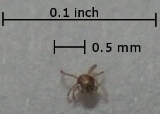
Harvest mite

Encyclopedia
Trombicula is a genus of harvest mite
s (also known as red bugs, scrub-itch mites, berry bugs or, in their larva
l stage, as chiggers or chigoe) in the Trombiculidae
family. In their larval stage, they attach to various animals, including humans, and feed on skin, often causing itching. These relatives of tick
s are nearly microscopic, measuring 0.4 mm (1/100 of an inch) and have a chrome-orange hue. A common species of harvest mite in Northern America is Trombicula alfreddugesi
; in the UK the most prevalent harvest mite is Trombicula autumnalis
.
The larval mites feed on the skin
cell
s, but not blood
, of animal
s, including human
s. The six-legged parasitic larva
feeds on a large variety of creatures, including human
s, rabbit
s, toad
s, box turtle
s, quail
, and even some insect
s. After crawling onto their host
, they inject digestive enzymes into the skin that break down skin cells. They do not actually "bite," but instead form a hole in the skin called a stylostome, and chew up tiny parts of the inner skin, thus causing severe irritation and swelling. The severe itching is accompanied by red pimple-like
bumps (papule
s) or hives and skin rash or lesions on a sun-exposed area. For humans, itching usually occurs after the larvae detach from the skin.
After feeding on their hosts, the larvae drop to the ground and become nymphs, then mature into adults, which have 8 legs and are harmless to humans. In the post-larval stage, they are not parasitic and feed on plant materials. The females lay 3–8 eggs in a litter, usually on a leaf or under the roots of a plant, and die by autumn.
s, berry patches, orchards, along lakes and streams, and even in drier places where vegetation is low, such as lawns, golf courses, and parks. They are most numerous in early summer, when grass, weeds and other vegetation are heaviest. They can also be found in Spanish Moss. Brought into homes and used for decoration, they become easier to attach to humans.
Other species include Trombicula batatas and Trombicula hirsti
.
Harvest mite
Trombicula is a genus of harvest mites in the Trombiculidae family. In their larval stage, they attach to various animals, including humans, and feed on skin, often causing itching...
s (also known as red bugs, scrub-itch mites, berry bugs or, in their larva
Larva
A larva is a distinct juvenile form many animals undergo before metamorphosis into adults. Animals with indirect development such as insects, amphibians, or cnidarians typically have a larval phase of their life cycle...
l stage, as chiggers or chigoe) in the Trombiculidae
Trombiculidae
Trombiculidae is a family of mites called trombiculid mites Trombiculidae is a family of mites called trombiculid mites Trombiculidae is a family of mites called trombiculid mites (also called berry bugs; harvest mites; red bugs; scrub-itch mites; and aoutas. In their larval stage, those...
family. In their larval stage, they attach to various animals, including humans, and feed on skin, often causing itching. These relatives of tick
Tick
Ticks are small arachnids in the order Ixodida, along with mites, constitute the subclass Acarina. Ticks are ectoparasites , living by hematophagy on the blood of mammals, birds, and sometimes reptiles and amphibians...
s are nearly microscopic, measuring 0.4 mm (1/100 of an inch) and have a chrome-orange hue. A common species of harvest mite in Northern America is Trombicula alfreddugesi
Trombicula alfreddugesi
Trombicula alfreddugesi also called Eutrombicula alfreddugè or E. alfreddugè, is a species in the genus Trombicula....
; in the UK the most prevalent harvest mite is Trombicula autumnalis
Trombicula autumnalis
The harvest mite, Trombicula autumnalis, is a species of mite of the family Trombiculidae. Their larvae live parasitically; they infect all domestic mammals, humans, and some ground-nesting birds.-Description:...
.
The larval mites feed on the skin
Skin
-Dermis:The dermis is the layer of skin beneath the epidermis that consists of connective tissue and cushions the body from stress and strain. The dermis is tightly connected to the epidermis by a basement membrane. It also harbors many Mechanoreceptors that provide the sense of touch and heat...
cell
Cell (biology)
The cell is the basic structural and functional unit of all known living organisms. It is the smallest unit of life that is classified as a living thing, and is often called the building block of life. The Alberts text discusses how the "cellular building blocks" move to shape developing embryos....
s, but not blood
Blood
Blood is a specialized bodily fluid in animals that delivers necessary substances such as nutrients and oxygen to the cells and transports metabolic waste products away from those same cells....
, of animal
Animal
Animals are a major group of multicellular, eukaryotic organisms of the kingdom Animalia or Metazoa. Their body plan eventually becomes fixed as they develop, although some undergo a process of metamorphosis later on in their life. Most animals are motile, meaning they can move spontaneously and...
s, including human
Human
Humans are the only living species in the Homo genus...
s. The six-legged parasitic larva
Larva
A larva is a distinct juvenile form many animals undergo before metamorphosis into adults. Animals with indirect development such as insects, amphibians, or cnidarians typically have a larval phase of their life cycle...
feeds on a large variety of creatures, including human
Human
Humans are the only living species in the Homo genus...
s, rabbit
Rabbit
Rabbits are small mammals in the family Leporidae of the order Lagomorpha, found in several parts of the world...
s, toad
Toad
A toad is any of a number of species of amphibians in the order Anura characterized by dry, leathery skin , short legs, and snoat-like parotoid glands...
s, box turtle
Box turtle
The box turtle , or box tortoise is a genus of turtle native to North America . The 12 taxa which are distinguished in the genus are distributed over four species. It is largely characterized by having a domed shell, which is hinged at the bottom, allowing the animal to close its shell tightly to...
s, quail
Quail
Quail is a collective name for several genera of mid-sized birds generally considered in the order Galliformes. Old World quail are found in the family Phasianidae, while New World quail are found in the family Odontophoridae...
, and even some insect
Insect
Insects are a class of living creatures within the arthropods that have a chitinous exoskeleton, a three-part body , three pairs of jointed legs, compound eyes, and two antennae...
s. After crawling onto their host
Host (biology)
In biology, a host is an organism that harbors a parasite, or a mutual or commensal symbiont, typically providing nourishment and shelter. In botany, a host plant is one that supplies food resources and substrate for certain insects or other fauna...
, they inject digestive enzymes into the skin that break down skin cells. They do not actually "bite," but instead form a hole in the skin called a stylostome, and chew up tiny parts of the inner skin, thus causing severe irritation and swelling. The severe itching is accompanied by red pimple-like
Pimple
A pimple, zit or spot is a kind of acne, and one of the many results of excess oil getting trapped in the pores. Some of the varieties are pustules or papules....
bumps (papule
Papule
A papule is a circumscribed, solid elevation of skin with no visible fluid, varying in size from a pinhead to 1 cm.With regard to the quote "...varying in size from a pinhead to 1cm," depending on which text is referenced, some authors state the cutoff between a papule and a plaque as 0.5cm,...
s) or hives and skin rash or lesions on a sun-exposed area. For humans, itching usually occurs after the larvae detach from the skin.
After feeding on their hosts, the larvae drop to the ground and become nymphs, then mature into adults, which have 8 legs and are harmless to humans. In the post-larval stage, they are not parasitic and feed on plant materials. The females lay 3–8 eggs in a litter, usually on a leaf or under the roots of a plant, and die by autumn.
Range
Harvest mites are found throughout the world. In Europe and North America, they tend to be more prevalent in the hot and humid parts. In the more temperate regions, they are found only in the summer (in French, harvest mites are called aoûtat, or "August" flies). In the United States, they are found mostly in the southeast, the south, and the Midwest. They are not present, or barely found, in far northern areas, in high mountains and in deserts. They live in forests and grasslands, and are also found in low, damp areas where vegetation is rank, such as woodlandWoodland
Ecologically, a woodland is a low-density forest forming open habitats with plenty of sunlight and limited shade. Woodlands may support an understory of shrubs and herbaceous plants including grasses. Woodland may form a transition to shrubland under drier conditions or during early stages of...
s, berry patches, orchards, along lakes and streams, and even in drier places where vegetation is low, such as lawns, golf courses, and parks. They are most numerous in early summer, when grass, weeds and other vegetation are heaviest. They can also be found in Spanish Moss. Brought into homes and used for decoration, they become easier to attach to humans.
Taxonomy
The genus Trombicula has 16 species recorded from North America:- Trombicula acuitlapanensis (A. Hoffmann, 1957)
- Trombicula alfreddugesiTrombicula alfreddugesiTrombicula alfreddugesi also called Eutrombicula alfreddugè or E. alfreddugè, is a species in the genus Trombicula....
- Trombicula autumnalisTrombicula autumnalisThe harvest mite, Trombicula autumnalis, is a species of mite of the family Trombiculidae. Their larvae live parasitically; they infect all domestic mammals, humans, and some ground-nesting birds.-Description:...
(Shaw) - Trombicula boneti (A. Hoffmann, 1952)
- Trombicula formicarum (Berlese, 1910)
- Trombicula geniticula
- Trombicula halidasys
- Trombicula imperfecta (Brennan & Jones, 1954)
- Trombicula jamesoni (J. M. Brennan, 1948)
- Trombicula jonesae (J. M. Brennan, 1952)
- Trombicula nagayoi
- Trombicula patrizii (Valle, 1952)
- Trombicula pumilis
- Trombicula spinosa
- Trombicula tecta
- Trombicula zeta
Other species include Trombicula batatas and Trombicula hirsti
Trombicula hirsti
Trombicula hirsti is a species in the genus Trombicula, commonly called the scrub-itch mite, it is found in Australia, though more common in the north, because they prefer warmer climate....
.