
All Topics  
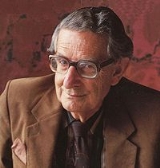
Hans Eysenck

 
Hans Eysenck

   Email Print
   Bookmark   Link


Hans Eysenck


Hans Jürgen Eysenck (March 4, 1916 – September 4, 1997) was a psychologist
Psychologist

"Psychologist" is an academic, occupational or professional title describing individuals who are either: * social scientists conducting research and/or teaching psychology in a college or university;...
 best remembered for his work on intelligence
Intelligence

Intelligence is an umbrella term used to describe a property of the mind that encompasses many related abilities, such as the capacities to reason, to plan, to problem solving, to think abstraction, to comprehend ideas, to use language, and to Learning....
 and personality
Personality psychology

Personality psychology is a branch of psychology that studies personality and individual differences. One emphasis in this area is to construct a coherent picture of a person and his or her major psychological processes ....
, though he worked in a wide range of areas. At the time of his death, Eysenck was the living psychologist most frequently cited in science journals.
Eysenck was born in Berlin
Berlin

Berlin is the Capital of Germany city and one of sixteen States of Germany of Germany. With a population of 3.4 million within its city limits, Berlin is the country's largest city....
, Germany
Germany

Germany , officially the Federal Republic of Germany , is a country in Central Europe. It is bordered to the north by the North Sea, Denmark, and the Baltic Sea; to the east by Poland and the Czech Republic; to the south by Austria and Switzerland; and to the west by France, Luxembourg, Belgium, and the Netherlands....
, but moved to England
England

native_name =|conventional_long_name = England|common_name = England|image_flag = Flag of England.svg|image_coat = England COA.svg|symbol_type = Royal Coat of Arms...
 as a young man in the 1930s because of his opposition to the Nazi
Nazism

Nazism, officially National Socialism , refers to the ideology and practices of the National Socialist German Workers? Party under Adolf Hitler, and the policies adopted by the dictatorial government of Nazi Germany from 1933 to 1945....
 party.


Discussion
Ask a question about 'Hans Eysenck'
Start a new discussion about 'Hans Eysenck'
Answer questions from other users
Full Discussion Forum


Encyclopedia


Hans Jürgen Eysenck (March 4, 1916 – September 4, 1997) was a psychologist
Psychologist

"Psychologist" is an academic, occupational or professional title describing individuals who are either: * social scientists conducting research and/or teaching psychology in a college or university;...
 best remembered for his work on intelligence
Intelligence

Intelligence is an umbrella term used to describe a property of the mind that encompasses many related abilities, such as the capacities to reason, to plan, to problem solving, to think abstraction, to comprehend ideas, to use language, and to Learning....
 and personality
Personality psychology

Personality psychology is a branch of psychology that studies personality and individual differences. One emphasis in this area is to construct a coherent picture of a person and his or her major psychological processes ....
, though he worked in a wide range of areas. At the time of his death, Eysenck was the living psychologist most frequently cited in science journals.

Life and work

Hans Eysenck was born in Berlin
Berlin

Berlin is the Capital of Germany city and one of sixteen States of Germany of Germany. With a population of 3.4 million within its city limits, Berlin is the country's largest city....
, Germany
Germany

Germany , officially the Federal Republic of Germany , is a country in Central Europe. It is bordered to the north by the North Sea, Denmark, and the Baltic Sea; to the east by Poland and the Czech Republic; to the south by Austria and Switzerland; and to the west by France, Luxembourg, Belgium, and the Netherlands....
, but moved to England
England

native_name =|conventional_long_name = England|common_name = England|image_flag = Flag of England.svg|image_coat = England COA.svg|symbol_type = Royal Coat of Arms...
 as a young man in the 1930s because of his opposition to the Nazi
Nazism

Nazism, officially National Socialism , refers to the ideology and practices of the National Socialist German Workers? Party under Adolf Hitler, and the policies adopted by the dictatorial government of Nazi Germany from 1933 to 1945....
 party. "My hatred of Hitler and the Nazis, and all they stood for, was so overwhelming that no argument could counter it." Eysenck was the founding editor of the journal Personality and Individual Differences
Personality and Individual Differences

Personality and Individual Differences is a scientific journal published bi-monthly by Elsevier and founded in 1980. PAID is the official journal of the International Society for the Study of Individual Differences ....
, and authored over 50 books and over 900 academic articles. He aroused intense debate with his controversial dealing with variation in IQ among racial groups (see race and intelligence
Race and intelligence

Race and intelligence have in some cases been claimed to be correlated. Contemporary debate on this issue focuses on the nature, causes, and rectifications of ethnic group differences in intelligence test scores....
).

Eysenck was Professor of Psychology at the Institute of Psychiatry
Institute of Psychiatry

The Institute of Psychiatry is a research institution dedicated to discovering what causes mental illness and diseases of the brain. In addition, its aim is to help identify new treatments for them and ways to prevent them in the first place....
 from 1955 to 1983. He received his PhD from the Department of Psychology at University College London
University College London

University College London is a university institution and constituent college of the University of London based primarily in London, England, United Kingdom....
 (UCL) under the supervision of Professor Sir Cyril Burt
Cyril Burt

Sir Cyril Lodowic Burt was an England educational psychology who contributed to educational psychology and claimed to have developed the method of factor analysis in psychological testing, although his mentor and predecessor as chair of the psychology department at University College London, Charles Spearman actually did so....
 with whom he had a tumultuous professional relationship throughout his working life. He was a major contributor to the modern scientific theory of personality and a brilliant teacher who also played a crucial role in the establishment of behavioural treatments for mental disorders.

Hans Eysenck died of a brain tumor in a London hospice in 1997.

Eysenck's work was often controversial. Examples of publications in which Eysenck's views have roused controversy include (chronologically):
  • A paper in the 1950s concluding that available data "fail to support the hypothesis that psychotherapy facilitates recovery from neurotic disorder".
  • A chapter in Uses and Abuses of Psychology (1953) entitled "What is wrong with psychoanalysis".
  • Race, Intelligence and Education (1971) (in the US: The IQ Argument)
  • Sex, Violence and the Media (1978).
  • Astrology — Science or Superstition? (1982)
  • Smoking, Personality and Stress (1991)


Eysenck was criticised for accepting funding from the Pioneer Fund
Pioneer Fund

The Pioneer Fund is a U.S. Non-profit organization established in 1937 "to advance the scientific study of heredity and human differences." Currently headed by psychology professor J....
, an organization that funds hereditarian research. By far the most acrimonious of the debates has been that over the role of genetics
Genetics

Genetics , a discipline of biology, is the science of heredity and Genetic variation in living organisms. The fact that living things inherit traits from their parents has been used since prehistoric times to improve crop plants and animals through selective breeding....
 in IQ differences (see intelligence quotient#Genetics vs environment
Intelligence quotient

An Intelligence Quotient or IQ is a score derived from one of several different standardized tests attempting to measure intelligence. The term "IQ," a calque of the German language Intelligenz-Quotient, was coined by the German psychologist William Stern in 1912 as a proposed method of scoring early modern children's intelligenc...
), which led to Eysenck famously being punched
Punch (strike)

A punch is "a thrusting blow, esp. with the fist." In some sports and disciplines, such as boxing or martial arts, where punches are regularly practiced, hand wraps or other padding such as gloves may be employed to protect athletes and practitioners from injuring themselves....
 on the nose during a talk at the London School of Economics
London School of Economics

The London School of Economics and Political Science, more commonly referred to as The London School of Economics or LSE, is a specialist college of the University of London in London, England....
.

Eysenck’s attitude is summarised in his autobiography Rebel with a Cause (Transaction Publishers (1997), ISBN 1-56000-938-1): "I always felt that a scientist owes the world only one thing, and that is the truth as he sees it. If the truth contradicts deeply held beliefs, that is too bad. Tact and diplomacy are fine in international relations, in politics, perhaps even in business; in science only one thing matters, and that is the facts."

Eysenck and the genetics of personality

In 1950, Eysenck's first empirical study into the genetics
Genetics

Genetics , a discipline of biology, is the science of heredity and Genetic variation in living organisms. The fact that living things inherit traits from their parents has been used since prehistoric times to improve crop plants and animals through selective breeding....
 of personality was carried out with his student and associate Donald Prell. It was an experiment involving identical and fraternal twins, children who were given a battery of tests relevant to the concept of neuroticism. It is described in detail it an article published in the Journal of Mental Science. Eysenck and Prell concluded: "that the factor of neuroticism is not a statistical artifact, but constitutes a biological unit which is inherited as a whole....neurotic predisposition
Predisposition

In medicine, predisposition is an increased risk of having a disease or other condition.*It can be a genetic predisposition, a genetics effect which influences the phenotype of an organism but which can be modified by the natural environment conditions....
 is to a large extent hereditarily determined."

Eysenck's model of personality (P–E–N)

Eysenck was one of the first psychologists to study personality with the method of factor analysis
Factor analysis

Factor analysis is a statistics method used to describe variance among observed variables in terms of fewer unobserved variables called factors....
, a statistical technique introduced by Charles Spearman
Charles Spearman

Charles Edward Spearman, Fellow of the Royal Society was an England psychologist known for work in statistics, as a pioneer of factor analysis, and for Spearman's rank correlation coefficient....
. Eysenck's results suggested two main personality factors. The first factor was the tendency to experience negative emotions, and Eysenck referred to it as neuroticism
Neuroticism

Neuroticism is a fundamental personality Trait theory in the study of psychology. It can be defined as an enduring tendency to experience negative emotional states....
. The second factor was the tendency to enjoy positive events, especially social events, and Eysenck named it extraversion. The two personality dimensions were described in his 1947 book Dimensions of Personality. It is common practice in personality psychology to refer to the dimensions by the first letters, E and N.

E and N provided a 2-dimensional space to describe individual differences in behaviour. An analogy can be made to how latitude and longitude describe a point on the face of the earth. Also, Eysenck noted how these two dimensions were similar to the four personality types first proposed by the Greek physician Hippocrates
Hippocrates

Hippocrates of Cos II or Hippokrates of Kos - ancient Greek: ; Hippokr?tes was an Ancient Greece physician of the Age of Pericles, and was considered one of the most outstanding figures in the history of medicine....
.
  • High N and High E = Choleric type
  • High N and Low E = Melancholic type
  • Low N and High E = Sanguine type
  • Low N and Low E = Phlegmatic type


The third dimension, psychoticism
Psychoticism

Psychoticism is one of the three Trait theory used by the psychologist Hans Eysenck in his P-E-N model model of personality psychology.High levels of this trait were believed by Eysenck to be linked to increased vulnerability to psychoses such as schizophrenia....
, was added to the model in the late 1970s, based upon collaborations between Eysenck and his wife, Sybil B. G. Eysenck, who is the current editor of Personality and Individual Differences.

The major strength of Eysenck's model was to provide detailed theory of the causes of personality. For example, Eysenck proposed that extraversion was caused by variability in cortical arousal: "introverts are characterized by higher levels of activity than extraverts and so are chronically more cortically aroused than extraverts". While it seems counterintuitive to suppose that introverts are more aroused than extraverts, the putative effect this has on behaviour is such that the introvert seeks lower levels of stimulation. Conversely, the extravert seeks to heighten his or her arousal to a more optimal level (as predicted by the Yerkes-Dodson Law
Yerkes-Dodson law

The Yerkes-Dodson law is an empirical relationship between arousal and performance, originally developed by psychologists, Robert M. Yerkes and John Dillingham Dodson in 1908....
) by increased activity, social engagement and other stimulation-seeking behaviors.

Comparison with other theories

The major alternative to Eysenck's three-factor model of personality is a model that makes use of five broad traits, often called the Big Five model (see big five personality traits
Big Five personality traits

In psychology, the "Big Five" personality traits are five broad factor analysis or dimensions of wikt:personality developed through lexical analysis....
) (Costa & McCrae, 1985). The traits in the Big Five are as follows:
  1. Openness to experience
  2. Conscientiousness
  3. Extraversion
  4. Agreeableness
  5. Neuroticism


Extraversion and Neuroticism in the Big Five are similar to Eysenck's traits of the same name. However, what Eysenck calls the trait of Psychoticism corresponds to two traits in the Big Five model: Conscientiousness and Agreeableness. Eysenck's personality system did not address Openness to experience. He argued that his approach was a better description of personality (Eysenck, 1992a; 1992b).

Another important model of personality is that of Jeffrey Alan Gray
Jeffrey Alan Gray

Jeffrey Alan Gray was a British psychologist. He was born in the East End of London. His father was a tailor, but died when Jeffrey was only seven....
, a former student of his.

Psychometric scales relevant to Eysenck's theory

Eysenck's theory of personality is closely linked with the scales that he and his co-workers developed. These include the Maudsley Medical Questionnaire, Eysenck Personality Inventory (EPI), Eysenck Personality Questionnaire
Eysenck Personality Questionnaire

In psychology, Eysenck Personality Questionnaire is a questionnaire to assess the personality traits of a person.It was devised by the psychologists Hans J?rgen Eysenck and his wife Sybil B....
 (EPQ) and Sensation Seeking Scale (developed in conjunction with Marvin Zuckerman). The Eysenck Personality Profiler (EPP) breaks down different facets of each trait considered in the model. There has been some debate about whether these facets should include impulsivity as a facet of extraversion as Eysenck declared in his early work; or psychoticism
Psychoticism

Psychoticism is one of the three Trait theory used by the psychologist Hans Eysenck in his P-E-N model model of personality psychology.High levels of this trait were believed by Eysenck to be linked to increased vulnerability to psychoses such as schizophrenia....
. Eysenck declared for the latter, in later work.

Eysenck's later work

In 1994 he was one of 52 signatories on "Mainstream Science on Intelligence
Mainstream Science on Intelligence

"Mainstream Science on Intelligence" was an opinion piece published in the Wall Street Journal on December 13, 1994. It was written by psychology professor Linda Gottfredson, and signed by Gottfredson and 51 other professors specializing in intelligence and related fields....
," an editorial written by Linda Gottfredson
Linda Gottfredson

Linda Susanne Gottfredson is a professor of educational psychology at the University of Delaware and co-director of the Delaware-Johns Hopkins University Project for the Study of Intelligence quotient and Society....
 and published in the Wall Street Journal, which defended the findings on race and intelligence
Race and intelligence

Race and intelligence have in some cases been claimed to be correlated. Contemporary debate on this issue focuses on the nature, causes, and rectifications of ethnic group differences in intelligence test scores....
 in The Bell Curve
The Bell Curve

The Bell Curve is a controversial book, best-selling 1994 book by the late Harvard University psychologist Richard Herrnstein and American Enterprise Institute political scientist Charles Murray ....
.

Eysenck made early contributions to fields such as personality
Personality psychology

Personality psychology is a branch of psychology that studies personality and individual differences. One emphasis in this area is to construct a coherent picture of a person and his or her major psychological processes ....
by express and explicit commitment to a very rigorous adherence to scientific methodology, as Eysenck believed that scientific method
Scientific method

Scientific method refers to techniques for investigating phenomenon, acquiring new knowledge, or correcting and integrating previous knowledge. To be termed scientific, a method of inquiry must be based on gathering observable, empirical and Measure evidence subject to specific principles of reasoning....
ology was required for progress in personality psychology. He used, for example, factor analysis
Factor analysis

Factor analysis is a statistics method used to describe variance among observed variables in terms of fewer unobserved variables called factors....
, a statistical method, to support his personality model. An example is Inheritance of Neuroticism: An Experimental Study, quoted above. His early work showed Eysenck to be an especially strong critic of psychoanalysis
Psychoanalysis

Psychoanalysis is a body of ideas developed by Austrian physician Sigmund Freud and his followers, which is devoted to the study of human psychological functioning and behaviour....
 as a form of therapy, preferring behaviour therapy
Behaviour therapy

Behavior therapy is a form of psychotherapy used to treat Clinical depression, anxiety disorders, phobias, and other forms of psychopathology. Its philosophical roots can be found in the school of behaviorism, which states that psychological matters can be studied scientifically by observing overt behavior, without discussing internal mental...
. Despite this strongly scientific interest, Eysenck was not shy, in later work, of giving attention to parapsychology
Parapsychology

Parapsychology is a discipline that seeks to investigate the existence and causes of psychic abilities and Survivalism using the scientific method....
 and astrology
Astrology

Astrology is a group of systems, traditions, and beliefs which hold that the relative positions of astronomical object and related details can provide useful information about personality, human affairs, and other terrestrial matters....
. Indeed, he believed that empirical evidence supported the existence of paranormal abilities.

Selected works

  • Dimensions of Personality (1947)
  • The Scientific Study of Personality (1952)
  • The Structure of Human Personality (1952) and later editions
  • Uses and Abuses of Psychology (1953)
  • The Psychology of Politics (1954)
  • Psychology and the Foundations of Psychiatry (1955)
  • Sense and Nonsense in Psychology (1956)
  • The Dynamics of Anxiety and Hysteria (1957)
  • Perceptual Processes and Mental Illnesses (1957) with G. Granger and J. C. Brengelmann
  • Manual of the Maudsley Personality Inventory (1959)
  • Handbook of Abnormal Psychology (1960) editor, later editions
  • Experiments in Personality (1960) two volumes, editor
  • Behaviour Therapy and Neuroses (1960) editor
  • Know Your Own I.Q. (1962)
  • Experiments with Drugs (1963) editor
  • Experiments in Motivation (1964) editor
  • Crime and Personality (1964) and later editions
  • Manual of the Eysenck Personality Inventory (1964) with S. B. G. Eysenck
  • The Causes and Cures of Neuroses (1965) with S. Rachman
  • Fact and Fiction in Psychology (1965)
  • Smoking, Health and Personality (1965)
  • Check Your Own I.Q. (1966)
  • The Effects of Psychotherapy (1966)
  • The Biological Basis of Personality (1967)
  • Eysenck, H.J. & Eysenck, S.B.G. (1969). Personality Structure and Measurement. London: Routledge.
  • Readings in Extraversion/Introversion (1971) three volumes
  • Race, Intelligence and Education (1971) in US as The IQ Argument
  • Psychology is about People (1972)
  • Lexicon de Psychologie (1972) three volumes, with W. Arnold and R. Meili
  • The Inequality of Man (1973)
  • Eysenck on Extraversion (1973) editor
  • The Measurement of Intelligence (1973) editor
  • The Experimental Study of Freudian theories (1973) with G. D. Wilson
  • Case Histories in Behaviour Therapy (1974) editor
  • Know Your Own Personality (1975) with G. D. Wilson
  • Manual of the Eysenck Personality Questionnaire (1975) with S. B. G. Eysenck
  • A Textbook of Human Psychology (1976) with G. D. Wilson
  • Sex and Personality (1976)
  • The Measurement of Personality (1976) editor
  • Eysenck, H.J. & Eysenck, S.B.G. (1976). Psychoticism as a Dimension of Personality. London: Hodder and Stoughton.
  • Reminiscence, Motivation and Personality (1977) with C. D. Frith
  • You and Neurosis (1977)
  • Die Zukunft der Psychologie (1977)
  • The Psychological Basis of Ideology (1978) editor, with G. D. Wilson
  • Sex Violence and the Media (1978) with D. Nias
  • The Structure and Measurement of Intelligence (1979)
  • The Psychology of Sex (1979) with G. D. Wilson
  • The Causes and Effects of Smoking (1980)
  • A Model for Personality (1981) editor
  • Mindwatching (1981) with M. W. Eysenck, and later editions
  • The Battle for the Mind (1981) with L. J. Kamin, in US as The Intelligence Controversy
  • Personality, Genetics and Behaviour (1982)
  • Explaining the Unexplained (1982) with Carl Sargent
  • H.J. Eysenck & D.K.B. Nias, Astrology: Science or Superstition? Penguin Books (1982) ISBN 0-14-022397-5
  • A Model for Intelligence (1982) editor
  • Know Your Own Psi-Q (1983) with Carl Sargent
  • …'I Do'. Your Happy Guide to Marriage (1983) with B. N. Kelly
  • Personality and Individual Differences: A Natural Science Approach (1985) with M. W. Eysenck
  • Decline and Fall of the Freudian Empire (1985)
  • Rauchen und Gesundheit (1987)
  • Personality Dimensions and Arousal (1987) editor, with J. Strelau
  • Theoretical Foundations of Behaviour Therapy (1988) editor, with I. Martin
  • The Causes and Cures of Criminality (1989) with G. H. Gudjonsson
  • Genes, Culture and Personality: An Empirical Approach (1989) with L. Eaves and N. Martin
  • Suggestion and Suggestibility (1989) editor, with V. A. Gheorghiu, P. Netter, and R. Rosenthal
  • Intelligence: A New Look (1998)
  • Eysenck, H.J. (1992). A reply to Costa and McCrae. P or A and C — the role of theory. Personality and Individual Differences, 13, 867–868.
  • Eysenck, H.J. (1992). Four ways five factors are not basic. Personality and Individual Differences, 13, 667–673.


External links

  • by Chris Brand
    Chris Brand

    Christopher Richard Brand is a British psychology and psychometrics researcher who gained media attention for his controversial statements on race and intelligence....