

Hammerhead shark

Encyclopedia
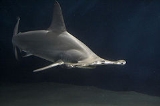
The hammerhead sharks are a group of shark
s in the family Sphyrnidae, so named for the unusual and distinctive structure of their heads, which are flattened and laterally extended into a "hammer" shape called a "cephalofoil". Most hammerhead species are placed in the genus Sphyrna while the winghead shark
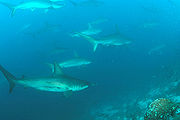
is placed in its own genus, Eusphyra. Many, not necessarily mutually exclusive, functions have been proposed for the cephalofoil, including sensory reception, maneuvering, and prey manipulation. Hammerheads are found worldwide in warmer waters along coastlines and continental shelves. Unlike most sharks, hammerheads usually swim in schools. Some of these schools can be found near Malpelo Island
in Colombia
, Cocos Island by Costa Rica and near Molokai Island in Hawaii.
range from 0.9 to 6 m (3 to 19.7 ft) long and weigh from 500 to 1000 pounds. They are usually light gray and have a greenish tint to them. Their bellies are white which allows them to be close to the bottom of the ocean and blend in to sneak up on their prey. Their heads have lateral projections which give them a hammer-like shape.
It was determined recently that the hammer-like shape of the head may have evolved (at least in part) to enhance the animal's vision. The positioning of the eyes give the shark good binocular vision
, as well as 360-degree vision in the vertical plane, meaning they can see above and below them at all times. The shape of the head was previously thought to help the shark find food, aiding in close-quarters maneuverability and allowing sharp turning movement without losing stability. However, it has been found that the unusual structure of its vertebrae was instrumental in making the turns correctly, more often than the shape of its head, though it would also shift and provide lift. From what is known about the Winghead shark, it would appear that the shape of the hammer-head has to do with an evolved sensory function. Like all sharks, hammerheads have electroreceptory
sensory pores called ampullae of Lorenzini
. By distributing the receptors over a wider area, hammerheads can sweep for prey more effectively. These sharks have been able to detect an electrical signal of half a billionth of a volt
. The hammer also allows the nostrils to be placed farther apart, increasing its ability to detect chemical gradients and localize the source.
Hammerheads have disproportionately small mouths and seem to do a lot of bottom-hunting. They are also known to form schools during the day, sometimes in groups of over 100. In the evening, like other sharks, they become solitary hunters.
Hammerheads are one of the few animals that acquire a tan
from prolonged exposure to sunlight. Tanning occurs when a hammerhead is in shallow waters or close to the surface for long periods.
ize, it is their teeth alone that are commonly found as fossils. The hammerheads seem closely related to the carcharhinid sharks
that evolved during the mid-Tertiary
Period. Because the teeth of hammerheads resemble those of some carcharhinids, it has been difficult to determine when hammerheads first appeared. It is probable that the hammerheads evolved during the late Eocene
, Oligocene
or early Miocene
.
Using mitochondrial DNA
, Andrew Martin constructed a phylogenetic tree
of the hammerhead sharks that showed the winghead shark as its most basal
member. As the winghead shark has proportionately the largest "hammer" of the hammerhead sharks, this suggests that the first ancestral hammerhead sharks also had large hammers.
to the female through one of two intromittent organ
s called claspers. The developing embryo
s are at first sustained by a yolk sac
. When the supply of yolk is exhausted, the depleted yolk sac transforms into a structure analogous to a mammal
ian placenta
(called a "yolk sac placenta" or "pseudoplacenta"), through which the mother delivers sustenance until birth. Once the baby sharks are born, they are not taken care of by the parents in any way. There is usually a litter of 12 to 15 pups; except for the Great Hammerhead which births litters of 20 to 40 pups. These baby sharks huddle together and swim toward warmer water and stay together until they are older and bigger to be on their own.
In 2007, the bonnethead
shark was found to be capable of asexual reproduction
via automictic parthenogenesis
, in which a female's ovum
fuses with a polar body
to form a zygote
without the need for a male. This was the first shark known to do this.
Announcements in June, 2006 reported the discovery of a possible new species of hammerhead off the shores of South Carolina
. The possible new species is referred to simply as a cryptic species until it receives an official designation. This is prolonged, in part, because the discovery is really that the "scalloped hammerhead" is possibly two different species, not that a new species has been sighted, in the normal way. The discovery that scalloped hammerheads are possibly two species is purely a result of genetic testing, not identification of physical differences.
 Of the nine known species of hammerhead, three can be dangerous to humans: the scalloped, great, and smooth hammerheads.
The great and the scalloped hammerhead are listed on the World Conservation Union's (IUCN) 2008 Red List as endangered
, whereas the smalleye hammerhead is listed as vulnerable
. The status given to these sharks is as a result of over-fishing and demand for their fins, an expensive delicacy. Among others, scientists expressed their concern about the plight of the scalloped hammerhead at the American Association for the Advancement of Science annual meeting in Boston. The young swim mostly in shallow waters along shores all over the world to avoid predators.
Shark fins are prized as a delicacy, and overfishing is putting many hammerhead sharks at risk of extinction. Fishermen who harvest the animals typically cut off the fins and toss the remainder of the fish, which is often still alive, back into the sea. As of 2010 there have been 33 attacks, but no fatalities.
, but many Maui natives believe that when the hammerhead sharks pass by, it is a sign that the gods are watching over the families, and the oceans are clean and balanced. In Hawaii, if one is caught attempting to fish for or harm a shark, it is considered a felony because it is detrimental to the Hawaiian way of life.
Shark
Sharks are a type of fish with a full cartilaginous skeleton and a highly streamlined body. The earliest known sharks date from more than 420 million years ago....
s in the family Sphyrnidae, so named for the unusual and distinctive structure of their heads, which are flattened and laterally extended into a "hammer" shape called a "cephalofoil". Most hammerhead species are placed in the genus Sphyrna while the winghead shark
Winghead shark
The winghead shark is a species of hammerhead shark, family Sphyrnidae, named for the remarkably wide lobes on its head. It is the sole species in the genus Eusphyra...
is placed in its own genus, Eusphyra. Many, not necessarily mutually exclusive, functions have been proposed for the cephalofoil, including sensory reception, maneuvering, and prey manipulation. Hammerheads are found worldwide in warmer waters along coastlines and continental shelves. Unlike most sharks, hammerheads usually swim in schools. Some of these schools can be found near Malpelo Island
Malpelo Island
Malpelo Island is an island located from Colombia's Pacific coast, and approximately from Panama's coast. It has a land area of . It is uninhabited except for a small military post manned by the Colombian Army, which was established in 1986. Visitors need a written permit from the Colombian...
in Colombia
Colombia
Colombia, officially the Republic of Colombia , is a unitary constitutional republic comprising thirty-two departments. The country is located in northwestern South America, bordered to the east by Venezuela and Brazil; to the south by Ecuador and Peru; to the north by the Caribbean Sea; to the...
, Cocos Island by Costa Rica and near Molokai Island in Hawaii.
Description
The nine known speciesSpecies
In biology, a species is one of the basic units of biological classification and a taxonomic rank. A species is often defined as a group of organisms capable of interbreeding and producing fertile offspring. While in many cases this definition is adequate, more precise or differing measures are...
range from 0.9 to 6 m (3 to 19.7 ft) long and weigh from 500 to 1000 pounds. They are usually light gray and have a greenish tint to them. Their bellies are white which allows them to be close to the bottom of the ocean and blend in to sneak up on their prey. Their heads have lateral projections which give them a hammer-like shape.
It was determined recently that the hammer-like shape of the head may have evolved (at least in part) to enhance the animal's vision. The positioning of the eyes give the shark good binocular vision
Binocular vision
Binocular vision is vision in which both eyes are used together. The word binocular comes from two Latin roots, bini for double, and oculus for eye. Having two eyes confers at least four advantages over having one. First, it gives a creature a spare eye in case one is damaged. Second, it gives a...
, as well as 360-degree vision in the vertical plane, meaning they can see above and below them at all times. The shape of the head was previously thought to help the shark find food, aiding in close-quarters maneuverability and allowing sharp turning movement without losing stability. However, it has been found that the unusual structure of its vertebrae was instrumental in making the turns correctly, more often than the shape of its head, though it would also shift and provide lift. From what is known about the Winghead shark, it would appear that the shape of the hammer-head has to do with an evolved sensory function. Like all sharks, hammerheads have electroreceptory
Electroreception
Electroreception is the biological ability to perceive natural electrical stimuli. It has been observed only in aquatic or amphibious animals, since water is a much better conductor than air. Electroreception is used in electrolocation and for electrocommunication.- Overview :Electroreception is...
sensory pores called ampullae of Lorenzini
Ampullae of Lorenzini
The ampullae of Lorenzini are special sensing organs called electroreceptors, forming a network of jelly-filled pores. They are mostly discussed as being found in cartilaginous fishes ; however, they are also reported to be found in Chondrostei such as Reedfish and sturgeon. Lungfish have also been...
. By distributing the receptors over a wider area, hammerheads can sweep for prey more effectively. These sharks have been able to detect an electrical signal of half a billionth of a volt
Volt
The volt is the SI derived unit for electric potential, electric potential difference, and electromotive force. The volt is named in honor of the Italian physicist Alessandro Volta , who invented the voltaic pile, possibly the first chemical battery.- Definition :A single volt is defined as the...
. The hammer also allows the nostrils to be placed farther apart, increasing its ability to detect chemical gradients and localize the source.
Hammerheads have disproportionately small mouths and seem to do a lot of bottom-hunting. They are also known to form schools during the day, sometimes in groups of over 100. In the evening, like other sharks, they become solitary hunters.
Hammerheads are one of the few animals that acquire a tan
Sun tanning
Sun tanning or simply tanning is the process whereby skin color is darkened or tanned. The process is most often a result of exposure to ultraviolet radiation from the sun or from artificial sources, such as a tanning bed, but can also be a result of windburn or reflected light...
from prolonged exposure to sunlight. Tanning occurs when a hammerhead is in shallow waters or close to the surface for long periods.
Taxonomy and evolution
Since sharks do not have mineralized bones and rarely fossilFossil
Fossils are the preserved remains or traces of animals , plants, and other organisms from the remote past...
ize, it is their teeth alone that are commonly found as fossils. The hammerheads seem closely related to the carcharhinid sharks
Carcharhinus
Carcharhinus is the type genus of the requiem shark family, Carcharhinidae.- Species :* Carcharhinus acarenatus * Carcharhinus acronotus...
that evolved during the mid-Tertiary
Tertiary
The Tertiary is a deprecated term for a geologic period 65 million to 2.6 million years ago. The Tertiary covered the time span between the superseded Secondary period and the Quaternary...
Period. Because the teeth of hammerheads resemble those of some carcharhinids, it has been difficult to determine when hammerheads first appeared. It is probable that the hammerheads evolved during the late Eocene
Eocene
The Eocene Epoch, lasting from about 56 to 34 million years ago , is a major division of the geologic timescale and the second epoch of the Paleogene Period in the Cenozoic Era. The Eocene spans the time from the end of the Palaeocene Epoch to the beginning of the Oligocene Epoch. The start of the...
, Oligocene
Oligocene
The Oligocene is a geologic epoch of the Paleogene Period and extends from about 34 million to 23 million years before the present . As with other older geologic periods, the rock beds that define the period are well identified but the exact dates of the start and end of the period are slightly...
or early Miocene
Miocene
The Miocene is a geological epoch of the Neogene Period and extends from about . The Miocene was named by Sir Charles Lyell. Its name comes from the Greek words and and means "less recent" because it has 18% fewer modern sea invertebrates than the Pliocene. The Miocene follows the Oligocene...
.
Using mitochondrial DNA
Mitochondrial DNA
Mitochondrial DNA is the DNA located in organelles called mitochondria, structures within eukaryotic cells that convert the chemical energy from food into a form that cells can use, adenosine triphosphate...
, Andrew Martin constructed a phylogenetic tree
Phylogenetic tree
A phylogenetic tree or evolutionary tree is a branching diagram or "tree" showing the inferred evolutionary relationships among various biological species or other entities based upon similarities and differences in their physical and/or genetic characteristics...
of the hammerhead sharks that showed the winghead shark as its most basal
Basal (phylogenetics)
In phylogenetics, a basal clade is the earliest clade to branch in a larger clade; it appears at the base of a cladogram.A basal group forms an outgroup to the rest of the clade, such as in the following example:...
member. As the winghead shark has proportionately the largest "hammer" of the hammerhead sharks, this suggests that the first ancestral hammerhead sharks also had large hammers.
Reproduction
Reproduction only occurs once a year for hammerhead sharks and usually occurs with the male shark biting the female shark violently until she agrees to mate with him. The hammerhead sharks exhibit a viviparous mode of reproduction with females giving birth to live young. Like other sharks, fertilization is internal with the male transferring spermSperm
The term sperm is derived from the Greek word sperma and refers to the male reproductive cells. In the types of sexual reproduction known as anisogamy and oogamy, there is a marked difference in the size of the gametes with the smaller one being termed the "male" or sperm cell...
to the female through one of two intromittent organ
Intromittent organ
An intromittent organ is a general term for an external organ of a male organism that is specialized to deliver sperm during copulation. Intromittent organs are found most often in terrestrial species, as most aquatic species fertilize their eggs externally, although there are...
s called claspers. The developing embryo
Embryo
An embryo is a multicellular diploid eukaryote in its earliest stage of development, from the time of first cell division until birth, hatching, or germination...
s are at first sustained by a yolk sac
Yolk sac
The yolk sac is a membranous sac attached to an embryo, providing early nourishment in the form of yolk in bony fishes, sharks, reptiles, birds, and primitive mammals...
. When the supply of yolk is exhausted, the depleted yolk sac transforms into a structure analogous to a mammal
Mammal
Mammals are members of a class of air-breathing vertebrate animals characterised by the possession of endothermy, hair, three middle ear bones, and mammary glands functional in mothers with young...
ian placenta
Placenta
The placenta is an organ that connects the developing fetus to the uterine wall to allow nutrient uptake, waste elimination, and gas exchange via the mother's blood supply. "True" placentas are a defining characteristic of eutherian or "placental" mammals, but are also found in some snakes and...
(called a "yolk sac placenta" or "pseudoplacenta"), through which the mother delivers sustenance until birth. Once the baby sharks are born, they are not taken care of by the parents in any way. There is usually a litter of 12 to 15 pups; except for the Great Hammerhead which births litters of 20 to 40 pups. These baby sharks huddle together and swim toward warmer water and stay together until they are older and bigger to be on their own.
In 2007, the bonnethead
Bonnethead
The bonnethead shark or shovelhead, Sphyrna tiburo, is a member of the hammerhead shark genus Sphyrna. The Greek word sphyrna translates as hammer, referring to the shape of this shark's head - tiburo is the Taino word for shark....
shark was found to be capable of asexual reproduction
Asexual reproduction
Asexual reproduction is a mode of reproduction by which offspring arise from a single parent, and inherit the genes of that parent only, it is reproduction which does not involve meiosis, ploidy reduction, or fertilization. A more stringent definition is agamogenesis which is reproduction without...
via automictic parthenogenesis
Parthenogenesis
Parthenogenesis is a form of asexual reproduction found in females, where growth and development of embryos occur without fertilization by a male...
, in which a female's ovum
Ovum
An ovum is a haploid female reproductive cell or gamete. Both animals and embryophytes have ova. The term ovule is used for the young ovum of an animal, as well as the plant structure that carries the female gametophyte and egg cell and develops into a seed after fertilization...
fuses with a polar body
Polar body
A polar body is a cell structure found inside an ovum. Both animal and plant ova possess it. It is also known as a polar cell.Asymmetrical cell division leads to the production of polar bodies during oogenesis. To conserve nutrients, the majority of cytoplasm is segregated into the secondary...
to form a zygote
Zygote
A zygote , or zygocyte, is the initial cell formed when two gamete cells are joined by means of sexual reproduction. In multicellular organisms, it is the earliest developmental stage of the embryo...
without the need for a male. This was the first shark known to do this.
Diet
Hammerhead sharks are known to eat a large range of items including fish, squid, octopus, crustaceans, and other hammerhead sharks. Stingrays are a particular favorite. These sharks are found many times swimming along the bottom of the ocean, stalking their prey. Their unique head is used as a weapon when hunting down prey. The hammerhead shark uses its head to pin down stingrays and eats the ray when the ray is weak and in shock. There is a species of the hammerhead shark that is more aggressive and large in size: the Great Hammerhead. These sharks tend to be more aggressive and eat squid, octopus, and other hammerhead sharks. They are also known to eat their own young.Species
- Genus Eusphyra GillTheodore GillTheodore Nicholas Gill was an American ichthyologist, mammalogist, malacologist and librarian.Born and educated in New York City under private tutors, Gill early showed interest in natural history. He was associated with J...
, 1862- Eusphyra blochii (CuvierGeorges CuvierGeorges Chrétien Léopold Dagobert Cuvier or Jean Léopold Nicolas Frédéric Cuvier , known as Georges Cuvier, was a French naturalist and zoologist...
, 1817) (Winghead shark)
- Eusphyra blochii (Cuvier
- Genus SphyrnaSphyrnaSphyrna is a genus of hammerhead sharks in the family Sphyrnidae. It currently consists of the following species:*Sphyrna corona S. Springer, 1940 *Sphyrna couardi Cadenat, 1951...
Rafinesque, 1810- Sphyrna corona S. SpringerStewart SpringerStewart Springer, was a world renowned expert on shark behavior, classification , and distribution of shark populations. There are more than 35 species of sharks, skates, rays, and other animals either classified originally by him or named after him.-Education:Springer was a field naturalist,...
, 1940 (Scalloped bonnethead) - Sphyrna couardi Cadenat, 1951 (Whitefin Hammerhead)
- Sphyrna lewini (E. Griffith & C. H. SmithCharles Hamilton SmithLieutenant-Colonel Charles Hamilton Smith was an English artist, naturalist, antiquary, illustrator, soldier and spy.-Military service:...
, 1834) (Scalloped hammerhead) - Sphyrna media S. SpringerStewart SpringerStewart Springer, was a world renowned expert on shark behavior, classification , and distribution of shark populations. There are more than 35 species of sharks, skates, rays, and other animals either classified originally by him or named after him.-Education:Springer was a field naturalist,...
, 1940 (Scoophead) - Sphyrna mokarran (RüppellEduard RüppellWilhelm Peter Eduard Simon Rüppell was a German naturalist and explorer. Rüppell is occasionally transliterated to "Rueppell" for the English alphabet....
, 1837) (Great hammerhead) - Sphyrna tiburo (Linnaeus, 1758) (Bonnethead)
- Sphyrna tudes (ValenciennesAchille ValenciennesAchille Valenciennes was a French zoologist.Valenciennes was born in Paris, and studied under Georges Cuvier. Valenciennes' study of parasitic worms in humans made an important contribution to the study of parasitology...
, 1822) (Smalleye hammerhead) - Sphyrna zygaena (Linnaeus, 1758) (Smooth hammerhead)
- Sphyrna corona S. Springer
Announcements in June, 2006 reported the discovery of a possible new species of hammerhead off the shores of South Carolina
South Carolina
South Carolina is a state in the Deep South of the United States that borders Georgia to the south, North Carolina to the north, and the Atlantic Ocean to the east. Originally part of the Province of Carolina, the Province of South Carolina was one of the 13 colonies that declared independence...
. The possible new species is referred to simply as a cryptic species until it receives an official designation. This is prolonged, in part, because the discovery is really that the "scalloped hammerhead" is possibly two different species, not that a new species has been sighted, in the normal way. The discovery that scalloped hammerheads are possibly two species is purely a result of genetic testing, not identification of physical differences.
Relationship to humans
The great and the scalloped hammerhead are listed on the World Conservation Union's (IUCN) 2008 Red List as endangered
Endangered species
An endangered species is a population of organisms which is at risk of becoming extinct because it is either few in numbers, or threatened by changing environmental or predation parameters...
, whereas the smalleye hammerhead is listed as vulnerable
Vulnerable species
On 30 January 2010, the IUCN Red List of Threatened Species identified 9694 Vulnerable species, subspecies and varieties, stocks and sub-populations.-References:...
. The status given to these sharks is as a result of over-fishing and demand for their fins, an expensive delicacy. Among others, scientists expressed their concern about the plight of the scalloped hammerhead at the American Association for the Advancement of Science annual meeting in Boston. The young swim mostly in shallow waters along shores all over the world to avoid predators.
Shark fins are prized as a delicacy, and overfishing is putting many hammerhead sharks at risk of extinction. Fishermen who harvest the animals typically cut off the fins and toss the remainder of the fish, which is often still alive, back into the sea. As of 2010 there have been 33 attacks, but no fatalities.
Hawaiian culture
In Native Hawaiian culture, sharks are considered to be gods of the sea, also known as aumakua, protectors of humans, and cleaners of excessive ocean life. Some of these sharks are believed to be family members who passed away and have been reincarnated into shark form. However, there are sharks that are considered man-eaters, also known as niuhi. These sharks include great white sharks, tiger sharks, and bull sharks. The hammerhead shark, also known as mano kihikihi, is not considered a man-eater or niuhi; it is considered to be one of the most respected sharks of the ocean, an aumakua. Many Hawaiian families believe that they have an aumakua watching over them and protecting them from the niuhi. The hammerhead shark is thought to be the birth animal of some children. Hawaiian children who are born with the hammerhead shark as an animal sign are believed to be warriors and are meant to sail the oceans. It is extremely rare for hammerhead sharks to pass through the waters of MauiMaui
The island of Maui is the second-largest of the Hawaiian Islands at and is the 17th largest island in the United States. Maui is part of the state of Hawaii and is the largest of Maui County's four islands, bigger than Lānai, Kahoolawe, and Molokai. In 2010, Maui had a population of 144,444,...
, but many Maui natives believe that when the hammerhead sharks pass by, it is a sign that the gods are watching over the families, and the oceans are clean and balanced. In Hawaii, if one is caught attempting to fish for or harm a shark, it is considered a felony because it is detrimental to the Hawaiian way of life.
See also
External links
- Animal Diversity Web Genus Sphyrna with species sub-pages
- Hammerhead Shark! web directory, with pictures
- Hammerhead Shark Facts fact sheet, general info, shark diving info
- Scaloped Hammerhead Shark Fact Sheet Scalloped Hammerhead Shark Fact Sheet
- Hammerhead Photos and Profile
- "Electroreception in juvenile scalloped hammerhead and sandbar sharks" by Stephen M. Kajiura and Kim N. Holland, The Journal of Experimental Biology (2002). Attempts to explain the "hammer" shape.
- MarineBio: Great hammerhead shark, Sphyrna mokarran
- BBC News announcement of new Hammerhead species
- BBC Earth News announcement on why Hammerhead species have unusual head shape