

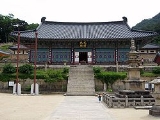
Haeinsa

Encyclopedia
Haeinsa is a head temple of the Jogye Order
(대한불교조계종, 大韓佛敎 曹溪宗) of Korean Buddhism
in the Gaya Mountains (가야산, 伽倻山), South Gyeongsang Province South Korea
. Haeinsa is most notable for being the home of the Tripitaka Koreana
, the whole of the Buddhist Scriptures carved onto 81,350 wooden printing blocks, which it has housed since 1398.
Haeinsa is one of the Three Jewel Temples of Korea
, and represents Dharma or the Buddha’s teachings. It is still an active Seon (선, 禪) practice center in modern times, and was the home temple of the influential Rev. Seongcheol
(성철, 性徹) , who died in 1993.
(애장왕, 哀莊王) wife's of her illness. In gratitude of the Buddha
's mercy, the king ordered the construction of the temple. Another account, by Choe Chi-Won in 900 states that Suneung and his disciple Ijeong, gained the support of a queen dowager who converted to Buddhism and then helped to finance the construction of the temple.
The temple complex was renovated in the 10th century, 1488, 1622, and 1644. Hirang, the temple abbot enjoyed the patronage of Taejo of Goryeo
during that king’s reign. Haeinsa was burned down in a fire in 1817 and was rebuilt in 1818. Another renovation in 1964 uncovered a royal robe of King Gwanghaegun
, who was responsible for the 1622 renovation, and an inscription on a ridge beam.
The main hall, Daejeokkwangjeon (대적광전, 大寂光殿: Hall of Great Silence and Light), is unusual because it is dedicated to Vairocana
where most other Korean temples house Seokgamoni in their main halls.
The Temple of Haeinsa and the Depositories for the "Tripitaka Koreana" Woodblocks, were added to the UNESCO
World Heritage List in 1995. The UNESCO committee noted that the buildings housing the Tripitaka Koreana are unique because no other historical structure was specifically dedicated to the preservation of artifacts and the techniques used were particularly ingenious.
The temple also holds several official treasures including a realistic wooden carving of a monk and interesting Buddhist paintings, stone pagodas, and lanterns.
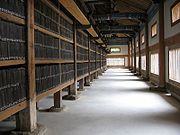 The storage halls known as the Janggyeong Panjeon complex are the depository for the Tripitaka Koreana
woodblocks at Haeinsa and were also designated by the Korean government as a national treasure of Korea on December 20, 1962. They are some of the largest wooden storage facilities in the world. Remarkably, the halls were untouched during the Japanese invasion of Korea and were spared from the 1818 fire that burned most of the temple complex down. All told, the storage halls have survived seven serious fires and one near-bombing during the Korean War
when a pilot disobeyed orders because he remembered that the temple held priceless treasures.
Janggyeong Panjeon complex is the oldest part of the temple and houses the 81,258 wooden printing blocks from the Tripitaka Koreana
. Although the exact construction date of the hall that houses the Tripitaka Koreana is uncertain, it is believed that King Sejo
expanded and renovated it in 1457. The complex is made up of four halls arranged in a rectangle and the style is very plain because of its use as a storage facility. The northern hall is called Beopbojeon (Hall of Dharma) and the southern hall is called Sudarajang (Hall of Sutras). These two main halls are 60.44 meters in length, 8.73 meters in width, and 7.8 meters in height. Both have fifteen rooms with two adjoining rooms. Additionally, there are two small halls on the east and west which house two small libraries.
Several ingenious preservation techniques are utilized to preserve the wooden printing blocks. The architects also utilized nature to help preserve the Tripitaka. The storage complex was built at the highest point of the temple and is 655 meters above sea level. Janggyeong Panjeon faces southwest to avoid damp southeasterly winds from the valley below and is blocked from the cold north wind by mountain peaks. Different sized windows on the north and south sides of both main halls are used for ventilation, utilizing principles of hydrodynamics. The windows were installed in every hall to maximize ventilation and regulate temperature. The clay floors were filled with charcoal, calcium oxide, salt, lime, and sand, which reduce humidity when it rains by absorbing excess moisture which is then retained during the dry winter months. The roof is also made with clay and the bracketing and wood rafters prevent sudden changes in temperature. Additionally, no part of the complex is exposed to sun. Apparently, animals, insects, and birds avoid the complex but the reason for this is unknown. These sophisticated preservation measures are widely credited as the reason the woodblocks have survived in such fantastic condition to this day.
In 1970, a modern storage complex was built utilizing modern preservation techniques but when test woodblocks were found to have mildewed, the intended move was canceled and the woodblocks remained at Haeinsa.
Jogye Order
The Jogye Order, officially the Jogye Order of Korean Buddhism is the representative order of traditional Korean Buddhism with roots that date back 1,200 years to Unified Silla National Master Doui, who brought Seon and the practice taught by the Sixth Patriarch, Huineng, from China about 820...
(대한불교조계종, 大韓佛敎 曹溪宗) of Korean Buddhism
Korean Buddhism
Korean Buddhism is distinguished from other forms of Buddhism by its attempt to resolve what it sees as inconsistencies in Mahayana Buddhism. Early Korean monks believed that the traditions they received from foreign countries were internally inconsistent. To address this, they developed a new...
in the Gaya Mountains (가야산, 伽倻山), South Gyeongsang Province South Korea
South Korea
The Republic of Korea , , is a sovereign state in East Asia, located on the southern portion of the Korean Peninsula. It is neighbored by the People's Republic of China to the west, Japan to the east, North Korea to the north, and the East China Sea and Republic of China to the south...
. Haeinsa is most notable for being the home of the Tripitaka Koreana
Tripitaka Koreana
The Tripitaka Koreana or Palman Daejanggyeong is a Korean collection of the Tripitaka , carved onto 81,258 wooden printing blocks in the 13th century...
, the whole of the Buddhist Scriptures carved onto 81,350 wooden printing blocks, which it has housed since 1398.
Haeinsa is one of the Three Jewel Temples of Korea
Three Jewel Temples of Korea
The Three Jewel Temples of Korea are the three principal Buddhist temples in Korea, each representing one of the Three Jewels of Buddhism, and all located in South Korea....
, and represents Dharma or the Buddha’s teachings. It is still an active Seon (선, 禪) practice center in modern times, and was the home temple of the influential Rev. Seongcheol
Seongcheol
Seongcheol is the dharma name of a Korean Seon Master. He was a key figure in modern Korean Buddhism, being responsible for significant changes to it from the 1950s to 1990s....
(성철, 性徹) , who died in 1993.
History
The temple was first built in 802. Legend says that two Korean monks returned from China, Suneung and Ijeong, and healed King AejangAejang of Silla
Aejang of Silla was the 40th ruler of the Korean kingdom of Silla. He was the eldest son of King Soseong and Queen Gyehwa. He married a lady of the Pak clan....
(애장왕, 哀莊王) wife's of her illness. In gratitude of the Buddha
Gautama Buddha
Siddhārtha Gautama was a spiritual teacher from the Indian subcontinent, on whose teachings Buddhism was founded. In most Buddhist traditions, he is regarded as the Supreme Buddha Siddhārtha Gautama (Sanskrit: सिद्धार्थ गौतम; Pali: Siddhattha Gotama) was a spiritual teacher from the Indian...
's mercy, the king ordered the construction of the temple. Another account, by Choe Chi-Won in 900 states that Suneung and his disciple Ijeong, gained the support of a queen dowager who converted to Buddhism and then helped to finance the construction of the temple.
The temple complex was renovated in the 10th century, 1488, 1622, and 1644. Hirang, the temple abbot enjoyed the patronage of Taejo of Goryeo
Taejo of Goryeo
Taejo of Goryeo was the founder of the Goryeo Dynasty, which ruled Korea from the 10th to the 14th century. Taejo ruled from 918 to 943.-Background:...
during that king’s reign. Haeinsa was burned down in a fire in 1817 and was rebuilt in 1818. Another renovation in 1964 uncovered a royal robe of King Gwanghaegun
Gwanghaegun of Joseon
Gwanghaegun or Prince Gwanghae was the fifteenth king of the Joseon Dynasty. His personal name was Yi Hon. Since he was deposed in a coup, later official historians did not give him a temple name like Taejo or Sejong...
, who was responsible for the 1622 renovation, and an inscription on a ridge beam.
The main hall, Daejeokkwangjeon (대적광전, 大寂光殿: Hall of Great Silence and Light), is unusual because it is dedicated to Vairocana
Vairocana
Vairocana is a celestial Buddha who is often interpreted as the Bliss Body of the historical Gautama Buddha; he can also be referred to as the dharmakaya Buddha and the great solar Buddha. In Sino-Japanese Buddhism, Vairocana is also seen as the embodiment of the Buddhist concept of shunyata or...
where most other Korean temples house Seokgamoni in their main halls.
The Temple of Haeinsa and the Depositories for the "Tripitaka Koreana" Woodblocks, were added to the UNESCO
UNESCO
The United Nations Educational, Scientific and Cultural Organization is a specialized agency of the United Nations...
World Heritage List in 1995. The UNESCO committee noted that the buildings housing the Tripitaka Koreana are unique because no other historical structure was specifically dedicated to the preservation of artifacts and the techniques used were particularly ingenious.
The temple also holds several official treasures including a realistic wooden carving of a monk and interesting Buddhist paintings, stone pagodas, and lanterns.
Janggyeong Panjeon (National Treasure No.52)
Tripitaka Koreana
The Tripitaka Koreana or Palman Daejanggyeong is a Korean collection of the Tripitaka , carved onto 81,258 wooden printing blocks in the 13th century...
woodblocks at Haeinsa and were also designated by the Korean government as a national treasure of Korea on December 20, 1962. They are some of the largest wooden storage facilities in the world. Remarkably, the halls were untouched during the Japanese invasion of Korea and were spared from the 1818 fire that burned most of the temple complex down. All told, the storage halls have survived seven serious fires and one near-bombing during the Korean War
Korean War
The Korean War was a conventional war between South Korea, supported by the United Nations, and North Korea, supported by the People's Republic of China , with military material aid from the Soviet Union...
when a pilot disobeyed orders because he remembered that the temple held priceless treasures.
Janggyeong Panjeon complex is the oldest part of the temple and houses the 81,258 wooden printing blocks from the Tripitaka Koreana
Tripitaka Koreana
The Tripitaka Koreana or Palman Daejanggyeong is a Korean collection of the Tripitaka , carved onto 81,258 wooden printing blocks in the 13th century...
. Although the exact construction date of the hall that houses the Tripitaka Koreana is uncertain, it is believed that King Sejo
Sejo of Joseon
Sejo of Joseon was the seventh king of the Joseon Dynasty of Korea. He produced a coup d'etat and became king himself in 1455.-Reign:...
expanded and renovated it in 1457. The complex is made up of four halls arranged in a rectangle and the style is very plain because of its use as a storage facility. The northern hall is called Beopbojeon (Hall of Dharma) and the southern hall is called Sudarajang (Hall of Sutras). These two main halls are 60.44 meters in length, 8.73 meters in width, and 7.8 meters in height. Both have fifteen rooms with two adjoining rooms. Additionally, there are two small halls on the east and west which house two small libraries.
Several ingenious preservation techniques are utilized to preserve the wooden printing blocks. The architects also utilized nature to help preserve the Tripitaka. The storage complex was built at the highest point of the temple and is 655 meters above sea level. Janggyeong Panjeon faces southwest to avoid damp southeasterly winds from the valley below and is blocked from the cold north wind by mountain peaks. Different sized windows on the north and south sides of both main halls are used for ventilation, utilizing principles of hydrodynamics. The windows were installed in every hall to maximize ventilation and regulate temperature. The clay floors were filled with charcoal, calcium oxide, salt, lime, and sand, which reduce humidity when it rains by absorbing excess moisture which is then retained during the dry winter months. The roof is also made with clay and the bracketing and wood rafters prevent sudden changes in temperature. Additionally, no part of the complex is exposed to sun. Apparently, animals, insects, and birds avoid the complex but the reason for this is unknown. These sophisticated preservation measures are widely credited as the reason the woodblocks have survived in such fantastic condition to this day.
In 1970, a modern storage complex was built utilizing modern preservation techniques but when test woodblocks were found to have mildewed, the intended move was canceled and the woodblocks remained at Haeinsa.
External links
- Asian Historical Architecture: Haeinsa
- South Korean Cultural Properties Administration page for Haeinsa and Tripitaka Koreana
- Digital Dictionary of Buddhism (log in as "guest")
- UNESCO: Haeinsa Temple Janggyeong Panjeon
- Cultural Heritage: Haeinsa Janggyeong Panjeon
- Haeinsa Temple : Official Site of Korea Tourism Org