


Grange movement

Encyclopedia
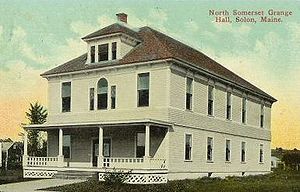
- Grange Hall redirects here. For other uses including individual Grange Hall buildings, see The Grange (disambiguation)
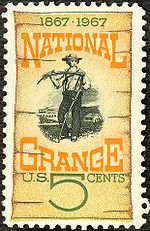
The National Grange of the Order of Patrons of Husbandry, also simply styled the Grange, is a fraternal organization for American farmers that encourages farm families to band together for their common economic and political well-being. Founded in 1867 after the Civil War
American Civil War
The American Civil War was a civil war fought in the United States of America. In response to the election of Abraham Lincoln as President of the United States, 11 southern slave states declared their secession from the United States and formed the Confederate States of America ; the other 25...
, it is the oldest surviving agricultural organization in America, though now much diminished from the over one million members it had in its peak in the 1890s through the 1950s. In addition to serving as a center for many farming communities, the Grange was an effective advocacy group
Advocacy group
Advocacy groups use various forms of advocacy to influence public opinion and/or policy; they have played and continue to play an important part in the development of political and social systems...
for farmers and their agendas, including fighting railroad monopolies and advocating rural mail deliveries. Indeed, the word "grange" itself comes from a Latin word for grain, and is related to a "granary" or, generically, a farm.
The motto of the Grange is: "In essentials, unity; in non-essentials, liberty; in all things, charity."
In 2005, the Grange had a membership of 300,000, with organizations in 3,600 communities in 37 states. Its headquarters are in a building in Washington, D.C.
Washington, D.C.
Washington, D.C., formally the District of Columbia and commonly referred to as Washington, "the District", or simply D.C., is the capital of the United States. On July 16, 1790, the United States Congress approved the creation of a permanent national capital as permitted by the U.S. Constitution....
, built by the organization in 1960. Many rural communities in the United States still have a "Grange Hall".
History

Oliver Hudson Kelley
Oliver Hudson Kelley is considered the "Father" of the Order of Patrons of Husbandry.-Biography:In Boston, he moved to the Minnesota frontier in 1849, where he became a farmer...
, William Saunders, Francis M. McDowell, John Trimble
John Trimble
John Trimble was one of the seven founders of the Grange.-Biography:Born in New Jersey, he was a student of the Protestant Episcopal Church, receiving his Doctor of Divinity. Following the American Civil War, he served in the Treasurer Department as agent for the collection of war claims for...
, Aaron B. Grosh
Aaron B. Grosh
Reverend Aaron Burt Grosh , a Universalist minister, was one of the seven founders of the Grange. He had a major part in the design of the Grange ritual and was also responsible for the various songs used during various celebrations of the Grange...
, John R. Thompson
John R. Thompson
John Richardson Thompson was one of the seven founders of the The National Grange of the Order of Patrons of Husbandry.-Biography:...
, and William M. Ireland
William M. Ireland
William M. Ireland was one of the seven founders of the Grange.-Biography:He served much of his life as chief clerk in the offices of the U.S. Post Office Department. Also an avid Mason, Ireland added valuable knowledge to organizational systems and methods in the formative period of the Grange...
.
President Andrew Johnson
Andrew Johnson
Andrew Johnson was the 17th President of the United States . As Vice-President of the United States in 1865, he succeeded Abraham Lincoln following the latter's assassination. Johnson then presided over the initial and contentious Reconstruction era of the United States following the American...
sent Oliver Hudson Kelley to the South to collect agricultural data. As a Northerner, Kelley was met with suspicion. However, he was a Freemason, an affiliation that overcame sectional differences. Kelley saw the need for an organization that would bring farmers together and advance their interests. After consultations with the other founders, the Grange was born in 1867. The first Grange was Potomac Grange #1 in Washington, D.C., still extant .
Membership in the Grange increased dramatically from 1873 (200,000) to 1875 (858,050) as many of the state and local granges adopted non-partisan political resolutions, especially regarding the regulation of railroad transportation costs. The organization was unusual at this time in that it allowed women and teens as equal members. In fact, four of the sixteen elected positions can only be held by women.
Aaron Montgomery Ward
Aaron Montgomery Ward was an American businessman notable for the invention of mail order.The mail-order industry was started by Aaron Montgomery Ward in 1872 in Chicago...
. Poor fiscal management, combined with organizational difficulties resulting from rapid growth, led to a massive decline in membership. By the turn of the 20th century, the Grange rebounded and membership stabilized.
In the middle of the 1870s the Granger movement succeeded in regulating
Regulation
Regulation is administrative legislation that constitutes or constrains rights and allocates responsibilities. It can be distinguished from primary legislation on the one hand and judge-made law on the other...
the railroads and grain warehouses. The birth of the Cooperative Extension Service
Cooperative extension service
The Cooperative Extension Service, also known as the Extension Service of the USDA, is a non-formal educational program implemented in the United States designed to help people use research-based knowledge to improve their lives. The service is provided by the state's designated land-grant...
, Rural Free Delivery, and the Farm Credit System
Farm Credit System
The Farm Credit System is a federally chartered network of cooperatives and related service organizations that lends to agricultural producers, rural homeowners, farm-related businesses, and agricultural, aquatic, and public utility cooperatives in the United States...
were largely due to Grange lobbying. The peak of their political power was marked by their success in Munn v. Illinois
Munn v. Illinois
Munn v. Illinois, 94 U.S. 113 , was a United States Supreme Court case dealing with corporate rates and agriculture. The Munn case allowed states to regulate certain businesses within their borders, including railroads, and is commonly regarded as a milestone in the growth of federal government...
, which held that the grain warehouses were a "private utility in the public interest
Public interest
The public interest refers to the "common well-being" or "general welfare." The public interest is central to policy debates, politics, democracy and the nature of government itself...
", and therefore could be regulated by public law (see references below, "The Granger Movement"). Other significant Grange causes included temperance
Temperance movement
A temperance movement is a social movement urging reduced use of alcoholic beverages. Temperance movements may criticize excessive alcohol use, promote complete abstinence , or pressure the government to enact anti-alcohol legislation or complete prohibition of alcohol.-Temperance movement by...
, the direct election of Senators
Seventeenth Amendment to the United States Constitution
The Seventeenth Amendment to the United States Constitution established direct election of United States Senators by popular vote. The amendment supersedes Article I, § 3, Clauses 1 and 2 of the Constitution, under which senators were elected by state legislatures...
and women's suffrage
Women's suffrage
Women's suffrage or woman suffrage is the right of women to vote and to run for office. The expression is also used for the economic and political reform movement aimed at extending these rights to women and without any restrictions or qualifications such as property ownership, payment of tax, or...
(Susan B. Anthony
Susan B. Anthony
Susan Brownell Anthony was a prominent American civil rights leader who played a pivotal role in the 19th century women's rights movement to introduce women's suffrage into the United States. She was co-founder of the first Women's Temperance Movement with Elizabeth Cady Stanton as President...
's last public appearance was at the National Grange Convention in 1903 ). During the Progressive Era
Progressive Era
The Progressive Era in the United States was a period of social activism and political reform that flourished from the 1890s to the 1920s. One main goal of the Progressive movement was purification of government, as Progressives tried to eliminate corruption by exposing and undercutting political...
of the 1890s to the 1920s political parties took up Grange causes. Consequently, local Granges focused more on community service, although the State and National Granges remain a political force.
In the 20th and 21st centuries, the position of the Grange as a respected organization in the United States was indicated by a membership that included Presidents Franklin D. Roosevelt
Franklin D. Roosevelt
Franklin Delano Roosevelt , also known by his initials, FDR, was the 32nd President of the United States and a central figure in world events during the mid-20th century, leading the United States during a time of worldwide economic crisis and world war...
and Harry S. Truman
Harry S. Truman
Harry S. Truman was the 33rd President of the United States . As President Franklin D. Roosevelt's third vice president and the 34th Vice President of the United States , he succeeded to the presidency on April 12, 1945, when President Roosevelt died less than three months after beginning his...
, as well as artist Norman Rockwell
Norman Rockwell
Norman Percevel Rockwell was a 20th-century American painter and illustrator. His works enjoy a broad popular appeal in the United States for their reflection of American culture. Rockwell is most famous for the cover illustrations of everyday life scenarios he created for The Saturday Evening...
and Nirvana
Nirvana (band)
Nirvana was an American rock band that was formed by singer/guitarist Kurt Cobain and bassist Krist Novoselic in Aberdeen, Washington in 1987...
bassist Krist Novoselic
Krist Novoselic
Krist Anthony Novoselic II is a Croatian-American rock musician, best known for being the bassist and co-founder of the grunge band Nirvana. After Nirvana ended, Novoselic formed Sweet 75 and then Eyes Adrift, releasing one album with each band...
. The monument to the founding of the Grange is the only private monument on the National Mall
National Mall
The National Mall is an open-area national park in downtown Washington, D.C., the capital of the United States. The National Mall is a unit of the National Park Service , and is administered by the National Mall and Memorial Parks unit...
in Washington, D.C.
The Grange today
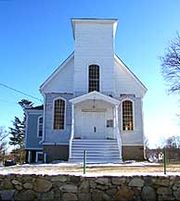
Despite this drop in membership and national awareness, the Grange continues to press for the causes of farmers, including issues of free trade and farm policy. In its 2006 Journal of Proceedings, the organization's report of its annual convention, the organization lays out its mission and how it works towards achieving it through fellowship, service, and legislation:
"The Grange provides opportunities for individuals and families to develop to their highest potential in order to build stronger communities and states, as well as a stronger nation."
The Grange is nonpartisan, and only supports policies, never political parties or candidates. Although the Grange was originally founded to serve the interests of farmers, because of the shrinking farm population the Grange has begun to broaden its range to include a wide variety of issues, and anyone is welcome to join the Grange.
The Junior grange is open to children 5-14. Regular Grange membership is open to anyone age 14 or older. The Grange Youth is a group created within the Grange and consists of members 14-35.
Rituals and ceremonies
When the Grange first began in 1867, it borrowed some of its rituals and symbols from Freemasonry, including secret meetings, oaths and special passwords. Small, ceremonial farm tools are often displayed at Grange meetings. Elected officers are in charge of opening and closing each meeting. There are seven degrees of Grange membership; the ceremony of each degree relates to the seasons and various symbols and principles.During the last few decades, the Grange has moved towards public meetings and no longer meets in secret. Though the secret meetings do not occur, the Grange still acknowledges its rich history and practices some traditions.
Organization
The Grange is a hierarchical organization ranging from local communities to the National Grange organization. At the local level are community Granges, otherwise known as "subordinate Granges". All members are affiliated with at least one subordinate. In most states, multiple subordinate Granges are grouped together to form "Pomona Granges". Typically, Pomonas are made up of all the subordinates in a county. Next in the order come State Granges, which is where the Grange begins to be especially active in the political process. State Masters (Presidents) are responsible for supervising the administration of Subordinate and Pomona Granges. Together, thirty-six State Granges, as well as Potomac Grange #1 in Washington, D.C., form the National Grange. The National Grange represents the interests of all Grangers in lobbying activities similar to the state, but on a much larger scale. In addition, the National Grange oversees the Grange ritual. The Grange is a grassrootsGrassroots
A grassroots movement is one driven by the politics of a community. The term implies that the creation of the movement and the group supporting it are natural and spontaneous, highlighting the differences between this and a movement that is orchestrated by traditional power structures...
organization; virtually all policy originates at the subordinate level.
Primary sources
- Atkeson, Thomas Clark. Semi-centennial history of the Patrons of husbandry (1916) 364pp full text online
- Goss, Albert S. "Legislative Program of the National Grange," Journal of Farm Economics, Vol. 29, No. 1, Proceedings Number (Feb., 1947), pp. 52–63 by Grange leader
- Kelley, Oliver Hudson. Origin and progress of the order of the Patrons of Husbandry in the United States (1875) 441pp full text online
- full texts of primary sources on Grange
Further reading
- Barnes, William D. "Oliver Hudson Kelley and the Genesis of the Grange: A Reappraisal," Agricultural History, Vol. 41, No. 3 (Jul., 1967), pp. 229–242 in JSTOR
- Buck, Solon Justus. The Granger movement: A Study of Agricultural Organization and its Political, Economic, and Social Manifestations, 1870-1880 (1913) 384pp; full text online; excellent older history (newer is Nordin (1974)
- Ferguson, James S. "The Grange and Farmer Education in Mississippi," Journal of Southern History, Vol. 8, No. 4 (Nov., 1942), pp. 497–512 in JSTOR
- Gardner, Charles M. The Grange: Friend of the Farmer (1949) 531pp.
- Hirsch, Arthur H. "Efforts of the Grange in the Middle West to Control the Price of Farm Machinery, 1870-1880," Mississippi Valley Historical Review, Vol. 15, No. 4 (Mar., 1929), pp. 473–496 in JSTOR
- Howard, David H. People, Pride, and Progress: 125 Years of the Grange in America (1992) 335pp.
- Lownsbrough, John. The Privileged Few. The Grange and its People in Nineteenth Century Ontario (1980)
- Marti, Donald B. Women of the Grange: Mutuality and Sisterhood in Rural America, 1866-1920 (1991)
- Nordin, D. Sven. Rich Harvest: A History of the Grange, 1867–1900 (1974), 273pp excerpt and text search
- Saloutos, Theodore. "The Grange in the South, 1870-1877," Journal of Southern History, Vol. 19, No. 4 (Nov., 1953), pp. 473–487 in JSTOR
- Schneiberg, Marc et al. "Social Movements and Organizational Form: Cooperative Alternatives to Corporations in the American Insurance, Dairy, and Grain Industries," American Sociological Review 2008 73(4): 635-667, theoretical essay
- Schell, Herbert S. "The Grange and the Credit Problem in Dakota Territory," Agricultural History, Vol. 10, No. 2 (Apr., 1936), pp. 59–83 in JSTOR
- Tontz, Robert L. "Memberships of General Farmers' Organizations, United States, 1874-1960," Agricultural History, Vol. 38, No. 3 (Jul., 1964), pp. 143–156 in JSTOR statistical tables showing membership in the Grange and other farm organizations by date and state and region
- Woods, Thomas A. 'Knights of the Plow: Oliver H. Kelley and the Origins of the Grange in Republican Ideology (2002)