

Gomphotherium

Encyclopedia
Gomphotherium is an extinct genus of proboscid
which evolved in the Early Miocene
of North America
from 13.650—3.6 Ma, living about .
The genus emigrated into Asia
, Europe
and Africa
after a drop in sea level (probably during the Tortonian
epoch) allowed them to cross over. It survived into the Pliocene
, and its remains have been found in Chile
, France
, Germany
, Austria
, Kansas
, Tennessee
, Pakistan
, Kenya
and Bosnia and Herzegovina
.
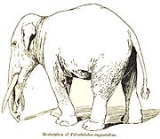
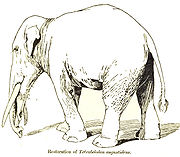 Gomphotherium stood around 3 metres (9.8 ft) high, and bore a strong resemblance to a modern elephant
. However, it had four tusks; two on the upper jaw and two on the elongated lower jaw. The lower tusks are parallel and shaped like a shovel
and were probably used as such. Unlike modern elephants, the upper tusks were covered by a layer of enamel. Compared to elephants, the skull was more elongated and low, indicating that the animal had a short trunk, rather like a tapir
's. These animals probably lived in swamps or near lakes, using their tusks to dig or scrape up aquatic vegetation. In comparison to earlier proboscids, Gomphotherium had far fewer molars
; the remaining ones had high ridges to expand their grinding surface. Gomphotherium inhabited dry wooded regions near lakes.
A complete skeleton of Gomphotherium has been found at Mühldorf
, Germany, in 1971.
Proboscidea
Proboscidea is a taxonomic order containing one living family, Elephantidae, and several extinct families. This order was first described by J. Illiger in 1881 and encompasses the trunked mammals...
which evolved in the Early Miocene
Early Miocene
The Early Miocene is a sub-epoch of the Miocene Epoch made up of two stages: the Aquitanian and Burdigalian stages....
of North America
North America
North America is a continent wholly within the Northern Hemisphere and almost wholly within the Western Hemisphere. It is also considered a northern subcontinent of the Americas...
from 13.650—3.6 Ma, living about .
The genus emigrated into Asia
Asia
Asia is the world's largest and most populous continent, located primarily in the eastern and northern hemispheres. It covers 8.7% of the Earth's total surface area and with approximately 3.879 billion people, it hosts 60% of the world's current human population...
, Europe
Europe
Europe is, by convention, one of the world's seven continents. Comprising the westernmost peninsula of Eurasia, Europe is generally 'divided' from Asia to its east by the watershed divides of the Ural and Caucasus Mountains, the Ural River, the Caspian and Black Seas, and the waterways connecting...
and Africa
Africa
Africa is the world's second largest and second most populous continent, after Asia. At about 30.2 million km² including adjacent islands, it covers 6% of the Earth's total surface area and 20.4% of the total land area...
after a drop in sea level (probably during the Tortonian
Tortonian
The Tortonian is in the geologic timescale an age or stage of the late Miocene that spans the time between 11.608 ± 0.005 Ma and 7.246 ± 0.005 Ma . It follows the Serravallian and is followed by the Messinian....
epoch) allowed them to cross over. It survived into the Pliocene
Pliocene
The Pliocene Epoch is the period in the geologic timescale that extends from 5.332 million to 2.588 million years before present. It is the second and youngest epoch of the Neogene Period in the Cenozoic Era. The Pliocene follows the Miocene Epoch and is followed by the Pleistocene Epoch...
, and its remains have been found in Chile
Chile
Chile ,officially the Republic of Chile , is a country in South America occupying a long, narrow coastal strip between the Andes mountains to the east and the Pacific Ocean to the west. It borders Peru to the north, Bolivia to the northeast, Argentina to the east, and the Drake Passage in the far...
, France
France
The French Republic , The French Republic , The French Republic , (commonly known as France , is a unitary semi-presidential republic in Western Europe with several overseas territories and islands located on other continents and in the Indian, Pacific, and Atlantic oceans. Metropolitan France...
, Germany
Germany
Germany , officially the Federal Republic of Germany , is a federal parliamentary republic in Europe. The country consists of 16 states while the capital and largest city is Berlin. Germany covers an area of 357,021 km2 and has a largely temperate seasonal climate...
, Austria
Austria
Austria , officially the Republic of Austria , is a landlocked country of roughly 8.4 million people in Central Europe. It is bordered by the Czech Republic and Germany to the north, Slovakia and Hungary to the east, Slovenia and Italy to the south, and Switzerland and Liechtenstein to the...
, Kansas
Kansas
Kansas is a US state located in the Midwestern United States. It is named after the Kansas River which flows through it, which in turn was named after the Kansa Native American tribe, which inhabited the area. The tribe's name is often said to mean "people of the wind" or "people of the south...
, Tennessee
Tennessee
Tennessee is a U.S. state located in the Southeastern United States. It has a population of 6,346,105, making it the nation's 17th-largest state by population, and covers , making it the 36th-largest by total land area...
, Pakistan
Pakistan
Pakistan , officially the Islamic Republic of Pakistan is a sovereign state in South Asia. It has a coastline along the Arabian Sea and the Gulf of Oman in the south and is bordered by Afghanistan and Iran in the west, India in the east and China in the far northeast. In the north, Tajikistan...
, Kenya
Kenya
Kenya , officially known as the Republic of Kenya, is a country in East Africa that lies on the equator, with the Indian Ocean to its south-east...
and Bosnia and Herzegovina
Bosnia and Herzegovina
Bosnia and Herzegovina , sometimes called Bosnia-Herzegovina or simply Bosnia, is a country in Southern Europe, on the Balkan Peninsula. Bordered by Croatia to the north, west and south, Serbia to the east, and Montenegro to the southeast, Bosnia and Herzegovina is almost landlocked, except for the...
.
Description
Elephant
Elephants are large land mammals in two extant genera of the family Elephantidae: Elephas and Loxodonta, with the third genus Mammuthus extinct...
. However, it had four tusks; two on the upper jaw and two on the elongated lower jaw. The lower tusks are parallel and shaped like a shovel
Shovel
A shovel is a tool for digging, lifting, and moving bulk materials, such as soil, coal, gravel, snow, sand, or ore. Shovels are extremely common tools that are used extensively in agriculture, construction, and gardening....
and were probably used as such. Unlike modern elephants, the upper tusks were covered by a layer of enamel. Compared to elephants, the skull was more elongated and low, indicating that the animal had a short trunk, rather like a tapir
Tapir
A Tapir is a large browsing mammal, similar in shape to a pig, with a short, prehensile snout. Tapirs inhabit jungle and forest regions of South America, Central America, and Southeast Asia. There are four species of Tapirs: the Brazilian Tapir, the Malayan Tapir, Baird's Tapir and the Mountain...
's. These animals probably lived in swamps or near lakes, using their tusks to dig or scrape up aquatic vegetation. In comparison to earlier proboscids, Gomphotherium had far fewer molars
Molar (tooth)
Molars are the rearmost and most complicated kind of tooth in most mammals. In many mammals they grind food; hence the Latin name mola, "millstone"....
; the remaining ones had high ridges to expand their grinding surface. Gomphotherium inhabited dry wooded regions near lakes.
A complete skeleton of Gomphotherium has been found at Mühldorf
Mühldorf
Mühldorf am Inn is a town in Bavaria, Germany, and the capital of the district Mühldorf on the river Inn. It is located at , and had a population of about 17,808 in 2005.-History:...
, Germany, in 1971.