

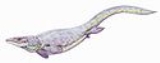
Globidens

Encyclopedia
Globidens is an extinct genus
of mosasaur
lizard
.
Globidens alabamaensis was first described by Gilmore (1912). A second species (G. dakotensis) was described by Russell (1975). The third North American species (G. schurmanni) was added by Martin (2007)
Globidens was ~6 m (20 ft) in length and in appearance very much like other mosasaurs (streamlined body with flipper
s, a laterally flattened tail
and powerful jaw
s). The teeth of Globidens were vastly different from other mosasaurs, as they were globular, as suggested in its generic name. Generally, most mosasaurs had sharp teeth evolved to grab soft, slippery prey like fish
and squid
, which, in later species, were later modified to rend flesh, as well. While many other mosasaurs were capable of crushing the shells of ammonites, none were as specialized in dealing with armored prey like Globidens. Globidens, unlike most other mosasaurs, had semispherical teeth with rounded nubbin-like points, which were much better suited for crushing tough armored prey like small turtle
s, ammonite
s, nautili
, and bivalves. Like its larger relative, Mosasaurus
, Globidens had a robustly built skull with tightly-articulating jaws. Such features no doubt played a large role in its ability to penetrate the armor of its shelled prey.
The smaller genus Carinodens
is regarded as a sister taxon of Globidens.
Genus
In biology, a genus is a low-level taxonomic rank used in the biological classification of living and fossil organisms, which is an example of definition by genus and differentia...
of mosasaur
Mosasaur
Mosasaurs are large extinct marine lizards. The first fossil remains were discovered in a limestone quarry at Maastricht on the Meuse in 1764...
lizard
Lizard
Lizards are a widespread group of squamate reptiles, with nearly 3800 species, ranging across all continents except Antarctica as well as most oceanic island chains...
.
Globidens alabamaensis was first described by Gilmore (1912). A second species (G. dakotensis) was described by Russell (1975). The third North American species (G. schurmanni) was added by Martin (2007)
Globidens was ~6 m (20 ft) in length and in appearance very much like other mosasaurs (streamlined body with flipper
Flipper (anatomy)
A flipper is a typically flat limb evolved for movement through water. Various creatures have evolved flippers, for example penguins , cetaceans A flipper is a typically flat limb evolved for movement through water. Various creatures have evolved flippers, for example penguins (also called...
s, a laterally flattened tail
Tail
The tail is the section at the rear end of an animal's body; in general, the term refers to a distinct, flexible appendage to the torso. It is the part of the body that corresponds roughly to the sacrum and coccyx in mammals, reptiles, and birds...
and powerful jaw
Jaw
The jaw is any opposable articulated structure at the entrance of the mouth, typically used for grasping and manipulating food. The term jaws is also broadly applied to the whole of the structures constituting the vault of the mouth and serving to open and close it and is part of the body plan of...
s). The teeth of Globidens were vastly different from other mosasaurs, as they were globular, as suggested in its generic name. Generally, most mosasaurs had sharp teeth evolved to grab soft, slippery prey like fish
Fish
Fish are a paraphyletic group of organisms that consist of all gill-bearing aquatic vertebrate animals that lack limbs with digits. Included in this definition are the living hagfish, lampreys, and cartilaginous and bony fish, as well as various extinct related groups...
and squid
Squid
Squid are cephalopods of the order Teuthida, which comprises around 300 species. Like all other cephalopods, squid have a distinct head, bilateral symmetry, a mantle, and arms. Squid, like cuttlefish, have eight arms arranged in pairs and two, usually longer, tentacles...
, which, in later species, were later modified to rend flesh, as well. While many other mosasaurs were capable of crushing the shells of ammonites, none were as specialized in dealing with armored prey like Globidens. Globidens, unlike most other mosasaurs, had semispherical teeth with rounded nubbin-like points, which were much better suited for crushing tough armored prey like small turtle
Turtle
Turtles are reptiles of the order Testudines , characterised by a special bony or cartilaginous shell developed from their ribs that acts as a shield...
s, ammonite
Ammonite
Ammonite, as a zoological or paleontological term, refers to any member of the Ammonoidea an extinct subclass within the Molluscan class Cephalopoda which are more closely related to living coleoids Ammonite, as a zoological or paleontological term, refers to any member of the Ammonoidea an extinct...
s, nautili
Nautilus
Nautilus is the common name of marine creatures of cephalopod family Nautilidae, the sole extant family of the superfamily Nautilaceae and of its smaller but near equal suborder, Nautilina. It comprises six living species in two genera, the type of which is the genus Nautilus...
, and bivalves. Like its larger relative, Mosasaurus
Mosasaurus
Mosasaurus is a genus of mosasaur, carnivorous, aquatic lizards, somewhat resembling flippered crocodiles, with elongated heavy jaws. The genus existed during the Maastrichtian age of the Cretaceous period , around 70-65 millions years ago in the area of modern Western Europe and North America...
, Globidens had a robustly built skull with tightly-articulating jaws. Such features no doubt played a large role in its ability to penetrate the armor of its shelled prey.
The smaller genus Carinodens
Carinodens
Carinodens is a genus of mosasaur. It was named in 1969 as a replacement for Compressidens, which was already in use for a mollusk. Measuring approximately in length, it is one of the smallest known mosasaurs. It is widely considered a sister taxon to Globidens. It also had round, blunt teeth for...
is regarded as a sister taxon of Globidens.