

Gibson Robot Guitar

Encyclopedia
| Gibson Robot Guitar | |
 |
|
| Company: | Gibson |
|---|---|
| Guitar Style: | Les Paul, SG, Flying V, Explorer |
| Release Date: | December 7, 2007 (Limited Run) |
The Gibson Robot Guitar (a.k.a GOR) typically refers to a sub-class of Les Paul
Gibson Les Paul
The Gibson Les Paul was the result of a design collaboration between Gibson Guitar Corporation and the late jazz guitarist and electronics inventor Les Paul. In 1950, with the introduction of the Fender Telecaster to the musical market, electric guitars became a public craze. In reaction, Gibson...
style guitars from Gibson
Gibson Guitar Corporation
The Gibson Guitar Corporation, formerly of Kalamazoo, Michigan and currently of Nashville, Tennessee, manufactures guitars and other instruments which sell under a variety of brand names...
. This is because the first run of limited edition Robot Guitars was exclusively made up of Les Paul bodies. Currently, there are five different Gibson models available with Robot Guitar features: The Robot Les Paul Studio
Gibson Les Paul Studio
-Background:The Gibson Les Paul Swamp Ash Studio was introduced in 2003 alongside the Les Paul Voodoo. These two instruments were essentially identical except for the Voodoo's dark finish, "Goth" aesthetic and different pickups.-Construction:...
, Robot SG
Gibson SG
At the launch of the SG in 1961, Gibson offered four variants of the SG; the SG Junior , the SG Special, the SG Standard, and the top-of-the-line SG Custom. However, Gibson's current core variants as of 2010 are the SG Standard and the SG Special...
, Robot Flying V
Gibson Flying V
-External links:*, , , , and , from the Gibson website*, a June 2001 article from Guitar Collector magazine*, a tribute site that lists all models and re-issues and most notable players**...
, Robot Explorer
Gibson Explorer
The Gibson Explorer is a type of electric guitar that made its debut in 1958. The Explorer offered a radical, "futuristic" body design, much like its sibling, the Flying V. The Explorer was the final development of a prototype design which years later Gibson marketed under the name Futura.The...
, and a Robot Les Paul Junior
Gibson Les Paul Junior
The Gibson Les Paul Jr. is a solid body electric guitar introduced in 1954 as an affordable, entry level Les Paul. It was first released with a single cut body style however models with a double cut body style were later introduced in 1958.-History:...
. Developed by Chris Adams, its most notable feature is that it uses an onboard computer to automatically tune itself. This is not the first guitar to be able to tune itself, but it is regarded as the most modern, unique, and un-invasive self-tuning model available, because it does not employ cams
Camshaft
A camshaft is a shaft to which a cam is fastened or of which a cam forms an integral part.-History:An early cam was built into Hellenistic water-driven automata from the 3rd century BC. The camshaft was later described in Iraq by Al-Jazari in 1206. He employed it as part of his automata,...
or cantilever
Cantilever
A cantilever is a beam anchored at only one end. The beam carries the load to the support where it is resisted by moment and shear stress. Cantilever construction allows for overhanging structures without external bracing. Cantilevers can also be constructed with trusses or slabs.This is in...
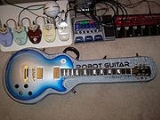
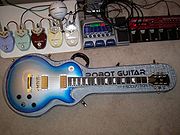
s throughout the body of the guitar. The non-limited edition SG and Les Paul Studio are available in a variety of finishes. The Flying V and Explorer are only available in metallic red. The price can range from about $1,000-$3,000 or more for custom options. In the case of the "Original 1st Production" Robot guitar, the only finish available was Blue Silverburst nitrocellulose (as in the photo to the right), and it is notable because Gibson have stated in the Robot marketing materials that (the color) "will never be used on any other Gibson guitar". The original Robot guitar also featured headstock and neck binding which are not standard on any current Les Paul Robot.
Technical information
The tuning system used on the Gibson Robot Guitar is based on the aftermarket Powertune system, which was developed by the Tronical Company of GermanyGermany
Germany , officially the Federal Republic of Germany , is a federal parliamentary republic in Europe. The country consists of 16 states while the capital and largest city is Berlin. Germany covers an area of 357,021 km2 and has a largely temperate seasonal climate...
. The Gibson system uses the standard Tune-o-matic
Tune-o-matic
Tune-o-matic is a name of fixed bridge design for electric guitars. It was designed by Ted McCarty and introduced in the Gibson Les Paul Custom guitar in 1954. In 1955, it was used on the Gibson Les Paul Gold Top...
style bridge typical on their guitars, but modifications were made to have individual piezo
Piezoelectric sensor
A piezoelectric sensor is a device that uses the piezoelectric effect to measure pressure, acceleration, strain or force by converting them to an electrical charge.-Applications:...
saddles that transmit each string's pitch to the microprocessor
Microprocessor
A microprocessor incorporates the functions of a computer's central processing unit on a single integrated circuit, or at most a few integrated circuits. It is a multipurpose, programmable device that accepts digital data as input, processes it according to instructions stored in its memory, and...
. The computer analyzes the signal, and then controls each of the Powerhead Locking Tuners. Each tuner is run by a small servo
Servomechanism
thumb|right|200px|Industrial servomotorThe grey/green cylinder is the [[Brush |brush-type]] [[DC motor]]. The black section at the bottom contains the [[Epicyclic gearing|planetary]] [[Reduction drive|reduction gear]], and the black object on top of the motor is the optical [[rotary encoder]] for...
motor that works in sync with the bridge to bring the string up to pitch by altering the string's tension until it is within a desired tolerance. The entire system is powered by a lithium-ion rechargeable battery
Rechargeable battery
A rechargeable battery or storage battery is a group of one or more electrochemical cells. They are known as secondary cells because their electrochemical reactions are electrically reversible. Rechargeable batteries come in many different shapes and sizes, ranging anything from a button cell to...
housed in the control cavity of the guitar.
Features and functionality
The Robot Guitar has the standard four knobs for individual pickup volume and tone controls; however, in place of the bridge pickup tone knob, there is the Master Control Knob (MCK). The control functions like a “push-pull” knob: when in the down position, it functions like a standard control. When in the up position, however, the MCK is what coordinates the automatic tuning for the guitar by sending the information and power to the neck PCB through the strings. Then the PCB activates the robot tuners by contact.Post-sale service and repairs
So far, there are no spare parts for sale to the general public from Gibson, nor from Tronical, and the batteries and another lesser importance adds are long ago out of stock, so in case of maintenance or repair needed, the owner should send the guitar to one of the four Gibson robot guitar maintenance authorized dealers in U.S. There are forums specialized in commenting the multiple electronic and mechanical issues in the robot tuning systems. The Dark Fire production was closed (v2), and new -Dusk Tiger and Firebird X - are the new versions. The v2 is radically different from v1.Tuning
Users can choose from seven factory presets for tunings, six of which are editable:Each tuning is selected by highlighting a specific string letter on the MCK.
- E - E B E G# B E - Open E
- A - D A D G A D - D Modal
- D - D A D G B E - "Drop D"
- G - D G D G B D - Open G
- B - Eb Ab Db Gb Bb Eb - "'Standard' down one half step"
- e - D A D G B D - "Double Drop D"
Each tuning can be returned to "standard" tuning of A (440Hz) by simply pulling up on the MCK knob, and strumming the strings lightly.
Out of the box, the guitar is calibrated to use a 0.10 gauge set of strings, and will tune up within a tolerance of one cent
Cent (music)
The cent is a logarithmic unit of measure used for musical intervals. Twelve-tone equal temperament divides the octave into 12 semitones of 100 cents each...
. The calibration can be changed to heavier or lighter strings, and the tolerance can be changed as well. The greater tolerance the user is willing to bear, the faster the Robot Guitar will tune itself. On the fastest setting, Gibson claims that the guitar will tune up in about 15 seconds with a tolerance of 2.5 cents. The onboard computer allows for each of the preset tunings to be overridden by user inputs, but the factory presets can be restored by resetting the computer.
According to company press releases, the system allows for 200 tunings before the battery has to be recharged. This is accomplished with a standard ¼” patch cable connected into a provided AC adaptor, and takes about 90 minutes for a full charge.
The system can be disabled and tuned just like a regular guitar. To do this, it requires the user to disengage the tuning button, making the adjustment manually, and re-engaging the system once the adjustment is complete.
Similar systems
While Gibson advertised the guitar in America as a "world first," similar systems developed by Transperformance have been in use for decades. Jimmy PageJimmy Page
James Patrick "Jimmy" Page, OBE is an English multi-instrumentalist, songwriter, and record producer. He began his career as a studio session guitarist in London and was subsequently a member of The Yardbirds from 1966 to 1968, after which he founded the English rock band Led Zeppelin.Jimmy Page...
currently uses a Les Paul Goldtop with the Transperformance system in it. This system is also endorsed by Graham Nash
Graham Nash
Graham William Nash, OBE is an English singer-songwriter known for his light tenor vocals and for his songwriting contributions with the British pop group The Hollies, and with the folk-rock band Crosby, Stills, Nash & Young. Nash is a photography collector and a published photographer...
(The Hollies
The Hollies
The Hollies are an English pop and rock group, formed in Manchester in the early 1960s, though most of the band members are from throughout East Lancashire. Known for their distinctive vocal harmony style, they became one of the leading British groups of the 1960s and 1970s...
, CSN
Crosby, Stills & Nash (and Young)
Crosby, Stills & Nash is a folk rock supergroup made up of David Crosby, Stephen Stills and Graham Nash, also known as Crosby, Stills, Nash & Young when joined by occasional fourth member Neil Young...
) as well as Ed Roland
Ed Roland
Edgar Eugene Roland III was born August 3, 1963 in Stockbridge, Georgia. He is an American musician and vocalist of the alternative rock band Collective Soul. He is the primary songwriter and also contributes guitars, keyboards, producing, and engineering....
(Collective Soul
Collective Soul
Collective Soul is an American rock band originally formed in Stockbridge, Georgia. Collective Soul broke into mainstream popularity with their first hit single, "Shine", which came from their debut album Hints, Allegations, and Things Left Unsaid, released in 1993...
). The drawback to the Transperformance system is that it requires heavy modification to the instrument, including routing and installing multiple cams and cantilevers.