
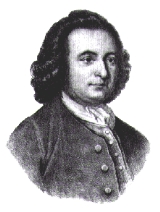
George Mason IV was an
AmericanThe United States of America is a federal constitutional republic comprising fifty states and a federal district...
PatriotPatriots is a name often used to describe the colonists of the British Thirteen United Colonies who rebelled against British control during the American Revolution. It was their leading figures who, in July 1776, declared the United States of America an independent nation...
, statesman and a delegate from
VirginiaThe Commonwealth of Virginia , is a U.S. state on the Atlantic Coast of the Southern United States. Virginia is nicknamed the "Old Dominion" and sometimes the "Mother of Presidents" after the eight U.S. presidents born there...
to the U.S. Constitutional Convention. Along with
James MadisonJames Madison, Jr. was an American statesman and political theorist. He was the fourth President of the United States and is hailed as the “Father of the Constitution” for being the primary author of the United States Constitution and at first an opponent of, and then a key author of the United...
, he is called the "Father of the Bill of Rights." For these reasons he is considered one of the "
Founding FathersThe Founding Fathers of the United States of America were political leaders and statesmen who participated in the American Revolution by signing the United States Declaration of Independence, taking part in the American Revolutionary War, establishing the United States Constitution, or by some...
" of the United States.
Like anti-federalist
Patrick HenryPatrick Henry was an orator and politician who led the movement for independence in Virginia in the 1770s. A Founding Father, he served as the first and sixth post-colonial Governor of Virginia from 1776 to 1779 and subsequently, from 1784 to 1786...
, Mason was a leader of those who pressed for the addition of explicit States rights and individual rights to the U.S. Constitution as a balance to the increased federal powers, and did not sign the document in part because it lacked such a statement. His efforts eventually succeeded in convincing the Federalists to add the first ten amendments of the Constitution. These amendments, collectively known as the
Bill of RightsThe Bill of Rights is the collective name for the first ten amendments to the United States Constitution. These limitations serve to protect the natural rights of liberty and property. They guarantee a number of personal freedoms, limit the government's power in judicial and other proceedings, and...
, were based on the earlier
Virginia Declaration of RightsThe Virginia Declaration of Rights is a document drafted in 1776 to proclaim the inherent rights of men, including the right to rebel against "inadequate" government...
, which Mason had drafted in 1776.
On the nagging issue of slavery, Mason walked a fine line. Although a slaveholder himself, he found slavery repugnant for a variety of reasons. He wanted to ban further importation of slaves from Africa and prevent slavery from spreading to more states. However, he did not want the new federal government to attempt to ban slavery where it already existed, because he anticipated that such an act would be difficult and controversial.
Family
George Mason was born on December 11, 1725 to George and Ann Thomson Mason at the
Mason familyThe Mason family of Virginia is a historically significant American political family whose prominent members are known for their accomplishments in politics, business, and the military. The progenitor of the Mason family, George Mason I , arrived at Norfolk, Virginia on the ship Assurance in 1652...
plantation in
Fairfax County, VirginiaFairfax County is a county in Virginia, in the United States. Per the 2010 Census, the population of the county is 1,081,726, making it the most populous jurisdiction in the Commonwealth of Virginia, with 13.5% of Virginia's population...
. His father died in 1735 in a boating accident on the Potomac, when the boat capsized and he drowned. After this event the younger Mason lived with his uncle
John MercerJohn Mercer was a colonial American lawyer, land speculator, and author.Born in Dublin, Ireland, he came to Virginia in 1720 where he built the colonial estate Marlborough...
. On April 4, 1750, he married sixteen-year-old Ann Eilbeck, from a plantation in
Charles County, MarylandCharles County is a county in the south central portion of the U.S. state of Maryland.As of 2010, the population was 146,551. Its county seat is La Plata. This county was named for Charles Calvert , third Baron Baltimore....
. They lived in a house on his property in Dogue's Neck, Virginia. Mason completed construction of
Gunston HallGunston Hall is an 18th-century Georgian mansion near the Potomac River in Mason Neck, Virginia, United States of America. The house was the home of the United States Founding Father George Mason. It was located at the center of a 5500 acre plantation...
, a plantation house on the Potomac River, in 1759. He and his wife had twelve children, nine of whom survived to adulthood. Mason's first child,
George Mason VGeorge Mason V of Lexington was a planter, businessman, and militia leader. Mason was the eldest son of United States patriot, statesman, and delegate from Virginia to the U.S. Constitutional Convention, George Mason IV....
of Lexington, was born on April 30, 1753. He married Elizabeth Mary Ann Barnes Hooe (Betsy) on April 22, 1784, and after having six children, died on December 5, 1796. The next Mason offspring was Ann Eilbeck Mason, fondly known as Nancy. Born on January 13, 1755, she married Rinaldo Johnson on February 4, 1789 and had three children before dying in 1814. The third child was named William Mason, but he did not live over a year and died in 1757. The fourth child, born on October 22, 1757, was also named
William MasonWilliam Mason was a militiaman in the American Revolutionary War and a prominent Virginia planter. Mason was the son of George Mason, an American patriot, statesman, and delegate from Virginia to the U.S. Constitutional Convention.-Early life and education:Mason was born on 22 October 1757...
, and he married Ann Stuart on July 11, 1793. They had five children together, and he died in 1818. The fifth child was a son they named
Thomson MasonThomson Mason was a prominent entrepreneur, planter, civil servant, and justice. Mason was the son of George Mason, an American patriot, statesman, and delegate from Virginia to the U.S. Constitutional Convention....
. He was born on March 4, 1759 and died on March 11, 1820. Thomson married Sarah McCarty Chichester of Newington in 1784; they had eight children.
George Mason's sixth child, christened Sarah Eilbeck Mason but fondly known as Sally, was born on December 11, 1760 and married in 1778. She had ten children with her husband Daniel McCarty, Jr. before dying on September 11, 1823. The seventh of the Mason children was another girl, Mary Thomson Mason. She was born on January 24, 1764, and married John Travers Cooke on November 18, 1784, with whom she had ten children before dying in 1806.
John MasonJohn Mason was an early American merchant, banker, planter. As a son of George Mason, a Founding Father of the United States, Mason was a scion of the prominent Mason political family.-Early life and education:...
was Mason's eighth child, being born on April 4, 1766. He married Anna Marie Murray on February 14, 1796, had ten children, and died on March 19, 1849. The ninth child was a daughter named Elizabeth Mason. She was born on April 19, 1768 and died sometime between 1792 and June of 1797. She married William Thornton in 1789 and they had two children. The tenth child,
Thomas MasonThomas Mason was an early American businessman, planter, and politician. As a son of George Mason, a Founding Father of the United States, Mason was a scion of the prominent Mason political family....
, was born on May 1, 1770 and died on September 18, 1800. He married Sarah Barnes Hooe on April 22, 1793 and the two had four children together.
George Mason's last two children were James and Richard Mason; twins who were born in December, 1772 but died six weeks later. Their mother died three months later on March 9, 1773 due to complications. George Mason remarried on April 11, 1780 but did not have any children with his new wife, Sarah Brent. George Mason also suffered from the condition known as
goutGout is a medical condition usually characterized by recurrent attacks of acute inflammatory arthritis—a red, tender, hot, swollen joint. The metatarsal-phalangeal joint at the base of the big toe is the most commonly affected . However, it may also present as tophi, kidney stones, or urate...
for a large part of his life, and in accordance with current medical treatment, relied upon
bloodlettingBloodletting is the withdrawal of often little quantities of blood from a patient to cure or prevent illness and disease. Bloodletting was based on an ancient system of medicine in which blood and other bodily fluid were considered to be "humors" the proper balance of which maintained health...
.
Mason had virtually no formal schooling and essentially educated himself from his uncle's library.
Politics
Mason served at the Virginia Convention in Williamsburg in 1776. During this time he created drafts of the first declaration of rights and state constitution in the Colonies. Both were adopted after committee alterations; the Virginia Declaration of Rights was adopted June 12, 1776, and the Virginia Constitution was adopted June 29, 1776.
Mason was appointed in 1786 to represent Virginia as a delegate to a Federal Convention, to meet in Philadelphia for the purpose of revising the
Articles of ConfederationThe Articles of Confederation, formally the Articles of Confederation and Perpetual Union, was an agreement among the 13 founding states that legally established the United States of America as a confederation of sovereign states and served as its first constitution...
. He served at the Federal Convention in Philadelphia from May to September 1787 and contributed significantly to the formation of the Constitution. "He refused to sign the
Constitution, however, and returned to his native state as an outspoken
opponent in the ratification contest."
One objection to the proposed Constitution was that it lacked a "declaration of rights". As a delegate to
Virginia's ratification conventionThe Virginia Ratifying Convention was a convention of 168 delegates from Virginia who met in 1788 to ratify or reject the United States Constitution, which had been drafted at the Philadelphia Convention the previous year.The Convention met and deliberated from June 2 through June 27 in Richmond...
, he opposed ratification without amendment. Among the amendments he desired was a bill of rights. This opposition, both before and during the convention, may have cost Mason his long friendship with his neighbor
George WashingtonGeorge Washington was the dominant military and political leader of the new United States of America from 1775 to 1799. He led the American victory over Great Britain in the American Revolutionary War as commander-in-chief of the Continental Army from 1775 to 1783, and presided over the writing of...
, and is probably a leading reason why George Mason became less well-known than other U.S. founding fathers in later years. On December 15, 1791, the U.S. Bill of Rights, based primarily on George Mason's Virginia Declaration of Rights, was ratified in response to the agitation of Mason and others.
At the convention, Mason was one of the five most frequent speakers. Mason believed in the disestablishment of the church. Mason was a strong anti-federalist who wanted a weak central government, divided into three parts, with little power, leaving the several States with a preponderance of political power.
An important issue for him in the convention was the Bill of Rights. He did not want the United States to be like England. He foresaw sectional strife and feared the power of government.
Slavery
A Virginia planter, Mason owned many African slaves. Like some of his contemporary slave owners (e.g. Thomas Jefferson and George Washington), Mason conceded that the institution was morally objectionable, once calling it a "slow Poison" that "is daily contaminating the Minds & Morals of our People."
Mason favored the abolition of the slave trade, but he did not advocate for the immediate abolition of slavery. Like Jefferson, he owned slaves whom he did not manumit.
Two of Mason's stated reasons for opposing the U.S. Constitution were seemingly contradictory: on the one hand, he said that the draft Constitution did not specifically protect the right of states to let slavery continue where it already existed, and on the other hand he also said that the draft Constitution did not allow Congress to immediately stop the importation of slaves. Mason's immediate concern was to prevent more slaves from being imported, and to prevent slavery from spreading into more states. He was not eager to ban slavery where it already existed: "It is far from being a desirable property. But it will involve us in great difficulties and infelicity to be now deprived of them." Mason ostensibly balanced his anti-slavery argument that importation should stop, with a pro-slavery argument that the draft Constitution should protect slavery from being taxed out of existence; however, the latter argument had already been incorporated into the Constitution according to James Madison.
Because of his efforts to stop the spread of slavery, and his recognition of the undesirability of slavery, some historians have said that Mason should be categorized as an abolitionist. Other historians have disagreed.
Death and remembrance
George Mason died peacefully at his home,
Gunston HallGunston Hall is an 18th-century Georgian mansion near the Potomac River in Mason Neck, Virginia, United States of America. The house was the home of the United States Founding Father George Mason. It was located at the center of a 5500 acre plantation...
, on October 7, 1792. Gunston Hall, located in
Mason Neck, VirginiaMason Neck is a peninsula jutting into the Potomac River to the south of Washington, DC. It is surrounded also by Belmont Bay to the west, Gunston Cove to the east, and Pohick Bay to the northeast...
, is now a museum and tourist attraction. The
George Mason MemorialThe George Mason Memorial is a memorial to George Mason in West Potomac Park in Washington, D.C., the capital of the United States.It commemorates the contributions of George Mason, an important American Founder who wrote the Virginia Declaration of Rights and served as a delegate to the 1787...
in
West Potomac ParkWest Potomac Park is a U.S. national park in Washington, D.C., adjacent to the National Mall. It includes the parkland that extends south of the Lincoln Memorial Reflecting Pool, from the Lincoln Memorial to the grounds of the Washington Monument...
,
Washington, D.C.Washington, D.C., formally the District of Columbia and commonly referred to as Washington, "the District", or simply D.C., is the capital of the United States. On July 16, 1790, the United States Congress approved the creation of a permanent national capital as permitted by the U.S. Constitution....
, near the Thomas Jefferson Memorial, was dedicated on April 9, 2002. The George Mason Memorial Bridge, one of five that make up the 14th Street Bridge, connects Washington, D.C. to Virginia. George Mason Elementary School in
Alexandria, VirginiaAlexandria is an independent city in the Commonwealth of Virginia. As of 2009, the city had a total population of 139,966. Located along the Western bank of the Potomac River, Alexandria is approximately six miles south of downtown Washington, D.C.Like the rest of northern Virginia, as well as...
,
George Mason High SchoolGeorge Mason High School is a comprehensive public high school serving the independent City of Falls Church. It is located in the unincorporated area of Idylwood, in Fairfax County, Virginia, adjacent to Falls Church City....
in
Falls Church, VirginiaThe City of Falls Church is an independent city in Virginia, United States, in the Washington Metropolitan Area. The city population was 12,332 in 2010, up from 10,377 in 2000. Taking its name from The Falls Church, an 18th-century Anglican parish, Falls Church gained township status within...
and
George Mason UniversityGeorge Mason University is a public university based in unincorporated Fairfax County, Virginia, United States, south of and adjacent to the city of Fairfax. Additional campuses are located nearby in Arlington County, Prince William County, and Loudoun County...
in
Fairfax, VirginiaThe City of Fairfax is an independent city forming an enclave within the confines of Fairfax County, in the Commonwealth of Virginia in the United States. Although politically independent of the surrounding county, the City is nevertheless the county seat....
, are named in his honor, as are
Mason County, KentuckyMason County is a county located in the U.S. state of Kentucky. As of 2000, the population was 16,800. Its county seat is Maysville. The county is named for George Mason, a Virginia delegate to the U.S. Constitutional Convention, known as the "Father of the Bill of Rights"...
,
Mason County, West VirginiaAs of the census of 2000, there were 25,957 people, 10,587 households, and 7,569 families residing in the county. The population density was 60 people per square mile . There were 12,056 housing units at an average density of 28 per square mile...
and
Mason County, Illinois. He was honored by the
United States Postal ServiceThe United States Postal Service is an independent agency of the United States government responsible for providing postal service in the United States...
with an 18¢
Great Americans seriesThe Great Americans series is a set of definitive stamps issued by the United States Postal Service, starting on December 27, 1980 with the 19¢ stamp depicting Sequoyah, and continuing through 2002, the final stamp being the 78¢ Alice Paul self-adhesive stamp. The series, noted for its simplicity...
postage stampA postage stamp is a small piece of paper that is purchased and displayed on an item of mail as evidence of payment of postage. Typically, stamps are made from special paper, with a national designation and denomination on the face, and a gum adhesive on the reverse side...
. A bas-relief of Mason appears in the Chamber of the U.S. House of Representatives as one of 23 honoring great lawmakers; his image is located above and to the right of the Speaker's chair.
See also
- U.S. Constitution, slavery debate in Convention
External links