
Home      Discussion      Topics      Dictionary      Almanac
Signup       Login
Geography of Hong Kong

Geography of Hong Kong

Overview
The geography
Geography
Geography is the study of the Earth and its lands, features, inhabitants, and phenomena. A literal translation would be "to describe or write about the Earth". The first person to use the word "geography" was Eratosthenes...

 of Hong Kong
Hong Kong
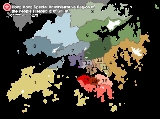
Hong Kong , officially the Hong Kong Special Administrative Region, is a highly autonomous territory of the People's Republic of China, facing Guangdong to the north and the South China Sea to the east, west and south...

primarily consists of three main territories: Hong Kong Island
Hong Kong Island
Hong Kong Island is an island in the southern part of Hong Kong. It has a population of 1,289,500 and its population density is 16,390/km², as of 2008...

, Kowloon Peninsula
Kowloon Peninsula
The Kowloon Peninsula is a peninsula that forms the southern part of the main landmass in the territory of Hong Kong. The Kowloon Peninsula and the area of New Kowloon are collectively known as Kowloon....

, and the New Territories
New Territories
New Territories is one of the three main regions of Hong Kong, alongside Hong Kong Island and the Kowloon peninsula. Historically, it is the region described in The Convention for the Extension of Hong Kong Territory...

. The geography of Hong Kong is varied and is home to various physical geographical features.

The name "Hong Kong", literally meaning "fragrant harbour", is derived from the area around present-day Aberdeen on Hong Kong Island
Hong Kong Island
Hong Kong Island is an island in the southern part of Hong Kong. It has a population of 1,289,500 and its population density is 16,390/km², as of 2008...

, where fragrant wood products and fragrant incense were once traded. The narrow body of water separating Hong Kong Island and Kowloon Peninsula, Victoria Harbour
Victoria Harbour
Victoria Harbour is a natural landform harbour situated between Hong Kong Island and the Kowloon Peninsula in Hong Kong. The harbour's deep, sheltered waters and strategic location on the South China Sea was instrumental in Hong Kong's establishment as a British colony and its subsequent...

, is one of the deepest natural maritime port
Port
||-||-||-||-||-||-||-||-|}A port is a facility for receiving ships and/or transferring cargo. It is usually found at the edge of an ocean, sea, river, or lake. The best ports have deep water in channels or berths, and protection from the wind and waves...

s in the world.

Hong Kong and its 260 territorial islands and peninsulas are located in the South China Sea
South China Sea
The South China Sea is a marginal sea*south of mainland China and Taiwan,*west of the Philippines,*north west of Sabah , Sarawak and Brunei,*north of Indonesia,*north east of the Malay peninsula and Singapore, and...

, at the mouth of the Pearl River Delta
Pearl River Delta
The Pearl River Delta in southern People's Republic of China is the low-lying area alongside the Pearl River estuary where the Pearl River flows into the South China Sea. Since economic liberalisation was adopted by the Chinese government in the late 1970s, the delta has become one of the leading...

.

The Kowloon Peninsula to the south of Boundary Street
Boundary Street
Boundary Street is a three-lane one-way street in Kowloon, Hong Kong. It runs in the eastbound direction starting at its intersection with Tung Chau Street in the west, and ending at its intersection with Prince Edward Road West in the east, near the former Kai Tak Airport.-History:Historically,...

 and the New Territories
New Territories
New Territories is one of the three main regions of Hong Kong, alongside Hong Kong Island and the Kowloon peninsula. Historically, it is the region described in The Convention for the Extension of Hong Kong Territory...

 to the north of Hong Kong Island were added to Colonial Hong Kong
Colonial Hong Kong
The British Hong Kong period began in the 19th century when the British, Dutch, French, Indians and Americans saw China as the world's largest untapped market. The British empire launched their first and one of the most aggressive expeditionary forces to claim the territory under Queen Victoria in...

 in 1860 and 1898 respectively.
Discussion
Ask a question about 'Geography of Hong Kong'
Start a new discussion about 'Geography of Hong Kong'
Answer questions from other users
Full Discussion Forum
 
Encyclopedia
The geography
Geography
Geography is the study of the Earth and its lands, features, inhabitants, and phenomena. A literal translation would be "to describe or write about the Earth". The first person to use the word "geography" was Eratosthenes...

 of Hong Kong
Hong Kong
Hong Kong , officially the Hong Kong Special Administrative Region, is a highly autonomous territory of the People's Republic of China, facing Guangdong to the north and the South China Sea to the east, west and south...

primarily consists of three main territories: Hong Kong Island
Hong Kong Island
Hong Kong Island is an island in the southern part of Hong Kong. It has a population of 1,289,500 and its population density is 16,390/km², as of 2008...

, Kowloon Peninsula
Kowloon Peninsula
The Kowloon Peninsula is a peninsula that forms the southern part of the main landmass in the territory of Hong Kong. The Kowloon Peninsula and the area of New Kowloon are collectively known as Kowloon....

, and the New Territories
New Territories
New Territories is one of the three main regions of Hong Kong, alongside Hong Kong Island and the Kowloon peninsula. Historically, it is the region described in The Convention for the Extension of Hong Kong Territory...

. The geography of Hong Kong is varied and is home to various physical geographical features.

The name "Hong Kong", literally meaning "fragrant harbour", is derived from the area around present-day Aberdeen on Hong Kong Island
Hong Kong Island
Hong Kong Island is an island in the southern part of Hong Kong. It has a population of 1,289,500 and its population density is 16,390/km², as of 2008...

, where fragrant wood products and fragrant incense were once traded. The narrow body of water separating Hong Kong Island and Kowloon Peninsula, Victoria Harbour
Victoria Harbour
Victoria Harbour is a natural landform harbour situated between Hong Kong Island and the Kowloon Peninsula in Hong Kong. The harbour's deep, sheltered waters and strategic location on the South China Sea was instrumental in Hong Kong's establishment as a British colony and its subsequent...

, is one of the deepest natural maritime port
Port
||-||-||-||-||-||-||-||-|}A port is a facility for receiving ships and/or transferring cargo. It is usually found at the edge of an ocean, sea, river, or lake. The best ports have deep water in channels or berths, and protection from the wind and waves...

s in the world.

Overview


Hong Kong and its 260 territorial islands and peninsulas are located in the South China Sea
South China Sea
The South China Sea is a marginal sea*south of mainland China and Taiwan,*west of the Philippines,*north west of Sabah , Sarawak and Brunei,*north of Indonesia,*north east of the Malay peninsula and Singapore, and...

, at the mouth of the Pearl River Delta
Pearl River Delta
The Pearl River Delta in southern People's Republic of China is the low-lying area alongside the Pearl River estuary where the Pearl River flows into the South China Sea. Since economic liberalisation was adopted by the Chinese government in the late 1970s, the delta has become one of the leading...

.

The Kowloon Peninsula to the south of Boundary Street
Boundary Street
Boundary Street is a three-lane one-way street in Kowloon, Hong Kong. It runs in the eastbound direction starting at its intersection with Tung Chau Street in the west, and ending at its intersection with Prince Edward Road West in the east, near the former Kai Tak Airport.-History:Historically,...

 and the New Territories
New Territories
New Territories is one of the three main regions of Hong Kong, alongside Hong Kong Island and the Kowloon peninsula. Historically, it is the region described in The Convention for the Extension of Hong Kong Territory...

 to the north of Hong Kong Island were added to Colonial Hong Kong
Colonial Hong Kong
The British Hong Kong period began in the 19th century when the British, Dutch, French, Indians and Americans saw China as the world's largest untapped market. The British empire launched their first and one of the most aggressive expeditionary forces to claim the territory under Queen Victoria in...

 in 1860 and 1898 respectively. The body of water between Hong Kong Island and Kowloon Peninsula is Victoria Harbour
Victoria Harbour
Victoria Harbour is a natural landform harbour situated between Hong Kong Island and the Kowloon Peninsula in Hong Kong. The harbour's deep, sheltered waters and strategic location on the South China Sea was instrumental in Hong Kong's establishment as a British colony and its subsequent...

, one of the deepest maritime ports in the world. The landscape of Hong Kong is fairly hilly to mountainous with steep slopes. The highest point in the territory is Tai Mo Shan
Tai Mo Shan
Tai Mo Shan has the highest peak in Hong Kong, with an altitude of 957 m. It is located approximately at the geographical centre of the New Territories....

, at a height of 958 metres. Lowlands exist in the northwestern part of the New Territories.

Hong Kong is 60 km east of Macau
Macau
The Macau Special Administrative Region , commonly known as Macau or Macao , is one of the two special administrative regions of the People's Republic of China, the other being Hong Kong...

 on the opposite side of the Pearl River estuary
Pearl River (China)
The Pearl River or less commonly, the "Guangdong River" , is China's third longest river , and second largest by volume . Located in the south, it flows into the South China Sea between Hong Kong and Macau...

. It has a land border with Shenzhen
Shenzhen
Shenzhen is a city of sub-provincial administrative status in southern China's Guangdong province, situated immediately north of Hong Kong...

 to the north. Of the territory's 1,092 square kilometres, less than 25 percent is developed. The remaining land is reserved as country parks and nature reserves.

Geographical information


Location


Hong Kong is located in eastern Asia
Asia
Asia is the world's largest and most populous continent, located in the eastern and northern hemispheres. It covers 8.6% of the earth's total surface area and with approximately 4 billion people, it hosts 60% of the world's current human population.Asia is traditionally defined as part of the...

, on the southeast coast of the People's Republic of China
People's Republic of China
The People's Republic of China , commonly known as China, is the largest country in East Asia and the most populous in the world with over 1.3 billion people, approximately one-fifth of the world's population...

, facing the South China Sea
South China Sea
The South China Sea is a marginal sea*south of mainland China and Taiwan,*west of the Philippines,*north west of Sabah , Sarawak and Brunei,*north of Indonesia,*north east of the Malay peninsula and Singapore, and...

.

Area


Total:

Land:

Water:

Figures published by the United States Central Intelligence Agency

Land boundaries


Total: 30 km

Border city: Shenzhen
Shenzhen
Shenzhen is a city of sub-provincial administrative status in southern China's Guangdong province, situated immediately north of Hong Kong...

 Special Economic Zone
Special Economic Zone
A Special Economic Zone is a geographical region that has economic laws that are more liberal than a country's typical economic laws...

, Guangdong
Guangdong
Guangdong is a province on the southern coast of People's Republic of China. The province was previously often written with the alternative English name Kwangtung Province...

 Province
Province
A province is a territorial unit, almost always an administrative division, within a country or state.-Roman provinces:The word is attested in English since c.1330, deriving from Old French province , which comes from the Latin word provincia, which referred to the sphere of activity which a...


Figures published by the United States Central Intelligence Agency

Coastline


Total: 733 km

Maritime claims:

Territorial sea: 3 nm

Figures published by the United States Central Intelligence Agency

Islands


Hong Kong
Hong Kong
Hong Kong , officially the Hong Kong Special Administrative Region, is a highly autonomous territory of the People's Republic of China, facing Guangdong to the north and the South China Sea to the east, west and south...

 has 262 islands including Hong Kong Island
Hong Kong Island
Hong Kong Island is an island in the southern part of Hong Kong. It has a population of 1,289,500 and its population density is 16,390/km², as of 2008...

, Lantau Island
Lantau Island
Lantau Island, also Lantao, based on the old local name of Lantau Peak , is the largest island in Hong Kong, located at the mouth of the Pearl River. Administratively, it is part of the Islands District, but a small part in the northeast of the island belongs to Tsuen Wan District. It has an area...

, Cheung Chau
Cheung Chau
Cheung Chau is a small island 10 km southwest of Hong Kong Island. It has been inhabited for longer than most other places in the territory of Hong Kong, with a population of about 30,000 up to 2006...

, Lamma Island
Lamma Island
Lamma Island , also known as Pok Liu Chau or simply Pok Liu , is the third largest island in Hong Kong and part of the Islands District, Hong Kong.-Description:Lamma Island is in the southwest of Hong Kong Island...

, Peng Chau
Peng Chau
Peng Chau is a small island located off the north-eastern coast of Lantau Island. Administratively, it is part of the Islands District of Hong Kong. It has an area of 0.98 km²....

 and Tsing Yi Island.

Climate


Hong Kong's climate is subtropical and monsoonal with cool dry winters and hot wet summers. As of 2006, its annual average rainfall is 2,214 mm, though about 80% of the rain falls between May and September. It is occasionally affected by tropical cyclone
Tropical cyclone
A tropical cyclone is a storm system characterized by a large low-pressure center and numerous thunderstorms that produce strong winds and heavy rain. Tropical cyclones feed on heat released when moist air rises, resulting in condensation of water vapor contained in the moist air...

s between May and November, most often from July to September. The mean temperature of Hong Kong ranges from 17 °C in January to 29 °C in July.

January and February are more cloudy, with occasional cold front
Cold front
A cold front is defined as the leading edge of a cooler and drier mass of air, replacing a warmer mass of air.-Development of cold front:...

s followed by dry northerly winds. It is not uncommon for temperatures to drop below 10 °C in urban areas. Sub-zero temperatures and frost
Frost
Frost is the solid deposition of water vapor from saturated air. It is formed when solid surfaces are cooled to below the dew point of the adjacent air. Frost crystals' size differ depending on time and water vapor available. Frost is also usually translucent in appearance. There are many types of...

 occur at times on high ground and in the New Territories. March and April can be pleasant although there are occasional spells of high humidity. Fog
Fog
Fog is a cloud that is in contact with the ground. A cloud may be considered partly fog; for example, the part of a cloud that is suspended in the air above the ground is not considered fog, whereas the part of the cloud that comes in contact with higher ground is considered fog...

 and drizzle
Drizzle
Drizzle is a light rain precipitation consisting of liquid water drops smaller than those of rain, and generally smaller than 0.5 mm in diameter. Drizzle is normally produced by low stratiform clouds and stratocumulus clouds. Precipitation rates due to drizzle are on the order of a millimeter per...

 are common on high ground which is exposed to the southeast. May to August are hot and humid with occasional shower
Shower
A shower is a device for washing, typically consisting of an enclosed area and an overhead nozzle. To use a shower, a person stands in the enclosed area while the nozzle sprays water down on the body...

s and thunderstorm
Thunderstorm
A thunderstorm, also known as an electrical storm, a lightning storm, a hailstorm, or simply a storm is a form of weather characterized by the presence of lightning and its acoustic effect on the Earth's atmosphere known as thunder. The meteorologically-assigned cloud type associated with the...

s. Afternoon temperatures often exceed 31 °C whereas at night, temperatures generally remain around 26 °C with high humidity. In November and December there are pleasant breezes, plenty of sunshine and comfortable temperatures.

Terrain


Hong Kong's terrain is hilly and mountainous with steep slopes. There are lowlands in the northern part of Hong Kong. A significant amount of land in Hong Kong, especially on the Hong Kong Island and the Kowloon peninsula, is reclaimed
Land reclamation in Hong Kong
This article is about Land reclamation in Hong Kong.Land is in short supply in Hong Kong and land reclamation has been conducted there since the mid-19th century.-Projects:...

.

Extreme points


The lowest elevation in Hong Kong is in South China Sea (0 m) while the highest elevation is at Tai Mo Shan
Tai Mo Shan
Tai Mo Shan has the highest peak in Hong Kong, with an altitude of 957 m. It is located approximately at the geographical centre of the New Territories....

 (958 m) in Tsuen Wan, the New Territories
New Territories
New Territories is one of the three main regions of Hong Kong, alongside Hong Kong Island and the Kowloon peninsula. Historically, it is the region described in The Convention for the Extension of Hong Kong Territory...

.

Land

  • Northernmost: Shenzhen River 
  • Easternmost: Ping Chau
    Ping Chau
    Ping Chau is an island in Hong Kong, China. It is also known as Tung Ping Chau . Tung is prepended to the name so as to avoid possible confusion with Peng Chau, another island in Hong Kong with a similarly pronounced name...

     
  • Southernmost: Tau Lo Chau 
  • Westernmost: Peaked Hill
    Peaked Hill
    Peaked Hill, also known as Kai Yek Kok , is an island on the westmost point of Hong Kong territories. The island is close to the west side of southwest Lantau Island, near Tsin Yue Wan and can be spotted from the 7th stage of Lantau Trail.The island is north of Lantau Channel and affected by the...


Principal peaks of Hong Kong


  1. Tai Mo Shan
    Tai Mo Shan
    Tai Mo Shan has the highest peak in Hong Kong, with an altitude of 957 m. It is located approximately at the geographical centre of the New Territories....

     - 957 m, Tsuen Wan
    Tsuen Wan
    Tsuen Wan is a bay in the New Territories of Hong Kong, opposite to Tsing Yi Island across Rambler Channel. A market town of the Tsuen Wan emerged for the surrounding villages and fleets of fishing boats in the area. The town is around the present-day Tsuen Wan Station of the MTR...

  2. Lantau Peak
    Lantau Peak
    Lantau Peak or Fung Wong Shan is the second highest peak in Hong Kong. It is situated on Lantau Island, with a height of 934 m above sea level...

     (Fung Wong Shan) - 934 m, on Lantau Island
    Lantau Island
    Lantau Island, also Lantao, based on the old local name of Lantau Peak , is the largest island in Hong Kong, located at the mouth of the Pearl River. Administratively, it is part of the Islands District, but a small part in the northeast of the island belongs to Tsuen Wan District. It has an area...

  3. Sunset Peak
    Sunset Peak
    Sunset Peak or Tai Tung Shan is the third highest peak in Hong Kong. It situates on the Lantau Island with height 869 m above the sea level. Whilst the second highest Lantau Peak is on the island west, it stands on the other side of the island.It is in the Lantau South Country Park.-See...

     (Tai Tung Shan) - 869 m, on Lantau Island
    Lantau Island
    Lantau Island, also Lantao, based on the old local name of Lantau Peak , is the largest island in Hong Kong, located at the mouth of the Pearl River. Administratively, it is part of the Islands District, but a small part in the northeast of the island belongs to Tsuen Wan District. It has an area...

  4. Sze Fong Shan
    Sze Fong Shan
    Sze Fong Shan , located in the New Territories, is the fourth highest peak in Hong Kong. With a height of 785 m, it is at the northeast of Tai Mo Shan. The Stage 8 of the MacLehose Trail passes near it....

     - 785 m
  5. Lin Fa Shan
    Lin Fa Shan
    Lin Fa Shan is the sixth highest hill in Hong Kong. With height of 766 m on the Lantau Island, it is situated between Mui Wo and Sunset Peak....

     - 766 m, on Lantau Island
    Lantau Island
    Lantau Island, also Lantao, based on the old local name of Lantau Peak , is the largest island in Hong Kong, located at the mouth of the Pearl River. Administratively, it is part of the Islands District, but a small part in the northeast of the island belongs to Tsuen Wan District. It has an area...

  6. Nei Lak Shan
    Nei Lak Shan
    Nei Lak Shan is the sixth highest hill in Hong Kong. With height on the Lantau Island, it is situated immediate north of Ngong Ping where Buddhist Po Lin Monastery located. Nei Lak, or correctly Mei Lak is a Cantonese language translation of Maitreya, the future Buddha, in Buddhism.There will...

     - 751 m, on Lantau Island
    Lantau Island
    Lantau Island, also Lantao, based on the old local name of Lantau Peak , is the largest island in Hong Kong, located at the mouth of the Pearl River. Administratively, it is part of the Islands District, but a small part in the northeast of the island belongs to Tsuen Wan District. It has an area...

  7. Yi Tung Shan
    Yi Tung Shan
    Yi Tung Shan is the seventh highest hill in Hong Kong. With height 747 m on the Lantau Island, it is situated east of Sunset Peak. While the Sunset Peak, known as Tai Tung Shan, literally means the first east hill in Cantonese language, the Yi Tung Shan means the second east hill...

     - 747 m, on Lantau Island
    Lantau Island
    Lantau Island, also Lantao, based on the old local name of Lantau Peak , is the largest island in Hong Kong, located at the mouth of the Pearl River. Administratively, it is part of the Islands District, but a small part in the northeast of the island belongs to Tsuen Wan District. It has an area...

  8. Ma On Shan
    Ma On Shan (peak)
    Ma On Shan is saddle-shaped peak in east of Tolo Harbour in the New Territories of Hong Kong. With a peak of 702 metres , it stands among the ten highest mountains in Hong Kong. The mountain borders Sha Tin, Sai Kung and Tai Po districts....

     - 702 m
  9. The Hunch Backs
    The Hunch Backs
    The Hunch Backs or Ngau Ngak Shan is the ninth highest hill in Hong Kong. Peaked at 674 m, it is at the north of Ma On Shan.-See also:*List of mountains, peaks and hills in Hong Kong...

     (Ngau Ngak Shan) - 674 m
  10. Grassy Hill
    Grassy Hill
    Grassy Hill is the tenth highest hill in Hong Kong. Peaked at 647 m, it is situated between Tsuen Wan and Tai Po and near the Lead Mine Pass. The Stage 7 of MacLehose Trail runs near its peak....

     - 647 m
  11. Wong Leng - 639 m
  12. Buffalo Hill - 606 m
  13. West Buffalo Hill - 604 m
  14. Kowloon Peak
    Kowloon Peak
    Kowloon Peak or Fei Ngor Shan or Fei Ngo Shan is a tall mountain in the northeast corner of New Kowloon, Hong Kong, situated in Ma On Shan Country Park. It is crossed by both the Wilson Trail and the MacLehose Trail. On the lower slopes is Gilwell Campsite, belonging to The Scout...

     (Fei Ngo Shan) - 602 m
  15. Shun Yeung Fung - 591 m
  16. Tiu Shau Ngam - 588 m
  17. Kai Kung Leng - 585 m
  18. Castle Peak
    Castle Peak, Hong Kong
    Castle Peak or Pui To Shan is a 583 m high peak in the western New Territories of Hong Kong.In contrast to its chinese name, which means green hill; Castle Peak is notorious for its severe loss of vegetation and weathering of its Granite surface.The area to the west of the hill was also named...

     - 583 m
  19. Lin Fa Shan, Tsuen Wan - 578 m
  20. Tate's Cairn
    Tate's Cairn
    Tate's Cairn is one of many mountain peaks in Hong Kong. The peak is 583 metres in height. It is a member of the Kowloon ridge....

     (Tai Lo Shan) - 577 m


Victoria Peak
Victoria Peak
Victoria Peak is a mountain in Hong Kong. It is also known as Mount Austin, and locally as The Peak. The mountain is located in the western half of Hong Kong Island...

, the highest point on Hong Kong Island
Hong Kong Island
Hong Kong Island is an island in the southern part of Hong Kong. It has a population of 1,289,500 and its population density is 16,390/km², as of 2008...

, at 552 m is the 24th highest peak in Hong Kong.

Natural resources


The natural resources of Hong Kong can be divided into three main categories:
  • Metalliferous minerals and non-metalliferous industrial minerals in the onshore area;
  • Quarried rock and building stone;
  • Offshore sand deposits.


Despite its small size, Hong Kong has a relatively large number of mineral occurrences. Some mineral deposits have been exploited commercially. Metalliferous mineral occurrences are grouped into four broad categories: tin
Tin
Tin is a chemical element with the symbol Sn and atomic number 50. It is a main group metal in group 14 of the periodic table. Tin shows chemical similarity to both neighboring group 14 elements, germanium and lead, like the two possible oxidation states +2 and +4...

-tungsten
Tungsten
Tungsten , also known as wolfram , is a chemical element with the chemical symbol W and atomic number 74.A steel-gray metal, tungsten is found in several ores, including wolframite and scheelite...

-molybdenum
Molybdenum
Molybdenum , is a Group 6 chemical element with the symbol Mo and atomic number 42. The free element, which is a silvery metal, has the sixth-highest melting point of any element. It readily forms hard, stable carbides, and for this reason it is often used in high-strength steel alloys...

 mineralisation, copper
Copper
Copper is a chemical element with the symbol Cu and atomic number 29.It is a ductile metal with very high thermal and electrical conductivity. Pure copper is rather soft and malleable and a freshly-exposed surface has a pinkish or peachy color...

-lead
Lead
Lead is a main-group element with symbol Pb and atomic number 82. Lead is a soft, malleable poor metal, also considered to be one of the heavy metals. Lead has a bluish-white color when freshly cut, but tarnishes to a dull grayish color when exposed to air...

-zinc
Zinc
Zinc , also known as spelter, is a metallic chemical element; it has the symbol Zn and atomic number 30. It is the first element in group 12 of the periodic table. Zinc is, in some respects, chemically similar to magnesium, because its ion is of similar size and its only common oxidation state is +2...

 mineralisation, iron
Iron
Iron is a metallic chemical element with the symbol Fe and atomic number 26. Iron is a group 8 and period 4 element and is therefore classified as a transition metal. Iron and iron alloys are by far the most common metals and the most common ferromagnetic materials in everyday use...

 mineralisation and placer deposits of tin
Tin
Tin is a chemical element with the symbol Sn and atomic number 50. It is a main group metal in group 14 of the periodic table. Tin shows chemical similarity to both neighboring group 14 elements, germanium and lead, like the two possible oxidation states +2 and +4...

 and gold
Gold
Gold is a chemical element with the symbol Au and an atomic number of 79. It has been a highly sought-after precious metal for coinage, jewelry, and other arts since the beginning of recorded history. The metal occurs as nuggets or grains in rocks, in veins and in alluvial deposits. Gold is...

. Mesozoic
Mesozoic
The Mesozoic Era is one of three geologic eras of the Phanerozoic eon. The division of time into eras dates back to Giovanni Arduino, in the 18th century, although his original name for the era now called the "Mesozoic" was "Secondary" The Mesozoic Era is one of three geologic eras of the...

 igneous activity is largely responsible for this diversity of mineral deposits and the mineral concentrations have been variably enhanced by hydrothermal activity associated with faulting. Concentrations of non-metalliferous minerals that have been commercially exploited include kaolin clay, feldspar
Feldspar
Feldspars are a group of rock-forming tectosilicate minerals which make up as much as 60% of the Earth's crust....

, quartz
Quartz
Quartz is the second most abundant mineral in the Earth's continental crust . It is made up of a continuous framework of SiO4 silicon-oxygen tetrahedra, with each oxygen being shared between two tetrahedra, giving an overall formula SiO2.There are many different varieties of...

, beryl
Beryl
The mineral beryl is a beryllium aluminium cyclosilicate with the chemical formula Be3Al26. The hexagonal crystals of beryl may be very small or range to several meters in size. Terminated crystals are relatively rare...

 and graphite
Graphite
The mineral graphite is one of the allotropes of carbon. It was named by Abraham Gottlob Werner in 1789 from the Greek γραφειν : "to draw/write", for its use in pencils, where it is commonly called lead, as distinguished from the actual metallic element lead...

.

For many years, granite
Granite
Granite is a common and widely occurring type of intrusive, felsic, igneous rock. Granite has a medium to coarse texture, occasionally with some individual crystals larger than the groundmass forming a rock known as porphyry. Granites can be pink to dark gray or even black, depending on their...

 and volcanic rocks have been quarried locally for road base metal, riprap, armour stone and asphalt, although the main purpose now is for concrete aggregates. At present, there are three quarries operating in Hong Kong. These are principally in granite and are located at Lam Tei
Lam Tei
Lam Tei is an area in the Tuen Mun District, New Territories, Hong Kong- See also :* Light Rail * Castle Peak Road* List of planning areas in Hong Kong* Hung Shui Kiu* Tuen Mun River* Yuen Long Highway* Anderson Road- External links :* *...

, Shek O
Shek O
Shek O is a beachside village in the Southern District of Hong Kong, surrounded by Shek O Country Park, Big Wave Bay and Cape D'Aguilar. The entire area is a peninsula on the southern coast of the Hong Kong Island, facing the South China Sea. The name "Shek O" literally means the "rocky bay"...

 and Anderson Road
Anderson Road
Anderson Road is a road on the eastern border of the New Territories and New Kowloon in Hong Kong. It starts near the junction of Clear Water Bay Road and New Clear Water Bay Road, above Shun Lee Estate, and runs southeast windingly to Tsiu Lan Shue and continues eastward on the hills above Sau...

. All the quarries are in the process of rehabilitation and have a life expectancy of between two to eight years.

Offshore sand bodies have been dredged for aggregate sand and reclamation fill in Hong Kong has grown as the rate of urban development has increased.

there are some more natural resources like forest and wildlife.

Land use


Arable land: 5.05%

Permanent crops: 1.01%

Other: 93.94% (2001 est.)

Figures published by the United States Central Intelligence Agency

Natural hazards


Tropical cyclone
Tropical cyclone
A tropical cyclone is a storm system characterized by a large low-pressure center and numerous thunderstorms that produce strong winds and heavy rain. Tropical cyclones feed on heat released when moist air rises, resulting in condensation of water vapor contained in the moist air...

s frequent Hong Kong during the summer months between June and August typically. Landslides are common after a rainstorm.

Environmental issues

  • Air
    Air pollution in Hong Kong
    Air pollution in Hong Kong is considered a serious problem. It affects flora and fauna in the area, and the health of residents living there. Visibility is currently less than eight kilometers for 30% of the year...

     and water pollution
    Water pollution
    Water pollution is the contamination of water bodies such as lakes, rivers, oceans, and groundwater. All water pollution affects organisms and plants that live in these water bodies and in almost all cases the effect is damaging either to individual species and populations but also to the natural...

     from rapid urbanisation
  • Extinction of natural species
  • Introduction of exotic species

See also


  • Country parks and conservation in Hong Kong
    Country parks and conservation in Hong Kong
    Although Hong Kong is regarded as one of the world's great cities, out of the total 1,092 km² of land, about three-quarters is countryside. Scenically, Hong Kong has a great deal to offer - a landscape rising from sandy beaches and rocky foreshores to heights of almost 1,000 metres, woodlands...

  • Beaches of Hong Kong
    Beaches of Hong Kong
    Hong Kong has a long coastline that is full of twists and turns with many bays and beaches. Many of them are well sheltered by mountains nearby, as Hong Kong is a mountainous place...

  • Rivers of Hong Kong
    Rivers of Hong Kong
    The location of Hong Kong, adjacent to the coast, is not close to the system of major rivers in southern China, though the water to the west of Hong Kong is influenced by Pearl River. In 1,103 km² of land, the territory is largely hilly with over 200 islands...

  • List of bays in Hong Kong
  • List of areas of Hong Kong
  • Geography of China
    Geography of China
    The geography of China stretches some across the East Asian landmass bordering the East China Sea, Korea Bay, Yellow Sea, and South China Sea, between North Korea and Vietnam in a changing configuration of broad plains, expansive deserts, and lofty mountain ranges, including vast areas of...

  • Geology of Hong Kong
    Geology of Hong Kong
    The geology of Hong Kong is dominated by Mesozoic volanic and granitic rocks, which together make up about 85% of the total land area. The remaining area is underlain by Palaeozoic meta-sedimentary rocks, Mesozoic to Cenozoic sedimentary rocks and superficial deposits.-External links:**...

  • Origins of names of cities and towns in Hong Kong
    Origins of names of cities and towns in Hong Kong
    Origins of names of cities and towns in Hong Kong...


External links