


General der Gebirgstruppe

Encyclopedia
Germany
Germany , officially the Federal Republic of Germany , is a federal parliamentary republic in Europe. The country consists of 16 states while the capital and largest city is Berlin. Germany covers an area of 357,021 km2 and has a largely temperate seasonal climate...
Army General
General (Germany)
General is presently the highest rank of the German Army and Luftwaffe . It is the equivalent to the rank of Admiral in the German Navy .-Early history:...
introduced by the Wehrmacht
Wehrmacht
The Wehrmacht – from , to defend and , the might/power) were the unified armed forces of Nazi Germany from 1935 to 1945. It consisted of the Heer , the Kriegsmarine and the Luftwaffe .-Origin and use of the term:...
in 1940.
Mountain Infantry (Gebirgsjäger
Gebirgsjäger
Gebirgsjäger, in English Mountain Riflemen, is the German designation for mountain infantry. The word Jäger is the traditional German term for rifleman...
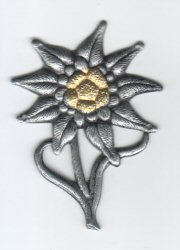
) Generals were identifiable by their edelweiss
Edelweiss
Edelweiss , Leontopodium alpinum, is a well-known European mountain flower, belonging to the sunflower family.-Names:The common name comes from German edel, meaning "noble", and weiß "white", thus signifying "noble whiteness".The scientific name Leontopodium is a Latin adaptation of Greek...
sleeve and cap insignia and the mountain cap
M43 field cap
The M43 field cap or "Einheitsmütze" was a cap used by the German Wehrmacht and SS, during World War II. The design of the fieldcap was based on the German Gebirgsjäger's ski cap, the only differences being the bill was slightly extended and the top panel of the hat had a smaller circumference,...
(bergmütze) worn instead of the peaked cap of officers from other branches of the Wehrmacht. In October 1942 an order was issued that general officers should have gold piping around the crown of the cap to distinguish them more readily from other ranks.
The rank was equivalent to the long established General der Kavallerie, General der Artillerie
General of the Artillery (Germany)
General of the artillery may mean:#a rank of general in the Imperial Army, Reichswehr or Wehrmacht - the second-highest regular rank below Generaloberst. Cavalry officers of equivalent rank were called general of the cavalry, and infantry officers of equivalent rank general of the infantry...
and General der Infanterie
General of the Infantry (Germany)
General of the Infantry is a rank of general in the Imperial Army, Reichswehr or Wehrmacht - the second-highest regular rank. The same rank spread to the Imperial Russian Army and the Defence forces of Finland between the world wars...
. The Wehrmacht also introduced General der Panzertruppe
General der Panzertruppe
General der Panzertruppe was a rank of German Army General introduced by the Wehrmacht in 1935. As the commander of a Panzer Corp this rank corresponds to a US Army Lieutenant-General...
(armoured troops), General der Pioniere
General der Pioniere
General der Pioniere was a rank of German Army General introduced by the Wehrmacht in 1938.The rank was equivalent to the long established General der Kavallerie, General der Artillerie and General der Infanterie...
(engineers), General der Fallschirmtruppe
General der Fallschirmtruppe
General der Fallschirmtruppe was a General’s rank of the German Luftwaffe.The rank was equivalent to the long established General der Kavallerie, General der Artillerie and General der Infanterie...
n (parachute troops
Paratrooper
Paratroopers are soldiers trained in parachuting and generally operate as part of an airborne force.Paratroopers are used for tactical advantage as they can be inserted into the battlefield from the air, thereby allowing them to be positioned in areas not accessible by land...
) and General der Nachrichtentruppe
General der Nachrichtentruppe
General der Nachrichtentruppe was a rank of German Army General introduced by the Wehrmacht in 1940....
n (communications troops).
List of officers who were General der Gebirgstruppe
- Franz BöhmeFranz BöhmeFranz Friedrich Böhme was an Austrian who later went on to become a military officer...
(1885–1947) (committed suicide) - Eduard DietlEduard DietlEduard Dietl was a German general of World War II. He was born in Bad Aibling, Bavaria. He was also a recipient of the Knight's Cross of the Iron Cross with Oak Leaves and Swords...
(1889–1944) (Promoted Generaloberst 1/6/1942, killed in plane crash 23/6/1944) - Karl EglseerKarl EglseerKarl Eglseer was a highly decorated General der Gebirgstruppe in the Wehrmacht during World War II who commanded the XVIII. Gebirgs-Korps. He was also a recipient of the Knight's Cross of the Iron Cross. The Knight's Cross of the Iron Cross was awarded to recognise extreme battlefield bravery or...
(1890–1944) (killed in plane crash 23/6/1944) - Valentin FeursteinValentin FeursteinValentin Feurstein was an Austrian military officer serving in the Austrian and German armies.Feurstein served in the Austrian Bundesheer in the 1930s. He served as Commander of 3.Division...
(1885–1970) - Georg Ritter von HenglGeorg Ritter von HenglGeorg Ritter von Hengl was a highly decorated General der Gebirgstruppe in the Wehrmacht during World War II who commanded the XIX Mountain Corps. He was also a recipient of the Knight's Cross of the Iron Cross. The Knight's Cross of the Iron Cross was awarded to recognise extreme battlefield...
(1897–1952) - Ferdinand JodlFerdinand JodlFerdinand Alfred Friedrich Jodl was a German Wehrmacht officer, who notably served as the General der Gebirgstruppe of Mountain Corps Norway during the Petsamo–Kirkenes Offensive...
(1896–1956) - Rudolf Konrad (1891–1964)
- Hans KreysingHans KreysingHans Kreysing was a German general who commanded the 3. Gebirgs-Division. He was also a recipient of the Knight's Cross of the Iron Cross with Oak Leaves and Swords...
(1890–1969) - Ludwig KüblerLudwig KüblerGeneral Ludwig Kübler was a German General of the Mountain Troops during World War II who was executed as a war criminal in Yugoslavia.- Early life :...
(1889–1947) (executed in Yugoslavia) - Hubert LanzHubert LanzKarl Hubert Lanz was a German Army officer who rose to the rank of General der Gebirgstruppe during the Second World War, in which he led units in the Eastern Front and in the Balkans. After the war, he was tried and convicted for several atrocities committed by units under his command in the...
(1896–1982) - Julius RingelJulius RingelJulius Alfred "Papa" Ringel was an Austrian-born German General of Mountain Troops . He commanded the 3. Gebirgs-Division, 5. Gebirgs-Division, LXIX Armeekorps, Wehrkreis XI and the Korps Ringel...
(1889–1967) - Ferdinand SchörnerFerdinand SchörnerFerdinand Schörner was a General and later Field Marshal in the German Army during World War II.-Early life:Schörner was born in Munich, Bavaria...
(1892–1973) (Promoted Generaloberst 1/4/1944, GeneralfeldmarschallGeneralfeldmarschallField Marshal or Generalfeldmarschall in German, was a rank in the armies of several German states and the Holy Roman Empire; in the Austrian Empire, the rank Feldmarschall was used...
4/4/1945) - Hans SchlemmerHans SchlemmerDipl.-Ing. Johann "Hans" SchlemmerIn German an engineer's degree is called Diplom-Ingenieur was a highly decorated General der Gebirgstruppe in the Wehrmacht during World War II who commanded the LXXV. Armeekorps. He was also a recipient of the Knight's Cross of the Iron Cross with Oak Leaves...
(1893–1973) - Hans Karl Maximilian von Le SuireKarl von Le SuireKarl Hans Maximilian von Le Suire was a highly decorated General der Gebirgstruppe in the Wehrmacht during World War II who commanded the XXXXIX. Gebirgs-Armeekorps. He was also a recipient of the Knight's Cross of the Iron Cross...
(1898–1954) - Kurt VersockKurt VersockGeneral Kurt Versock was a German General of the Mountain Troops who was awarded the Knight's Cross during World War II.From 1913 to 1914 he studied Law and Economics...
(1895–1963) - Emil VogelEmil VogelEmil Wilhelm Vogel was a highly decorated General der Gebirgstruppe in the Wehrmacht during World War II who commanded the XXXVI. Gebirgskorps. He was also a recipient of the Knight's Cross of the Iron Cross with Oak Leaves...
(1894-1985) - Friedrich-Jobst Volckamer von KirchensittenbachFriedrich-Jobst Volckamer von KirchensittenbachFriedrich-Jobst Volckamer von Kirchensittenbach was a highly decorated General der Gebirgstruppe in the Wehrmacht during World War II who commanded the 16. Armee. He was also a recipient of the Knight's Cross of the Iron Cross...
(1894–1989) - August Winter (1897–1979)