


General Affairs State Council

Encyclopedia
Executive (government)
Executive branch of Government is the part of government that has sole authority and responsibility for the daily administration of the state bureaucracy. The division of power into separate branches of government is central to the idea of the separation of powers.In many countries, the term...
of the government of the Japanese-controlled Empire of Manchukuo
Manchukuo
Manchukuo or Manshū-koku was a puppet state in Manchuria and eastern Inner Mongolia, governed under a form of constitutional monarchy. The region was the historical homeland of the Manchus, who founded the Qing Empire in China...
from 1934-1945.
Background
Manchukuo was proclaimed a monarchyMonarchy
A monarchy is a form of government in which the office of head of state is usually held until death or abdication and is often hereditary and includes a royal house. In some cases, the monarch is elected...
on 1 March 1934, with former Qing dynasty
Qing Dynasty
The Qing Dynasty was the last dynasty of China, ruling from 1644 to 1912 with a brief, abortive restoration in 1917. It was preceded by the Ming Dynasty and followed by the Republic of China....
emperor Puyi
Puyi
Puyi , of the Manchu Aisin Gioro clan, was the last Emperor of China, and the twelfth and final ruler of the Qing Dynasty. He ruled as the Xuantong Emperor from 1908 until his abdication on 12 February 1912. From 1 to 12 July 1917 he was briefly restored to the throne as a nominal emperor by the...
assuming the Manchukuo throne under the reign name of Emperor Kang-de. An imperial rescript
Imperial Rescript
An Imperial Rescript is a major political edict issued from an imperial authority. In each culture where practiced there are specific traditions, normally associated with the written form the statement takes .Examples:...
issued the same day, promulgated the organic law
Organic law
An organic or fundamental law is a law or system of laws which forms the foundation of a government, corporation or other organization's body of rules. A constitution is a particular form of organic law for a sovereign state....
of the new state, establishing a Privy Council
Privy council
A privy council is a body that advises the head of state of a nation, typically, but not always, in the context of a monarchic government. The word "privy" means "private" or "secret"; thus, a privy council was originally a committee of the monarch's closest advisors to give confidential advice on...
, a Legislative Council
Legislative Council
A Legislative Council is the name given to the legislatures, or one of the chambers of the legislature of many nations and colonies.A Member of the Legislative Council is commonly referred to as an MLC.- Unicameral legislatures :...
and the General Affairs State Council
Council of State
The Council of State is a unique governmental body in a country or subdivision thereoff, though its nature may range from the formal name for the cabinet to a non-executive advisory body surrounding a head of state. It is sometimes regarded as the equivalent of a privy council.-Modern:*Belgian...
to “advise and assist the emperor in the discharge of his duties”. The Privy Council was an appointive body consisting of Puyi's closest friends and confidants, and the Legislative Council was largely an honorary body without authority. The State Council was therefore the center of political power in Manchukuo.
Workings
The General Affairs State Council consisted of ten ministries forming a cabinetCabinet (government)
A Cabinet is a body of high ranking government officials, typically representing the executive branch. It can also sometimes be referred to as the Council of Ministers, an Executive Council, or an Executive Committee.- Overview :...
. The cabinet ministers were all native Manchukuoans, of either ethnic Manchu
Manchu
The Manchu people or Man are an ethnic minority of China who originated in Manchuria . During their rise in the 17th century, with the help of the Ming dynasty rebels , they came to power in China and founded the Qing Dynasty, which ruled China until the Xinhai Revolution of 1911, which...
or Han Chinese
Han Chinese
Han Chinese are an ethnic group native to China and are the largest single ethnic group in the world.Han Chinese constitute about 92% of the population of the People's Republic of China , 98% of the population of the Republic of China , 78% of the population of Singapore, and about 20% of the...
descent, and in all cases, the vice-ministers in each ministry were Imperial Japanese Army
Imperial Japanese Army
-Foundation:During the Meiji Restoration, the military forces loyal to the Emperor were samurai drawn primarily from the loyalist feudal domains of Satsuma and Chōshū...
officers, appointed by the Kwantung Army leadership. The Japanese vice-ministers functions in roles similar to British resident officer
Resident Commissioner
Resident Commissioner is the title of several, quite different types of Commissioner in overseas possession or protectorate of the British Crown or of the United States.-British English:...
s in British overseas protectorates in that they had final approval over any actions of the “native” ministers. The State Council itself was presided over by a Secretary-General, the first of whom was Takuzo Komai, an ethnic Japanese.
The Council's initial composition was at the time of Prime Minister Zheng Xiaoxu
Zheng Xiaoxu
Zhèng Xiàoxū . Chinese statesman, diplomat and calligrapher.-Early life and diplomatic career:Although Zheng traced his ancestral roots to Minhou, a small town near Fuzhou, he was born in Suzhou, Jiangsu...
included the following portfolio
Ministry (government department)
A ministry is a specialised organisation responsible for a sector of government public administration, sometimes led by a minister or a senior public servant, that can have responsibility for one or more departments, agencies, bureaus, commissions or other smaller executive, advisory, managerial or...
s:
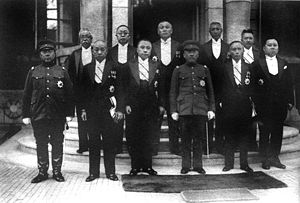
- Prime Minister
- Home Affairs
- Foreign Affairs
- Defense
- Finance
- Industry and Agriculture
- Transportation and Communications
- Justice
- Education
- Mongolian Affairs
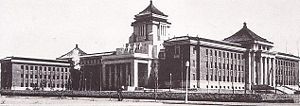
The State Council building
The State Council Building was an imposing five-story structure with two four-story wings built in downtown Hsinking in reinforced concreteReinforced concrete
Reinforced concrete is concrete in which reinforcement bars , reinforcement grids, plates or fibers have been incorporated to strengthen the concrete in tension. It was invented by French gardener Joseph Monier in 1849 and patented in 1867. The term Ferro Concrete refers only to concrete that is...
with a portal frame construction with a pseudo-oriental roof with towers. The building was designed so that its main entrance faces west. The building is still in use today by the Jilin
Jilin
Jilin , is a province of the People's Republic of China located in the northeastern part of the country. Jilin borders North Korea and Russia to the east, Heilongjiang to the north, Liaoning to the south, and Inner Mongolia to the west...
Provincial government of the People's Republic of China
People's Republic of China
China , officially the People's Republic of China , is the most populous country in the world, with over 1.3 billion citizens. Located in East Asia, the country covers approximately 9.6 million square kilometres...
. Each of the main cabinet-level ministries also had its own imposing building. Many of these structures are still in use in various capacities in modern China.