


Gemshorn

Encyclopedia
The gemshorn is an instrument of the ocarina
family that was historically made from the horn of a chamois
, goat
, or other suitable animal. The gemshorn receives its name from the German language
, and means a chamois horn.
. A skeletal figure is seen holding one in a Danse Macabre
illustration dated to 1485. There is also mention of this instrument in "The Complaynt of Scotlande" as "ane gatehorn"(goat horn). Volume 2 of Praetorius's
De Organographica from the early 17th century, provides detailed construction plates and diagrams for the gemshorn. They were primarily a pastoral instrument and were not widely known after the mid-to-late 16th century. With resurgent interest in early music
in the 19th and 20th centuries, they have received new attention. Horace Fitzpatrick developed a form of gemshorn which adopted the fingering method of recorders and produced them in consort
families, which have proven very popular since the 1960s.
 Modern gemshorns are often made of the horns of domesticated cattle
, because they are readily available, and their use prevents endangering wild species. The hollow horn has tone holes
down the front, like a recorder
or clarinet
. The pointed end of the horn is left intact, and serves as the bottom of the instrument. A fipple
plug, usually of wood
, is fitted into the wide end of the instrument, with a recorder type voicing window on the front of the horn, for tone production.
On more advanced models, there is a "tuning ring". This is a metal band or ring, placed between the voicing window and the top tone hole. A hole is drilled through this ring and the horn beneath. When the ring is turned with the fingers the hole is partially blocked. This lowers the flute's keynote by up to about 1 major tone. Partial wax closure of the dorsal (rear) thumb hole will accomplish the same keynote tuning.
Some recent makers have used synthetic materials in place of the animal horn. Another alternative, offered by some makers, is wooden gemshorns.
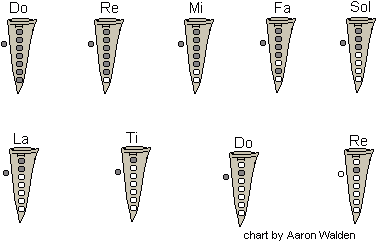 16th-century illustrations show an instrument which had only a few tone holes, and a very limited range. The intact clay gemshorn, mentioned above, which was found beneath a 15th-century house, had a chromatic range of one octave. Modern makers have often chosen to build them using the Baroque recorder
fingering.
The sound of the gemshorn is like that of other flutes, but with an ocarina-like lack of harmonic overtones.
, modeled after this instrument. Its pipes are conical, with the wind going in at the wide end, as in the actual gemshorn. In organ pipe classification it is a flute/string hybrid.
Ocarina
The ocarina is an ancient flute-like wind instrument. Variations do exist, but a typical ocarina is an enclosed space with four to twelve finger holes and a mouthpiece that projects from the body...
family that was historically made from the horn of a chamois
Chamois
The chamois, Rupicapra rupicapra, is a goat-antelope species native to mountains in Europe, including the Carpathian Mountains of Romania, the European Alps, the Tatra Mountains, the Balkans, parts of Turkey, and the Caucasus. The chamois has also been introduced to the South Island of New Zealand...
, goat
Goat
The domestic goat is a subspecies of goat domesticated from the wild goat of southwest Asia and Eastern Europe. The goat is a member of the Bovidae family and is closely related to the sheep as both are in the goat-antelope subfamily Caprinae. There are over three hundred distinct breeds of...
, or other suitable animal. The gemshorn receives its name from the German language
German language
German is a West Germanic language, related to and classified alongside English and Dutch. With an estimated 90 – 98 million native speakers, German is one of the world's major languages and is the most widely-spoken first language in the European Union....
, and means a chamois horn.
History
The gemshorn was in use in the 15th century. Examples have been unearthed in Italy, in Hungary and in Germany, including one intact instrument made of clay which dates at least to 1450, as it was found buried beneath the foundation of a house built at that time. The early history of the instrument is not well-known, but the oldest known illustration of one in a reference work is in Musica Getutscht (1511), by Sebastian VirdungSebastian Virdung
Sebastian Virdung was a German composer and theorist on musical instruments. He is grouped among the composers known as the Colorists. He studied in Heidelberg as a scholar of Johannes von Soest at the chapel of the ducal court. After being ordained, he became chaplain at the court in Heidelberg....
. A skeletal figure is seen holding one in a Danse Macabre
Danse Macabre
Dance of Death, also variously called Danse Macabre , Danza de la Muerte , Dansa de la Mort , Danza Macabra , Dança da Morte , Totentanz , Dodendans , is an artistic genre of late-medieval allegory on the universality of death: no matter one's...
illustration dated to 1485. There is also mention of this instrument in "The Complaynt of Scotlande" as "ane gatehorn"(goat horn). Volume 2 of Praetorius's
Michael Praetorius
Michael Praetorius was a German composer, organist, and music theorist. He was one of the most versatile composers of his age, being particularly significant in the development of musical forms based on Protestant hymns, many of which reflect an effort to make better the relationship between...
De Organographica from the early 17th century, provides detailed construction plates and diagrams for the gemshorn. They were primarily a pastoral instrument and were not widely known after the mid-to-late 16th century. With resurgent interest in early music
Early music
Early music is generally understood as comprising all music from the earliest times up to the Renaissance. However, today this term has come to include "any music for which a historically appropriate style of performance must be reconstructed on the basis of surviving scores, treatises,...
in the 19th and 20th centuries, they have received new attention. Horace Fitzpatrick developed a form of gemshorn which adopted the fingering method of recorders and produced them in consort
Consort of instruments
A consort of instruments was a phrase used in England during the sixteenth and seventeenth centuries to indicate an instrumental ensemble. These could be of the same or a variety of instruments. Consort music enjoyed considerable popularity at court and in households of the wealthy in the...
families, which have proven very popular since the 1960s.
Construction
Cattle
Cattle are the most common type of large domesticated ungulates. They are a prominent modern member of the subfamily Bovinae, are the most widespread species of the genus Bos, and are most commonly classified collectively as Bos primigenius...
, because they are readily available, and their use prevents endangering wild species. The hollow horn has tone holes
Tone holes
Saxophone tone holes are tone holes that exist in the body and bell of a saxophone. They are strategically placed in order to achieve a variety of notes while holding the best possible intonation.-Varieties:...
down the front, like a recorder
Recorder
The recorder is a woodwind musical instrument of the family known as fipple flutes or internal duct flutes—whistle-like instruments which include the tin whistle. The recorder is end-blown and the mouth of the instrument is constricted by a wooden plug, known as a block or fipple...
or clarinet
Clarinet
The clarinet is a musical instrument of woodwind type. The name derives from adding the suffix -et to the Italian word clarino , as the first clarinets had a strident tone similar to that of a trumpet. The instrument has an approximately cylindrical bore, and uses a single reed...
. The pointed end of the horn is left intact, and serves as the bottom of the instrument. A fipple
Fipple
A fipple is a constricted mouthpiece common to many end-blown woodwind instruments, such as the tin whistle and the recorder. These instruments are known variously as fipple flutes, duct flutes, or tubular-ducted flutes.-How it works:...
plug, usually of wood
Wood
Wood is a hard, fibrous tissue found in many trees. It has been used for hundreds of thousands of years for both fuel and as a construction material. It is an organic material, a natural composite of cellulose fibers embedded in a matrix of lignin which resists compression...
, is fitted into the wide end of the instrument, with a recorder type voicing window on the front of the horn, for tone production.
On more advanced models, there is a "tuning ring". This is a metal band or ring, placed between the voicing window and the top tone hole. A hole is drilled through this ring and the horn beneath. When the ring is turned with the fingers the hole is partially blocked. This lowers the flute's keynote by up to about 1 major tone. Partial wax closure of the dorsal (rear) thumb hole will accomplish the same keynote tuning.
Some recent makers have used synthetic materials in place of the animal horn. Another alternative, offered by some makers, is wooden gemshorns.
Playing and sound
Recorder
The recorder is a woodwind musical instrument of the family known as fipple flutes or internal duct flutes—whistle-like instruments which include the tin whistle. The recorder is end-blown and the mouth of the instrument is constricted by a wooden plug, known as a block or fipple...
fingering.
The sound of the gemshorn is like that of other flutes, but with an ocarina-like lack of harmonic overtones.
Organ stop
There is a gemshorn organ stopOrgan stop
An organ stop is a component of a pipe organ that admits pressurized air to a set of organ pipes. Its name comes from the fact that stops can be used selectively by the organist; some can be "on" , while others can be "off" .The term can also refer...
, modeled after this instrument. Its pipes are conical, with the wind going in at the wide end, as in the actual gemshorn. In organ pipe classification it is a flute/string hybrid.
See also
- Early musicEarly musicEarly music is generally understood as comprising all music from the earliest times up to the Renaissance. However, today this term has come to include "any music for which a historically appropriate style of performance must be reconstructed on the basis of surviving scores, treatises,...
- Helmholtz resonanceHelmholtz resonanceHelmholtz resonance is the phenomenon of air resonance in a cavity, such as when one blows across the top of an empty bottle. The name comes from a device created in the 1850s by Hermann von Helmholtz, the "Helmholtz resonator", which he, the author of the classic study of acoustic science, used to...
- Pan flutePan fluteThe pan flute or pan pipe is an ancient musical instrument based on the principle of the closed tube, consisting usually of five or more pipes of gradually increasing length...
- PifanaPifanaThe pifana is a type of gemshorn played in Corsica. The pifana is generally made from goat horn....
, a Corsican gemshorn
External links
- Musica Antiqua's Gemshorn Page Gemshorn history, photos, mp3s
- Photograph of a gemshorn
- Gemshorn Society Ratingen Sheet music for the gemshorn (in German)
