

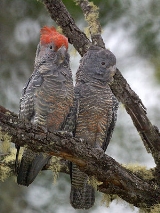
Gang-gang Cockatoo

Encyclopedia
The Gang-gang Cockatoo, Callocephalon fimbriatum, is found in the cooler and wetter forests and woodlands of Australia
, particularly alpine bushland
. Mostly mild grey in colour with some lighter scalloping (more pronounced and buffish in females) the male has a red head and crest, while the female has a small fluffy grey crest. It ranges throughout south-eastern Australia and Tasmania
. The Gang-gang Cockatoo is the faunal emblem of the Australian Capital Territory
. It is easily identified by its distinctive call, which is described as resembling a creaky gate, or the sound of a cork being pulled from a wine bottle.
The name Gang-gang comes from a New South Wales
Aboriginal language, either Ngunnawal
or Wiradjuri
. It is possible both language groups called it gang gang.
s, Gang-gangs nest in young, solid tree
s, the females using their strong beak
s to excavate nesting cavities.
Also breed in the canopy of most trees.
. This has always been controversial due to the unusual appearance and coloration of the bird, especially its sexual dichromatism. New research has finally resolved the matter, with the Gang-gang Cockatoo being recognized as a distinctive early offshoot of the calyptorhynchine (dark) cockatoos (Brown & Toft, 1999). Considering the robust phylogeny of the cockatoos now established, a comparison of characters gained and lost during the evolution of cockatoos suggests that the Gang-gang Cockatoo - while of course much changed and adapted during the perhaps 20 million years since its last common ancestor with any other living species lived - is probably still very similar in overall appearance to how the earliest cockatoos would have looked, and certainly the most primitive-looking of the species alive today.
Australia
Australia , officially the Commonwealth of Australia, is a country in the Southern Hemisphere comprising the mainland of the Australian continent, the island of Tasmania, and numerous smaller islands in the Indian and Pacific Oceans. It is the world's sixth-largest country by total area...
, particularly alpine bushland
Bushland
Bushland is any area in Australia that is predominantly indigenous flora and fauna.Bushland is the term commonly used by conservation protection groups and other environmental groups as a blanket term for natural vegetation, which may cover any kind of habitat from open shrubby country with few...
. Mostly mild grey in colour with some lighter scalloping (more pronounced and buffish in females) the male has a red head and crest, while the female has a small fluffy grey crest. It ranges throughout south-eastern Australia and Tasmania
Tasmania
Tasmania is an Australian island and state. It is south of the continent, separated by Bass Strait. The state includes the island of Tasmania—the 26th largest island in the world—and the surrounding islands. The state has a population of 507,626 , of whom almost half reside in the greater Hobart...
. The Gang-gang Cockatoo is the faunal emblem of the Australian Capital Territory
Australian Capital Territory
The Australian Capital Territory, often abbreviated ACT, is the capital territory of the Commonwealth of Australia and is the smallest self-governing internal territory...
. It is easily identified by its distinctive call, which is described as resembling a creaky gate, or the sound of a cork being pulled from a wine bottle.
The name Gang-gang comes from a New South Wales
New South Wales
New South Wales is a state of :Australia, located in the east of the country. It is bordered by Queensland, Victoria and South Australia to the north, south and west respectively. To the east, the state is bordered by the Tasman Sea, which forms part of the Pacific Ocean. New South Wales...
Aboriginal language, either Ngunnawal
Ngunnawal
Ngunnawal or Ngunawal may refer to:* The Ngunnawal people, the indigenous people of the Canberra region of Australia.* The Ngunnawal language, their traditional language....
or Wiradjuri
Wiradjuri
The Wiradjuri are an Indigenous Australian group of central New South Wales.In the 21st century, major Wiradjuri groups live in Condobolin, Peak Hill, Narrandera and Griffith...
. It is possible both language groups called it gang gang.
Breeding
Unlike most other cockatooCockatoo
A cockatoo is any of the 21 species belonging to the bird family Cacatuidae. Along with the Psittacidae and the Strigopidae , they make up the parrot order Psittaciformes . Placement of the cockatoos as a separate family is fairly undisputed, although many aspects of the other living lineages of...
s, Gang-gangs nest in young, solid tree
Tree
A tree is a perennial woody plant. It is most often defined as a woody plant that has many secondary branches supported clear of the ground on a single main stem or trunk with clear apical dominance. A minimum height specification at maturity is cited by some authors, varying from 3 m to...
s, the females using their strong beak
Beak
The beak, bill or rostrum is an external anatomical structure of birds which is used for eating and for grooming, manipulating objects, killing prey, fighting, probing for food, courtship and feeding young...
s to excavate nesting cavities.
Also breed in the canopy of most trees.
Status
Loss of older, hollow trees and loss of feeding habitat across south-eastern Australia through land clearing has led to a significant reduction in the numbers of this cockatoo in recent years. As a result, the Gang-Gang is now listed as vulnerable in NSW.Taxonomy
The Gang-gang Cockatoo was most often allied with the white cockatoos of the genus CacatuaCacatua
Cacatua is a genus of cockatoos found from the Philippines and Wallacea east to the Solomon Islands and south to Australia. They have a primarily white plumage , an expressive crest, and a black or pale bill...
. This has always been controversial due to the unusual appearance and coloration of the bird, especially its sexual dichromatism. New research has finally resolved the matter, with the Gang-gang Cockatoo being recognized as a distinctive early offshoot of the calyptorhynchine (dark) cockatoos (Brown & Toft, 1999). Considering the robust phylogeny of the cockatoos now established, a comparison of characters gained and lost during the evolution of cockatoos suggests that the Gang-gang Cockatoo - while of course much changed and adapted during the perhaps 20 million years since its last common ancestor with any other living species lived - is probably still very similar in overall appearance to how the earliest cockatoos would have looked, and certainly the most primitive-looking of the species alive today.
External links
- World Parrot Trust Parrot Encyclopedia - Species Profiles
- ParrotScience - cockatoo heavy information site
- NSW National Parks & Wildlife - Vulnerable species listing
- BirdLife Species Factsheet