


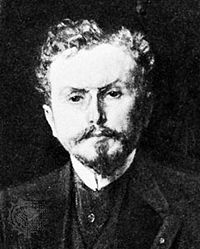
Gabriel Hanotaux

Encyclopedia
Statesman
A statesman is usually a politician or other notable public figure who has had a long and respected career in politics or government at the national and international level. As a term of respect, it is usually left to supporters or commentators to use the term...
and historian
Historian
A historian is a person who studies and writes about the past and is regarded as an authority on it. Historians are concerned with the continuous, methodical narrative and research of past events as relating to the human race; as well as the study of all history in time. If the individual is...
.
Biography
He was born at BeaurevoirBeaurevoir
Beaurevoir is a commune in the department of Aisne in Picardy in northern France.-Population:...
in the département of Aisne
Aisne
Aisne is a department in the northern part of France named after the Aisne River.- History :Aisne is one of the original 83 departments created during the French Revolution on 4 March 1790. It was created from parts of the former provinces of Île-de-France, Picardie, and Champagne.Most of the old...
. He studied history at the École des Chartes, and became maître de conférence in the École des Hautes Études. His political career was that of a civil servant rather than a party politician. In 1879 he entered the ministry of foreign affairs as a secretary, and rose step by step through the diplomatic service.
In 1886 he was elected deputy for Aisne, but, defeated in 1889, he returned to his diplomatic career, and on 31 May 1894 was chosen by Charles Dupuy
Charles Dupuy
Charles Alexandre Dupuy was a French statesman, three times prime minister.-Biography:He was born in Le Puy-en-Velay, Haute-Loire, Auvergne, where his father was a minor official. After a period as a professor of philosophy in the provinces, he was appointed a school inspector, thus obtaining a...
to be minister of foreign affairs. With one interruption (during the Ribot ministry, from 26 January to 2 November 1895) he held this portfolio until 14 June 1898. During his ministry he developed the rapprochement of France with Russia—visiting Saint Petersburg
Saint Petersburg
Saint Petersburg is a city and a federal subject of Russia located on the Neva River at the head of the Gulf of Finland on the Baltic Sea...
with the president, Félix Faure
Félix Faure
Félix François Faure was President of France from 1895 until his death.-Biography:Félix François Faure was born in Paris, the son of a small furniture maker...
—and sent expeditions to delimit the French colonies
French Colonies
"French Colonies" is the name used by philatelists to refer to the postage stamps issued by France for use in the parts of the French colonial empire that did not have stamps of their own...
in Africa. The Fashoda Incident
Fashoda Incident
The Fashoda Incident was the climax of imperial territorial disputes between Britain and France in Eastern Africa. A French expedition to Fashoda on the White Nile sought to gain control of the Nile River and thereby force Britain out of Egypt. The British held firm as Britain and France were on...
of July 1898 was a result of this policy, and Hanotaux's distrust of England is frankly stated in his literary works.
Hanotaux was elected a member of the Académie française
Académie française
L'Académie française , also called the French Academy, is the pre-eminent French learned body on matters pertaining to the French language. The Académie was officially established in 1635 by Cardinal Richelieu, the chief minister to King Louis XIII. Suppressed in 1793 during the French Revolution,...
on 1 April 1897. He served as a delegate for France with the League of Nations
League of Nations
The League of Nations was an intergovernmental organization founded as a result of the Paris Peace Conference that ended the First World War. It was the first permanent international organization whose principal mission was to maintain world peace...
and participated in the 1st (15 November - 18 December 1920), 2nd (5 September - 5 October 1921), 3rd (4 September - 30 September, 1922) and 4th Assemblies (3 September - 29 September 1923). In the early 1920s, there was a proposal for the League of Nations to accept Esperanto
Esperanto
is the most widely spoken constructed international auxiliary language. Its name derives from Doktoro Esperanto , the pseudonym under which L. L. Zamenhof published the first book detailing Esperanto, the Unua Libro, in 1887...
as their working language. Ten delegates accepted the proposal with only one voice against, the French delegate, Gabriel Hanotaux. Hanotaux did not like how the French language was losing its position as the international language of diplomacy and saw Esperanto as a threat.
Gabriel Hanotaux died in Paris in 1944 and was interred in the Passy Cemetery. His home in Orchaise
Orchaise
Orchaise is a commune in the Loir-et-Cher department of central France....
now serves as a botanical garden
Botanical garden
A botanical garden The terms botanic and botanical, and garden or gardens are used more-or-less interchangeably, although the word botanic is generally reserved for the earlier, more traditional gardens. is a well-tended area displaying a wide range of plants labelled with their botanical names...
, the Parc botanique du Prieuré d'Orchaise
Parc botanique du Prieuré d'Orchaise
The Parc botanique du Prieuré d'Orchaise is a botanical garden and park located on the grounds of the former priory at the Place de l'Eglise, Orchaise, Loir-et-Cher, Centre, France...
.
Works
As a historian he published:- Origines de l'institution des intendants de provinces (1884), which is the authoritative study on the intendants
- Études historiques sur les XVI et XVII siècles en France (1886)
- Histoire de Richelieu (2 vols., 1888)
- Histoire de la Troisième République (1904), the standard history of contemporary France.
- "Jean D'Arc" (1911) Hachette
- Histoire de la Guerre de 1914 (9 vols., 1914)
- Le Traité de Versailles (1919)
- Histoire de la Nation française (17 vols., 1920)
He edited the Instructions des ambassadeurs de France à Rome, depuis les traités de Westphalie (1888).