

GAZ-24

Encyclopedia
Automobile
An automobile, autocar, motor car or car is a wheeled motor vehicle used for transporting passengers, which also carries its own engine or motor...
manufactured by the Gorkovsky Avtomobilny Zavod (GAZ
GAZ
GAZ or Gorkovsky Avtomobilny Zavod , translated as Gorky Automobile Plant , started in 1932 as NAZ, a cooperation between Ford and the Soviet Union. It is one of the largest companies in the Russian automotive industry....
, Gorky Automobile Plant) from 1968 to 1985 as a generation of its Volga
Volga (automobile)
Volga is an automobile brand that originated in the Soviet Union to replace the venerated GAZ-M20 Pobeda in 1956. Modern in design, it became a symbol of higher status in the Soviet nomenklatura...
marque. A largely redesigned version (practically, a new car in modified old body) - GAZ-24-10 - was produced from 1985 to 1992. It was sold as the Scaldia-Volga M24 and M24D in the Western European market.
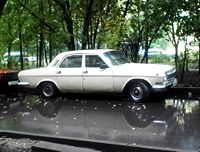
1967-69
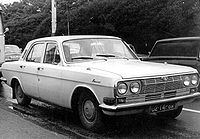
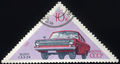

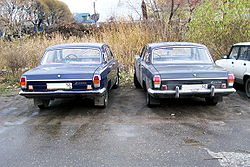
GAZ-24 was developed to replace outdated Volga GAZ-21
GAZ-21
The GAZ M21 Volga, the first car to carry the Volga name, was developed in the early 1950s. Volgas were built to last in the harsh climate and rough roads of the Soviet Union, with high ground clearance , rugged suspension, strong and forgiving engine, and rustproofing on a...
developed in 1950s. New Volga http://www.gaz24.ru/gabariti_24.gif had a longer wheelbase (2800 mm) then the GAZ-21 (2700 mm), but slightly shorter overall length (4735 mm compared to 4810) and was substantially lower (1490 mm compared to 1620). Width remained untouched. Long wheelbase, boxier styling, bucket seats with lower bases and flat roof made the new Volga generously sized inside, with comfortable 5...6-passenger seating. The car was designed to last for years in severe road conditions, and its reinforced unibody construction gave the Volga extra weight if compared to foreign analogs.

Standard engine was aluminium 2445 cc inline-four, OHV, high-compression ZMZ-24D http://www.gaz24.ru/library/album/dvigustr.html producing 95 hp@4500 rpm [106,5 SAE hp] with one 2bbl carburetor
Carburetor
A carburetor , carburettor, or carburetter is a device that blends air and fuel for an internal combustion engine. It is sometimes shortened to carb in North America and the United Kingdom....
. Only 4-speed manual transmission http://www.gaz24.ru/library/album/transkpp.html with floor-mounted shifter was offered.
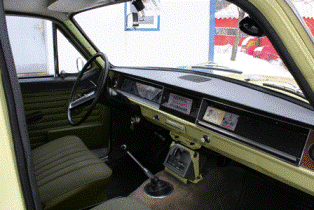
GAZ-21 trim lines ("standard" and "improved") were dropped, all GAZ-24 Volgas had similar trim. No specific options or extras were listed, but standard equipment included self-adjusting power drum brakes with front/rear split brake system, 3-wave radio with power antenna, interior safety padding, central armrests http://www.gaz24.ru/HISTORY/MODIFS/podlokotnik.jpg (both front and rear), alternator, 3-speed windshield wiper and foot-operated windshield washer, heater with defroster, rear window defogger, electric clock, trunk and engine compartment lights. Early cars had "ribbon" speedometer http://www.gaz24.ru/HISTORY/MODIFS/SP-104.JPG, with gauge that filled up with red, thermometer fashion. Interior http://www.gaz24.ru/HISTORY/MODIFS/salon24.jpg was available in 3 different colours - red, brown or light gray, it was not color-coded. Dashboard was made of aluminium and painted in exterior color, upper part was covered with safety padding and black vinyl.


Volga's styling was rather conventional and surely American inspired. Some features were thematically quite similar to those on GAZ-21 such as vertical tail lights, so called "baleen
Baleen
Baleen or whalebone is a filter-feeder system inside the mouths of baleen whales. The baleen system works when a whale opens its mouth underwater and then water pours into the whale's mouth. The whale then pushes the water out, and animals such as krill are filtered by the baleen and remain as food...
plates" grille, tiny fins on rear fenders. One of the most recognizable feature of GAZ-24 Volga sedan styling are chromed rhombic vents on C-pillar http://www.gaz24.ru/HISTORY/MODIFS/grebenka_24_s_ognem.jpg. Among another distinctive features can be mentioned dashboard handles with "ivory" plastic inserts http://www.gaz24.ru/HISTORY/MODIFS/ruchka_do77.jpg, two chromed "fangs" under front bumper http://www.gaz24.ru/HISTORY/MODIFS/24_70_nomer.jpg, large two spoke steering wheel and large chromed parking brake handle placed under the dashboard in the right.


1970-74
In 1970 full-scale manufacturing started. During 1970-74 the Volga remained almost unchanged. Only minor modifications took place in 1972...73, when the car got new trunk decklid lock http://www.gaz24.ru/HISTORY/MODIFS/ZAMOK000.jpg, flat ashtrays http://www.gaz24.ru/HISTORY/MODIFS/dverkarta_1ser_late.jpg in rear doors instead of early ashtrays that were built in rear doors armrests http://www.gaz24.ru/HISTORY/MODIFS/pepeln_mini.jpg, new rear bumper and new radio http://www.gaz24.ru/HISTORY/MODIFS/radio_24_rannee.jpg with more pleasant appearance and modified construction. In 1973 dashboard with simulated wood insert http://www.gaz24.ru/HISTORY/MODIFS/priemnik_24_pozdnii.jpg appeared (also there was a "silver" grained finish that was used until 1974). After 1973 ignition switch was moved from the dashboard http://www.gaz24.ru/HISTORY/MODIFS/zamok_zazhig_rannii.jpg to the place under the steering wheel http://www.gaz24.ru/HISTORY/MODIFS/zazhig_mini.jpg to prevent knee injure in road accidents, although that was inconvenient for the driver. Also in 1974 Volga got additional parking lights on C-pillar http://www.gaz24.ru/HISTORY/MODIFS/grebenka_24_s_ognem.jpg (something like opera lights).


Taxicab
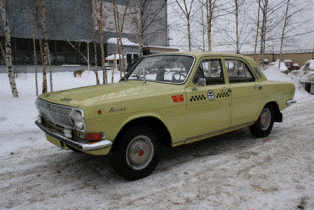
Volga cars were almost the only taxi cabs in the USSR. In 1971 taxi version of GAZ-24 - GAZ-24-01 http://www.gaz24.ru/HISTORY/MODIFS/TAXI2.JPG - was introduced. It had cheap and easy-to-wash all-vinyl interior http://www.vektaxi.ru/images/IMG_2144_dob_a.gif, low compression ZMZ-24-01 engine (85 hp, SAE 95 hp), taximeter
Taximeter
A taximeter is a mechanical or electronic device installed in taxicabs and auto rickshaws that calculates passenger fares based on a combination of distance travelled and waiting time...
http://www.vektaxi.ru/images/DSC01710.JPG under the dash and distinctive checkerboard stripe on front doors. At first Volga taxicabs were painted in different light colors, later most taxicabs were painted in lime-yellowhttp://www.vektaxi.ru/images/IMG_2143_24gaz.gif. Volga GAZ-24 is still famous for fantastic roadworthiness and durability. Volga taxicabs often have more than 1,000,000 km on their odometers and had several engine rebuilds. Taxicab drivers nicknamed GAZ-24 sedan "The Shrimp" due to its slim (if compare to GAZ-21 that was nicknamed "The Holy Cow") appearance and two "fangs" under front bumper that resembled shrimp's claws. Wagon taxicabs GAZ-24-04 (station wagons were used as cargo taxies) were nicknamed "The Shed" due to vast interior space.

Station wagon and ambulance
In 1972 4-door station wagon GAZ-24-02 was introduced. However, Volga wagons were not sold to private owners without special permit. For example, families with many children or sportsmen who had to carry heavy sport equipment (like parachutes) were allowed to purchase a Volga wagon. Famous clown and actor Yuri NikulinYuri Nikulin
Yuri Vladimirovich Nikulin was a well-known Soviet and Russian actor and clown who starred in many popular films.He was awarded the title of People's Artist of the USSR in 1973 and Hero of Socialist Labour in 1990...
was permitted to own GAZ-24-02 wagon because he often transported heavy circus equipment. This restrictions came from small volume of GAZ-24-02 production. Wagons were primarily used by hospitals (as ambulances), state-owned shops and taxi companies, Militsiya
Militsiya
Militsiya or militia is used as an official name of the civilian police in several former communist states, despite its original military connotation...
, GAI
GAI
GAI , short for State Automobile Inspectorate , are the Russian traffic police. They are responsible for the regulation of traffic, investigating traffic accidents, and manning the stop lights. GAI officers are called "GAI inspectors" in Russia...
, post offices and other state enterprises.
GAZ-24-02 had generous interior area with 3 rows of seats and 7...8-passenger seating. Area behind the front seat could be converted into spacious one-level cargo compartment. 24-02 had heavy-duty rear leaf springs (six leaves as opposed to the sedan's five) and could carry up to 400 kg (800 lbs) of cargo.
GAZ-24-04 http://www.vektaxi.ru/images/GAZ-24-02.jpg was a taxicab breed of Volga station wagon with distinctive features similar to sedan taxicab.
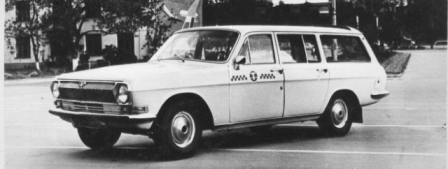
Ambulance modification GAZ-24-03 was introduced in 1973.
Convertible
The GAZ never built GAZ-24 convertibles http://www.gaz24.ru/HISTORY/MODIFS/cabrio.html. All convertibles were produced by military plant in the city of Bronnitsa. They were used for military parades.Pickup truck
Volga-based pickup trucks were built by different car repairing plants all over the country. Exteriors differed.4x4 version
In 1973-74 five AWD Volgas GAZ-24-95 http://www.gaz24.ru/HISTORY/MODIFS/gaz-24-95_volga4x4.jpg were built. Some disadvantages were discovered during the tests and this modification remained experimental.
1975-76
In 1975 the car was slightly modified. It got another, more conventional speedometer http://www.gaz24.ru/HISTORY/MODIFS/050720-20.jpg, more convenient outside rearview mirror http://www.gaz24.ru/HISTORY/MODIFS/zerkalo_puhloye_mini.jpg. Engine cooling system was modified to use antifreeze instead of water.

V8-powered version
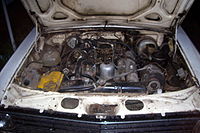
Russian language
Russian is a Slavic language used primarily in Russia, Belarus, Uzbekistan, Kazakhstan, Tajikistan and Kyrgyzstan. It is an unofficial but widely spoken language in Ukraine, Moldova, Latvia, Turkmenistan and Estonia and, to a lesser extent, the other countries that were once constituent republics...
: догонялка, dogonyalka). "Device 2424" was used by the KGB
KGB
The KGB was the commonly used acronym for the . It was the national security agency of the Soviet Union from 1954 until 1991, and was the premier internal security, intelligence, and secret police organization during that time.The State Security Agency of the Republic of Belarus currently uses the...
as interceptor and security car. The main task for "2424" was to accompany governmental Chayka
CHAYKA
Chayka is a Russian terrestrial radio navigation system, similar to LORAN-C. It is also run on 100 kHz and is described like LORAN-C by its GRI.-Chayka-Chains:There are 5 Chayka-chains in use:...
and ZIL
Zavod Imeni Likhacheva
Zavod imeni Likhachova, more commonly called ZIL is a major Russian truck and heavy equipment manufacturer, which also produced armored cars for most Soviet leaders, as well as buses, armored fighting vehicles, and aerosani...
limos.
1977-85
In 1976-78 the car was completely refreshed. To improve the safety, bumperguards, yellow front fog lamps http://www.gaz24.ru/HISTORY/MODIFS/2serise_detailed_mini.jpg, secondary turning signals on front fenders and seat belts (both front and rear)http://www.gaz24.ru/HISTORY/MODIFS/seatbelts.jpg became standard equipment. The car got modified interior. New dashboard consisted of aluminium body and two pieces of soft polyurethane foam padding. Upper door panels had the same construction. Lower door panels were completely different from the previous version. Seats got more convenient vinyl-and-cloth upholstery with cloth seat cushion. Due to installation of seatbelts front central armrest was eliminated. New interior was available in red, brown, yellow, lime green, dark green, dark blue, or black. Interior trim became non-reflective.

Olympiad '80
For the 1980 Summer Olympics1980 Summer Olympics
The 1980 Summer Olympics, officially known as the Games of the XXII Olympiad, was an international multi-sport event celebrated in Moscow in the Soviet Union. In addition, the yachting events were held in Tallinn, and some of the preliminary matches and the quarter-finals of the football tournament...
a special fleet of Volga sedans and station wagons was built with special two-tone white and yellow paint http://www.gaz24.ru/HISTORY/MODIFS/OLIMPIX3.JPG. They accompanied the Olympic Torch. The color scheme was chosen by the local Moscow organizers, not the IOC- that year's Winter Games fleet was light blue (Ford products).

GAZ-24-10


Derivative models
RAF-2203 "Latvija"RAF-2203
The RAF-2203 Latvija was a minibus designed and developed by Rīgas Autobusu Fabrika from 1976—1997. They were widely used throughout the USSR as fixed-run taxis , medical cars, used for Latvenergo and as a special services vehicles...
van by Rīgas Autobusu Fabrika
Rigas Autobusu Fabrika
The Riga Autobus Factory was a factory in Jelgava, Latvia, making vans and minibuses under the brand name Latvija....
(in production 1976-97) was based on drivetrain and suspensions of GAZ-24 Volga.
GAZ-3102 Volga (produced since 1982) and almost all later GAZ passenger cars (31029, 3110, 31105) use central body shell of GAZ-24.
International variants

Vinyl roof
Vinyl roof refers to a vinyl covering for an automobile's top. This covering was originally designed to give the appearance of a convertible to models with a fixed roof, but eventually it evolved into a styling statement in its own right. Vinyl roofs were most popular in the American market, and...
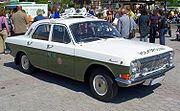
http://www.gaz24.ru/HISTORY/MODIFS/24_vynil_top_350px.jpg, leather interior and other luxuries. Station wagons sometimes had simulated "wood" decoration http://www.home.no/migreg/Bilder/ekeberg_1350.jpg and often - rear window wiper and heater http://www.gaz24.ru/HISTORY/MODIFS/obogrev_stekla_24_52.jpg. This features were mostly installed by European GAZ dealers.


