


Furikake

Encyclopedia
Condiment
A condiment is an edible substance, such as sauce or seasoning, added to food to impart a particular flavor, enhance its flavor, or in some cultures, to complement the dish. Many condiments are available packaged in single-serving sachets , like mustard or ketchup, particularly when supplied with...
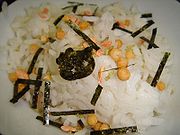
meant to be sprinkled on top of rice. It typically consists of a mixture of dried and ground fish, sesame seeds, chopped seaweed
Seaweed
Seaweed is a loose, colloquial term encompassing macroscopic, multicellular, benthic marine algae. The term includes some members of the red, brown and green algae...
, sugar, salt, and monosodium glutamate
Monosodium glutamate
Monosodium glutamate, also known as sodium glutamate or MSG, is the sodium salt of glutamic acid, one of the most abundant naturally occurring non-essential amino acids....
. Other flavorful ingredients such as katsuobushi
Katsuobushi
is the Japanese name for dried, fermented, and smoked skipjack tuna .Shaved Katsuobushi and dried kelp - kombu - are the main ingredients of dashi, a broth that forms the basis of many soups and sauces in Japanese cuisine.Katsuobushi's distinct umami flavor comes from its high...
(sometimes indicated on the package as bonito
Bonito
Bonito is a name given to various species of medium-sized, predatory fish in the Scombridae family. First, bonito most commonly refers to species in the genus Sarda, including the Atlantic bonito and the Pacific bonito ; second, in Japanese cuisine, bonito refers to the skipjack tuna , which, in...
), or okaka (bonito flakes moistened with soy sauce and dried again), salmon
Salmon
Salmon is the common name for several species of fish in the family Salmonidae. Several other fish in the same family are called trout; the difference is often said to be that salmon migrate and trout are resident, but this distinction does not strictly hold true...
, shiso
Perilla
Perilla is the common name of the herbs of the genus Perilla of the mint family, Lamiaceae. In mild climates, the plant reseeds itself. There are both green-leafed and purple-leafed varieties, which are generally recognized as separate species by botanists. The leaves resemble stinging nettle...
, egg, powdered miso
Miso
is a traditional Japanese seasoning produced by fermenting rice, barley and/or soybeans, with salt and the fungus , the most typical miso being made with soy. The result is a thick paste used for sauces and spreads, pickling vegetables or meats, and mixing with dashi soup stock to serve as miso...
, vegetables, etc. are often added to the mix.
Furikake is often brightly colored and flaky. It can have a slight fish or seafood flavoring, and is sometimes spicy. It can be used in Japanese cooking for pickling
Pickling
Pickling, also known as brining or corning is the process of preserving food by anaerobic fermentation in brine to produce lactic acid, or marinating and storing it in an acid solution, usually vinegar . The resulting food is called a pickle. This procedure gives the food a salty or sour taste...
foods for onigiri
Onigiri
, also known as or rice ball, is a Japanese food made from white rice formed into triangular or oval shapes and often wrapped in nori . Traditionally, an onigiri is filled with pickled ume , salted salmon, katsuobushi, kombu, tarako, or any other salty or sour ingredient as a natural preservative...
, or rice balls.
Outside Japan, furikake can be found in most Asian groceries
Asian supermarket
An Asian supermarket, sometimes called an "Oriental supermarket", is a grocery store in non-Asian countries that stocks items imported from the many countries in East and Southeast Asia. They carry items and ingredients generally well-suited for Asian cuisines and not found in most Western...
(near the katsuobushi
Katsuobushi
is the Japanese name for dried, fermented, and smoked skipjack tuna .Shaved Katsuobushi and dried kelp - kombu - are the main ingredients of dashi, a broth that forms the basis of many soups and sauces in Japanese cuisine.Katsuobushi's distinct umami flavor comes from its high...
) or in the ethnic food aisle of some major supermarkets.
See also
- GomashioGomashioGomashio is a dry condiment, similar to furikake, made from unhulled sesame seeds and salt . It is often used in Japanese cuisine, such as a topping for sekihan. It is also sometimes sprinkled over plain rice or over an onigiri...
—a type of furikake mostly consisting of cooked black sesame seeds and sea salt crystals. - ShichimiShichimiShichimi tōgarashi , also known as , and simply shichimi, is a common Japanese spice mixture containing seven ingredients.A typical blend may contain:* coarsely ground red chili pepper...
- OchazukeOchazukeChazuke or ochazuke is a simple Japanese dish made by pouring green tea, dashi, or hot water over cooked rice roughly in the same proportion as milk over cereal, usually with savoury toppings....
—like furikake, ochazuke goes on rice, but the rice is soaked in green teaGreen teaGreen tea is made solely from the leaves of Camellia sinensis that have undergone minimal oxidation during processing. Green tea originates from China and has become associated with many cultures throughout Asia. It has recently become more widespread in the West, where black tea is traditionally...
.