

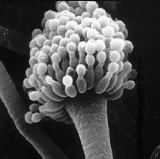
Fungi imperfecti

Encyclopedia
The Fungi imperfecti or imperfect fungi, also known as Deuteromycota, are fungi which do not fit into the commonly established taxonomic
classifications of fungi that are based on biological species concepts or morphological characteristics of sexual structures because their sexual form of reproduction has never been observed; hence the name "imperfect fungi." Only their asexual form of reproduction is known, meaning that this group of fungus produces their spores asexually.
The Deuteromycota (Greek
for "second fungi") were once considered a formal phylum
of the kingdom
Fungi. The term is now used only informally, to denote species of fungi that are asexually reproducing members of the fungal phyla Ascomycota
and Basidiomycota
.
There are about 25,000 species that have been classified in the deuteromycota. Fungi producing the antibiotic penicillin
and those that cause athlete's foot
and yeast infection
s are imperfect fungi. In addition, there are a number of edible imperfect fungi, including the ones that provide the distinctive characteristics of Roquefort and Camembert cheese.
Other, more informal, names besides Deuteromycota ("Deuteromycetes") and fungi imperfecti, are anamorphic fungi, or mitosporic fungi, but these are terms without taxonomic rank.
, many of the fungi it included have yet to find a place in modern fungal classification. This is because most fungi are classified based on characteristics of the fruiting bodies and spores produced during sexual reproduction, and members of the Deutromycota have only been observed to produce asexual or no spores.
For this reason, mycologists are unique among those who study extant organisms in using a dual system of nomenclature. Dual naming is permitted by Article 59 of the International Code of Botanical Nomenclature (which governs the naming of plants and fungi). Under this system, a name for an asexually reproducing fungus is considered a form taxon. For example, the ubiquitous and industrially important mold, Aspergillus niger
, has no known sexual cycle. Thus Aspergillus niger is considered a form taxon. In contrast, isolates of its close relative, Aspergillus nidulans
, revealed it to be the anomorphic stage of a teleomorph already named Emericella nidulans. When a teleomorphic stage is known, that name will take priority over the name of an anamorph, hence this formerly classified Aspergillus species is now properly called Emericella nidulans.
s constructed from comparative analyses of DNA sequence
s, such as RNA
, or multigene phylogenies may be used to infer relationships between asexually reproducing fungi and their sexually reproducing counterparts. With these methods, many asexually reproducing fungi have now been placed in the tree of life. However, because phylogenetic methods require sufficient quantities of biological materials (spores or fresh specimens) that are from pure (i.e., uncontaminated) fungal cultures, for many asexual species their exact relationship with other fungal species has yet to be determined. Under the current system of fungal nomenclature, teleomorph names cannot be applied to fungi that lack sexual structures. Classifying and naming asexually reproducing fungi is the subject of ongoing debate in the mycological community.
. The taxon names are sometimes used informally. In particular, the term 'hyphomycetes' is often used to refer to molds, and the term 'coelomycetes' is used to refer to many asexually reproducing plant pathogens that form discrete fruiting bodies. Other systems of classification are reviewed by Kendrick (1981).
Taxonomy
Taxonomy is the science of identifying and naming species, and arranging them into a classification. The field of taxonomy, sometimes referred to as "biological taxonomy", revolves around the description and use of taxonomic units, known as taxa...
classifications of fungi that are based on biological species concepts or morphological characteristics of sexual structures because their sexual form of reproduction has never been observed; hence the name "imperfect fungi." Only their asexual form of reproduction is known, meaning that this group of fungus produces their spores asexually.
The Deuteromycota (Greek
Greek language
Greek is an independent branch of the Indo-European family of languages. Native to the southern Balkans, it has the longest documented history of any Indo-European language, spanning 34 centuries of written records. Its writing system has been the Greek alphabet for the majority of its history;...
for "second fungi") were once considered a formal phylum
Phylum
In biology, a phylum The term was coined by Georges Cuvier from Greek φῦλον phylon, "race, stock," related to φυλή phyle, "tribe, clan." is a taxonomic rank below kingdom and above class. "Phylum" is equivalent to the botanical term division....
of the kingdom
Kingdom (biology)
In biology, kingdom is a taxonomic rank, which is either the highest rank or in the more recent three-domain system, the rank below domain. Kingdoms are divided into smaller groups called phyla or divisions in botany...
Fungi. The term is now used only informally, to denote species of fungi that are asexually reproducing members of the fungal phyla Ascomycota
Ascomycota
The Ascomycota are a Division/Phylum of the kingdom Fungi, and subkingdom Dikarya. Its members are commonly known as the Sac fungi. They are the largest phylum of Fungi, with over 64,000 species...
and Basidiomycota
Basidiomycota
Basidiomycota is one of two large phyla that, together with the Ascomycota, comprise the subkingdom Dikarya within the Kingdom Fungi...
.
There are about 25,000 species that have been classified in the deuteromycota. Fungi producing the antibiotic penicillin
Penicillin
Penicillin is a group of antibiotics derived from Penicillium fungi. They include penicillin G, procaine penicillin, benzathine penicillin, and penicillin V....
and those that cause athlete's foot
Athlete's foot
Athlete's foot is a fungal infection of the skin that causes scaling, flaking, and itch of affected areas. It is caused by fungi in the genus Trichophyton and is typically transmitted in moist areas where people walk barefoot, such as showers or bathhouses...
and yeast infection
Candida (genus)
Candida is a genus of yeasts. Many species are harmless commensals or endosymbionts of animal hosts including humans, but other species, or harmless species in the wrong location, can cause disease. Candida albicans can cause infections in humans and other animals, especially in immunocompromised...
s are imperfect fungi. In addition, there are a number of edible imperfect fungi, including the ones that provide the distinctive characteristics of Roquefort and Camembert cheese.
Other, more informal, names besides Deuteromycota ("Deuteromycetes") and fungi imperfecti, are anamorphic fungi, or mitosporic fungi, but these are terms without taxonomic rank.
Problems in taxonomic classification
Although Fungi imperfecti/Deuteromycota is no longer formally accepted as a taxonTaxon
|thumb|270px|[[African elephants]] form a widely-accepted taxon, the [[genus]] LoxodontaA taxon is a group of organisms, which a taxonomist adjudges to be a unit. Usually a taxon is given a name and a rank, although neither is a requirement...
, many of the fungi it included have yet to find a place in modern fungal classification. This is because most fungi are classified based on characteristics of the fruiting bodies and spores produced during sexual reproduction, and members of the Deutromycota have only been observed to produce asexual or no spores.
For this reason, mycologists are unique among those who study extant organisms in using a dual system of nomenclature. Dual naming is permitted by Article 59 of the International Code of Botanical Nomenclature (which governs the naming of plants and fungi). Under this system, a name for an asexually reproducing fungus is considered a form taxon. For example, the ubiquitous and industrially important mold, Aspergillus niger
Aspergillus niger
Aspergillus niger is a fungus and one of the most common species of the genus Aspergillus. It causes a disease called black mold on certain fruits and vegetables such as grapes, onions, and peanuts, and is a common contaminant of food...
, has no known sexual cycle. Thus Aspergillus niger is considered a form taxon. In contrast, isolates of its close relative, Aspergillus nidulans
Aspergillus nidulans
Aspergillus nidulans is one of many species of filamentous fungi in the phylum Ascomycota...
, revealed it to be the anomorphic stage of a teleomorph already named Emericella nidulans. When a teleomorphic stage is known, that name will take priority over the name of an anamorph, hence this formerly classified Aspergillus species is now properly called Emericella nidulans.
Phylogeny and taxonomy
Phylogenetic classification of asexually reproducing fungi now commonly uses molecular systematics. Phylogenetic treePhylogenetic tree
A phylogenetic tree or evolutionary tree is a branching diagram or "tree" showing the inferred evolutionary relationships among various biological species or other entities based upon similarities and differences in their physical and/or genetic characteristics...
s constructed from comparative analyses of DNA sequence
DNA sequence
The sequence or primary structure of a nucleic acid is the composition of atoms that make up the nucleic acid and the chemical bonds that bond those atoms. Because nucleic acids, such as DNA and RNA, are unbranched polymers, this specification is equivalent to specifying the sequence of...
s, such as RNA
Ribosomal DNA
Ribosomal DNA codes for ribosomal RNA. The ribosome is an intracellular macromolecule that produces proteins or polypeptide chains. The ribosome itself consists of a composite of proteins and RNA. As shown in the figure, rDNA consists of a tandem repeat of a unit segment, an operon, composed of...
, or multigene phylogenies may be used to infer relationships between asexually reproducing fungi and their sexually reproducing counterparts. With these methods, many asexually reproducing fungi have now been placed in the tree of life. However, because phylogenetic methods require sufficient quantities of biological materials (spores or fresh specimens) that are from pure (i.e., uncontaminated) fungal cultures, for many asexual species their exact relationship with other fungal species has yet to be determined. Under the current system of fungal nomenclature, teleomorph names cannot be applied to fungi that lack sexual structures. Classifying and naming asexually reproducing fungi is the subject of ongoing debate in the mycological community.
Historical classification of the imperfect fungi
These groups are no longer formally accepted because they do not adhere to the principle of monophylyMonophyly
In common cladistic usage, a monophyletic group is a taxon which forms a clade, meaning that it contains all the descendants of the possibly hypothetical closest common ancestor of the members of the group. The term is synonymous with the uncommon term holophyly...
. The taxon names are sometimes used informally. In particular, the term 'hyphomycetes' is often used to refer to molds, and the term 'coelomycetes' is used to refer to many asexually reproducing plant pathogens that form discrete fruiting bodies. Other systems of classification are reviewed by Kendrick (1981).
- Class HyphomycetesHyphomycetesHyphomycetes is an obsolete class of fungi in the equally obsolete phylum Deuteromycota that lack fruiting bodies. Most hyphomycetes have now been assigned to the Ascomycota, mainly as a result of DNA sequencing, but many remain unassigned...
lacking fruiting bodies- Order Moniliales (producing spores on simple conidiophores)
- Order Stilbellales (producing spores on synnemaSynnemaA Synnema is a large, erect reproductive structure borne by some fungi. Conidiophores fuse together to form a strand resembling a stalk of wheat, with conidia at the end or on the edges....
ta) - Order Tuberculariales (producing spores in sporodochiaSporodochiumA sporodochium is a small, compact stroma usually formed on host plants parasitised by mitosporic fungi of the form order Tuberculariales . This stroma bears the conidiophores on which the asexual spores or conidia are formed....
)
- Class Coelomycetes spores produced in fruiting bodies
- Order Melanconiales (producing spores in acervuliAcervulusAn acervulus is a small asexual fruiting body that erupts through the epidermis of host plants parasitised by mitosporic fungi of the form order Melanconiales . It has the form of a small cushion at the bottom of which short crowded conidiophores are formed...
) - Order Sphaeropsidales (producing spores in pycnidiaPycnidiumA pycnidium is an asexual fruiting body produced by mitosporic fungi in the form order Sphaeropsidales . It is often spherical or inversely pearshaped and its internal cavity is lined with conidiophores. When ripe, an opening generally appears at the top, through which the pycnidiospores escape....
)
- Order Melanconiales (producing spores in acervuli
- Class Agonomycetales lacking spores
Industrially-relevant fungi
- Tolypocladium inflatum → from which we obtain the immunosuppressantImmunosuppressantAn immunosuppressant is any substance that performs immunosuppression of the immune system. They may be either exogenous, as immunosuppressive drugs, or endogenous, as ,e. g., testosterone...
ciclosporinCiclosporinCiclosporin , cyclosporine , cyclosporin , or cyclosporin A is an immunosuppressant drug widely used in post-allogeneic organ transplant to reduce the activity of the immune system, and therefore the risk of organ rejection...
; - Penicillium chrysogenumPenicillium chrysogenumPenicillium chrysogenum is common in temperate and subtropical regions and can be found on salted food products, but it is mostly found in indoor environments, especially in damp or waterdamaged buildings. It was previously known as Penicillium notatum. It has rarely been reported as a cause of...
- Penicillium griseofulvum
- Penicillium roquefortiPenicillium roquefortiPenicillium roqueforti is a common saprotrophic fungus from the family Trichocomaceae. Widespread in nature, it can be isolated from soil, decaying organic matter, and plants. The major industrial use of this fungus is the production of blue cheeses, flavouring agents, antifungals, polysaccharides,...
- Penicillium camembertiPenicillium camembertiPenicillium camemberti is a species of fungus used in the production of Camembert and Brie cheeses, on which colonies of P. camemberti form a hard, white crust. It is responsible for giving these cheeses their distinctive taste.- Synonyms :...
- Other species of Penicillium are used to improve both the taste and the texture of cheeseCheeseCheese is a generic term for a diverse group of milk-based food products. Cheese is produced throughout the world in wide-ranging flavors, textures, and forms....
s - Aspergillus oryzaeAspergillus oryzaeAspergillus oryzae is a filamentous fungus . It is used in Chinese and Japanese cuisine to ferment soybeans. It is also used to saccharify rice, other grains, and potatoes in the making of alcoholic beverages such as huangjiu, sake, and shōchū...
- Aspergillus sojaeAspergillus sojaeAspergillus sojae is a mold species in the genus Aspergillus.In Japan it is used to make the ferment of soy sauce, the mirin and other lacto-fermented condiments like tsukemono...
- Aspergillus nigerAspergillus nigerAspergillus niger is a fungus and one of the most common species of the genus Aspergillus. It causes a disease called black mold on certain fruits and vegetables such as grapes, onions, and peanuts, and is a common contaminant of food...
- Cladosporium resinae
- Lecanicillium sp.LecanicilliumLecanicillium is a genus of fungi within the order Hypocreales and is described as anamorphic Cordycipitaceae; 21 species are currently described. These are entomopathogenic fungus species, that were previously widely known as Verticillium lecanii Viegas .The IndexFungorum records the following...
→ these produce conidiaConidiumConidia, sometimes termed conidiospores, are asexual, non-motile spores of a fungus and are named after the greek word for dust, konia. They are also called mitospores due to the way they are generated through the cellular process of mitosis...
which may control certain species of insect pests - Other entomopathogenic fungi, including MetarhiziumMetarhiziumMetarhizium is a genus of entomopathogenic fungi in the Clavicipitaceae family. With the advent of genetic profiling, it has now become possible to place these fungi in proper taxa. Most turn out to be the asexual forms of fungi in the phylum Ascomycota.- Species :Nine distinct species have now...
and BeauveriaBeauveriaBeauveria is a genus of asexually-reproducing fungi allied with the ascomycete family Clavicipitaceae. Its several species are typically insect pathogens. The sexual states of Beauveria species, where known, are species of Cordyceps....
spp. - PochoniaPochoniaPochonia is a genus of fungi within the order Hypocreales and is described as anamorphic Metacordyceps; 8 species are currently described. Previously placed in the genus Verticillium, these fungi are known to be pathogenic to nematodes and are being developed and commercialized as biological...
spp. are under development for control of NematodeNematodeThe nematodes or roundworms are the most diverse phylum of pseudocoelomates, and one of the most diverse of all animals. Nematode species are very difficult to distinguish; over 28,000 have been described, of which over 16,000 are parasitic. It has been estimated that the total number of nematode...
pests.