

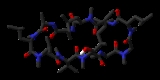
Ciclosporin

Encyclopedia
Ciclosporin , cyclosporine (USAN
), cyclosporin (former BAN), or cyclosporin A is an immunosuppressant
drug
widely used in post-allogeneic organ transplant
to reduce the activity of the immune system
, and therefore the risk of organ rejection
. Initially isolated from the fungus Tolypocladium inflatum
isolated from a soil sample obtained by Sandoz scientists at Hardangervidda, Norway in 1969, ciclosporin is a cyclic
nonribosomal peptide
of 11 amino acid
s and contains a single D-amino acid
, which are rarely encountered in nature.Some sources list the fungus under an alternative species name Hypocladium inflatum gams such as Pritchard and Sneader in 2005:
*
*
However, the name, "Beauveria nivea", also appears in several other articles including in a 2001 online publication by Harriet Upton entitled "Origin of drugs in current use: the cyclosporin story" (retrieved June 19, 2005). Mark Plotkin states in his book Medicine Quest, Penguin Books 2001, pages 46-47, that in 1996 mycology
researcher Kathie Hodge found that it is in fact a species of Cordyceps
.
(now Novartis
) in Basel
, Switzerland
, in a screening test on immune suppression designed and implemented by Hartmann F. Stähelin
, M.D. The success of ciclosporin in preventing organ rejection was shown in kidney transplants by Calne and colleagues at the University of Cambridge, and in liver
transplants performed by Dr. Thomas Starzl
at the University of Pittsburgh
Hospital. The first patient, on 9 March 1980, was a 28-year-old woman. Ciclosporin was subsequently approved for use in 1983.
Apart from in transplant medicine, ciclosporin is also used in psoriasis
, severe atopic dermatitis
, pyoderma gangrenosum
, chronic autoimmune urticaria, and, infrequently, in rheumatoid arthritis
and related diseases, although it is only used in severe cases. It is commonly prescribed in the US as an ophthalmic eyedrop for the treatment of dry eyes. It has been investigated for use in many other autoimmune disorders, and is sometimes prescribed in veterinary cases, particularly in extreme cases of immune-mediated hemolytic anemia
. Inhaled ciclosporin has been investigated to treat asthma and is being studied as a preventive therapy for chronic rejection of the lungs. Ciclosporin has also been used to help treat patients with ulcerative colitis
that do not respond to treatment with steroids. This drug is also used as a treatment of posterior or intermediate uveitis
with noninfective etiology
.
Ciclosporin has been investigated as a possible neuroprotective agent in conditions such as traumatic brain injury
, and has been shown in animal experiments to reduce brain damage
associated with injury. Ciclosporin blocks the formation of the mitochondrial permeability transition pore
, which has been found to cause much of the damage associated with head injury
and neurodegenerative diseases.
Ciclosporin is a drug currently used to experimentally treat cardiac hypertrophy (an increase in cell volume). It is a cyclic undecapeptide (chain of 11 amino acid residues) of fungal origin and is used presently as an immunosuppressant.
s (ADRs).
ADRs can include gingival hyperplasia, convulsion
s, peptic ulcer
s, pancreatitis
, fever
, vomiting, diarrhea
, confusion
, hypercholesterolemia
, dyspnea
, numbness and tingling
particularly of the lips, pruritus, high blood pressure
, potassium
retention, and possibly hyperkalemia
, kidney
and liver
dysfunction (nephrotoxicity
and hepatotoxicity
), burning sensations at finger tips and an increased vulnerability to opportunistic fungal and viral infection
s.
An alternate form of the drug, cyclosporin G (OG37-324), has been found to be much less nephrotoxic than the standard ciclosporin (cyclosporin A). Cyclosporin G (molecular mass
1217) differs from cyclosporin A in the amino acid
2 position, where an L-norvaline
replaces the α-aminobutyric acid
.
(immunophilin) of immunocompetent lymphocytes, especially T-lymphocytes. This complex of ciclosporin and cyclophilin
inhibits calcineurin
, which, under normal
circumstances, is responsible for activating the transcription of interleukin 2
. In T-cells, activation of the T-cell receptor normally increases intracellular calcium, which acts via calmodulin to activate calcineurin. Calcineurin then dephosphorylates the transcription factor NF-AT (nuclear factor of activated T-cells), which moves to the nucleus of the T-cell and increases the activity of genes coding for IL-2 and related cytokines. Ciclosporin prevents the dephosphorlyation of NF-AT by binding to cyclophilin. It also inhibits lymphokine
production and interleukin
release and, therefore, leads to a reduced function of effector T-cells. It does not affect cytostatic activity.
Ciclosporin affects mitochondria by preventing the mitochondrial permeability transition pore from opening, thus inhibiting cytochrome c
release, a potent apoptotic stimulation factor. This is not the primary mechanism of action for clinical use, but is an important effect for research on apoptosis
.
Ciclosporin is believed to elicit its effects by directly binding to the cyclophilin D protein (CypD) that constitutes part of the mitochondrial permeability transition pore (MPTP), and by inhibiting the calcineurin phosphatase pathway.
The MPTP is found in the mitochondrial membrane of cardiac myocytes (heart muscle cells) and functions to move calcium ions into the mitochondria. When open, enters the mitochondria, disrupting transmembrane potential (the electric charge across a membrane). If unregulated, this can contribute to mitochondrial swelling and dysfunction. To allow for normal contraction, intracellular increases, and the MPTP in turn opens, shuttling into the mitochondria.
Calcineurin is a -activated phosphatase (enzyme that removes a phosphate group from substrate) that regulates cardiac hypertrophy. Regulation occurs through NFAT (nuclear factor of activated T-cells) activation, which, when dephosphorylated, binds to GATA and forms a transcription factor (protein that can bind DNA and alter the expression of DNA) with ability to control the hypertrophic gene (2). Activation of calcineurin causes increases in hypertrophy.
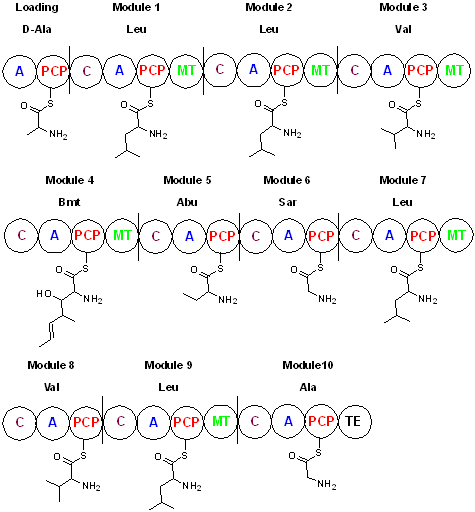 Ciclosporin is synthesized by a nonribosomal peptide
synthetase, ciclosporin synthetase. The enzyme contains an adenylation
domain, a thiolation domain, a condensation domain
, and an N-methyltransferase
domain. The adenylation
domain is responsible for substrate recognition and activation, whereas the thiolation domain covalently binds the adenylated amino acids to phosphopantetheine
, and the condensation domain elongates the peptide chain. Ciclosporin synthetase substrates include L-valine
, L-leucine
, L-alanine
, L-glycine
, 2-aminobutyric acid
, 4-methylthreonine
, and D-alanine. With the adenylation domain, ciclosporin synthetase generates the acyl-adenylated amino acids, then covalently binds the amino acid
to phosphopantetheine
through a thioester
linkage. Some of the amino acid substrates become N-methylated by S-adenosyl methionine
. The cyclization step releases ciclosporin from the enzyme
. Amino acids such as D-Ala and butenyl-methyl-L-threonine indicate ciclosporin synthetase requires the action of other enzymes such as a D-alanine racemase. The racemization of L-Ala to D-Ala is pyridoxal phosphate-dependent. The formation of butenyl-methyl-L-threonine is performed by a butenyl-methyl-L-threonine polyketide synthase that uses acetate/malonate as its starting material.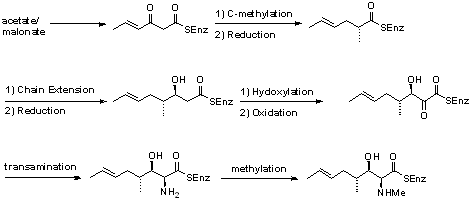
(MPTP) manifests in ischemia (blood flow restriction to tissue) and reperfusion injury (damage occurring after ischemia when blood flow returns to tissue), after myocardial infarction (heart attack) and when mutations in mitochondrial DNA polymerase occur. The heart attempts to compensate for disease state by increasing the intracellular to increase the contractility cycling rates. Constitutively high levels of mitochondrial cause inappropriate MPTP opening leading to a decrease in the cardiac range of function, leading to cardiac hypertrophy as an attempt to compensate for the problem.
, now Novartis
, under the brand name Sandimmune, which is available as soft gelatin capsules, as an oral solution, and as a formulation for intravenous administration. These are all nonaqueous compositions. A newer microemulsion
, orally-administered formulation, Neoral, is available as a solution and as soft gelatin capsules. The Neoral compositions are designed to form microemulsions in contact with water. Generic ciclosporin preparations have been marketed under various trade names, including Cicloral (Sandoz/Hexal
), Gengraf (Abbott
)and Deximune (Dexcel Pharma Ltd). Since 2002, a topical emulsion
of ciclosporin for treating inflammation caused by keratoconjunctivitis sicca
(dry eye syndrome) has been marketed under the trade name Restasis (0.05%). Inhaled ciclosporin formulations are in clinical development, and include a solution in propylene glycol
and liposome
dispersions.
The drug is also available in a dog preparation manufactured by Novartis Animal Health called Atopica. Atopica is indicated for the treatment of atopic dermatitis
in dogs. Unlike the human form of the drug, the lower doses used in dogs mean the drug acts as an immunomodulator and has fewer side effects than in humans. The benefits of using this product include the reduced need for concurrent therapies to bring the condition under control. It is available as an ophthalmic ointment for dogs called Optimmune
, manufactured by Intervet, which is part of Merck
.
United States Adopted Name
United States Adopted Names are unique nonproprietary names assigned to pharmaceuticals marketed in the United States. Each name is assigned by the USAN Council, which is co-sponsored by the American Medical Association , the United States Pharmacopeial Convention , and the American Pharmacists...
), cyclosporin (former BAN), or cyclosporin A is an immunosuppressant
Immunosuppressant
An immunosuppressant is any substance that performs immunosuppression of the immune system. They may be either exogenous, as immunosuppressive drugs, or endogenous, as ,e. g., testosterone...
drug
Medication
A pharmaceutical drug, also referred to as medicine, medication or medicament, can be loosely defined as any chemical substance intended for use in the medical diagnosis, cure, treatment, or prevention of disease.- Classification :...
widely used in post-allogeneic organ transplant
Organ transplant
Organ transplantation is the moving of an organ from one body to another or from a donor site on the patient's own body, for the purpose of replacing the recipient's damaged or absent organ. The emerging field of regenerative medicine is allowing scientists and engineers to create organs to be...
to reduce the activity of the immune system
Immune system
An immune system is a system of biological structures and processes within an organism that protects against disease by identifying and killing pathogens and tumor cells. It detects a wide variety of agents, from viruses to parasitic worms, and needs to distinguish them from the organism's own...
, and therefore the risk of organ rejection
Transplant rejection
Transplant rejection occurs when transplanted tissue is rejected by the recipient's immune system, which destroys the transplanted tissue. Transplant rejection can be lessened by determining the molecular similitude between donor and recipient and by use of immunosuppressant drugs after...
. Initially isolated from the fungus Tolypocladium inflatum
Tolypocladium inflatum
Tolypocladium inflatum is an asexual ascomycete fungus originally isolated from a Norwegian soil sample that, in certain conditions, produces ciclosporin....
isolated from a soil sample obtained by Sandoz scientists at Hardangervidda, Norway in 1969, ciclosporin is a cyclic
Cyclic compound
In chemistry, a cyclic compound is a compound in which a series of atoms is connected to form a loop or ring.While the vast majority of cyclic compounds are organic, a few inorganic substances form cyclic compounds as well, including sulfur, silanes, phosphanes, phosphoric acid, and triboric acid. ...
nonribosomal peptide
Nonribosomal peptide
Nonribosomal peptides are a class of peptide secondary metabolites, usually produced by microorganisms like bacteria and fungi. Nonribosomal peptides are also found in higher organisms, such as nudibranchs, but are thought to be made by bacteria inside these organisms...
of 11 amino acid
Amino acid
Amino acids are molecules containing an amine group, a carboxylic acid group and a side-chain that varies between different amino acids. The key elements of an amino acid are carbon, hydrogen, oxygen, and nitrogen...
s and contains a single D-amino acid
Chirality (chemistry)
A chiral molecule is a type of molecule that lacks an internal plane of symmetry and thus has a non-superimposable mirror image. The feature that is most often the cause of chirality in molecules is the presence of an asymmetric carbon atom....
, which are rarely encountered in nature.Some sources list the fungus under an alternative species name Hypocladium inflatum gams such as Pritchard and Sneader in 2005:
*
*
However, the name, "Beauveria nivea", also appears in several other articles including in a 2001 online publication by Harriet Upton entitled "Origin of drugs in current use: the cyclosporin story" (retrieved June 19, 2005). Mark Plotkin states in his book Medicine Quest, Penguin Books 2001, pages 46-47, that in 1996 mycology
Mycology
Mycology is the branch of biology concerned with the study of fungi, including their genetic and biochemical properties, their taxonomy and their use to humans as a source for tinder, medicinals , food and entheogens, as well as their dangers, such as poisoning or...
researcher Kathie Hodge found that it is in fact a species of Cordyceps
Cordyceps
Cordyceps is a genus of ascomycete fungi that includes about 400 described species. All Cordyceps species are endoparasitoids, mainly on insects and other arthropods ; a few are parasitic on other fungi. The best known species of the genus is Cordyceps sinensis, first recorded as yartsa gunbu in...
.
Medical uses
The immunosuppressive effect of ciclosporin was discovered on 31 January 1972 by employees of SandozSandoz
Founded in 2003, Sandoz presently is the generic drug subsidiary of Novartis, a multinational pharmaceutical company. The company develops, manufactures and markets generic drugs as well as pharmaceutical and biotechnological active ingredients....
(now Novartis
Novartis
Novartis International AG is a multinational pharmaceutical company based in Basel, Switzerland, ranking number three in sales among the world-wide industry...
) in Basel
Basel
Basel or Basle In the national languages of Switzerland the city is also known as Bâle , Basilea and Basilea is Switzerland's third most populous city with about 166,000 inhabitants. Located where the Swiss, French and German borders meet, Basel also has suburbs in France and Germany...
, Switzerland
Switzerland
Switzerland name of one of the Swiss cantons. ; ; ; or ), in its full name the Swiss Confederation , is a federal republic consisting of 26 cantons, with Bern as the seat of the federal authorities. The country is situated in Western Europe,Or Central Europe depending on the definition....
, in a screening test on immune suppression designed and implemented by Hartmann F. Stähelin
Hartmann F. Stähelin
Hartmann F. Stähelin, M.D. was a Swiss pharmacologist with an outstanding record in basic and applied cancer and immunology research. He discovered two important drugs: etoposide and ciclosporin.-Early life:...
, M.D. The success of ciclosporin in preventing organ rejection was shown in kidney transplants by Calne and colleagues at the University of Cambridge, and in liver
Liver
The liver is a vital organ present in vertebrates and some other animals. It has a wide range of functions, including detoxification, protein synthesis, and production of biochemicals necessary for digestion...
transplants performed by Dr. Thomas Starzl
Thomas Starzl
Thomas E. Starzl is an American physician, researcher, and is an expert on organ transplants. He performed the first human liver transplants, and has often been referred to as "the father of modern transplantation."-Life:...
at the University of Pittsburgh
University of Pittsburgh
The University of Pittsburgh, commonly referred to as Pitt, is a state-related research university located in Pittsburgh, Pennsylvania, United States. Founded as Pittsburgh Academy in 1787 on what was then the American frontier, Pitt is one of the oldest continuously chartered institutions of...
Hospital. The first patient, on 9 March 1980, was a 28-year-old woman. Ciclosporin was subsequently approved for use in 1983.
Apart from in transplant medicine, ciclosporin is also used in psoriasis
Psoriasis
Psoriasis is an autoimmune disease that appears on the skin. It occurs when the immune system mistakes the skin cells as a pathogen, and sends out faulty signals that speed up the growth cycle of skin cells. Psoriasis is not contagious. However, psoriasis has been linked to an increased risk of...
, severe atopic dermatitis
Atopic dermatitis
Atopic dermatitis is an inflammatory, chronically relapsing, non-contagious and pruritic skin disorder...
, pyoderma gangrenosum
Pyoderma gangrenosum
Pyoderma gangrenosum is a disease that causes tissue to become necrotic, causing deep ulcers that usually occur on the legs. When they occur, they can lead to chronic wounds. Ulcers usually initially look like small bug bites or papules, and they progress to larger ulcers. Though the wounds...
, chronic autoimmune urticaria, and, infrequently, in rheumatoid arthritis
Rheumatoid arthritis
Rheumatoid arthritis is a chronic, systemic inflammatory disorder that may affect many tissues and organs, but principally attacks synovial joints. The process produces an inflammatory response of the synovium secondary to hyperplasia of synovial cells, excess synovial fluid, and the development...
and related diseases, although it is only used in severe cases. It is commonly prescribed in the US as an ophthalmic eyedrop for the treatment of dry eyes. It has been investigated for use in many other autoimmune disorders, and is sometimes prescribed in veterinary cases, particularly in extreme cases of immune-mediated hemolytic anemia
Hemolytic anemia
Hemolytic anemia is a form of anemia due to hemolysis, the abnormal breakdown of red blood cells , either in the blood vessels or elsewhere in the human body . It has numerous possible causes, ranging from relatively harmless to life-threatening...
. Inhaled ciclosporin has been investigated to treat asthma and is being studied as a preventive therapy for chronic rejection of the lungs. Ciclosporin has also been used to help treat patients with ulcerative colitis
Ulcerative colitis
Ulcerative colitis is a form of inflammatory bowel disease . Ulcerative colitis is a form of colitis, a disease of the colon , that includes characteristic ulcers, or open sores. The main symptom of active disease is usually constant diarrhea mixed with blood, of gradual onset...
that do not respond to treatment with steroids. This drug is also used as a treatment of posterior or intermediate uveitis
Uveitis
Uveitis specifically refers to inflammation of the middle layer of the eye, termed the "uvea" but in common usage may refer to any inflammatory process involving the interior of the eye....
with noninfective etiology
Etiology
Etiology is the study of causation, or origination. The word is derived from the Greek , aitiologia, "giving a reason for" ....
.
Ciclosporin has been investigated as a possible neuroprotective agent in conditions such as traumatic brain injury
Traumatic brain injury
Traumatic brain injury , also known as intracranial injury, occurs when an external force traumatically injures the brain. TBI can be classified based on severity, mechanism , or other features...
, and has been shown in animal experiments to reduce brain damage
Brain damage
"Brain damage" or "brain injury" is the destruction or degeneration of brain cells. Brain injuries occur due to a wide range of internal and external factors...
associated with injury. Ciclosporin blocks the formation of the mitochondrial permeability transition pore
Mitochondrial permeability transition pore
The Mitochondrial Permeability Transition, or MPT, is defined as an increase in the permeability of the mitochondrial membranes to molecules of less than 1500 Daltons in molecular weight. MPT results from the opening of a mitochondrial permeability transition pore, also known as the MPT pore or MPTP...
, which has been found to cause much of the damage associated with head injury
Head injury
Head injury refers to trauma of the head. This may or may not include injury to the brain. However, the terms traumatic brain injury and head injury are often used interchangeably in medical literature....
and neurodegenerative diseases.
Ciclosporin is a drug currently used to experimentally treat cardiac hypertrophy (an increase in cell volume). It is a cyclic undecapeptide (chain of 11 amino acid residues) of fungal origin and is used presently as an immunosuppressant.
Cardiac disease
CsA has been shown to decrease cardiac hypertrophy by affecting cardiac myocytes in many ways. CsA binds to cyclophilin D to block the opening of MPTP, and thus decreases the release of protein cytochrome C, which can cause programmed cell death. CypD is a protein within the MPTP that acts as a gate; binding by CsA decreases the amount of inappropriate opening of MPTP, which decreases the intramitochondrial . Decreasing intramitochondrial allows for reversal of cardiac hypertrophy caused in the original cardiac response. Decreasing the release of cytochrome C caused decreased cell death during injury and disease. CsA also inhibits the phosphatase calcineurin pathway (14). Inhibition of this pathway has been shown to decrease myocardial hypertrophy.Adverse effects and interactions
Treatment may be associated with a number of potentially serious adverse drug reactionAdverse drug reaction
An adverse drug reaction is an expression that describes harm associated with the use of given medications at a normal dosage. ADRs may occur following a single dose or prolonged administration of a drug or result from the combination of two or more drugs...
s (ADRs).
ADRs can include gingival hyperplasia, convulsion
Seizure
An epileptic seizure, occasionally referred to as a fit, is defined as a transient symptom of "abnormal excessive or synchronous neuronal activity in the brain". The outward effect can be as dramatic as a wild thrashing movement or as mild as a brief loss of awareness...
s, peptic ulcer
Peptic ulcer
A peptic ulcer, also known as PUD or peptic ulcer disease, is the most common ulcer of an area of the gastrointestinal tract that is usually acidic and thus extremely painful. It is defined as mucosal erosions equal to or greater than 0.5 cm...
s, pancreatitis
Pancreatitis
Pancreatitis is inflammation of the pancreas. It occurs when pancreatic enzymes that digest food are activated in the pancreas instead of the small intestine. It may be acute – beginning suddenly and lasting a few days, or chronic – occurring over many years...
, fever
Fever
Fever is a common medical sign characterized by an elevation of temperature above the normal range of due to an increase in the body temperature regulatory set-point. This increase in set-point triggers increased muscle tone and shivering.As a person's temperature increases, there is, in...
, vomiting, diarrhea
Diarrhea
Diarrhea , also spelled diarrhoea, is the condition of having three or more loose or liquid bowel movements per day. It is a common cause of death in developing countries and the second most common cause of infant deaths worldwide. The loss of fluids through diarrhea can cause dehydration and...
, confusion
ConFusion
ConFusion is an annual science fiction convention organized by the Stilyagi Air Corps and its parent organization, the Ann Arbor Science Fiction Association. Commonly, it is held the third weekend of January. It is the oldest science fiction convention in Michigan, a regional, general SF con...
, hypercholesterolemia
Hypercholesterolemia
Hypercholesterolemia is the presence of high levels of cholesterol in the blood. It is not a disease but a metabolic derangement that can be caused by many diseases, notably cardiovascular disease...
, dyspnea
Dyspnea
Dyspnea , shortness of breath , or air hunger, is the subjective symptom of breathlessness.It is a normal symptom of heavy exertion but becomes pathological if it occurs in unexpected situations...
, numbness and tingling
Tingling
Tingling or Tili was a tribe union west of China before 300 BC. After c.300BC they were called tieloe or kauko. The avars was the tieloe tribe union most west members....
particularly of the lips, pruritus, high blood pressure
Blood pressure
Blood pressure is the pressure exerted by circulating blood upon the walls of blood vessels, and is one of the principal vital signs. When used without further specification, "blood pressure" usually refers to the arterial pressure of the systemic circulation. During each heartbeat, BP varies...
, potassium
Potassium
Potassium is the chemical element with the symbol K and atomic number 19. Elemental potassium is a soft silvery-white alkali metal that oxidizes rapidly in air and is very reactive with water, generating sufficient heat to ignite the hydrogen emitted in the reaction.Potassium and sodium are...
retention, and possibly hyperkalemia
Hyperkalemia
Hyperkalemia refers to the condition in which the concentration of the electrolyte potassium in the blood is elevated...
, kidney
Kidney
The kidneys, organs with several functions, serve essential regulatory roles in most animals, including vertebrates and some invertebrates. They are essential in the urinary system and also serve homeostatic functions such as the regulation of electrolytes, maintenance of acid–base balance, and...
and liver
Liver
The liver is a vital organ present in vertebrates and some other animals. It has a wide range of functions, including detoxification, protein synthesis, and production of biochemicals necessary for digestion...
dysfunction (nephrotoxicity
Nephrotoxicity
Nephrotoxicity is a poisonous effect of some substances, both toxic chemicals and medication, on the kidneys. There are various forms of toxicity. Nephrotoxicity should not be confused with the fact that some medications have a predominantly renal excretion and need their dose adjusted for the...
and hepatotoxicity
Hepatotoxicity
Hepatotoxicity implies chemical-driven liver damage.The liver plays a central role in transforming and clearing chemicals and is susceptible to the toxicity from these agents. Certain medicinal agents, when taken in overdoses and sometimes even when introduced within therapeutic ranges, may injure...
), burning sensations at finger tips and an increased vulnerability to opportunistic fungal and viral infection
Infection
An infection is the colonization of a host organism by parasite species. Infecting parasites seek to use the host's resources to reproduce, often resulting in disease...
s.
An alternate form of the drug, cyclosporin G (OG37-324), has been found to be much less nephrotoxic than the standard ciclosporin (cyclosporin A). Cyclosporin G (molecular mass
Molecular mass
The molecular mass of a substance is the mass of one molecule of that substance, in unified atomic mass unit u...
1217) differs from cyclosporin A in the amino acid
Amino acid
Amino acids are molecules containing an amine group, a carboxylic acid group and a side-chain that varies between different amino acids. The key elements of an amino acid are carbon, hydrogen, oxygen, and nitrogen...
2 position, where an L-norvaline
Norvaline
Norvaline is an amino acid with the chemical formula C5H11NO2, isomeric with valine. This amino acid is often made synthetically.-Background:...
replaces the α-aminobutyric acid
Alpha-Aminobutyric acid
α-Aminobutyric acid is an isomer of the amino acid aminobutyric acid with chemical formula C4H9NO2. There is also gamma-aminobutyric acid and beta-aminobutyric acid....
.
Mechanism of action
Ciclosporin is thought to bind to the cytosolic protein cyclophilinCyclophilin
Cyclophilins are a family of proteins from vertebrates and other organisms that bind to cyclosporine, an immunosuppressant which is usually used to suppress rejection after internal organ transplants...
(immunophilin) of immunocompetent lymphocytes, especially T-lymphocytes. This complex of ciclosporin and cyclophilin
Cyclophilin
Cyclophilins are a family of proteins from vertebrates and other organisms that bind to cyclosporine, an immunosuppressant which is usually used to suppress rejection after internal organ transplants...
inhibits calcineurin
Calcineurin
Calcineurin is a protein phosphatase also known as protein phosphatase 3, PPP3CA, and calcium-dependent serine-threonine phosphatase, and formerly known as protein phosphatase 2B . It activates the T cells of the immune system and can be blocked by drugs...
, which, under normal
circumstances, is responsible for activating the transcription of interleukin 2
Interleukin 2
Interleukin-2 is an interleukin, a type of cytokine immune system signaling molecule, which is a leukocytotrophic hormone that is instrumental in the body's natural response to microbial infection and in discriminating between foreign and self...
. In T-cells, activation of the T-cell receptor normally increases intracellular calcium, which acts via calmodulin to activate calcineurin. Calcineurin then dephosphorylates the transcription factor NF-AT (nuclear factor of activated T-cells), which moves to the nucleus of the T-cell and increases the activity of genes coding for IL-2 and related cytokines. Ciclosporin prevents the dephosphorlyation of NF-AT by binding to cyclophilin. It also inhibits lymphokine
Lymphokine
Lymphokines are a subset of cytokines that are produced by a type of immune cell known as a lymphocyte. They are protein mediators typically produced by T cells to direct the immune system response by signalling between its cells...
production and interleukin
Interleukin
Interleukins are a group of cytokines that were first seen to be expressed by white blood cells . The term interleukin derives from "as a means of communication", and "deriving from the fact that many of these proteins are produced by leukocytes and act on leukocytes"...
release and, therefore, leads to a reduced function of effector T-cells. It does not affect cytostatic activity.
Ciclosporin affects mitochondria by preventing the mitochondrial permeability transition pore from opening, thus inhibiting cytochrome c
Cytochrome c
The Cytochrome complex, or cyt c is a small heme protein found loosely associated with the inner membrane of the mitochondrion. It belongs to the cytochrome c family of proteins. Cytochrome c is a highly soluble protein, unlike other cytochromes, with a solubility of about 100 g/L and is an...
release, a potent apoptotic stimulation factor. This is not the primary mechanism of action for clinical use, but is an important effect for research on apoptosis
Apoptosis
Apoptosis is the process of programmed cell death that may occur in multicellular organisms. Biochemical events lead to characteristic cell changes and death. These changes include blebbing, cell shrinkage, nuclear fragmentation, chromatin condensation, and chromosomal DNA fragmentation...
.
Ciclosporin is believed to elicit its effects by directly binding to the cyclophilin D protein (CypD) that constitutes part of the mitochondrial permeability transition pore (MPTP), and by inhibiting the calcineurin phosphatase pathway.
The MPTP is found in the mitochondrial membrane of cardiac myocytes (heart muscle cells) and functions to move calcium ions into the mitochondria. When open, enters the mitochondria, disrupting transmembrane potential (the electric charge across a membrane). If unregulated, this can contribute to mitochondrial swelling and dysfunction. To allow for normal contraction, intracellular increases, and the MPTP in turn opens, shuttling into the mitochondria.
Calcineurin is a -activated phosphatase (enzyme that removes a phosphate group from substrate) that regulates cardiac hypertrophy. Regulation occurs through NFAT (nuclear factor of activated T-cells) activation, which, when dephosphorylated, binds to GATA and forms a transcription factor (protein that can bind DNA and alter the expression of DNA) with ability to control the hypertrophic gene (2). Activation of calcineurin causes increases in hypertrophy.
Biosynthesis
Nonribosomal peptide
Nonribosomal peptides are a class of peptide secondary metabolites, usually produced by microorganisms like bacteria and fungi. Nonribosomal peptides are also found in higher organisms, such as nudibranchs, but are thought to be made by bacteria inside these organisms...
synthetase, ciclosporin synthetase. The enzyme contains an adenylation
Adenylation
Adenylylation is a posttranslational modification that can occur to molecules such as tyrosine residues. Adenylylation involves a phosphodiester bond between a hydroxyl group of the molecule undergoing adenylylation and the phosphate group of the adenosine monophosphate nucleotide Adenylylation is...
domain, a thiolation domain, a condensation domain
Condensation domain
In molecular biology, the condensation domain is a protein domain found in many multi-domain enzymes which synthesise peptide antibiotics. This domain catalyses a condensation reaction to form peptide bonds in non-ribosomal peptide biosynthesis. It is usually found to the carboxy side of a...
, and an N-methyltransferase
N-methyltransferase
N-methyltransferase may refer to*-1-benzyl-1,2,3,4-tetrahydroisoquinoline N-methyltransferase*3-hydroxy-16-methoxy-2,3-dihydrotabersonine N-methyltransferase*Amine N-methyltransferase*Anthranilate N-methyltransferase...
domain. The adenylation
Adenylation
Adenylylation is a posttranslational modification that can occur to molecules such as tyrosine residues. Adenylylation involves a phosphodiester bond between a hydroxyl group of the molecule undergoing adenylylation and the phosphate group of the adenosine monophosphate nucleotide Adenylylation is...
domain is responsible for substrate recognition and activation, whereas the thiolation domain covalently binds the adenylated amino acids to phosphopantetheine
Phosphopantetheine
4'-Phosphopantetheine is an essential prosthetic group of acyl carrier protein and peptidyl carrier proteins and aryl carrier proteins derived from Coenzyme A...
, and the condensation domain elongates the peptide chain. Ciclosporin synthetase substrates include L-valine
Valine
Valine is an α-amino acid with the chemical formula HO2CCHCH2. L-Valine is one of 20 proteinogenic amino acids. Its codons are GUU, GUC, GUA, and GUG. This essential amino acid is classified as nonpolar...
, L-leucine
Leucine
Leucine is a branched-chain α-amino acid with the chemical formula HO2CCHCH2CH2. Leucine is classified as a hydrophobic amino acid due to its aliphatic isobutyl side chain. It is encoded by six codons and is a major component of the subunits in ferritin, astacin and other 'buffer' proteins...
, L-alanine
Alanine
Alanine is an α-amino acid with the chemical formula CH3CHCOOH. The L-isomer is one of the 20 amino acids encoded by the genetic code. Its codons are GCU, GCC, GCA, and GCG. It is classified as a nonpolar amino acid...
, L-glycine
Glycine
Glycine is an organic compound with the formula NH2CH2COOH. Having a hydrogen substituent as its 'side chain', glycine is the smallest of the 20 amino acids commonly found in proteins. Its codons are GGU, GGC, GGA, GGG cf. the genetic code.Glycine is a colourless, sweet-tasting crystalline solid...
, 2-aminobutyric acid
Alpha-Aminobutyric acid
α-Aminobutyric acid is an isomer of the amino acid aminobutyric acid with chemical formula C4H9NO2. There is also gamma-aminobutyric acid and beta-aminobutyric acid....
, 4-methylthreonine
Threonine
Threonine is an α-amino acid with the chemical formula HO2CCHCHCH3. Its codons are ACU, ACA, ACC, and ACG. This essential amino acid is classified as polar...
, and D-alanine. With the adenylation domain, ciclosporin synthetase generates the acyl-adenylated amino acids, then covalently binds the amino acid
Amino acid
Amino acids are molecules containing an amine group, a carboxylic acid group and a side-chain that varies between different amino acids. The key elements of an amino acid are carbon, hydrogen, oxygen, and nitrogen...
to phosphopantetheine
Phosphopantetheine
4'-Phosphopantetheine is an essential prosthetic group of acyl carrier protein and peptidyl carrier proteins and aryl carrier proteins derived from Coenzyme A...
through a thioester
Thioester
Thioesters are compounds with the functional group C-S-CO-C. They are the product of esterification between a carboxylic acid and a thiol. Thioesters are widespread in biochemistry, the best-known derivative being acetyl-CoA.-Synthesis:...
linkage. Some of the amino acid substrates become N-methylated by S-adenosyl methionine
S-Adenosyl methionine
S-Adenosyl methionine is a common cosubstrate involved in methyl group transfers. SAM was first discovered in Italy by G. L. Cantoni in 1952. It is made from adenosine triphosphate and methionine by methionine adenosyltransferase . Transmethylation, transsulfuration, and aminopropylation are the...
. The cyclization step releases ciclosporin from the enzyme
Enzyme
Enzymes are proteins that catalyze chemical reactions. In enzymatic reactions, the molecules at the beginning of the process, called substrates, are converted into different molecules, called products. Almost all chemical reactions in a biological cell need enzymes in order to occur at rates...
. Amino acids such as D-Ala and butenyl-methyl-L-threonine indicate ciclosporin synthetase requires the action of other enzymes such as a D-alanine racemase. The racemization of L-Ala to D-Ala is pyridoxal phosphate-dependent. The formation of butenyl-methyl-L-threonine is performed by a butenyl-methyl-L-threonine polyketide synthase that uses acetate/malonate as its starting material.
Cardiac disease
Inappropriate opening of the mitochondrial permeability transition poreMitochondrial permeability transition pore
The Mitochondrial Permeability Transition, or MPT, is defined as an increase in the permeability of the mitochondrial membranes to molecules of less than 1500 Daltons in molecular weight. MPT results from the opening of a mitochondrial permeability transition pore, also known as the MPT pore or MPTP...
(MPTP) manifests in ischemia (blood flow restriction to tissue) and reperfusion injury (damage occurring after ischemia when blood flow returns to tissue), after myocardial infarction (heart attack) and when mutations in mitochondrial DNA polymerase occur. The heart attempts to compensate for disease state by increasing the intracellular to increase the contractility cycling rates. Constitutively high levels of mitochondrial cause inappropriate MPTP opening leading to a decrease in the cardiac range of function, leading to cardiac hypertrophy as an attempt to compensate for the problem.
Formulations
The drug exhibits very poor solubility in water, and, as a consequence, suspension and emulsion forms of the drug have been developed for oral administration and for injection. Ciclosporin was originally brought to market by SandozSandoz
Founded in 2003, Sandoz presently is the generic drug subsidiary of Novartis, a multinational pharmaceutical company. The company develops, manufactures and markets generic drugs as well as pharmaceutical and biotechnological active ingredients....
, now Novartis
Novartis
Novartis International AG is a multinational pharmaceutical company based in Basel, Switzerland, ranking number three in sales among the world-wide industry...
, under the brand name Sandimmune, which is available as soft gelatin capsules, as an oral solution, and as a formulation for intravenous administration. These are all nonaqueous compositions. A newer microemulsion
Microemulsion
Microemulsions are clear, thermodynamically stable, isotropic liquid mixtures of oil, water and surfactant, frequently in combination with a cosurfactant. The aqueous phase may contain salt and/or other ingredients, and the "oil" may actually be a complex mixture of different hydrocarbons and olefins...
, orally-administered formulation, Neoral, is available as a solution and as soft gelatin capsules. The Neoral compositions are designed to form microemulsions in contact with water. Generic ciclosporin preparations have been marketed under various trade names, including Cicloral (Sandoz/Hexal
Sandoz
Founded in 2003, Sandoz presently is the generic drug subsidiary of Novartis, a multinational pharmaceutical company. The company develops, manufactures and markets generic drugs as well as pharmaceutical and biotechnological active ingredients....
), Gengraf (Abbott
Abbott Laboratories
Abbott Laboratories is an American-based global, diversified pharmaceuticals and health care products company. It has 90,000 employees and operates in over 130 countries. The company headquarters are in Abbott Park, North Chicago, Illinois. The company was founded by Chicago physician, Dr....
)and Deximune (Dexcel Pharma Ltd). Since 2002, a topical emulsion
Emulsion
An emulsion is a mixture of two or more liquids that are normally immiscible . Emulsions are part of a more general class of two-phase systems of matter called colloids. Although the terms colloid and emulsion are sometimes used interchangeably, emulsion is used when both the dispersed and the...
of ciclosporin for treating inflammation caused by keratoconjunctivitis sicca
Keratoconjunctivitis sicca
Keratoconjunctivitis sicca , also called keratitis sicca, xerophthalmia or dry eye syndrome is an eye disease caused by eye dryness, which, in turn, is caused by either decreased tear production or increased tear film evaporation. It is found in humans and some animals...
(dry eye syndrome) has been marketed under the trade name Restasis (0.05%). Inhaled ciclosporin formulations are in clinical development, and include a solution in propylene glycol
Propylene glycol
Propylene glycol, also called 1,2-propanediol or propane-1,2-diol, is an organic compound with formula C3H8O2 or HO-CH2-CHOH-CH3...
and liposome
Liposome
Liposomes are artificially prepared vesicles made of lipid bilayer. Liposomes can be filled with drugs, and used to deliver drugs for cancer and other diseases. Liposomes are composite structures made of phospholipids and may contain small amounts of other molecules...
dispersions.
The drug is also available in a dog preparation manufactured by Novartis Animal Health called Atopica. Atopica is indicated for the treatment of atopic dermatitis
Atopy
Atopy or atopic syndrome is a predisposition toward developing certain allergic hypersensitivity reactions.Atopy may have a hereditary component, although contact with the allergen must occur before the hypersensitivity reaction can develop ....
in dogs. Unlike the human form of the drug, the lower doses used in dogs mean the drug acts as an immunomodulator and has fewer side effects than in humans. The benefits of using this product include the reduced need for concurrent therapies to bring the condition under control. It is available as an ophthalmic ointment for dogs called Optimmune
Optimmune
Optimmune is an ophthalmic ointment with cyclosporine as the active ingredient for the treatment of pannus and chronic idiopathic keratoconjunctivitis sicca in dogs. It is a veterinary product produced by Intervet, which is part of Merck. Optimmune was invented by Dr. Renee Kaswan, a DVM and...
, manufactured by Intervet, which is part of Merck
Merck & Co.
Merck & Co., Inc. , also known as Merck Sharp & Dohme or MSD outside the United States and Canada, is one of the largest pharmaceutical companies in the world. The Merck headquarters is located in Whitehouse Station, New Jersey, an unincorporated area in Readington Township...
.
See also
- Cremophor ELCremophor ELCremophor EL is the registered trademark of BASF Corp. for its version of polyethoxylated castor oil. It is prepared by reacting 35 moles of ethylene oxide with each mole of castor oil...
(additive in Sandimmune) - Castor oilCastor oilCastor oil is a vegetable oil obtained from the castor bean . Castor oil is a colorless to very pale yellow liquid with mild or no odor or taste. Its boiling point is and its density is 961 kg/m3...
(additive in Sandimmune) - AlcoholEthanolEthanol, also called ethyl alcohol, pure alcohol, grain alcohol, or drinking alcohol, is a volatile, flammable, colorless liquid. It is a psychoactive drug and one of the oldest recreational drugs. Best known as the type of alcohol found in alcoholic beverages, it is also used in thermometers, as a...
(additive in Sandimmune and Neoral)