

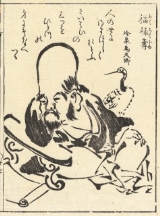
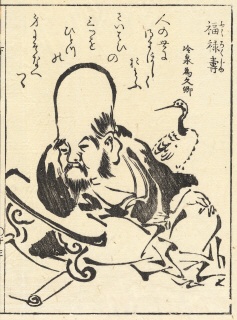
Fukurokuju

Encyclopedia
Japan
Japan is an island nation in East Asia. Located in the Pacific Ocean, it lies to the east of the Sea of Japan, China, North Korea, South Korea and Russia, stretching from the Sea of Okhotsk in the north to the East China Sea and Taiwan in the south...
, Fukurokuju (福禄寿) (from Japanese
Japanese language
is a language spoken by over 130 million people in Japan and in Japanese emigrant communities. It is a member of the Japonic language family, which has a number of proposed relationships with other languages, none of which has gained wide acceptance among historical linguists .Japanese is an...
fuku, "happiness"; roku, "wealth"; and ju, "longevity") is one of the Seven Lucky Gods
Seven Lucky Gods
The , commonly referred to in English as the Seven Lucky Gods, refer to the seven gods of good fortune in Japanese mythology and folklore. They are often the subject of netsuke carvings and other representations.Each has a traditional attribute:...
in Japanese mythology
Japanese mythology
Japanese mythology is a system of beliefs that embraces Shinto and Buddhist traditions as well as agriculturally based folk religion. The Shinto pantheon comprises innumerable kami...
. It has been theorized that he is a Japanese assimilation
Cultural assimilation
Cultural assimilation is a socio-political response to demographic multi-ethnicity that supports or promotes the assimilation of ethnic minorities into the dominant culture. The term assimilation is often used with regard to immigrants and various ethnic groups who have settled in a new land. New...
of the Chinese Three Star Gods (Fulushou) embodied in one deity. Most related in appearance to the Chinese star god Shou, he is the God of wisdom and longevity
Longevity
The word "longevity" is sometimes used as a synonym for "life expectancy" in demography or known as "long life", especially when it concerns someone or something lasting longer than expected ....
. According to some, before attaining divinity, he was a Chinese hermit of the Song Dynasty
Song Dynasty
The Song Dynasty was a ruling dynasty in China between 960 and 1279; it succeeded the Five Dynasties and Ten Kingdoms Period, and was followed by the Yuan Dynasty. It was the first government in world history to issue banknotes or paper money, and the first Chinese government to establish a...
and a reincarnation of the Taoist god Xuanwu
Xuan Wu (god)
Xuan Wu , posthumously known as The Dark/Mysterious Heavenly Upper Emperor , as well as True Warrior Grand Emperor , and commonly known as The Northern Emperor or Emperor Lord or Teh Kong in Hokkien...
. It is said that during his human incarnation, he was a sennin
Sennin
The Japanese term sennin is a loanword from Chinese xiānrén 仙人 "immortal person", known also as xian "immortal; transcendent; genie; mage; djinn; sage; hermit" in Daoism....
; a philosopher who could exist without eating food.
He is sometimes confused with Juroujin
Juroujin
In Japan, Jurōjin , also known as Gama, is one of the Seven Gods of Fortune or Shichi-fuku-jin, according to Taoist beliefs. He is the God of longevity....
, who by some accounts is Fukurokuju's grandson and by other accounts inhabits the same body as Fukurokuju.
Usually portrayed as being bald, with long whiskers, he is said to be an incarnation of the Southern Polestar
Pole star
The term "Pole Star" usually refers to Polaris, which is the current northern pole star, also known as the North Star.In general, however, a pole star is a visible star, especially a prominent one, that is approximately aligned with the Earth's axis of rotation; that is, a star whose apparent...
. In many depictions, Fukurokuju has an abnormally high forehead
Forehead
For the Arsenal striker see GervinhoIn human anatomy, the forehead is the fore part of the head. It is, formally, an area of the head bounded by three features, two of the skull and one of the scalp. The top of the forehead is marked by the hairline, the edge of the area where hair on the scalp...
. The sacred book tied to his staff either contains the lifespan of every person on earth or a magical scripture. He is accompanied by a crane
Crane (bird)
Cranes are a family, Gruidae, of large, long-legged and long-necked birds in the order Gruiformes. There are fifteen species of crane in four genera. Unlike the similar-looking but unrelated herons, cranes fly with necks outstretched, not pulled back...
and a turtle
Turtle
Turtles are reptiles of the order Testudines , characterised by a special bony or cartilaginous shell developed from their ribs that acts as a shield...
, which are considered to be symbols of longevity. He is also sometimes accompanied by a black deer
Deer
Deer are the ruminant mammals forming the family Cervidae. Species in the Cervidae family include white-tailed deer, elk, moose, red deer, reindeer, fallow deer, roe deer and chital. Male deer of all species and female reindeer grow and shed new antlers each year...
(ancient legends say a deer turns black if it is over 2000 years old).
He is the only member of the Seven Lucky Gods credited with the ability to revive the dead.