

Fritsch-Buttenberg-Wiechell rearrangement

Encyclopedia
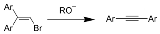
The Fritsch–Buttenberg–Wiechell rearrangement, named for Paul Ernst Moritz Fritsch, Wilhelm Paul Buttenberg, and Heinrich G. Wiechell, is a chemical reaction
whereby a 1,1-diaryl-2-bromo-alkene
rearranges
to a 1,2-diaryl-alkyne
by reaction with a strong base such as an alkoxide
.
 This rearrangement is also possible with alkyl substituents.
, which after alpha-elimination forms a vinyl
carbene
. A 1,2-aryl migration forms the desired product, the 1,2-diaryl-alkyne.
s :
Chemical reaction
A chemical reaction is a process that leads to the transformation of one set of chemical substances to another. Chemical reactions can be either spontaneous, requiring no input of energy, or non-spontaneous, typically following the input of some type of energy, such as heat, light or electricity...
whereby a 1,1-diaryl-2-bromo-alkene
Alkene
In organic chemistry, an alkene, olefin, or olefine is an unsaturated chemical compound containing at least one carbon-to-carbon double bond...
rearranges
Rearrangement reaction
A rearrangement reaction is a broad class of organic reactions where the carbon skeleton of a molecule is rearranged to give a structural isomer of the original molecule. Often a substituent moves from one atom to another atom in the same molecule...
to a 1,2-diaryl-alkyne
Alkyne
Alkynes are hydrocarbons that have a triple bond between two carbon atoms, with the formula CnH2n-2. Alkynes are traditionally known as acetylenes, although the name acetylene also refers specifically to C2H2, known formally as ethyne using IUPAC nomenclature...
by reaction with a strong base such as an alkoxide
Alkoxide
An alkoxide is the conjugate base of an alcohol and therefore consists of an organic group bonded to a negatively charged oxygen atom. They can be written as RO−, where R is the organic substituent. Alkoxides are strong bases and, when R is not bulky, good nucleophiles and good ligands...
.
Reaction Mechanism
The strong base deprotonates the vinylic hydrogenHydrogen
Hydrogen is the chemical element with atomic number 1. It is represented by the symbol H. With an average atomic weight of , hydrogen is the lightest and most abundant chemical element, constituting roughly 75% of the Universe's chemical elemental mass. Stars in the main sequence are mainly...
, which after alpha-elimination forms a vinyl
Vinyl
A vinyl compound is any organic compound that contains a vinyl group ,which are derivatives of ethene, CH2=CH2, with one hydrogen atom replaced with some other group...
carbene
Carbene
In chemistry, a carbene is a molecule containing a neutral carbon atom with a valence of two and two unshared valence electrons. The general formula is RR'C:, but the carbon can instead be double-bonded to one group. The term "carbene" may also merely refer to the compound H2C:, also called...
. A 1,2-aryl migration forms the desired product, the 1,2-diaryl-alkyne.
Scope
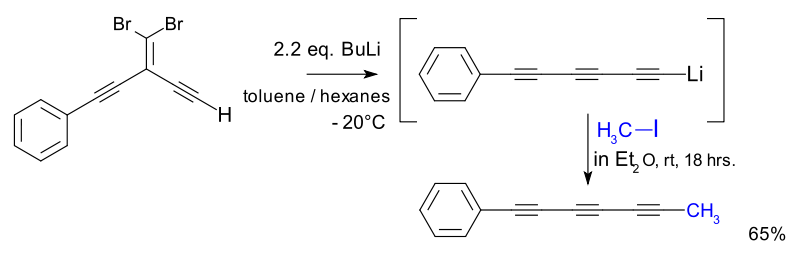
One study explored this reaction for the synthesis of novel polyynePolyyne
The polyynes are a group of organic compounds with alternating single and triple bonds. The simplest example is diacetylene or buta-1,3-diyne, HC≡C-C≡CH....
s :