


Fringford

Encyclopedia
Fringford is a village and civil parish in Oxfordshire
, about 4 miles (6.4 km) northeast of Bicester
. The parish is bounded to the east by the Roman road that linked Alchester Roman Town with Roman Towcester, to the south by a brook that joins the River Bure
, to the north mostly by a brook that is a tributary of the River Great Ouse
, and to the west by field boundaries. Fringford village is in the north of the parish, surrounded on two sides by a bend in the tributary of the Great Ouse.
. The site is only about 200 yards (182.9 m) west of the Roman road. It is now occupied by Fringford Lodge.
is derived from an Old English tribal or family name Ferring or Fcaring and the ford that formed the only crossing-point of the narrow stream that flows around three sides of the village. An earlier form of the name would have been Ferringas-ford.
After the Norman conquest of England
in 1066, William of Normandy
gave his half-brother Odo, Bishop of Bayeux, manors
that included Fringford. Later the Crown
deposed Odo and granted the manor of Fringford to Baron William de Arsic of Cogges
. By the early part of the twelfth century William's son Baron Manessah Arsic had built a stone church at Fringford in place of an earlier wooden one. The new church was dedicated to Saint Michael
and All Angels and granted to the Benedictine
Priory
founded at Cogges by Baron William.
The south aisle may have been rebuilt in the 14th century. The peal
of bells must have been hung sometime before the end of the 17th century. The only maintenance recorded before the 19th century is in 1788, when £18.4.3d. was spent on general repairs.
In 1814 Henry Dawson Roundel was appointed Rector. He is described as having ample means and he proved to be both generous and forethinking. He started a plan for the letting of small allotments to labourers in the parish and, throughout his life, he was the driving force for the restoration of the church. After Roundel's incumbency the north aisle was rebuilt in 1905 and the roof was restored in 1909.
Notes from local pamphlet entitled "A Guided Tour of Five Churches of the Shelswell Group" about Fringford, Oxfordshire, England.
's Lark Rise to Candleford
trilogy, in which Fringford is the prototype for Candleford Green. In 1844 the Oxford Chronicle noted "there aren't enough dwellings to shelter the poor". In 1851 the population was 357. During this time the parish had only a few good farm-houses. However, population grew in 1871, it reached its highest number until 1990s at 479.
Fringford had five blacksmiths, three carpenters, three sawyers, three brickmakers, a stonemason, a shoemaker, three decorators, a carrier, a coal haulier, two bakers, two grocers and a butcher. Also two grooms, two footmen, six gardeners and a coachman from Fringford were employed at Shelswell House, Tusmore Park and Swift House.
 Mains electricity was not supplied until after the Second World War and mains water until 1960.
The Church of England
parish of Fringford is now linked with four of its neighbours to form one benefice of Stratton Audley
with Godington
, Fringford with Hethe
and Stoke Lyne
. These form the southern part of the Shelswell
Group of parishes, which number ten in all. The Rector
for the southern part of the group lives at Stratton Audley.
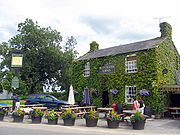
Primary School had, as of 2009, 104 pupils. Fringford has one public house
, the Butchers Arms. Shelswell Women's Institute meets in Fringford.
Oxfordshire
Oxfordshire is a county in the South East region of England, bordering on Warwickshire and Northamptonshire , Buckinghamshire , Berkshire , Wiltshire and Gloucestershire ....
, about 4 miles (6.4 km) northeast of Bicester
Bicester
Bicester is a town and civil parish in the Cherwell district of northeastern Oxfordshire in England.This historic market centre is one of the fastest growing towns in Oxfordshire Development has been favoured by its proximity to junction 9 of the M40 motorway linking it to London, Birmingham and...
. The parish is bounded to the east by the Roman road that linked Alchester Roman Town with Roman Towcester, to the south by a brook that joins the River Bure
River Bure
The River Bure is a river in the county of Norfolk, England, most of it in The Broads. The Bure rises near Melton Constable, upstream of Aylsham, which was the original head of navigation. Nowadays, the head of navigation is downstream at Coltishall Bridge...
, to the north mostly by a brook that is a tributary of the River Great Ouse
River Great Ouse
The Great Ouse is a river in the east of England. At long, it is the fourth-longest river in the United Kingdom. The river has been important for navigation, and for draining the low-lying region through which it flows. Its course has been modified several times, with the first recorded being in...
, and to the west by field boundaries. Fringford village is in the north of the parish, surrounded on two sides by a bend in the tributary of the Great Ouse.
Archaeology
At the southern edge of the parish, beside the tributary of the River Bure, there may have been a Roman villaRoman villa
A Roman villa is a villa that was built or lived in during the Roman republic and the Roman Empire. A villa was originally a Roman country house built for the upper class...
. The site is only about 200 yards (182.9 m) west of the Roman road. It is now occupied by Fringford Lodge.
History
Fringford's toponymToponymy
Toponymy is the scientific study of place names , their origins, meanings, use and typology. The word "toponymy" is derived from the Greek words tópos and ónoma . Toponymy is itself a branch of onomastics, the study of names of all kinds...
is derived from an Old English tribal or family name Ferring or Fcaring and the ford that formed the only crossing-point of the narrow stream that flows around three sides of the village. An earlier form of the name would have been Ferringas-ford.
After the Norman conquest of England
Norman conquest of England
The Norman conquest of England began on 28 September 1066 with the invasion of England by William, Duke of Normandy. William became known as William the Conqueror after his victory at the Battle of Hastings on 14 October 1066, defeating King Harold II of England...
in 1066, William of Normandy
William I of England
William I , also known as William the Conqueror , was the first Norman King of England from Christmas 1066 until his death. He was also Duke of Normandy from 3 July 1035 until his death, under the name William II...
gave his half-brother Odo, Bishop of Bayeux, manors
Manorialism
Manorialism, an essential element of feudal society, was the organizing principle of rural economy that originated in the villa system of the Late Roman Empire, was widely practiced in medieval western and parts of central Europe, and was slowly replaced by the advent of a money-based market...
that included Fringford. Later the Crown
The Crown
The Crown is a corporation sole that in the Commonwealth realms and any provincial or state sub-divisions thereof represents the legal embodiment of governance, whether executive, legislative, or judicial...
deposed Odo and granted the manor of Fringford to Baron William de Arsic of Cogges
Cogges
Cogges is a district beside the River Windrush in Witney, Oxfordshire, east of the town centre. It had been a separate village and until 1932 it was a separate civil parish.-History:...
. By the early part of the twelfth century William's son Baron Manessah Arsic had built a stone church at Fringford in place of an earlier wooden one. The new church was dedicated to Saint Michael
Michael (archangel)
Michael , Micha'el or Mîkhā'ēl; , Mikhaḗl; or Míchaël; , Mīkhā'īl) is an archangel in Jewish, Christian, and Islamic teachings. Roman Catholics, Anglicans, and Lutherans refer to him as Saint Michael the Archangel and also simply as Saint Michael...
and All Angels and granted to the Benedictine
Order of Saint Benedict
The Order of Saint Benedict is a Roman Catholic religious order of independent monastic communities that observe the Rule of St. Benedict. Within the order, each individual community maintains its own autonomy, while the organization as a whole exists to represent their mutual interests...
Priory
Priory
A priory is a house of men or women under religious vows that is headed by a prior or prioress. Priories may be houses of mendicant friars or religious sisters , or monasteries of monks or nuns .The Benedictines and their offshoots , the Premonstratensians, and the...
founded at Cogges by Baron William.
The south aisle may have been rebuilt in the 14th century. The peal
Change ringing
Change ringing is the art of ringing a set of tuned bells in a series of mathematical patterns called "changes". It differs from many other forms of campanology in that no attempt is made to produce a conventional melody....
of bells must have been hung sometime before the end of the 17th century. The only maintenance recorded before the 19th century is in 1788, when £18.4.3d. was spent on general repairs.
In 1814 Henry Dawson Roundel was appointed Rector. He is described as having ample means and he proved to be both generous and forethinking. He started a plan for the letting of small allotments to labourers in the parish and, throughout his life, he was the driving force for the restoration of the church. After Roundel's incumbency the north aisle was rebuilt in 1905 and the roof was restored in 1909.
Notes from local pamphlet entitled "A Guided Tour of Five Churches of the Shelswell Group" about Fringford, Oxfordshire, England.
19th century
Fringford in the 19th century is associated with Flora ThompsonFlora Thompson
Flora Jane Thompson was an English novelist and poet famous for her semi-autobiographical trilogy about the English countryside, Lark Rise to Candleford.-Early life and family:...
's Lark Rise to Candleford
Lark Rise to Candleford
Lark Rise to Candleford is a trilogy of semi-autobiographical novels about the countryside of north-east Oxfordshire and Buckinghamshire, England, at the end of the 19th century. They were written by Flora Thompson and first published together in 1945...
trilogy, in which Fringford is the prototype for Candleford Green. In 1844 the Oxford Chronicle noted "there aren't enough dwellings to shelter the poor". In 1851 the population was 357. During this time the parish had only a few good farm-houses. However, population grew in 1871, it reached its highest number until 1990s at 479.
Fringford had five blacksmiths, three carpenters, three sawyers, three brickmakers, a stonemason, a shoemaker, three decorators, a carrier, a coal haulier, two bakers, two grocers and a butcher. Also two grooms, two footmen, six gardeners and a coachman from Fringford were employed at Shelswell House, Tusmore Park and Swift House.
20th century
The Church of England
Church of England
The Church of England is the officially established Christian church in England and the Mother Church of the worldwide Anglican Communion. The church considers itself within the tradition of Western Christianity and dates its formal establishment principally to the mission to England by St...
parish of Fringford is now linked with four of its neighbours to form one benefice of Stratton Audley
Stratton Audley
Stratton Audley is a village and civil parish northeast of Bicester in Oxfordshire, England.-Manor:The Domesday Book of 1086 records that Robert D'Oyly held five hides of land at Stratton. Like many D'Oyly manors, Stratton later became part of the Honour of Wallingford...
with Godington
Godington
Godington is a village and civil parish northeast of Bicester in Oxfordshire. The parish is bounded on all but the west side by a brook called the Birne, which at this point forms also the county boundary with Buckinghamshire.-Manor:...
, Fringford with Hethe
Hethe
Hethe is a village and civil parish about north of Bicester in Oxfordshire.-Manor:The village's toponym comes from the Old English hæp meaning "uncultivated ground"....
and Stoke Lyne
Stoke Lyne
Stoke Lyne is a village and civil parish about north of Bicester, Oxfordshire.-Manor:Tostig Godwinson, Earl of Northumbria owned the manor of Stoke Lyne before the Norman Conquest of England in 1066...
. These form the southern part of the Shelswell
Shelswell
Shelswell is a hamlet in Oxfordshire about south of Brackley in neighbouring Northamptonshire.-Manor:Shelswell's toponym comes from Old English and suggest's that the settlement may originally have been the well belonging to Scield, a Saxon settler. The spring that gave rise to this well is no...
Group of parishes, which number ten in all. The Rector
Rector
The word rector has a number of different meanings; it is widely used to refer to an academic, religious or political administrator...
for the southern part of the group lives at Stratton Audley.
Amenities
Fringford Church of EnglandVoluntary controlled school
A voluntary controlled school is a state-funded school in England, Wales and Northern Ireland in which a foundation or trust has some formal influence in the running of the school...
Primary School had, as of 2009, 104 pupils. Fringford has one public house
Public house
A public house, informally known as a pub, is a drinking establishment fundamental to the culture of Britain, Ireland, Australia and New Zealand. There are approximately 53,500 public houses in the United Kingdom. This number has been declining every year, so that nearly half of the smaller...
, the Butchers Arms. Shelswell Women's Institute meets in Fringford.