
All Topics  
French art

 
French Art

   Email Print
   Bookmark   Link


French art


For practical purposes, the history of French art has been divided into a series of separate articles accessible through the template to the right. The template also gives direct access to French art category indexes, such as alphabetical lists of painters or sculptors. To locate artists from a particular period or art movement, the relatively comprehensive manual list of painters and artistic movements in chronological order is recommended.


Discussion
Ask a question about 'French art'
Start a new discussion about 'French art'
Answer questions from other users
Full Discussion Forum


Encyclopedia


For practical purposes, the history of French art has been divided into a series of separate articles accessible through the template to the right. The template also gives direct access to French art category indexes, such as alphabetical lists of painters or sculptors. To locate artists from a particular period or art movement, the relatively comprehensive manual list of painters and artistic movements in chronological order is recommended. In addition to a brief historic overview, some supplementary or general material is included on this page, including art vocabulary and general French art references.

French art consists of the visual
Visual arts

The visual arts are Art#Art forms that focus on the creation of works which are primarily visual in nature, such as drawing, painting, photography, printmaking, and filmmaking....
 and plastic arts
Plastic arts

Plastic arts are those visual arts that involve the use of materials that can be moulded or modulated in some way, often in three dimensions. Examples are clay, paint and plaster....
 (including architecture, woodwork, textiles, and ceramics) originating from the geographical area of France
France

France , officially the French Republic , is a country whose Metropolitan France is located in Western Europe and that also comprises various Overseas departments and territories of France....
. Historical surveys of French art typically begin with Pre-Romanesque art
Pre-Romanesque art

Pre-Romanesque art and architecture is the period in Western European art from either the emergence of the Merovingian kingdom in about 500 or from the Carolingian Renaissance in the late 8th century, to the beginning of the 11th century Romanesque art period....
, Romanesque art
Romanesque art

Romanesque art refers to the art of Western Europe from approximately 1000 AD to the rise of the Gothic Art in the 13th century, or later, depending on region....
, and Gothic art
Gothic art

Gothic art was a Medieval art art movement that lasted about 200 years. It began in France out of the Romanesque art period in the mid-12th century, concurrent with Gothic architecture found in Cathedrals....
, but some surveys, such as André Chastel's French Art, include discussions of prehistoric art, Celtic art
Celtic art

Celtic art is art associated with various people known as Celts; those who spoke the Celtic languages in Europe from pre-history through to the modern period, as well as the art of ancient people whose language is unknown, but where cultural and stylistic similarities suggest they are related to Celts....
, and Roman art
Roman art

Roman art includes the visual arts produced in Ancient Rome, and in the territories of the Roman empire. Major forms of Roman art are Roman architecture, painting, sculpture and mosaic work....
 within France.

Historic overview


Prehistory

Currently, the earliest known European art is from the Upper Palaeolithic period of between 40,000 and 10,000 years ago and France has a large selection of extant pre-historic art
Pre-historic art

In the history of art, prehistoric art is all art produced in preliterate, prehistory cultures beginning somewhere in very late geological history, and generally continuing until that culture either develops writing or other methods of record-keeping, or it makes significant contact with another culture that has....
 from the Châtelperronian
Châtelperronian

Ch?telperronian was the earliest archaeological industry of the Upper Palaeolithic in central and south western France, extending also into Northern Spain....
, Aurignacian
Aurignacian

The Aurignacian culture is an archaeological culture of the Upper Palaeolithic, located in Europe and southwest Asia. It dates to between 32,000 and 26,000 Before Christ....
, Solutrean
Solutrean

The Solutrean archaeological industry is a relatively advanced flint tool-making style of the Upper Palaeolithic.It is named after the type-site of Solutr? in the M?con district, Sa?ne-et-Loire, eastern France, and appeared around 19,000 BCE....
, Gravettian
Gravettian

The Gravettian was an archaeological industry of the European Upper Palaeolithic. It is named after the type site of La Gravette in the Dordogne region of France....
, and Magdalenian
Magdalenian

The Magdalenian, also spelled Magdal?nien, refers to one of the later archaeological cultures of the Upper Paleolithic in western Europe. It is named after the type site of La Madeleine, a rock shelter located in the V?z?re valley, commune of Tursac, in the Dordogne department of France....
 cultures. This art includes cave painting
Cave painting

Cave paintings are paintings on cave walls and ceilings, and the term is used especially for those dating to prehistoric times. The earliest known European cave paintings date to 32,000 years ago....
s, such as the famous paintings at Pech Merle
Pech Merle

Sorry, no overview for this topic
 in the Lot
Lot (département)

Lot is a departments of France in the southwest of France named after the Lot River....
 in Languedoc
Languedoc

Languedoc is a former province of France, now continued in the modern-day List of regions in France of Languedoc-Roussillon and Midi-Pyr?n?es in the south of France, and whose capital city was Toulouse, now in Midi-Pyr?n?es....
 which date back to 16,000 B.C., Lascaux
Lascaux

Lascaux is the setting of a complex of caves in southwestern France famous for its prehistory cave paintings. The original caves are located near the village of Montignac, Dordogne, in the Dordogne d?partement in France....
, located near the village of Montignac
Montignac, Dordogne

Montignac is a Communes of the Dordogne department in the Dordogne Departments of France in Aquitaine in southwestern France. It is situated on the V?z?re river....
, in the Dordogne
Dordogne

Dordogne is a departments of France in central France named after the Dordogne River....
, dating back to between 13,000 and 15,000 B.C., or perhaps, as far back as 25,000 B.C., the Cosquer Cave
Cosquer Cave

The Cosquer cave is located in the Calanque de Morgiou near Marseille, France, not very far from Cap Morgiou. This cave, the entrance of which is located underwater nowadays, was discovered by Henri Cosquer in 1985 and declared to the authorities in 1991....
, the Chauvet Cave
Chauvet Cave

The Chauvet Cave or Chauvet-Pont-d'Arc Cave is located at N 44? 21' and E 4? 29' 24", near Vallon-Pont-d'Arc, in the Ard?che d?partement, in southern France....
, and the Trois-Frères cave
Trois-Frères

The Cave of the Trois-Fr?res is one of the famous caves in southwestern France famous for its cave paintings. It is located in Montesquieu-Avant?s, in the Ari?ge d?partement in France....
; and portable art
Portable art

Prehistoric portable art included small mobile pieces that could be carried from place to place. Though the game hunted for food was a recurring subject within portable art, the over 10,000 pieces that have been discovered exhibit a great diversity in terms of scale, subject, use, date of creation, and media....
, such as animal carvings and great goddess stauettes called Venus figurines
Venus figurines

Venus figurines is an umbrella term for a number of prehistory statuettes of women sharing common attributes from the Aurignacian or Gravettian period of the upper Palaeolithic, found from Western Europe to Siberia....
, such as the "" of 21,000 B.C., discovered in the Landes, now in the museum at the Château de Saint-Germain-en-Laye
Château de Saint-Germain-en-Laye

The Ch?teau de Saint-Germain-en-Laye is a French royal palace in the commune in France of Saint-Germain-en-Laye, in the d?partement in France of Yvelines, about 19 km west of Paris....
. Ornamental beads, bone pins, carvings, as well as flint and stone arrowhead
Arrowhead

An arrowhead is point of an arrow, or a shape resembling such a point; as archaeological artifacts arrowheads are a subclass of projectile points....
s also are among the prehistoric objects from the area of France.

Speculations exist that only Homo sapiens are capable of artistic expression, however, a recent find, the Mask of La Roche-Cotard—a Mousterian
Mousterian

Mousterian is a name given by archaeologists to a style of predominantly flint tools associated primarily with Neanderthal and dating to the Middle Paleolithic, the middle part of the Old Stone Age....
 or Neanderthal
Neanderthal

The Neanderthal , or Neandertal, is an extinct member of the Homo genus that is known from Pleistocene specimens found in Europe and parts of western and central Asia....
 artifact, found in 2002 in a cave near the banks of the Loire River
Loire River

The Loire is the longest river in France. With a length of , it drains an area of , which represents more than a fifth of France's land area....
, dating back to about 33,000 B.C.
Paleolithic

The Paleolithic or Palaeolithic or "Old Stone" era is a Prehistory era distinguished by the development of the first stone tools, and covers roughly 99% of human history....
—now suggests that Neanderthal humans may have developed a sophisticated and complex artistic tradition.

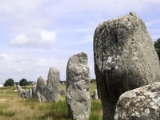
Carnac Megalith Alignment 1
In the Neolithic
Neolithic

The Neolithic period was a period in the development of human technology, beginning about 9500 Before the Christian Era in the Middle East that is traditionally considered the last part of the Stone Age....
 period (see Neolithic Europe
Neolithic Europe

Neolithic Europe is the time between roughly from 7000 BC to ca. 1700 BC . The Neolithic overlaps the Mesolithic and Bronze Age periods in Europe as cultural changes moved from the south east to north west at about 1km/year....
), megalith
Megalith

A megalith is a large Rock which has been used to construct a structure or monument, either alone or together with other stones. Megalithic means structures made of such large stones, utilizing an interlocking system without the use of mortar or cement....
ic (large stone) monuments, such as the dolmen
Dolmen

File:paulnabrone.jpgFile:KilclooneyDolmen1986.jpgA dolmen is a type of single-chamber megalithic tomb, usually consisting of three or more megalith supporting a large flat horizontal capstone ....
s and menhir
Menhir

A menhir is a large upright standing stone. Menhirs may be found singly as monoliths, or as part of a group of similar stones. Their size can vary considerably; but their shape is generally uneven and squared, often tapering towards the top....
s at Carnac
Carnac stones

The Carnac stones are an exceptionally dense collection of megalithic sites around the French village of Carnac, in Brittany, consisting of stone row, dolmens, tumulus and single menhirs....
, Saint-Sulpice-de-Faleyrens
Saint-Sulpice-de-Faleyrens

Saint-Sulpice-de-Faleyrens is a Communes of France in the Gironde Departments of France in Aquitaine in southwestern France....
 and elsewhere in France begin to appear; this appearance is thought to start in the fifth millennium B.C., although some authors speculate about Mesolithic
Mesolithic

The Mesolithic or Middle Stone Age was a period in the development of human technology in between the Paleolithic or Old Stone Age and the Neolithic or New Stone Age....
 roots. France has numerous painted stones, polished stone axes, and inscribed menhirs from this period.

In France from the Neolithic to the Bronze Age
Bronze Age

The Bronze Age is, with respect to a given prehistory, the period in that society when the most advanced metalworking included smelting copper and tin from naturally-occurring outcroppings of copper and tin ores, creating a bronze alloy by melting those metals together, and casting them into bronze artifact s....
, one finds a variety of archaeological cultures, including the Rössen culture
Rössen culture

The R?ssen Culture is a Central European Archaeological culture of the middle Neolithic .It is named after the necropolis of R?ssen . The R?ssen Culture has been identified in 11 of the 16 states of Germany , but also in the southeast Low Countries, northeast France, northern Switzerland and a small part of Austria....
 of c. 4500—4000 B.C., Beaker culture
Beaker culture

The Bell-Beaker culture , ca. 2800 – 1900 BC, is the term for a widely scattered cultural phenomenon of prehistoric Europe western Europe starting in the late Neolithic Europe running into the early Bronze Age Europe....
 of c. 2800 – 1900 B.C., Tumulus culture
Tumulus culture

The Tumulus culture dominated Central Europe during the European Bronze Age .It was the descendant of the Unetice culture. Its heartland the area previously occupied by the Unetice culture besides Bavaria and W?rttemberg....
 of c. 1600-1200 B.C., Urnfield culture
Urnfield culture

The Urnfield culture was a late Bronze Age culture of central Europe. The name comes from the custom of cremation the dead and placing their ashes in urns which were then buried in fields....
 of c. 1300-800 B.C., and, in a transition to the Iron Age
Iron Age

In archaeology, the Iron Age was the stage in the development of any people in which tools and weapons whose main ingredient was iron were prominent....
, Hallstatt culture
Hallstatt culture

The Hallstatt culture was the predominant Central European culture from the 8th to 6th centuries BC , developing out of the Urnfield culture of the 12th century BC and followed in much of Central Europe by the La T?ne culture....
 of c. 1200 - 500 B.C.

For more on Prehistoric sites in Western France, see Prehistory of Brittany
Prehistory of Brittany

This page concerns the prehistory of Brittany....
.

Celtic and Roman periods

From the Proto-Celtic Urnfield and Hallstat cultures, a continental Iron age
Iron Age

In archaeology, the Iron Age was the stage in the development of any people in which tools and weapons whose main ingredient was iron were prominent....
 Celt
Celt

Celts , is a modern term used to describe any of the European peoples who spoke, or speak, a Celtic languages. The term is also used in a wider sense to describe the Modern Celts of those peoples, notably those who participate in a Celtic culture....
ic art developed; mainly associated with La Tène culture
La Tène culture

The La T?ne culture was a European Iron Age culture named after the archaeological site of La T?ne, Marin-Epagnier on the north side of Lake Neuch?tel in Switzerland, where a rich trove of artifacts was discovered by Hansli Kopp in 1857....
, which flourished during the late Iron Age from 450 B.C. to the Roman conquest in the first century B.C. This art drew on native, classical and perhaps, the Mediterranean, oriental sources. The Celts of Gaul
Gaul

Gaul is the name used for the region of Western Europe comprising part of present day northern Italy, France, Belgium, western Switzerland and the parts of the Netherlands and Germany on the west bank of the River Rhine....
 are known through numerous tombs and burial mounds found throughout France.

Celtic art
Celtic art

Celtic art is art associated with various people known as Celts; those who spoke the Celtic languages in Europe from pre-history through to the modern period, as well as the art of ancient people whose language is unknown, but where cultural and stylistic similarities suggest they are related to Celts....
 is ornamental, avoiding straight lines and only occasionally using symmetry, without the imitation of nature nor ideal of beauty central to the classical
Classicism

File:Nicolas Poussin 055.jpgClassicism, in the The Arts, refers generally to a high regard for classical antiquity, as setting standards for taste which the classicists seeks to emulate....
 tradition, but apparently, often involves complex symbolism. This artwork includes a variety of styles and often incorporates subtly modified elements from other cultures, an example being the characteristic over-and-under interlacing which arrived in France only in the sixth century, although it was already used by Germanic
Germany

Germany , officially the Federal Republic of Germany , is a country in Central Europe. It is bordered to the north by the North Sea, Denmark, and the Baltic Sea; to the east by Poland and the Czech Republic; to the south by Austria and Switzerland; and to the west by France, Luxembourg, Belgium, and the Netherlands....
 artists.

The region of Gaul came under the rule of the Roman Empire
Roman Empire

The Roman Empire was the Roman Republic phase of the Ancient Rome, characterised by an autocracy form of government and large territorial holdings in Europe and around the Mediterranean....
 from the first century B.C. to the fifth century A.D. Monumental works from this period include the amphitheater
Théâtre antique d'Orange

The Th??tre antique d'Orange is an ancient Roman theatre , in Orange, Vaucluse, southern France, built early in the 1st Century AD. It is owned by the municipality of Orange and is the home of the summer opera festival, the Chor?gies d'Orange....
 in Orange, Vaucluse
Orange, Vaucluse

Orange is a town and Communes of France in the Departments of France of Vaucluse, in the south of France. It has a population of 27,989 people , with a primarily agricultural economy....
, the "Maison Carrée
Maison Carrée

The Maison Carr?e at N?mes in southern France is one of the best preserved temples to be found anywhere in the territory of the former Roman Empire....
" at Nîmes
Nîmes

N?mes is a city in southern France. It is the capital of the Gard Departments of France. N?mes has a rich history, dating back to the Roman Empire, and it is a popular tourist destination....
, the Pont du Gard
Pont du Gard

The Pont du Gard is an aqueduct in the South of France constructed by the Roman Empire, and located in Vers-Pont-du-Gard near Remoulins, in the Gard d?partement in France....
 aqueduct
Aqueduct

File:Tomar December 2008-4.jpgAn aqueduct is a water supply or navigable canal constructed to convey water. In modern engineering, the term is used for any system of pipes, ditches, canals, tunnels, and other structures used for this purpose....
, and the Roman baths
Thermes de Cluny

Thermes de Cluny are an ancient Gallo-Roman ruin lying in the heart of Paris' 5th arrondissement of Paris and which are partly subsumed into the Mus?e de Cluny....
, and the arena
Arènes de Lutèce

The Ar?nes de Lut?ce are among the most important remains from the Gallo-Roman era in Paris , together with the Thermes de Cluny. Lying in what is now the Quartier Latin, this amphitheater could once seat 15,000 people, and was used to present gladiatorial combats....
 of Paris
Paris

Paris is the Capital of France and the country's largest city. It is situated on the river Seine, in northern France, at the heart of the ?le-de-France Regions of France ....
.

Orange Roman Theatre

Medieval period

Merovingian art is the art and architecture of the Merovingian dynasty of the Franks
Franks

The Franks or Frankish people were a West Germanic ethnic group first identified in the 3rd century as living north and east of the Lower Rhine River....
, which lasted from the fifth century to the eighth century in present day France and Germany
Germany

Germany , officially the Federal Republic of Germany , is a country in Central Europe. It is bordered to the north by the North Sea, Denmark, and the Baltic Sea; to the east by Poland and the Czech Republic; to the south by Austria and Switzerland; and to the west by France, Luxembourg, Belgium, and the Netherlands....
. The advent of the Merovingian dynasty in Gaul
Gaul

Gaul is the name used for the region of Western Europe comprising part of present day northern Italy, France, Belgium, western Switzerland and the parts of the Netherlands and Germany on the west bank of the River Rhine....
 during the fifth century led to important changes in the arts. In architecture, there was no longer the desire to build robust and harmonious buildings. Sculpture regressed to being little more than a simple technique for the ornamentation of sarcophagi
Sarcophagus

A sarcophagus is a funeral receptacle for a corpse, most commonly carved or cut from stone. The word "sarcophagus" comes from the Greek language sa?? sarx meaning "flesh", and fa?e?? phagein meaning "to eat", hence sarkophagus means "flesh-eating"; from the phrase lithos sarkophagos the word came to refer to the limestone t...
, altars, and ecclesiastical furniture. On the other hand, the rise of gold work
Goldsmith

A goldsmith is a metalworker who specializes in working with gold and other precious metals. Since ancient times the techniques of a Goldsmith have evolved very little in order to produce items of jewelry of quality standards....
 and manuscript illumination
Illuminated manuscript

An illuminated manuscript is a manuscript in which the Writing is supplemented by the addition of decoration, such as decorated initials, borders and Miniature ....
 brought about a resurgence of Celt
Celt

Celts , is a modern term used to describe any of the European peoples who spoke, or speak, a Celtic languages. The term is also used in a wider sense to describe the Modern Celts of those peoples, notably those who participate in a Celtic culture....
ic decoration, which, with Christian
Christian

A Christian is a person who adheres to Christianity, a Monotheism#Christian view religion centered on the life and teachings of Jesus and interpreted by Christians to have been prophesied in the Hebrew Bible/Old Testament....
 and other contributions, constitutes the basis of Merovingian art. The unification of the Frankish
Franks

The Franks or Frankish people were a West Germanic ethnic group first identified in the 3rd century as living north and east of the Lower Rhine River....
 kingdom under Clovis I
Clovis I

Clovis was the first King of the Franks to unite all the Franks under one king. He succeeded his father Childeric I in 481 as King of the Salian Franks, one of the Frankish tribes who were then occupying the area west of the lower Rhine, with their centre around Tournai and Cambrai along the modern frontier between France and Belgium, in an...
 (465–511) and his successors, corresponded with the need to build churches. The plans for them probably were copied from Roman
Roman architecture

The Architecture of Ancient Rome adopted the external Greek Architecture for their own purposes, which were so different from Greek buildings as to create a new architecture style....
 basilica
Basilica

The Latin word basilica , was originally used to describe a ancient Rome public building , usually located in the Forum of a Roman town. In Hellenistic cities, public basilicas appeared in the 2nd century BC....
s. Unfortunately, these timber structures have not survived because of destruction by fire, whether accidental or caused by the Normans
Normans

The Normans were the people who gave their names to Normandy, a region in northern France. They descended from Viking conquerors of the territory and the native population of mostly Frankish and Gallo-Roman stock....
 at the time of their incursions.

Karolingischer Buchmaler Um 820 001
Carolingian art
Carolingian art

Carolingian art is the roughly 120-year period from about Anno Domini 780 to 900 — during the reign of Charlemagne and his immediate heirs — popularly known as the Carolingian Renaissance....
 is the approximate 120-year period from 750 to 900—during the reign of Charles Martel
Charles Martel

Charles "The Hammer" Martel was proclaimed Mayor of the Palace and ruled the Franks in the name of a Titular ruler. Late in his reign he proclaimed himself Duke of the Franks and by any name was de facto ruler of the Frankish Realms....
, Pippin the Younger
Pippin the Younger

Pepin or Pippin , called the Short, and often known as Pepin the Younger or Pepin III, was the Mayor of the Palace and Duke of the Franks from 741 and King of the Franks from 751 to 768....
, Charlemagne
Charlemagne

Charlemagne was List of Frankish kings from 768 to his death. He expanded the Franks kingdoms into a Carolingian Empire that incorporated much of Western Europe and Central Europe....
, and his immediate heirs—popularly known as the Carolingian Renaissance
Carolingian Renaissance

The Carolingian Renaissance was a period of intellectual and cultural revival occurring in the late Eighth century and Ninth century centuries, with the peak of the activities occurring during the reigns of the Carolingian rulers Charlemagne and Louis the Pious....
. The Carolingian era is the first period of the Medieval art movement known as Pre-Romanesque
Pre-Romanesque art

Pre-Romanesque art and architecture is the period in Western European art from either the emergence of the Merovingian kingdom in about 500 or from the Carolingian Renaissance in the late 8th century, to the beginning of the 11th century Romanesque art period....
. For the first time, Northern European kings patronized classical Mediterranean Roman art forms, blending classical forms with Germanic ones, creating entirely new innovations in figurine line drawing, and setting the stage for the rise of Romanesque art
Romanesque art

Romanesque art refers to the art of Western Europe from approximately 1000 AD to the rise of the Gothic Art in the 13th century, or later, depending on region....
 and, eventually, Gothic art
Gothic art

Gothic art was a Medieval art art movement that lasted about 200 years. It began in France out of the Romanesque art period in the mid-12th century, concurrent with Gothic architecture found in Cathedrals....
 in the West.

Illuminated manuscripts, metalwork, small-scale sculpture, mosaics, and frescos survive from the period. The Carolingians also undertook major architectural building campaigns at numerous churches in France. These include, those of Metz
Metz

Metz is a city in the northeast of France, capital of the Lorraine R?gion in France and prefecture of the Moselle Departments of France.It is located at the confluence of the Moselle River and the Seille rivers....
, Lyon
Lyon

||-||}Lyon, also known as Lyons in English, is a city in east-central France. Its name is pronounced in French language and Franco-Proven?al language, and or in English language....
, Vienne
Vienne

Vienne is a d?partement of France, named after the Vienne River....
, Le Mans
Le Mans

Le Mans is a commune in France in France, located on the Sarthe River. Traditionally the capital of the province of Maine , it is now the pr?fecture of the Sarthe D?partement in France, and is furthermore the seat of the Roman Catholic diocese of Le Mans....
, Reims
Reims

The city of Reims lies in the Champagne-Ardenne region in northeastern France 129 km east-northeast of Paris.Founded by the Gauls, it became a major city during the period of the Roman Empire....
, Beauvais
Beauvais

Beauvais is a town and commune in France and capital of the Oise Departments of France in northern France. Population : city: 57,355; city and suburbs: 59,003; metropolitan area: 100,733....
, Verdun
Verdun

Verdun is a city in the Meuse Departments of France in Lorraine in northeastern France. It is a sub-prefecture of the department.Verdun is the biggest city in Meuse, although it is not the capital, but the slightly smaller Bar-le-Duc....
, Saint-Germain in Auxerre, Saint-Pierre in Flavigny
Flavigny

Flavigny is the name or part of the name of several commune in France in France:* Flavigny, Cher, in the Cher d?partement in France* Flavigny, Marne, in the Marne d?partement...
, and Saint-Denis
Saint-Denis

Saint-Denis is a commune in France in the northern suburbs of Paris, France. It is located 9.4 kilometres from the Kilometre Zero. Saint-Denis is a sous-pr?fecture of the Seine-Saint-Denis d?partement in France, being the seat of the Arrondissement of Saint-Denis, Seine-Saint-Denis....
, as well as the town center of Chartres
Chartres

Chartres is a town and Communes of France and capital of the Eure-et-Loir Departments of France in north-central France It is located southwest of Paris in central France....
. The Centula Abbey of Saint-Riquier
Saint-Riquier

Saint-Riquier is a communes of the Somme d?partement in the Somme d?partement in France in the Picardie region of France....
 (Somme
Somme

The Somme is a departments of France of France, located in the north of the country and named after the Somme River. It is part of the Picardie regions of France....
), completed in 788, was a major achievement in monastic architecture. Another important building (mostly lost today) was "Theodulf's Villa" in Germigny-des-Prés
Germigny-des-Prés

Germigny-des-Pr?s is a Communes of France in the Loiret Departments of France in north-central France.The oratory at Germigny-des-Pr?s was built by Bishop Theodulf of Orl?ans in 806 as part of his palace complex within the Gallo-Roman villa in Germaniacus....
.

With the end of Carolingian rule around 900, artistic production halted for almost three generations. After the demise of the Carolingian Empire, France split into a number of feuding provinces, lacking any organized patronage. French art of the tenth and eleventh centuries was produced by local monasteries to promote literacy and piety, however, the primitive styles produced were not so highly skilled as the techniques of the earlier Carolingian period.

Multiple regional styles developed based on the chance availability of Carolingian manuscripts as models to copy, and the availability of itinerant artists. The monastery of Saint Bertin became an important center under its abbot Odbert (986-1007), who created a new style based on Anglo-Saxon and Carolingian forms. The nearby abbey of St. Vaast
St. Vaast's Abbey

St. Vaast's Abbey was a Order of St. Benedict monastery situated at Arras, d?partement in France of Pas-de-Calais, France....
 (Pas-de-Calais) also created a number of important works. In southwestern France a number of manuscripts were produced c. 1000, at the monastery of Saint Martial
Saint Martial

Saint Martial was the first bishop of Limoges in today's France, according to a lost vita of Saturnin, first bishop of Toulouse, which Gregory of Tours quotes in his Historia Francorum....
 in Limoges
Limoges

Limoges is a city and Communes of France in France, the Prefectures in France of the Haute-Vienne Departments of France, and the administrative capital of the Limousin Regions of France....
, as well as at Albi
Albi

Albi is a commune in France in southern France. It is the capital of the Tarn Departments of France. It is located on the Tarn River 50 miles northeast of Toulouse....
, Figeac
Figeac

Figeac is a Communes of France in the Lot Departments of France in southwestern France.Figeac is a Subprefectures in France of the department....
, and Saint-Sever-de-Rustan
Saint-Sever-de-Rustan

Saint-Sever-de-Rustan is a commune in France of the Hautes-Pyr?n?es d?partement in France, in southwestern France....
 in Gascogne. In Paris a unique style developed at the abbey of Saint-Germain-des-Prés
Abbey of Saint-Germain-des-Prés

The Benedictine Abbey of Saint-Germain-des-Pr?s, just beyond the outskirts of early medieval Paris, was the burial place of Merovingian kings of Neustria....
. In Normandy
Normandy

Normandy is a geographical region corresponding to the former Duchy of Normandy. It is situated along the coast of France south of the English Channel between Brittany and Picardy and comprises territory in northern France and the Channel Islands....
 a new style arose in 975. By the later tenth century with the Cluny
Cluny

The town and commune in France of Cluny or Clugny lies in the modern-day D?partements of France of Sa?ne-et-Loire in the r?gion in France of Bourgogne, in east-central France, near M?con....
 reform movement and a revived spirit for the concept of Empire, art production resumed.

Romanesque art
Romanesque art

Romanesque art refers to the art of Western Europe from approximately 1000 AD to the rise of the Gothic Art in the 13th century, or later, depending on region....
 refers to the art of Western Europe during a period of two hundred and fifty years, from approximately 1000 A.D. to the rise of the Gothic style
Gothic art

Gothic art was a Medieval art art movement that lasted about 200 years. It began in France out of the Romanesque art period in the mid-12th century, concurrent with Gothic architecture found in Cathedrals....
, which arose in the middle of the twelfth century in France. "Romanesque Art" was marked by a renewed interest in Roman construction techniques. For example, the twelfth-century capitals on the cloister of Saint-Guilhem-le-Désert
Saint-Guilhem-le-Désert

Saint-Guilhem-le-D?sert is a Communes of France in the H?rault Departments of France in Languedoc-Roussillon in southern France.Situated in the narrow valley of the Gellone river where it meets the steep sided gorge of the H?rault River, Saint-Guilhem-le-D?sert is essentially a mediaeval village located on the Chemin de St Jacques pilgrim...
, adopt an acanthus
Acanthus (ornament)

The acanthus is one of the most common ornaments used to depict foliage. Architectural ornaments are carved in stone or wood in the appearance of leaves from the Mediterranean Acanthus plant, with some resemblance to thistle, poppy and parsley leaves....
-leaf motif
Motif (art)

File:Ajanta Entrance cave 17.jpgFile:TajFlowerCloseUp.jpgIn art, a motif is a repeated idea, pattern, image, or theme. Paisley are referred to as motifs....
 and the decorative use of drill holes, which were commonly found on Roman monuments. Other important Romanesque buildings in France include the abbey of Saint-Benoît-sur-Loire
Saint-Benoît-sur-Loire

Saint-Beno?t-sur-Loire is a Communes of France in the Loiret Departments of France in north-central France.This town hosts the Fleury Abbey, also known as the Abbaye de Saint Beno?t ....
 in Loiret
Loiret

Loiret is a departments of France in north-central France named after the Loiret River....
, the churches of Saint-Foy in Conques
Conques

Conques is a Communes of France in the Aveyron Departments of France in southwestern France....
 of Aveyron
Aveyron

Aveyron is a departments of France in southern France named after the Aveyron River....
, Saint-Martin in Tours
Tours

Tours is a city in central France, the capital of the Indre-et-Loire Departments of France.It is located on the lower reaches of the river River Loire, between Orl?ans and the Atlantic Ocean coast....
, Saint-Philibert in Tournus
Tournus

Tournus is a commune in France of the Sa?ne-et-Loire d?partement in France, in east-central France....
 of Saône-et-Loire
Saône-et-Loire

Sa?ne-et-Loire is a France departments of France, named after the Sa?ne River and the Loire River rivers between which it lies....
, Saint-Remi
Abbey of Saint-Remi

The Abbey of Saint-Remi is an abbey in Reims, France, founded in the sixth century. Since 553 it has conserved the relics of Saint Remi, the Bishop of Reims who converted Clovis I, King of the Franks, to Christianity at Christmas in AD 496, after he defeated the Alamanni in the Battle of Tolbiac....
 in Reims
Reims

The city of Reims lies in the Champagne-Ardenne region in northeastern France 129 km east-northeast of Paris.Founded by the Gauls, it became a major city during the period of the Roman Empire....
, and Saint-Sernin
Saint-Sernin Basilica

St. Sernin's Basilica in Toulouse, France, is the former abbey church of St. Sernin's or St. Saturnin's Abbey, and was built in the Romanesque architecture style between about 1080 and 1120....
 in Toulouse
Toulouse

Toulouse is a commune of France in southwest France on the banks of the Garonne, half-way between the Atlantic Ocean and the Mediterranean Sea....
. In particular, Normandy
Normandy

Normandy is a geographical region corresponding to the former Duchy of Normandy. It is situated along the coast of France south of the English Channel between Brittany and Picardy and comprises territory in northern France and the Channel Islands....
 experienced a large building campaign in the churches of Bernay
Bernay

Bernay may refer to:French communes*Bernay, Eure, in the Eure d?partement in France*Bernay-en-Champagne, in the Sarthe d?partement*Bernay-en-Ponthieu, in the Somme d?partement...
, Mont-Saint-Michel, Coutances Cathedral
Coutances Cathedral

Coutances Cathedral is a Gothic architecture Roman Catholic cathedral in the town of Coutances, Normandy, France.It is the seat of the Bishop of Coutances and Avranches, previously the Bishops of Coutances....
, and Bayeux
Bayeux

Bayeux is a Communes of France in the Calvados Departments of France in Normandy in northwestern France.Bayeux is the home of the Bayeux Tapestry, one of the oldest surviving complete tapestries in the world....
.

Most Romanesque sculpture was integrated into church architecture, not only for aesthetic, but also for structural, purposes. Small-scale sculpture during the pre-Romanesque period was influenced by Byzantine
Byzantine

The word Byzantine may refer to:Topics directly related to the Byzantine Empire* A citizen of Byzantine Empire, or native Greeks during the Middle Ages ....
 and Early Christian sculpture. Other elements were adopted from various local styles of Middle Eastern countries. Motifs were derived from the arts of the "barbarian," such as grotesque figures, beasts, and geometric patterns, which were all important additions, particularly in the regions north of the Alps. Among the important sculptural works of the period are the ivory carvings at the monastery of Saint Gall
Abbey of St. Gall

The Abbey of Saint Gall was for many centuries one of the chief Benedictine abbeys in Europe. It is located in the city of St. Gallen in present-day Switzerland....
. Monumental sculpture was rarely practiced separately from architecture in the Pre-Romanesque period. For the first time after the fall of the Roman empire, monumental sculpture emerged as a significant art form. Covered church facades, doorways, and capitals
Capital (architecture)

In several traditions of architecture including Classical architecture, the capital forms the crowning member of a column or a pilaster. The capital projects on each side as it rises, in order to support the abacus and unite the form of the latter with the circular shaft of the column....
 all increased and expanded in size and importance, as in the Last Judgment
Last Judgment

In Christian eschatology, the Last Judgment, Final Judgment, Judgment Day, or End time is the judgment by God of all nations....
 Tympanum
Tympanum (architecture)

A tympanum is the semi-circular or triangular decorative wall surface over an entrance bounded by a lintel and arch. It often contains sculptures or other ornaments....
, Beaulieu-sur-Dordogne
Beaulieu-sur-Dordogne

Beaulieu-sur-Dordogne is a Communes of France in the Departments of France of Corr?ze in the Limousin of central France. Beaulieu is a medieval city, originally dominated by its great abbey of St Pierre, of which only the abbey church remains....
, and the Standing Prophet at Moissac
Moissac

Moissac is a town and communes of France of the Tarn-et-Garonne Departments of France, in southwestern France. It is on the ancient pilgrimage route of Santiago de Compostela....
. Monumental doors, baptismal fonts, and candle holders, frequently decorated with scenes from biblical history, were cast in bronze, attesting to the skills of the contemporary metalworkers. Frescoes were applied to the vaults and walls of churches. Rich textiles and precious objects in gold and silver, such as chalices and reliquaries, were produced in increasing numbers to meet the needs of the liturgy, and to serve the cult of the saints. In the twelfth century, large-scale stone sculpture spread throughout Europe. In the French Romanesque churches of Provence
Provence

Provence is a region of southeastern France on the Mediterranean adjacent to Italy. It is part of the administrative regions of France of Provence-Alpes-C?te d'Azur....
, Burgundy, and Aquitaine
Aquitaine

Aquitaine , archaic Guyenne/Guienne , is one of the 26 regions of France, in the south-western part of metropolitan France, along the Atlantic Ocean and the Pyrenees mountain range on the border with Spain....
, sculptures adorned the facades and statues were incorporated into the capitals.

Figures From Cathedral of Chartres
Gothic art
Gothic art

Gothic art was a Medieval art art movement that lasted about 200 years. It began in France out of the Romanesque art period in the mid-12th century, concurrent with Gothic architecture found in Cathedrals....
 and architecture
Gothic architecture

Gothic architecture is a style of architecture which flourished during the high and late Middle Ages. It evolved from Romanesque architecture and was succeeded by Renaissance architecture....
 were products of a Medieval art movement that lasted about three hundred years. It began in France, developing from the Romanesque period in the mid-twelfth century. By the late fourteenth century, it had evolved toward a more secular and natural style known as, International Gothic
International Gothic

International Gothic is a phase of Gothic art which developed in Burgundy , Bohemia, France and northern Italy in the late 14th century and early 15th century....
, which continued until the late fifteenth century, when it evolved further, into Renaissance art. The primary Gothic art media were sculpture
Sculpture

Sculpture is Three-dimensional space artwork created by shaping or combining hard and or plastic material, sound, and or text and or light, commonly Stone sculpture , metal, glass, or wood....
, panel painting
Panel painting

A panel painting is a painting on a panel made of wood, either a single piece, or a number of pieces joined together. Until canvas became the more popular support medium in the 16th century, it was the normal form of support for a painting not on a wall or on vellum, which was used for miniature in illuminated manuscripts and also for pa...
, stained glass
Stained glass

For the Blackford Oakes novel, see Stained Glass The term stained glass can refer to the material of coloured glass or the craft of working with it....
, fresco
Fresco

Fresco is any of several related painting types, done on plaster on walls or ceilings. The word fresco comes from the Italian word affresco which derives from the adjective fresco , which has Latin origins....
, and illuminated manuscript
Illuminated manuscript

An illuminated manuscript is a manuscript in which the Writing is supplemented by the addition of decoration, such as decorated initials, borders and Miniature ....
.

Gothic architecture was born in the middle of the twelfth century in Île-de-France
Île-de-France (province)

?le-de-France is one of the ancient provinces of France, and the one that has been the centre of power during most of History of France. It is centred on Paris....
, when Abbot Suger
Abbot Suger

Suger was one of the last France abbot-statesmen, a historian and the influential first patron of Gothic architecture.Suger was born into a poor family and in 1091 was brought to the nearby Saint Denis Basilica for education....
  built the abbey at St. Denis, c. 1140, considered the first Gothic building, and soon afterward, the Chartres Cathedral, c. 1145. Prior to this, there had been no sculpture tradition in Ile-de-France—so sculptors were brought in from Burgundy, who created the revolutionary figures acting as columns in the Western (Royal) Portal of Chartres Cathedral (see image) —it was an entirely new invention in French art, and would provide the model for a generation of sculptors. Other notable Gothic churches in France include Bourges Cathedral
Cathédrale Saint-Étienne de Bourges

Bourges Cathedral is a cathedral, dedicated to Saint Stephen, located in Bourges, France. It is the seat of the Archbishop of Bourges....
, Amiens Cathedral
Amiens Cathedral

The Cathedral of Our Lady of Amiens , or simply Amiens Cathedral, is the tallest complete cathedral in France, with the greatest interior volume ....
, Notre-Dame de Laon
Notre-Dame of Laon

The cathedral of Notre-Dame of Laon is one of the most important examples of the Gothic architecture of the 12th and 13th centuries, ranking with the cathedrals of Cath?drale Saint-?tienne de Sens and Notre-Dame de Paris....
, Notre Dame
Notre Dame de Paris

Notre Dame de Paris is a Gothic architecture cathedral on the eastern half of the ?le de la Cit? in the 4th arrondissement of Paris of Paris, France, with its main entrance to the west....
 in Paris
Paris

Paris is the Capital of France and the country's largest city. It is situated on the river Seine, in northern France, at the heart of the ?le-de-France Regions of France ....
, Reims Cathedral, the Sainte-Chapelle
Sainte-Chapelle

La Sainte-Chapelle is a Gothic architecture chapel on the ?le de la Cit? in the heart of Paris, France. It is perhaps the high point of the full tide of the Rayonnant period of Gothic architecture....
 in Paris
Paris

Paris is the Capital of France and the country's largest city. It is situated on the river Seine, in northern France, at the heart of the ?le-de-France Regions of France ....
, Strasbourg Cathedral
Strasbourg Cathedral

Strasbourg Cathedral or the Cathedral of Our Lady of Strasbourg is a Roman Catholic cathedral in Strasbourg, France. Although considerable parts of it are still in Romanesque architecture, it is widely considered to be among the finest examples of high, or late, Gothic architecture....
.

The designations of styles in French Gothic architecture are as follows: Early Gothic, High Gothic, Rayonnant, and Late Gothic or "Flamboyant". Division into these divisions is effective, but debatable. Because Gothic cathedrals were built over several successive periods, and the artisans of each period not necessarily following the wishes of previous periods, the dominant architectural style often changed during the building of a particular building. Consequently, it is difficult to declare one building as belonging to certain era of Gothic architecture. It is more useful to use the terms as descriptors for specific elements within a structure, rather than applying it to the building as a whole.

The French ideas spread. Gothic sculpture evolved from the early stiff and elongated style, still partly Romanesque, into a spatial and naturalistic treatment in the late twelfth and early thirteenth century. Influences from surviving ancient Greek and Roman sculptures were incorporated into the treatment of drapery, facial expression, and pose of the Dutch-Burgundian sculptor, Claus Sluter
Claus Sluter

Claus Sluter was a sculptor of The Netherlands origin. He was the most important northern European sculptor of his age and is considered a pioneer of the "northern realism" of the Early Netherlandish painting that came into full flower with the work of Jan van Eyck and others in the next generation....
, and the taste for naturalism first signaled the end of Gothic sculpture, evolving into the classicistic Renaissance style by the end of the fifteenth century.

Painting in a style that may be called, "Gothic," did not appear until about 1200, nearly fifty years after the start of Gothic architecture and sculpture. The transition from Romanesque to Gothic is very imprecise and by no means clearly delineated, but one may see the beginning of a style that is more somber, dark, and emotional than the previous period. This transition occurs first in England and France around 1200, in Germany around 1220, and in Italy around 1300. Painting, the representation of images on a surface, was practiced during the Gothic period in four primary crafts, fresco
Fresco

Fresco is any of several related painting types, done on plaster on walls or ceilings. The word fresco comes from the Italian word affresco which derives from the adjective fresco , which has Latin origins....
s, panel painting
Panel painting

A panel painting is a painting on a panel made of wood, either a single piece, or a number of pieces joined together. Until canvas became the more popular support medium in the 16th century, it was the normal form of support for a painting not on a wall or on vellum, which was used for miniature in illuminated manuscripts and also for pa...
s, manuscript illumination, and stained glass
Stained glass

For the Blackford Oakes novel, see Stained Glass The term stained glass can refer to the material of coloured glass or the craft of working with it....
. Frescoes continued to be used as the main pictorial narrative craft on church walls in southern Europe as a continuation of early Christian and Romanesque traditions. In the north, stained glass remained the dominant art form until the fifteenth century.

Early Modern period

In the late fifteenth century, the French invasion of Italy
Italian Wars

The Italian Wars, often referred to as the Great Italian Wars or the Great Wars of Italy in historical works, were a series of conflicts from 1494 to 1559 that involved, at various times, most of the Italian city-states, the Papal States, all the major states of western Europe as well as the Ottoman Empire....
 and the proximity of the vibrant Burgundy
Duchy of Burgundy

The Duchy of Burgundy was a feudal territory once existing within the France in the Middle Ages. It roughly conforms to the modern Bourgogne. Existing between 843 and 1477, the Duchy was ruled by a succession of Duke of Burgundy, whose extinction with the death of Charles the Bold in 1477 led to the Duchy being absorbed into the French crown...
 court, with its Flemish connections, brought the French into contact with the goods, paintings, and the creative spirit of the Northern
Northern Renaissance

The Northern Renaissance is the term used to describe the Renaissance in northern Europe, or more broadly in Europe outside Italy. Before 1450 Italian Renaissance Renaissance humanism had little influence outside Italy....
 and Italian Renaissance
Italian Renaissance

The Italian Renaissance began the opening phase of the Renaissance, a period of great cultural change and achievement in Europe that spanned the period from the end of the 13th century to about 1600, marking the transition between Medieval and Early Modern Europe....
. Initial artistic changes at that time in France were executed by Italian and Flemish artists, such as Jean Clouet
Jean Clouet

Jean Clouet was a miniaturist and Painting who worked in France during the French Renaissance. He was the father of Fran?ois Clouet....
 and his son François Clouet
François Clouet

File:Dame_au_bain_Francois_Clouet_end_of_16th_century.jpgFran?ois Clouet son of Jean Clouet, was a French Renaissance miniaturist and painter, particularly known for his detailed portraits of the French ruling family....
, along with the Italians, Rosso Fiorentino
Rosso Fiorentino

Giovanni Battista di Jacopo , known as Rosso Fiorentino , or Il Rosso, was an Italy Mannerism Painting, in oil and fresco, belonging to the Florentine school....
, Francesco Primaticcio
Francesco Primaticcio

Francesco Primaticcio was an Italy Mannerism Painting, architect and sculpture who spent most of his career in France....
, and Niccolò dell'Abbate
Niccolò dell'Abbate

Nicol? dell' Abate, sometimes Niccol?, was an Italian painter and decorator. He was of the Emilian school, and was part of the staff of artists called the School of Fontainebleau that introduced the Italianate Renaissance to France....
 of what is often called the first School of Fontainebleau
School of Fontainebleau

The Ecole de Fontainebleau refers to two periods of artistic production in France during the late French Renaissance centered around the royal Ch?teau de Fontainebleau....
 from 1531. Leonardo da Vinci
Leonardo da Vinci

Leonardo di ser Piero da Vinci was an Italy polymath, being a scientist, mathematician, engineer, inventor, anatomist, Painting, sculptor, architect, botanist, musician and writer....
 also was invited to France by François I, but other than the paintings which he brought with him, he produced little for the French king.

Meister Der Schule Von Fontainebleau 001
The art of the period from François I through Henri IV often is heavily inspired by late Italian pictorial and sculptural developments commonly referred to as Mannerism
Mannerism

Mannerism is a Art periods of European art which emerged from the later years of the Italian High Renaissance around 1520. It lasted until about 1580 in Italy, when a more Baroque style began to replace it, but continued into the seventeenth century throughout much of Europe....
, which is associated with Michelangelo
Michelangelo

Michelangelo di Lodovico Buonarroti Simoni , commonly known as Michelangelo, was an Italian Renaissance Painting, sculptor, architect, poet, and engineer....
 and Parmigianino
Parmigianino

Girolamo Francesco Maria Mazzola , also known as Francesco Mazzola or more commonly as Parmigianino or sometimes "Parmigiano", was a prominent Italy Mannerism Painting and printmaker active in Florence, Rome, Bologna, and his native city of Parma....
, among others. It is characterized by figures which are elongated and graceful that rely upon visual rhetoric
Rhetoric

Rhetoric is the art of using language as a means to persuade. Along with logic and dialectic, rhetoric is one of the three ancient arts of discourse....
, including the elaborate use of allegory
Allegory

Allegory is generally treated as a figure of rhetoric, but an allegory does not have to be expressed in language: it may be addressed to the eye, and is often found in realistic painting, sculpture or some other form of Mimesis, or representative art....
 and mythology
Mythology

The word mythology refers to a body of folklore/myths/legends that a particular culture believes to be true and that often use the supernatural to interpret natural events and to explain the nature of the universe and humanity....
. Perhaps the greatest accomplishment of the French Renaissance was the construction of the Châteaux of the Loire Valley. No longer conceived of as fortresses, such pleasure palaces took advantage of the richness of the rivers and lands of the Loire region and they show remarkable architectural skill.

In the early part of the seventeenth century, late mannerist
Mannerism

Mannerism is a Art periods of European art which emerged from the later years of the Italian High Renaissance around 1520. It lasted until about 1580 in Italy, when a more Baroque style began to replace it, but continued into the seventeenth century throughout much of Europe....
 and early Baroque
Baroque

In the the arts, the Baroque was a Western cultural Epoch , starting roughly at the beginning of the 17th century in Rome, Italy. It was exemplified by drama and grandeur in Baroque sculpture, Baroque painting, literature, Baroque dance, and Baroque music....
 tendencies continued to flourish in the court of Marie de Medici and Louis XIII
Louis XIII of France

Louis XIII reigned as List of French monarchs and List of Navarrese monarchs from 1610 to 1643....
. Art from this period shows influences from both the north of Europe, namely the Dutch and Flemish schools, and from Roman painters of the Counter-Reformation
Counter-Reformation

The Counter-Reformation denotes the period of Roman Catholic Church revival from the pontificate of Pope Pius IV in 1560 to the close of the Thirty Years' War, 1648....
. Artists in France frequently debated the contrasting merits of Peter Paul Rubens
Peter Paul Rubens

Peter Paul Rubens was a prolific seventeenth-century Flemish Baroque painter, and a proponent of an exuberant Baroque style that emphasized movement, color, and sensuality....
 with his the Flemish baroque, voluptuous lines and colors to Nicolas Poussin
Nicolas Poussin

Nicolas Poussin was a French Painting in the Classicism style. His work predominantly features clarity, logic, and order, and favors line over color....
 with his rational control, proportion, Roman classicism.

Nicolas Poussin 052
There was also a strong Caravaggisti school represented in the period by the amazing candle-lit paintings of Georges de La Tour
Georges de La Tour

Georges de La Tour was a Painting, who spent most of his working life in the Duchy of Lorraine, which became part of France the year before his death....
. The wretched and the poor were featured in a quasi-Dutch manner in the paintings by the three Le Nain
Le Nain

The three Le Nain brothers were Paintings in 17th-century France:Antoine Le Nain ,Louis Le Nain , andMathieu Le Nain .The three were born in Laon , and by 1630, all three lived in Paris....
 brothers. In the paintings of Philippe de Champaigne
Philippe de Champaigne

Philippe de Champaigne was a Baroque era painter of the French art.Born in Brussels of a poor family, Champaigne was a pupil of the landscape painter Jacques Fouqui?res....
 there are both propagandistic portraits of Louis XIII
Louis XIII of France

Louis XIII reigned as List of French monarchs and List of Navarrese monarchs from 1610 to 1643....
' s minister Cardinal Richelieu and other more contemplative portraits of people in the Catholic Jansenist sect.

From the mid to late seventeenth century, French art is more often referred to by the term "Classicism" which implies an adherence to certain rules of proportion and sobriety uncharacteristic of the Baroque, as it was practiced in southern and eastern Europe during the same period. Under Louis XIV
Louis XIV of France

Louis XIV ruled as List of French monarchs and of King of Navarre. He ascended the throne a few months before his fifth birthday, but did not assume actual personal control of the government until the death of his prime minister , the Italians Jules Cardinal Mazarin, in 1661....
, the Baroque as it was practiced in Italy, was not in French taste, for instance, as Bernini's famous proposal for redesigning the Louvre was rejected by Louis XIV. Through propaganda
Propaganda

Propaganda is the dissemination of information aimed at influencing the opinions or behaviors of large numbers of people. As opposed to Objectivity providing information, propaganda in its most basic sense presents information in order to influence its audience....
, wars, and great architectural works, Louis XIV
Louis XIV of France

Louis XIV ruled as List of French monarchs and of King of Navarre. He ascended the throne a few months before his fifth birthday, but did not assume actual personal control of the government until the death of his prime minister , the Italians Jules Cardinal Mazarin, in 1661....
 launched a vast program designed for the glorification of France and his name. The Palace of Versailles
Palace of Versailles

The Palace of Versailles, or simply Versailles, is a royal ch?teau in Versailles, the ?le-de-France region of France. In French language, it is known as the Ch?teau de Versailles....
, initially a tiny hunting lodge built by his father, was transformed by Louis XIV into a marvelous palace for fêtes and parties, under the direction of architect Louis Le Vau
Louis Le Vau

Louis Le Vau was a French Classical architect who worked for Louis XIV of France. He was born and died in Paris.He was responsible, with Andr? Le N?tre and Charles Le Brun, for the redesign of the ch?teau of Vaux-le-Vicomte....
, painter and designer Charles Le Brun
Charles Le Brun

Charles Le Brun was a French Painting and Aesthetics, one of the dominant artists in 17th century France....
, and the landscape architect André Le Nôtre
André Le Nôtre

Andr? Le N?tre was a landscape architect and the gardener of King Louis XIV of France from 1645 to 1700. Most notably, he was responsible for the construction of the park of the Palace of Versailles....
.

Rococo
Rococo

Rococo is a style of 18th century French art and interior design. Rococo rooms were designed as total works of art with elegant and ornate furniture, small sculptures, ornamental mirrors, and tapestry complementing architecture, reliefs, and wall paintings....
 and Neoclassicism
Neoclassicism

Neoclassicism is the name given to quite distinct Cultural movement in the Decorative art and visual arts, literature, theatre, music, and architecture that draw upon Western classical art and culture ....
 are terms used to describe the visual and plastic arts and architecture in Europe from the late seventeenth to the late eighteenth centuries. In France, the death of Louis XIV
Louis XIV of France

Louis XIV ruled as List of French monarchs and of King of Navarre. He ascended the throne a few months before his fifth birthday, but did not assume actual personal control of the government until the death of his prime minister , the Italians Jules Cardinal Mazarin, in 1661....
 lead to a period of freedom commonly called the Régence
Régence

The R?gence is the period in History of France between 1715 and 1723, when King Louis XV of France was a minor and the land was governed by a regent, Philip II, Duke of Orl?ans, the nephew of Louis XIV of France....
. Versailles was abandoned from 1715 to 1722. Painting turned toward "fêtes galantes", theater settings, and the female nude. Painters from this period include Antoine Watteau
Antoine Watteau

Jean-Antoine Watteau was a France Painting whose brief career spurred the revival of interest in colour and movement , and revitalized the waning Baroque idiom, which eventually became known as Rococo....
, Nicolas Lancret
Nicolas Lancret

Nicolas Lancret , List of French artists, was born in Paris, and became a brilliant depicter of light comedy which reflected the tastes and manners of French society under the regent Orleans....
, and François Boucher
François Boucher

Fran?ois Boucher was a France Painting, a proponent of Rococo taste, known for his idyllic and voluptuous paintings on classical themes, decorative allegories representing the arts or pastoral occupations, intended as a sort of two-dimensional furniture....
. The Louis XV style of decoration, although already apparent at the end of the last reign, was lighter with pastel colors, wood panels, smaller rooms, less gilding, and fewer brocades; shells, garlands, and occasional Chinese subjects predominated. Rooms were more intimate.

Fragonard, Inspiration
The latter half of the eighteenth century continued to see French preeminence in Europe, particularly through the arts and sciences, and the speaking the French language
French language

French is a Romance language spoken around the world by around 80 million people as first language, by 190 million as second language, and by about another 200 million people as an acquired tongue, with significant speakers in 54 countries....
 was expected for members of the European courts, hence the term, lingua franca, for the accepted language. The French academic system continued to produce artists, but some, such as Jean-Honoré Fragonard
Jean-Honoré Fragonard

Jean-Honor? Fragonard was a France painter and printmaker whose late Rococo manner was distinguished by remarkable facility, exuberance, and hedonism....
 and Jean-Baptiste Siméon Chardin, explored new and increasingly impressionist styles of painting with thick brushwork. Although the hierarchy of genres continued to be respected officially, genre painting, landscape
Landscape

Landscape comprises the visible features of an area of land, including physical elements such as landforms, living elements of flora and fauna, abstract elements such as lighting and weather conditions, and human elements, for instance human activity or the built environment....
, portrait
Portrait

A portrait is a portrait painting, portrait photography, sculpture, or other artistic representation of a person, in which the face and its expression is predominant....
, and still life
Still life

A still life is a work of art depicting mostly inanimate subject matter, typically commonplace objects which may be either natural or man-made in an artificial setting....
 were extremely fashionable.

One also finds in this period a Pre-romanticism aspect. Hubert Robert
Hubert Robert

Sorry, no overview for this topic
's images of ruins, inspired by Italian cappricio paintings, are typical in this respect. So too the change from the rational and geometrical French garden of André Le Nôtre
André Le Nôtre

Andr? Le N?tre was a landscape architect and the gardener of King Louis XIV of France from 1645 to 1700. Most notably, he was responsible for the construction of the park of the Palace of Versailles....
 to the English garden, which emphasized artificially wild and irrational nature. One also finds in some of these gardens—curious ruins of temples—called "follies".

The middle of the eighteenth century saw a turn to Neoclassicism
Neoclassicism

Neoclassicism is the name given to quite distinct Cultural movement in the Decorative art and visual arts, literature, theatre, music, and architecture that draw upon Western classical art and culture ....
 in France, that is to say a conscious use of Greek and Roman forms and iconography
Iconography

Iconography is the branch of art history which studies the identification, description, and the interpretation of the content of images. The word iconography literally means "image writing", and comes from the Ancient Greek e???? and ??afe?? ....
. In painting, the greatest representative of this style is Jacques Louis David, who, mirroring the profiles of Greek vases, emphasized the use of the profile. His subject matter often involved classical history such as the death of Socrates and Brutus. The dignity and subject matter of his paintings were greatly inspired by Nicolas Poussin
Nicolas Poussin

Nicolas Poussin was a French Painting in the Classicism style. His work predominantly features clarity, logic, and order, and favors line over color....
 in the seventeenth century.

Modern period

The French Revolution
French Revolution

The French Revolution was a period of political and social upheaval and radical change in the history of France, during which the French governmental structure, previously an absolute monarchy with feudalism for the aristocracy and Roman Catholic Church clergy, underwent radical change to forms based on Age of Enlightenment principles of cit...
 and the Napoleonic wars
Napoleonic Wars

The Napoleonic Wars were a series of conflicts involving Napoleon I of France First French Empire and changing sets of European allies and opposing coalitions that ran from 1803 to 1815....
 brought great changes to the arts in France. The program of exaltation and myth making attendant to the Emperor Napoleon I of France
Napoleon I of France

Napoleon Bonaparte later known as Emperor Napoleon I, was a military and political leader of France whose actions shaped European politics in the early 19th century....
 was closely coordinated in the paintings of Gros and Guérin. Meanwhile, Orientalism
Orientalism

Orientalism refers to the imitation or depiction of aspects of Eastern cultures in the West by writers, designers and artists, and can also refer to a sympathetic stance towards the region by a writer or other person....
, Egyptian motifs, the tragic anti-hero
Anti-hero

In fiction, an antihero is a protagonist whose character or goals are antithetical to traditional hero. The term dates to 1714, although literary criticism identifies the trope in earlier literature....
, the wild landscape, the historical novel
Historical novel

A historical novel is a novel in which the story is set among historical events, or more generally, in which the time of the action predates the lifetime of the author....
, and scenes from the Middle Ages and the Renaissance—all these elements of Romanticism
Romanticism

Romanticism is a complex artistic, literary, and intellectual movement that originated in the second half of the 18th century in Western Europe, and gained strength during the Industrial Revolution....
—created a vibrant period that defies easy classification.

Romantic tendencies continued throughout the century, both idealized landscape painting and Naturalism
Naturalism (art)

Naturalism in art refers to the depiction of realistic objects in a natural setting. The realism movement of the 19th century advocated naturalism in reaction to the stylized and idealized depictions of subjects in Romanticism, but many painters have adopted a similar approach over the centuries....
 have their seeds in Romanticism. The work of Gustave Courbet
Gustave Courbet

Jean D?sir? Gustave Courbet was a France Painting who led the realism movement in 19th-century French painting....
 and the Barbizon school
Barbizon school

The Barbizon school of painters is named after the village of Barbizon near Fontainebleau, France, where the artists gathered.The Barbizon painters were part of a movement towards realism in art which arose in the context of the dominant Romanticism of the time....
 are logical developments from it, as is the late nineteenth century Symbolism
Symbolism (arts)

Symbolism was a late nineteenth-century art movement of French and Belgium origin in symbolist poetry and other arts....
 of such painters as Gustave Moreau
Gustave Moreau

Gustave Moreau was a France Symbolist painters whose main focus was the illustration of Bible and mythological figures. As a painter of literary ideas rather than visual images, Moreau appealed to the imaginations of some Symbolism writers and artists, who saw him as a precursor to their movement....
, the professor of Matisse and Rouault, as well as Odilon Redon
Odilon Redon

Bertrand-Jean Redon, better known as Odilon Redon was a Symbolist painters and printmaker, born in Bordeaux, Aquitaine, France....
.

For many critics Édouard Manet
Édouard Manet

?douard Manet , 23 January 1832 – 30 April 1883, was a French Painting. One of the first nineteenth century artists to approach modern-life subjects, he was a pivotal figure in the transition from realism to Impressionism....
 wrote of the nineteenth century and the modern period (much as Charles Baudelaire
Charles Baudelaire

Charles Pierre Baudelaire was a nineteenth century French poetry, critic and translator. A controversial figure in his lifetime, Baudelaire's name has become a byword for literary and artistic Decadent movement....
 does in poetry). His rediscovery of Spanish painting from the golden age, his willingness to show the unpainted canvas, his exploration of the forthright nude, and his radical brush strokes are the first steps toward Impressionism. Impressionism
Impressionism

Impressionism was a 19th-century art movement that began as a loose association of Paris-based artists art exhibition their art publicly in the 1860s....
 would take the Barbizon school
Barbizon school

The Barbizon school of painters is named after the village of Barbizon near Fontainebleau, France, where the artists gathered.The Barbizon painters were part of a movement towards realism in art which arose in the context of the dominant Romanticism of the time....
 one step farther, rejecting once and for all a belabored style and the use of mixed colors and black, for fragile transitive effects of light as captured outdoors in changing light (partly inspired by the paintings of J. M. W. Turner
J. M. W. Turner

Joseph Mallord William Turner Royal Academy was an English Romanticism Landscape art, watercolourist and printmaker, whose style is said to have laid the foundation for Impressionism....
). It led to Claude Monet
Claude Monet

Claude Monet also known as Oscar-Claude Monet or Claude Oscar Monet was a founder of French impressionism painting, and the most consistent and prolific practitioner of the movement's philosophy of expressing one's perceptions before nature, especially as applied to plein-air landscape painting....
 with his cathedrals and haystacks, Pierre-Auguste Renoir with both his early outdoor festivals and his later feathery style of ruddy nudes, Edgar Degas
Edgar Degas

Edgar Degas , born Hilaire-Germain-Edgar Degas , was a French artist famous for his work in painting, sculpture, printmaking and drawing. He is regarded as one of the founders of Impressionism although he rejected the term, and preferred to be called a realist....
 with his dancers and bathers.

After that threshold was crossed, the next thirty years became a litany of amazing experiments. Vincent van Gogh
Vincent van Gogh

Vincent Willem van Gogh was a Dutch people Post-Impressionism artist. Some of his paintings are now among the world's best known, most popular and expensive works of art....
, Dutch born, but living in France, opened the road to expressionism
Expressionism

Expressionism is the tendency of an artist to distort reality for an emotional effect; it is a subjective art form. Expressionism is exhibited in many art forms, including painting, literature, theatre, film, Expressionist architecture and Expressionism ....
. Georges Seurat
Georges-Pierre Seurat

Georges-Pierre Seurat was a France Painting and drawing. His large work Sunday Afternoon on the Island of La Grande Jatte, his most famous painting, altered the direction of modern art by initiating Neo-impressionism, and is one of the icons of 19th century History of painting....
, influenced by color theory, devised a pointillist
Pointillism

Pointillism is a style of painting in which small distinct points of primary colors create the impression of a wide selection of secondary and intermediate colors....
 technique that governed the Impressionist experiment. Paul Cézanne
Paul Cézanne

Paul C?zanne was a French artist and Post-Impressionist Painting whose work laid the foundations of the transition from the 19th century conception of artistic endeavour to a new and radically different world of art in the 20th century....
, a painter's painter, attempted a geometrical exploration of the world, that left many of his peers indifferent. Paul Gauguin
Paul Gauguin

Eug?ne Henri Paul Gauguin was a leading Post-Impressionism Painting. His bold experimentation with coloring led directly to the Synthetism style of modern art while his expression of the inherent meaning of the subjects in his paintings, under the influence of the cloisonnist style, paved the way to Primitivism and the return to the pastoral...
, a banker, found symbolism in Brittany
Brittany

Brittany is a former independent Celtic nations monarchy and duchy, now incorporated into France. It is also, more generally, the name of the cultural area whose limits correspond to the historic province and independent duchy....
 and then exoticism and primitivism in French Polynesia
French Polynesia

French Polynesia is a France overseas collectivity in the southern Pacific Ocean. It is made up of several groups of Polynesian islands, the most famous island being Tahiti in the Society Islands group, which is also the most populous island and the seat of the capital of the territory ....
. Henri Rousseau
Henri Rousseau

Henri Julien F?lix Rousseau was a France Post-Impressionism painter in the Na?ve art or Primitivism manner. He is also known as Le Douanier after his place of employment....
, the self-taught dabbling postmaster, became the model for the naïve revolution.

The early years of the twentieth century were dominated by experiments in colour and content that Impressionism
Impressionism

Impressionism was a 19th-century art movement that began as a loose association of Paris-based artists art exhibition their art publicly in the 1860s....
 and Post-Impressionism
Post-Impressionism

Post-Impressionism is the term coined by the British artist and art critic Roger Fry in 1910 to describe the development of French art since Edouard Manet....
 had unleashed. The products of the far east also brought new influences. Les Nabis
Les Nabis

Les Nabis were a group of Post-Impressionism avant-garde artists who set the pace for fine arts and graphic arts in France in the 1890s. Initially a group of friends interested in contemporary art and literature, most of them studied at the private art school of Rodolphe Julian in Paris in the late 1880s....
 explored a decorative art in flat plains with the graphic approach of a Japanese print. At roughly the same time, Les Fauves
Fauvism

Les Fauves were a short-lived and loose grouping of early 20th century Modern artists whose works emphasized painterly qualities and strong colour over the Realism or Representation values retained by Impressionism....
, exploded into color, much like German Expressionism
Expressionism

Expressionism is the tendency of an artist to distort reality for an emotional effect; it is a subjective art form. Expressionism is exhibited in many art forms, including painting, literature, theatre, film, Expressionist architecture and Expressionism ....
.

The discovery of African tribal masks by Pablo Picasso
Pablo Picasso

Pablo Diego Jos? Francisco de Paula Juan Nepomuceno Mar?a de los Remedios Cipriano de la Sant?sima Trinidad Ruiz y Picasso was a Spanish people Painting, drawing, and Sculpture....
, a Spaniard living in Paris, lead him to create his
Les Demoiselles d'Avignon

Les Demoiselles d'Avignon is a large oil painting by Pablo Picasso , that depicts five nude prostitutes in a brothel on Avignon street in Barcelona....
of 1907. Working independently, Picasso and Georges Braque
Georges Braque

Georges Braque was a major 20th century French Painting and sculpture who, along with Pablo Picasso, developed the art movement known as cubism....
 returned to and refined Cézanne's way of rationally comprehension of objects in a flat medium, heir experiments in cubism
Cubism

Cubism was a 20th century avant-garde art movement, pioneered by Pablo Picasso and Georges Braque, that revolutionized European painting and sculpture, and inspired related movements in music and literature....
 also would lead them to integrate all aspects and objects of day to day life, collage
Collage

Sorry, no overview for this topic
 of newspapers, musical instruments, cigarettes, wine, and other objects into their works. Cubism
Cubism

Cubism was a 20th century avant-garde art movement, pioneered by Pablo Picasso and Georges Braque, that revolutionized European painting and sculpture, and inspired related movements in music and literature....
 in all its phases would dominate paintings of Europe and America for the next ten years. (See the article on Cubism
Cubism

Cubism was a 20th century avant-garde art movement, pioneered by Pablo Picasso and Georges Braque, that revolutionized European painting and sculpture, and inspired related movements in music and literature....
 for a complete discussion.)

World War I
World War I

World War I, or the First World War , was a global military conflict which involved the Great powers, organized into two opposing military alliances: the Allies of World War I and the Central Powers....
 did not stop the dynamic creation of art in France. In 1916 a group of discontents met in a bar in Zurich, the Cabaret Voltaire
Cabaret Voltaire (Zürich)

Cabaret Voltaire was the name of a nightclub in Z?rich, Switzerland. It was founded by Hugo Ball, with his companion Emmy Hennings on February 5, 1916 as a cabaret for artistic and political purposes....
, and created the most radical gesture possible, the anti-art of Dada
Dada

Dada or Dadaism is a cultural movement that began in Z?rich, Switzerland, during World War I and peaked from 1916 to 1922. The movement primarily involved visual arts, literature?poetry, art manifestoes, aesthetics?theatre, and graphic design, and concentrated its anti-war politics through a rejection of the prevailing standards in art...
. At the same time, Francis Picabia
Francis Picabia

Francis Picabia was a well-known painter and poet born of a France mother and a Spain father who was an attach? at the Cuban legation in Paris, France....
 and Marcel Duchamp
Marcel Duchamp

Marcel Duchamp was a France artist whose work is most often associated with the Dada and Surrealism movements. Duchamp's output influenced the development of post-World War I Western art....
 were exploring similar notions. At a 1917 art show in New York
New York City

The City of New York is the List of United States cities by population in the United States, while the New York metropolitan area ranks among the List of urban areas by population....
, Duchamp presented a white porcelain urinal (
Fountain
Fountain (Duchamp)

Fountain is a 1917 work by Marcel Duchamp. It is one of the pieces which he called Readymades of Marcel Duchamp , because he made use of an already existing object—in this case a urinal, which he titled Fountain and signed "R....
) signed R. Mutt as work of art, becoming the father of the readymade
Readymades of Marcel Duchamp

The Found art of Marcel Duchamp are ordinary manufactured objects that he selected and modified, as an antidote to what he called "retinal art"....
.

When Dada
Dada

Dada or Dadaism is a cultural movement that began in Z?rich, Switzerland, during World War I and peaked from 1916 to 1922. The movement primarily involved visual arts, literature?poetry, art manifestoes, aesthetics?theatre, and graphic design, and concentrated its anti-war politics through a rejection of the prevailing standards in art...
 reached Paris, it was avidly embraced by a group of young artists and writers who were fascinated with the writings of Sigmund Freud
Sigmund Freud

Sigmund Freud , born Sigismund Schlomo Freud , was an Austrian psychiatrist who founded the psychoanalysis of psychology. Freud is best known for his theories of the unconscious mind and the defense mechanism of Psychological repression and for creating the clinical practice of psychoanalysis for curing psychopathology through dialogue...
, particularly by his notion of the unconscious mind
Unconscious mind

The Unconscious is a term invented by the 18th century German philosophy romanticism philosopher Friedrich Wilhelm Joseph Schelling and later introduced into English by the poet and essayist Samuel Taylor Coleridge....
. The provocative spirit of Dada became linked to the exploration of the unconscious mind through the use of automatic writing
Automatic writing

Automatic writing is the process or production of writing material that does not come from the consciousness thoughts of the writer. Practitioners say that the writer's hand forms the message, with the person being unaware of what will be written....
, chance operations, and, in some cases, altered states. The surrealists
Surrealism

Surrealism is a cultural movement that began in the early-1920s, and is best known for the visual artworks and writings of the group members....
 quickly turned to painting and sculpture. The shock of unexpected elements, the use of Frottage, collage
Collage

Sorry, no overview for this topic
, and decalcomania
Decalcomania

Decalcomania, from the French d?calcomanie, is a decorative technique by which engravings and prints may be transferred to pottery or other materials....
, the rendering of mysterious landscapes and dreamed images were to become the key techniques through the rest of the 1930s.

Immediately after this war the French art scene diverged roughly into in two directions. There were those who continued in the artistic experiments from before the war, especially surrealism, and others who adopted the new Abstract Expressionism
Abstract expressionism

Abstract expressionism was an American post?World War II art movement. It was the first specifically American movement to achieve worldwide influence and also the one that put New York City at the center of the art world, a role formerly filled by Paris....
 and action painting
Action painting

Action painting, sometimes called "gestural abstraction", is a style of painting in which paint is spontaneously dribbled, splashed or smeared onto the canvas, rather than being carefully applied....
 from New York, executing them in a French manner using Tachism or L'art informel. Parallel to both of these tendencies, Jean Dubuffet
Jean Dubuffet

Jean Philippe Arthur Dubuffet was one of the most famous France Paintings and sculpture of the second half of the 20th century....
 dominated the early post-war years while exploring child-like drawings, graffiti, and cartoons in a variety of media.

The late 1950s and early 1960s in France saw art forms that might be considered
Pop Art
Pop art

Pop art is a visual art movement that emerged in the mid 1950s in UK and in the late 1950s in the United States. Pop art challenged tradition by asserting that an artist's use of the mass-produced visual commodities of popular culture is contiguous with the perspective of Fine Art since Pop removes the material from its context and isolates...
. Yves Klein
Yves Klein

Yves Klein was a French artist and is considered an important figure in post-war European art. New York critics of Klein's time classify him as neo-Dada, but other critics, such as Thomas McEvilley in an essay submitted to Artforum in 1982, have since classified Klein as an early, though "enigmatic," Post-Modernist....
 had attractive nude women roll around in blue paint and throw themselves at canvases. Victor Vasarely
Victor Vasarely

Victor Vasarely was a Hungarian people France artist whose work is generally seen aligned with Op-art.Zebra -- artwork, created by Vasarely in the 1930s, is considered by some to be one of the earliest examples of Op-art....
 invented Op-Art by designing sophisticated optical patterns. Artists of the Fluxus
Fluxus

Fluxus?a name taken from a Latin word meaning "to flow"?is an international network of artists, composers and designers noted for blending different artistic media and disciplines in the 1960s....
 movement such as Ben Vautier
Ben Vautier

Ben Vautier , also known simply as Ben, is a France artist.He lives and works in Nice, where he ran a record shop when he was young. He discovered Yves Klein and the Nouveau R?alisme in the 1950s, but he became quickly interested in the French dada artist Marcel Duchamp, the music of John Cage and joined the Fluxus artistic movement i...
 incorporated graffiti
Graffiti

Graffiti is the name for images or lettering scratched, scrawled, painted or marked in any manner on property. Graffiti is sometimes regarded as a form of art and other times regarded as unsightly damage or unwanted....
 and found objects into their work. Niki de Saint-Phalle created bloated and vibrant plastic figures. Arman
Arman

Arman , was a France-born United States artist. Born Armand Pierre Fernandez in Nice, France, Arman is a painter who moved from using the objects as paintbrushes to using them as the painting itself....
 gathered together found objects in boxed or resin-coated assemblages, and César Baldaccini
César Baldaccini

C?sar Baldaccini , usually called C?sar was a noted France sculpture.C?sar was at the forefront of the Nouveau realisme movement with his radical compressions , expansions , and fantastic representations of animals and insects....
 produced a series of large compressed object-sculptures. In May 1968, the radical youth movement, through their
atelier populaire, produced a great deal of poster-art protesting the moribund policies of president Charles de Gaulle
Charles de Gaulle

Charles Andr? Joseph Marie de Gaulle , , was a French people general and statesman who led the Free French Forces during World War II. He later founded the French Fifth Republic in 1958 and served as its first President of France from 1959 to 1969....
.

Many contemporary artists continue to be haunted by the horrors of the Second World War and the specter of the Holocaust. Christian Boltanski
Christian Boltanski

Christian Boltanski is a France photographer, sculptor, self-proclaimed painter, and installation artist....
's harrowing installations of the lost and the anonymous are particularly powerful.

Art museums in France


Paris


  • Musée du Louvre
  • Musée d'Orsay
    Musée d'Orsay

    The Mus?e d'Orsay is a museum in Paris, France, on the left bank of the Seine, housed in the former railway station, the Gare d'Orsay. It holds mainly French art dating from 1848 to 1915, including paintings, sculptures, furniture, and Fine art photography, and is probably best known for its extensive collection of impressionist masterpieces...
     — nineteenth century art (national collection)
  • Centre Pompidou (Beaubourg) — twentieth century art (national collection)
  • Musée national du Moyen âge
    Musée de Cluny

    The Mus?e de Cluny, officially known as Mus?e National du Moyen ?ge , is a museum in Paris, France. It is located in the Ve arrondissement at 6 Place Paul Painlev?, south of the Boulevard Saint-Germain, between the Boulevard Saint-Michel and the Rue Saint-Jacques ....
     (Musée de Cluny) — medieval collection
  • Palais de Tokyo
    Palais de Tokyo

    The Palais de Tokyo is a contemporary art museum in Paris, France. The museum is situated in the eponymous building, the "Palais de Tokyo" built in 1937, located near the Trocad?ro, in the 16th arrondissement and also hosting the Mus?e d'Art Moderne de la Ville de Paris ....
     — twentieth century art (city of Paris collection)
  • Musée Guimet — Asian art
  • Musée du quai Branly
    Musée du quai Branly

    The Mus?e du quai Branly, known in English as the Quai Branly Museum, nicknamed MQB, is a museum in Paris, France that features indigenous art, cultures and civilizations from Africa, Asia, Oceania, and the Americas....
     — Non-Western art
  • Grand Palais
    Grand Palais

    The Grand Palais is a large glass exhibition hall that was built for the Exposition Universelle . It is located in the 8th arrondissement of Paris of Paris, France....
     — changing expositions
  • Petit Palais
    Petit Palais

    The Petit Palais is a museum in Paris, France. Built for the Exposition Universelle in 1900 to Charles Girault's designs, it now houses the City of Paris Museum of Fine Arts ....
  • Galerie nationale du Jeu de Paume
    Galerie nationale du Jeu de Paume

    The Galerie nationale du Jeu de Paume is a museum of contemporary art in the north-west corner of the Tuileries Palace in Paris.The building was constructed in 1861 during the reign of Napoleon III of France....
     — changing expositions
  • Musée Picasso
    Musée Picasso

    The Mus?e Picasso is an art gallery located in the H?tel Sal? in rue de Thorigny, in the Le Marais district of Paris. The h?tel particulier that houses the collection was built between 1656 and 1659 for Pierre Aubert, seigneur de Fontenay, a tax farmer who became rich collecting the Gabelle ....
     — the artist Pablo Picasso
    Pablo Picasso

    Pablo Diego Jos? Francisco de Paula Juan Nepomuceno Mar?a de los Remedios Cipriano de la Sant?sima Trinidad Ruiz y Picasso was a Spanish people Painting, drawing, and Sculpture....
  • Musée Rodin
    Musée Rodin

    The Mus?e Rodin in Paris, France, is a museum that was opened in 1919 in the H?tel Biron and surrounding grounds. It displays works by the France sculpture Auguste Rodin....
     — the sculptor Auguste Rodin
  • — the big sculptor Ossip Zadkine
    Ossip Zadkine

    Ossip Zadkine was a Russian artist and sculpture. Born Yossel Aronovich Tsadkin in Vitebsk, Belarus, then part of the Russian Empire, of Jewish and Scotland extraction, Zadkine is primarily known as a sculptor but also produced paintings and lithographs....
  • — the sculptor and painter Jean Dubuffet
    Jean Dubuffet

    Jean Philippe Arthur Dubuffet was one of the most famous France Paintings and sculpture of the second half of the 20th century....
  • Musée Carnavalet — Paris and the seventeenth century in a former mansion
  • Musée Jacquemart-André
    Musée Jacquemart-André

    The Mus?e Jacquemart-Andr? is a public museum located at 158 Boulevard Haussmann in Paris, 8th Municipal arrondissements of France. The museum was created from the private home of ?douard Andr? and N?lie Jacquemart to display the art they collected during their lifetimes....
     — private collection from the renaissance to the nineteenth century
  • — contemporary Art
  • Centre National de la photographie
  • — the sculptor Emile-Antoine Bourdelle
  • — African art
  • — the symbolist painter Gustave Moreau
    Gustave Moreau

    Gustave Moreau was a France Symbolist painters whose main focus was the illustration of Bible and mythological figures. As a painter of literary ideas rather than visual images, Moreau appealed to the imaginations of some Symbolism writers and artists, who saw him as a precursor to their movement....
  • Manufacture des Gobelins — tapestries and weaving from the 17th century
  • — private collection of 18th century works
  • — Fondation Dina Vierny — the sculptor Aristide Maillol
    Aristide Maillol

    Aristide Maillol or Aristides Maillol was a France Catalans Sculpture and Painting....
  • Musée du Montparnasse
    Musée du Montparnasse

    The Mus?e du Montparnasse is a museum at 21 Avenue du Maine in the Montparnasse of Paris, France.The museum opened its doors on May 28, 1998....


Near Paris

  • Palace of Versailles
    Palace of Versailles

    The Palace of Versailles, or simply Versailles, is a royal ch?teau in Versailles, the ?le-de-France region of France. In French language, it is known as the Ch?teau de Versailles....
  • Fontainebleau
  • Château de Saint-Germain-en-Laye
    Château de Saint-Germain-en-Laye

    The Ch?teau de Saint-Germain-en-Laye is a French royal palace in the commune in France of Saint-Germain-en-Laye, in the d?partement in France of Yvelines, about 19 km west of Paris....
     - Musée des Antiquités Nationales (Museum of National Antiquities).


Vocabulary

French words and expressions dealing with the arts:
  • peintre — painter
    • peinture à l'huileoil painting
      Oil painting

      Oil painting is the process of painting with pigments that are bound with a medium of drying oil ? especially in early modern Europe, linseed oil....
  • tableau — painting
  • toile — canvas
  • gravureengraving
    Engraving

    Engraving is the practice of incising a design onto a hard, usually flat surface, by cutting grooves into it. The result may be a decorated object in itself, as when silver, gold, steel, or glass engraving are engraved, or may provide an intaglio printing plate, of copper or another metal, for printing images on paper as prints or illustra...
  • dessin — drawing
  • aquarelle — watercolor
  • croquis — sketch
  • ébauche — draft
  • crayon — pencil
  • paysagelandscape
    Landscape art

    Landscape art depicts scenery such as mountains, valleys, trees, rivers, and forests. Sky is almost always included in the view, and weather usually is an element of the composition....
  • nature mortestill life
    Still life

    A still life is a work of art depicting mostly inanimate subject matter, typically commonplace objects which may be either natural or man-made in an artificial setting....
  • la peinture d'histoireHistory painting
    History painting

    History painting, as formulated in 1667 by Andr? F?libien, a historiographer, architect and theoretician of French classicism, was in the hierarchy of genres considered to be the grand genre....
    , see Hierarchy of genres
    Hierarchy of genres

    A hierarchy of genres is any formalization which ranks different types of genres in an art-form in terms of their value.In literature, the epic won hands down among classical critics, for the reason expressed by Samuel Johnson in his Life of John Milton: "By the general consent of criticks, the first praise of genius is due...


Reference works

  • Anthony Blunt
    Anthony Blunt

    Anthony Frederick Blunt , known as Sir Anthony Blunt, Royal Victorian Order between 1956 and 1979, was a British spy, art history, formerly Professor of the History of Art, University of London and director of the Courtauld Institute of Art, London ....
    :
    Art and Architecture in France 1500-1700 ISBN 0-300-05314-2
  • André Chastel. French Art Vol I: Prehistory to the Middle Ages ISBN 2-08-013566-X
  • André Chastel. French Art Vol II: The Renaissance ISBN 2-08-013583-X
  • André Chastel. French Art Vol III: The Ancient Régime ISBN 2-08-013617-8


See also

  • For information about French literature, see: French literature
    French literature

    French literature is, generally speaking, literature written in the French language, particularly by citizens of France; it may also refer to literature written by people living in France who speak other traditional languages of France....
  • For information about French history, see: History of France
    History of France

    The History of France has been divided into a series of separate historical articles navigable through the list to the right. The chronological era articles address broad French historical, cultural and sociological developments....
  • For other topics on French culture, see: French culture