

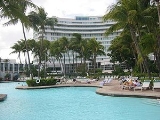
Fontainebleau Hotel

Encyclopedia
The Fontainebleau Miami Beach or the Fontainebleau Hotel is one of the most historically and architecturally significant hotels on Miami Beach. Opened in 1954 and designed by Morris Lapidus
, it was considered the most luxurious hotel on Miami Beach, and is thought to be the most significant building of Lapidus's career. In 2007, the Fontainebleau Hotel was ranked ninety-third in the American Institute of Architects
list of "America's Favorite Architecture".
The Fontainebleau Miami Beach is situated on oceanfront Collins Avenue in the heart of Millionaire's Row and is currently owned by Fontainebleau Resorts
. Fronting the Atlantic Ocean, the 1504-room resort’s most distinguishing features include two new towers; 12 restaurants and bars; a 40000 square feet (3,716.1 m²) spa with mineral-rich water therapies and co-ed swimming pools; and oceanfront poolscape featuring a free-form pool shaped as a re-interpretation of Lapidus’ signature bow-tie design.
to his office in Manhattan
. The hotel was built by hotelier Ben Novack on the Harvey Firestone estate. Novack owned and operated the hotel until its bankruptcy in 1977.
It is not widely known but the hotel actually charged a monetery fee for tourists to view the hotel in all its glory.
The Fontainebleau is famous in judicial circles for its victory in the landmark 1959 Florida District Courts of Appeal
decision, Fontainebleau Hotel Corp. v. Forty-Five Twenty-Five, Inc. 114 So. 2d 357, in which the Fontainebleau Hotel successfully appealed an injunction by the neighboring Eden Roc Hotel
, to prevent construction of an expansion that blocked sunlight to the Eden Roc's swimming pool. The Court rejected the Eden Roc's claim to an easement allowing sunlight, in favor of affirming the Fontainebleau's vertical property rights to build on its land. It stated that the "ancient lights" doctrine has been unanimously repudiated in the United States.
In the 1970s a suite in the hotel was used by members of the Black Tuna Gang
to run their operations. This is recounted in the 2011 documentary Square Grouper
, which follows the burgeoning marijuana-smuggling trade of the mid-to-late 1970s. It was at this time that large amounts of the drug were being shipped to southeastern Florida - the film goes so far as to aver that more than ninety percent of the United States' illicit demand was being met through such channels.
The hotel closed a large part of its property in 2006, though one building remained open to hotel guests, and the furnishings were available for sale. The expanded hotel and its new condominium buildings re-opened in November 2008.
On December 22, 2008, the Fontainebleau was added to the U.S.
National Register of Historic Places
.
. Tony Manetta (played by Frank Sinatra
) comes to a party there for businessman and friend Jerry Marks (Keenan Wynn
). Miami Mayor Robert King High
had a cameo during the gala for Marks. Sinatra then videotaped a special, on March 26, 1960, during his regular Timex-sponsored television series for ABC, to welcome back Elvis Presley
from his two years of military service in Germany, which was then broadcast on May 12, 1960.
The hotel was also the setting for Jerry Lewis
's 1960 comedy film, The Bellboy
.
The Fontainbleau is continually depicted and mentioned in the 1960-1962 television series, Surfside 6
which centers on two detectives living aboard and working out of a houseboat moored directly across the street from the hotel, at the eponymous address. Supporting character Cha Cha O'Brien was an entertainer who worked at The Boom Boom Room in the hotel. Aside from establishing shots, however, the series was filmed entirely at Warner Bros.
studios in Burbank, California
.
The Fontainebleau Miami Beach is featured in the 1964 James Bond
film Goldfinger
, most notably in the sweeping aerial shot that follows the opening credits and accompanies composer John Barry
's big-band track Into Miami. It was the hotel where character Jill Masterton (played by Shirley Eaton
) was killed by the villainous Oddjob (Harold Sakata
).
It gained a second round of architectural fame by its inclusion in critic and novelist Tom Wolfe
's From Bauhaus to Our House
, published in 1981, which referred to the condescending way that Lapidus was treated by the architectural profession and critics. In the 1981 Woody Allen
movie Bananas, the hotel is referenced when the ex-dictator Vargas flees his fictitious country San Marcos in a plane and calls the Fontainebleau to reserve a room.
The hotel, predominantly the pool area, was featured in the 1983 film Scarface
. Other movies filmed there include Go for It
(1983), Police Academy 5: Assignment Miami Beach
(1988), The Bodyguard
(1992), and The Specialist
(1994).
The Fontainebleau was seen on The Sopranos
in the season 4 (2002) episode "Calling All Cars
". The Fontainebleau was also the location of the Bravo television network's show Top Chef
for the third season in 2007, and an episode of FOX's The O.C.
.
The hotel was the location of the Victoria's Secret Fashion Show in 2008.
From May 5–9, 2009 Regis Philbin
and Kelly Ripa
broadcast their talk show Live with Regis and Kelly
from the Fontainebleau Hotel, primarily from the pool area.
The hotel is repeatedly mentioned by Allan Sherman
in his 1962 comedy song, "The Streets of Miami
" (based on "The Streets of Laredo
"). The Fontainebleau is the title subject of a song written by Neil Young
and performed by the Stills-Young Band on their 1976 album Long May You Run
, which was recorded at the hotel. The Joni Mitchell song "Otis and Marlena" from her 1977 album Don Juan's Reckless Daughter
is generally thought to include an oblique reference to the Fontainbleu as, among other things, "that celebrated dump sleazing by the sea".
Restaurants and nightclubs in the complex include:
Morris Lapidus
Morris Lapidus was the architect of Neo-baroque Miami Modern hotels that has since come to define the 1950s resort-hotel style synonymous with Miami and Miami Beach....
, it was considered the most luxurious hotel on Miami Beach, and is thought to be the most significant building of Lapidus's career. In 2007, the Fontainebleau Hotel was ranked ninety-third in the American Institute of Architects
American Institute of Architects
The American Institute of Architects is a professional organization for architects in the United States. Headquartered in Washington, D.C., the AIA offers education, government advocacy, community redevelopment, and public outreach to support the architecture profession and improve its public image...
list of "America's Favorite Architecture".
The Fontainebleau Miami Beach is situated on oceanfront Collins Avenue in the heart of Millionaire's Row and is currently owned by Fontainebleau Resorts
Fontainebleau Resorts
Fontainebleau Resorts, LLC, is a resort-hotel company started by South Florida real estate developers Turnberry Associates and the Plant family in 2005 after their purchase of the famous Fontainebleau Hotel in Miami Beach, Florida. The two families have a 50% stake in the company each...
. Fronting the Atlantic Ocean, the 1504-room resort’s most distinguishing features include two new towers; 12 restaurants and bars; a 40000 square feet (3,716.1 m²) spa with mineral-rich water therapies and co-ed swimming pools; and oceanfront poolscape featuring a free-form pool shaped as a re-interpretation of Lapidus’ signature bow-tie design.
History
Lapidus once wrote, “If you create a stage and it is grand, everyone who enters will play their part.” He conceived of the ideas for the hotel each morning as he took a subway from FlatbushFlatbush, Brooklyn
Flatbush is a community of the Borough of Brooklyn, a part of New York City, consisting of several neighborhoods.The name Flatbush is an Anglicization of the Dutch language Vlacke bos ....
to his office in Manhattan
Manhattan
Manhattan is the oldest and the most densely populated of the five boroughs of New York City. Located primarily on the island of Manhattan at the mouth of the Hudson River, the boundaries of the borough are identical to those of New York County, an original county of the state of New York...
. The hotel was built by hotelier Ben Novack on the Harvey Firestone estate. Novack owned and operated the hotel until its bankruptcy in 1977.
It is not widely known but the hotel actually charged a monetery fee for tourists to view the hotel in all its glory.
The Fontainebleau is famous in judicial circles for its victory in the landmark 1959 Florida District Courts of Appeal
Florida District Courts of Appeal
The Florida District Courts of Appeal are the intermediate appellate courts of the Florida state court system. There are five DCAs:*The First District Court of Appeal is headquartered in Tallahassee...
decision, Fontainebleau Hotel Corp. v. Forty-Five Twenty-Five, Inc. 114 So. 2d 357, in which the Fontainebleau Hotel successfully appealed an injunction by the neighboring Eden Roc Hotel
Eden Roc (hotel)
The Eden Roc Renaissance Hotel Miami Beach is a resort and spa located at 4525 Collins Avenue on Miami Beach, Florida. It was designed by Morris Lapidus, in the Miami Modern style, and opened in 1956...
, to prevent construction of an expansion that blocked sunlight to the Eden Roc's swimming pool. The Court rejected the Eden Roc's claim to an easement allowing sunlight, in favor of affirming the Fontainebleau's vertical property rights to build on its land. It stated that the "ancient lights" doctrine has been unanimously repudiated in the United States.
In the 1970s a suite in the hotel was used by members of the Black Tuna Gang
Black Tuna Gang
The Black Tuna gang was an American marijuana-smuggling organization active in 1970s Miami. The group were responsible for bringing in around 500 tons of marijuana into the United States over the course of 16 months....
to run their operations. This is recounted in the 2011 documentary Square Grouper
Square Grouper: The Godfathers of Ganja
Square Grouper: The Godfathers of Ganja is a 2011 documentary by director Billy Corben and produced by Alfred Spellman and Billy Corben through their Miami-based media studio Rakontur. The term square grouper was a nickname given to bales of marijuana thrown overboard or out of airplanes in South...
, which follows the burgeoning marijuana-smuggling trade of the mid-to-late 1970s. It was at this time that large amounts of the drug were being shipped to southeastern Florida - the film goes so far as to aver that more than ninety percent of the United States' illicit demand was being met through such channels.
The hotel closed a large part of its property in 2006, though one building remained open to hotel guests, and the furnishings were available for sale. The expanded hotel and its new condominium buildings re-opened in November 2008.
On December 22, 2008, the Fontainebleau was added to the U.S.
United States
The United States of America is a federal constitutional republic comprising fifty states and a federal district...
National Register of Historic Places
National Register of Historic Places
The National Register of Historic Places is the United States government's official list of districts, sites, buildings, structures, and objects deemed worthy of preservation...
.
Film, television and music history
The swimming pool is shown in the 1959 film A Hole in the HeadA Hole in the Head
A Hole in the Head is a comedy film released by United Artists. It was directed by Frank Capra and featured Frank Sinatra, Edward G. Robinson, Eleanor Parker, Keenan Wynn, Carolyn Jones, Thelma Ritter, Dub Taylor and Joi Lansing. The film introduced the song "High Hopes", a Sinatra standard used...
. Tony Manetta (played by Frank Sinatra
Frank Sinatra
Francis Albert "Frank" Sinatra was an American singer and actor.Beginning his musical career in the swing era with Harry James and Tommy Dorsey, Sinatra became an unprecedentedly successful solo artist in the early to mid-1940s, after being signed to Columbia Records in 1943. Being the idol of the...
) comes to a party there for businessman and friend Jerry Marks (Keenan Wynn
Keenan Wynn
Keenan Wynn was an American character actor. His bristling mustache and expressive face were his stock in trade, and though he rarely had a lead role, he got prominent billing in most of his film and TV parts....
). Miami Mayor Robert King High
Robert King High
Robert King High was a reform Mayor of Miami, Florida from 1957 until his death, and the Democratic Party nominee for governor of Florida in 1966.-Early years:...
had a cameo during the gala for Marks. Sinatra then videotaped a special, on March 26, 1960, during his regular Timex-sponsored television series for ABC, to welcome back Elvis Presley
Elvis Presley
Elvis Aaron Presley was one of the most popular American singers of the 20th century. A cultural icon, he is widely known by the single name Elvis. He is often referred to as the "King of Rock and Roll" or simply "the King"....
from his two years of military service in Germany, which was then broadcast on May 12, 1960.
The hotel was also the setting for Jerry Lewis
Jerry Lewis
Jerry Lewis is an American comedian, actor, singer, film producer, screenwriter and film director. He is best known for his slapstick humor in film, television, stage and radio. He was originally paired up with Dean Martin in 1946, forming the famed comedy team of Martin and Lewis...
's 1960 comedy film, The Bellboy
The Bellboy
The Bellboy is a 1960 comedy film starring, written by and directed by Jerry Lewis. The film was released on July 20, 1960 by Paramount Pictures.-Plot:The movie opens with a movie studio executive introducing the movie...
.
The Fontainbleau is continually depicted and mentioned in the 1960-1962 television series, Surfside 6
Surfside 6
Surfside 6 was an ABC television series which aired from 1960 to 1962. The show centered around a Miami Beach detective agency set on a houseboat and featured Troy Donahue as Sandy Winfield, II; Van Williams as Kenny Madison ; and Lee Patterson as Dave Thorne...
which centers on two detectives living aboard and working out of a houseboat moored directly across the street from the hotel, at the eponymous address. Supporting character Cha Cha O'Brien was an entertainer who worked at The Boom Boom Room in the hotel. Aside from establishing shots, however, the series was filmed entirely at Warner Bros.
Warner Bros.
Warner Bros. Entertainment, Inc., also known as Warner Bros. Pictures or simply Warner Bros. , is an American producer of film and television entertainment.One of the major film studios, it is a subsidiary of Time Warner, with its headquarters in Burbank,...
studios in Burbank, California
Burbank, California
Burbank is a city in Los Angeles County in Southern California, United States, north of downtown Los Angeles. The estimated population in 2010 was 103,340....
.
The Fontainebleau Miami Beach is featured in the 1964 James Bond
James Bond
James Bond, code name 007, is a fictional character created in 1953 by writer Ian Fleming, who featured him in twelve novels and two short story collections. There have been a six other authors who wrote authorised Bond novels or novelizations after Fleming's death in 1964: Kingsley Amis,...
film Goldfinger
Goldfinger (film)
Goldfinger is the third spy film in the James Bond series and the third to star Sean Connery as the fictional MI6 agent James Bond. Released in 1964, it is based on the novel of the same name by Ian Fleming. The film also stars Honor Blackman as Bond girl Pussy Galore and Gert Fröbe as the title...
, most notably in the sweeping aerial shot that follows the opening credits and accompanies composer John Barry
John Barry (composer)
John Barry Prendergast, OBE was an English conductor and composer of film music. He is best known for composing the soundtracks for 12 of the James Bond films between 1962 and 1987...
's big-band track Into Miami. It was the hotel where character Jill Masterton (played by Shirley Eaton
Shirley Eaton
Shirley Eaton is an English actress.Eaton appeared regularly in British films throughout the 1950s and 1960s, and achieved notability for her performance as Bond Girl Jill Masterson in the 1964 James Bond film Goldfinger...
) was killed by the villainous Oddjob (Harold Sakata
Harold Sakata
Toshiyuki "Harold" Sakata was a Japanese American professional wrestler and film actor most famous for his role as the villain "Oddjob" in the James Bond film Goldfinger.-Career:...
).
It gained a second round of architectural fame by its inclusion in critic and novelist Tom Wolfe
Tom Wolfe
Thomas Kennerly "Tom" Wolfe, Jr. is a best-selling American author and journalist. He is one of the founders of the New Journalism movement of the 1960s and 1970s.-Early life and education:...
's From Bauhaus to Our House
From Bauhaus to Our House
From Bauhaus to Our House is a 1981 narrative of Modern architecture, written by Tom Wolfe.- Background :In 1975 Wolfe made his first foray into art criticism with The Painted Word, in which he argued that art theory had become too pervasive because the art world was controlled by a small elitist...
, published in 1981, which referred to the condescending way that Lapidus was treated by the architectural profession and critics. In the 1981 Woody Allen
Woody Allen
Woody Allen is an American screenwriter, director, actor, comedian, jazz musician, author, and playwright. Allen's films draw heavily on literature, sexuality, philosophy, psychology, Jewish identity, and the history of cinema...
movie Bananas, the hotel is referenced when the ex-dictator Vargas flees his fictitious country San Marcos in a plane and calls the Fontainebleau to reserve a room.
The hotel, predominantly the pool area, was featured in the 1983 film Scarface
Scarface (1983 film)
Scarface is a 1983 American epic crime drama movie directed by Brian De Palma, written by Oliver Stone, produced by Martin Bregman and starring Al Pacino as Tony Montana...
. Other movies filmed there include Go for It
Go for It (film)
Go for It is a 1983 comedy film and spy movie parody starring Terence Hill and Bud Spencer.- Plot :The charming dodger Rosco Frazer and the recently released convict Doug O’Riordan meet each other during a rough brawl in a roadhouse. After this they drive off in a truck, each one thinking of the...
(1983), Police Academy 5: Assignment Miami Beach
Police Academy 5: Assignment Miami Beach
Police Academy 5: Assignment Miami Beach is the 1988 installment in the Police Academy series, launched in 1984. The film was given a PG rating for language and ribald humor....
(1988), The Bodyguard
The Bodyguard
The Bodyguard is a 1992 American romantic-thriller film starring Kevin Costner and Whitney Houston. Costner stars as a former Secret Service Agent turned bodyguard who is hired to protect Houston's character, a music star, from an unknown stalker. Lawrence Kasdan wrote the film in the 1970s,...
(1992), and The Specialist
The Specialist
The Specialist is a 1994 American action film from Warner Bros. Pictures. It is directed by Luis Llosa, produced by Jerry Weintraub, and written by Alexandra Seros...
(1994).
The Fontainebleau was seen on The Sopranos
The Sopranos
The Sopranos is an American television drama series created by David Chase that revolves around the New Jersey-based Italian-American mobster Tony Soprano and the difficulties he faces as he tries to balance the often conflicting requirements of his home life and the criminal organization he heads...
in the season 4 (2002) episode "Calling All Cars
Calling All Cars (The Sopranos episode)
"Calling All Cars" is the fiftieth episode of the HBO original series The Sopranos and was the eleventh of the show's fourth season. It was written by David Chase, Robin Green, Mitchell Burgess and David Flebotte from a story by Chase, Green, Burgess and Terence Winter...
". The Fontainebleau was also the location of the Bravo television network's show Top Chef
Top Chef
Top Chef is an American reality competition show that airs on the cable television network Bravo, in which chefs compete against each other in culinary challenges. They are judged by a panel of professional chefs and other notables from the food and wine industry with one or more contestants...
for the third season in 2007, and an episode of FOX's The O.C.
The O.C.
The O.C. is an American teen drama television series that originally aired on the Fox television network in the United States from August 5, 2003, to February 21, 2007, running a total of four seasons...
.
The hotel was the location of the Victoria's Secret Fashion Show in 2008.
From May 5–9, 2009 Regis Philbin
Regis Philbin
Regis Francis Xavier Philbin is an American media personality, actor and singer, known for hosting talk and game shows since the 1960s. Philbin is often called "the hardest working man in show business" and holds the Guinness World Record for the most time spent in front of a television camera...
and Kelly Ripa
Kelly Ripa
Kelly Ripa is an American actress and television host. Since February 2001, she has served as the co-host of talk show Live with Regis and Kelly, along with Regis Philbin and now solo host of Live! With Kelly...
broadcast their talk show Live with Regis and Kelly
Live with Regis and Kelly
Live! with Kelly is a syndicated American television morning talk show, hosted by Kelly Ripa. The show has aired since 1983 in New York City and 1988 nationwide. Tony Pigg has been the show's announcer since its inception...
from the Fontainebleau Hotel, primarily from the pool area.
The hotel is repeatedly mentioned by Allan Sherman
Allan Sherman
Allan Sherman was an American comedy writer and television producer who became famous as a song parodist in the early 1960s. His first album, My Son, the Folk Singer , became the fastest-selling record album up to that time...
in his 1962 comedy song, "The Streets of Miami
My Son, the Folk Singer
My Son, the Folk Singer is an album by Allan Sherman [monophonic W-1475/stereophonic WS-1475], released by Warner Bros. Records in 1962. On the album sleeve, the title appears directly below the words "Allan Sherman's mother presents."- Side One :...
" (based on "The Streets of Laredo
Streets of Laredo (song)
"Streets of Laredo" , also known as the "Cowboy's Lament", is a famous American cowboy ballad in which a dying cowboy tells his story to a living one. Derived from the English folk song "The Unfortunate Lad", it has become a folk music standard, and as such has been performed, recorded and adapted...
"). The Fontainebleau is the title subject of a song written by Neil Young
Neil Young
Neil Percival Young, OC, OM is a Canadian singer-songwriter who is widely regarded as one of the most influential musicians of his generation...
and performed by the Stills-Young Band on their 1976 album Long May You Run
Long May You Run
-Side two:-Personnel:* Neil Young – vocals, guitars, piano, harmonica, synthesizer* Stephen Stills – vocals, guitar, piano* Jerry Aiello – organ, piano* George "Chocolate" Perry – bass, backing vocals...
, which was recorded at the hotel. The Joni Mitchell song "Otis and Marlena" from her 1977 album Don Juan's Reckless Daughter
Don Juan's Reckless Daughter
Don Juan's Reckless Daughter is a 1977 double album by the folk/pop/rock musician Joni Mitchell. It is unusual for its experimental style, expanding even further on the jazz fusion sound of Mitchell's Hejira from the year before...
is generally thought to include an oblique reference to the Fontainbleu as, among other things, "that celebrated dump sleazing by the sea".
Renovations
Fontainebleau’s grand re-opening marked the end of a two year,$1 billion transformation. Special care was taken to preserve many of the original design elements including the "Staircase to Nowhere."Restaurants and nightclubs in the complex include:
- Gotham Steak
- Scarpetta (Italian)
- Hakkasan (Cantonese)
- La Côte (two-level poolside bar and grille)
- Blade Sushi
- Vida (Pan American)
- Solo (Café & Patisserie)
- Fresh (Snacks & Gelato)
- LIV (Nightclub, a.k.a. '54 formerly Tropigala Lounge)
- Arkadia
- Bleau Bar
- Glow Bar
