


Flip the Frog

Encyclopedia
Animation
Animation is the rapid display of a sequence of images of 2-D or 3-D artwork or model positions in order to create an illusion of movement. The effect is an optical illusion of motion due to the phenomenon of persistence of vision, and can be created and demonstrated in several ways...
cartoon character
Fictional character
A character is the representation of a person in a narrative work of art . Derived from the ancient Greek word kharaktêr , the earliest use in English, in this sense, dates from the Restoration, although it became widely used after its appearance in Tom Jones in 1749. From this, the sense of...
created by American cartoonist Ub Iwerks
Ub Iwerks
Ub Iwerks, A.S.C. was a two-time Academy Award winning American animator, cartoonist, character designer, inventor, creator of Mickey Mouse, and special effects technician, who was famous for his work for Walt Disney....
. He starred in a series of cartoons produced by Celebrity Pictures and distributed through Metro-Goldwyn-Mayer
Metro-Goldwyn-Mayer
Metro-Goldwyn-Mayer Inc. is an American media company, involved primarily in the production and distribution of films and television programs. MGM was founded in 1924 when the entertainment entrepreneur Marcus Loew gained control of Metro Pictures, Goldwyn Pictures Corporation and Louis B. Mayer...
from 1930 to 1933. The series had many recurring characters besides Flip, including Flip's dog, the mule Orace
Orace
Orace is the mule companion of Flip the Frog in such early 1930s cartoons as The Village Specialist, Spooks, and The Milkman. Orace is a lazy, foul-mouthed character who is meant to serve Flip as a draft animal, but doesn't always do a very good job of it.Orace was the creation of Ub Iwerks, who...
, and a dizzy neighborhood spinster
Spinster
A spinster, or old maid, is an older, childless woman who has never been married.For a woman to be identified as a spinster, age is critical...
.
History
Flip was created by Ub Iwerks, animator for the Walt Disney Studios and a personal friend of Walt DisneyWalt Disney
Walter Elias "Walt" Disney was an American film producer, director, screenwriter, voice actor, animator, entrepreneur, entertainer, international icon, and philanthropist, well-known for his influence in the field of entertainment during the 20th century. Along with his brother Roy O...
in 1930, at the Iwerks Studios
Ub Iwerks
Ub Iwerks, A.S.C. was a two-time Academy Award winning American animator, cartoonist, character designer, inventor, creator of Mickey Mouse, and special effects technician, who was famous for his work for Walt Disney....
. After a series of disputes between the two, Iwerks left Disney
The Walt Disney Company
The Walt Disney Company is the largest media conglomerate in the world in terms of revenue. Founded on October 16, 1923, by Walt and Roy Disney as the Disney Brothers Cartoon Studio, Walt Disney Productions established itself as a leader in the American animation industry before diversifying into...
and went on to accept an offer from Pat Powers to open a cartoon studio of his own and receive a salary of $300 a week, an offer that Disney couldn't match at the time. Iwerks was to produce new cartoons under Powers's Celebrity Pictures auspices and distributed by Metro-Goldwyn-Mayer. The first series he was to produce was to feature a character called Tony the Frog, but Iwerks disliked the name and it was subsequently changed to Flip.
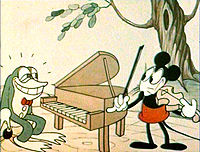
Flip's debut short was Fiddlesticks
Fiddlesticks (cartoon)
Fiddlesticks is a ground-breaking 1930 animated cartoon film. It was the first animated sound cartoon that was photographed in two-strip Technicolor. It was also Ub Iwerks's first cartoon since he departed from Walt Disney's studio....
(released on August 16, 1930). Although the short looks to be very much like one of Iwerks's Silly Symphony endeavors, it attracted public attention by being the first color sound cartoon ever produced. The short was produced in two-color Technicolor
Technicolor
Technicolor is a color motion picture process invented in 1916 and improved over several decades.It was the second major process, after Britain's Kinemacolor, and the most widely used color process in Hollywood from 1922 to 1952...
and is the only Flip cartoon known to have been processed in color. However, some evidence indicates that the second Flip short, Flying Fists
Flying Fists
Flying Fists is a 1937 American film directed by Robert F. Hill.The film is also known as The Last Comeback .- Cast :*Bruce Bennett as Hal "Chopper" Donovan, aka Hal Smith*Jeanne Martel as Katherine "Kay" Conrad...
, may have been produced in Technicolor as well, and some have speculated that the later Techno-Cracked
Techno-Cracked
Techno-Cracked is a 1933 Celebrity Productions, Inc. animated short, directed by Ub Iwerks.-Synopsis:In this satire of the Technocracy, Flip the Frog is nearly killed by a menacing robot he builds to work for him....
(1933) may have been photographed in Cinecolor
Cinecolor
Cinecolor was an early subtractive color-model two color film process, based upon the Prizma system of the 1910s and 1920s and the Multicolor system of the late 1920s and 1930s. It was developed by William T. Crispinel and Alan M...
. The Cinecolor process was a new two-strip color process that came out in 1932 and was considered superior to the two-strip Technicolor process. Iwerks would go on to make extensive use of this process with his ComiColor Cartoon
ComiColor Cartoons
The ComiColor Cartoon series was a series of 25 animated short subjects produced by the Ub Iwerks studio from 1933 to 1936. The series was the last produced by the studio; after losing distributor Metro-Goldwyn-Mayer in 1934, the Iwerks studio's senior company Celebrity Pictures had to distribute...
series.
Iwerks studio quickly began accumulating new talent, such as animators Fred Kopietz, Irv Spence, Grim Natwick
Grim Natwick
Myron "Grim" Natwick was an American artist, animator and film director. Natwick is best known for drawing the Fleischer Studio's most popular character, Betty Boop.-Background:...
, and Chuck Jones
Chuck Jones
Charles Martin "Chuck" Jones was an American animator, cartoon artist, screenwriter, producer, and director of animated films, most memorably of Looney Tunes and Merrie Melodies shorts for the Warner Bros. Cartoons studio...
(who worked at the Iwerks studio as a cel-washer before going on to inbetweening and then animating at the Leon Schlesinger studio). After the first two cartoons, the appearance of Flip the Frog gradually became less froglike. This was done under the encouragement of MGM, who thought that the series would sell better if the character were more humanized. Flip's major redesign is attributed to Grim Natwick, who made a name for himself at the Fleischer Studios
Fleischer Studios
Fleischer Studios, Inc., was an American corporation which originated as an Animation studio located at 1600 Broadway, New York City, New York...
with the creation of Betty Boop
Betty Boop
Betty Boop is an animated cartoon character created by Max Fleischer, with help from animators including Grim Natwick. She originally appeared in the Talkartoon and Betty Boop film series, which were produced by Fleischer Studios and released by Paramount Pictures. She has also been featured in...
. Natwick also had a hand in changing Flip's girlfriend. In earlier films, she was consistently a cat, but Natwick made Flip's new girlfriend, Fifi, a human who shared distinct similarities with Betty (even down to her spit curls).
The frog's personality also began to develop. As the series progressed, Flip became more of a down-and-out, Chaplin-esque
Charlie Chaplin
Sir Charles Spencer "Charlie" Chaplin, KBE was an English comic actor, film director and composer best known for his work during the silent film era. He became the most famous film star in the world before the end of World War I...
character who always found himself in everyday conflicts surrounding the poverty-stricken atmosphere of the Great Depression
Great Depression
The Great Depression was a severe worldwide economic depression in the decade preceding World War II. The timing of the Great Depression varied across nations, but in most countries it started in about 1929 and lasted until the late 1930s or early 1940s...
. Owing to the influx of New York City
New York City
New York is the most populous city in the United States and the center of the New York Metropolitan Area, one of the most populous metropolitan areas in the world. New York exerts a significant impact upon global commerce, finance, media, art, fashion, research, technology, education, and...
animators to Iwerks's studio, such as Natwick, the shorts became increasingly risqué. In Room Runners (1932), Flip, out of cash and luck, attempts to sneak out of his hotel in order to avoid paying his past-due rent. Another gag has Flip watch a girl taking a shower through a keyhole. In The Office Boy, released the same year, Flip tries to secure a low-level office job and meets a shapely secretary. At one point in the short, a mischievous mouse that Flip tries to apprehend scoots up the secretary's skirt. In A Chinaman's Chance (1933), Flip and his dog track down the notorious Chinese criminal Chow Mein. While investigating in a Chinese laundry, Flip stumbles into an opium
Opium
Opium is the dried latex obtained from the opium poppy . Opium contains up to 12% morphine, an alkaloid, which is frequently processed chemically to produce heroin for the illegal drug trade. The latex also includes codeine and non-narcotic alkaloids such as papaverine, thebaine and noscapine...
den, inhales the stuff via opium pipe, and begins hallucinating.
The character eventually wore out his welcome at MGM. His final short was Soda Squirt, released on October 12, 1933. Subsequently, Iwerks replaced the series with a new one starring an imaginative liar named Willie Whopper
Willie Whopper
Willie Whopper is an animated cartoon character created by American cartoonist Ub Iwerks. The Whopper series was the second from the Iwerks studio to be produced by Pat Powers and distributed through Metro-Goldwyn-Mayer. It lasted only two years; from 1933 to 1934.-History:Willie is a young lad who...
. Flip became largely forgotten by the public in the coming years. However, the character would make a small comeback when animation enthusiasts and historians began digging up the old Iwerks shorts. Most of the Flip cartoons are now available on DVD
DVD
A DVD is an optical disc storage media format, invented and developed by Philips, Sony, Toshiba, and Panasonic in 1995. DVDs offer higher storage capacity than Compact Discs while having the same dimensions....
, in particular on the Cartoons That Time Forgot series.
A character resembling Flip can be seen in one of the pictures in R.K. Maroon's office in the film Who Framed Roger Rabbit
Who Framed Roger Rabbit
Who Framed Roger Rabbit is a 1988 American fantasy-comedy-noir film directed by Robert Zemeckis and released by Touchstone Pictures. The film combines live action and animation, and is based on Gary K. Wolf's novel Who Censored Roger Rabbit?, which depicts a world in which cartoon characters...
.
Flip The Frog annual
In 1932, a Flip The Frog Annual was issued in England by Dean & Son Ltd. Published "by exclusive arrangement with Ub Iwerks, The Originator of The Film Character, Flip The Frog", it was drawn by Wilfred Haughton, who also drew the early Mickey Mouse Annuals for Deans. The Annual only ran for one edition, based on Flip's ending in 1933 and the lack of success with it. The earlier, more froglike character was used rather than the later version. The book contains 11 full cartoon strip stories, 4 colour plates and other one-page items that are not derived from any of his cartoons. All the adventures take place outside, unlike the cartoons, and feature additional characters, including a fox, a policeman, a girlfriend (Flap), an Uncle Flop (mentioned only), and others not shown in the cartoon films.1930
| Film | Original release date | Availability |
|---|---|---|
| Fiddlesticks Fiddlesticks (cartoon) Fiddlesticks is a ground-breaking 1930 animated cartoon film. It was the first animated sound cartoon that was photographed in two-strip Technicolor. It was also Ub Iwerks's first cartoon since he departed from Walt Disney's studio.... in Technicolor Technicolor Technicolor is a color motion picture process invented in 1916 and improved over several decades.It was the second major process, after Britain's Kinemacolor, and the most widely used color process in Hollywood from 1922 to 1952... (2-strip) 1 |
August 16, 1930 | Cartoons That Time Forgot: The Ub Iwerks Collection Vol. 1 |
| Flying Fists Flying Fists Flying Fists is a 1937 American film directed by Robert F. Hill.The film is also known as The Last Comeback .- Cast :*Bruce Bennett as Hal "Chopper" Donovan, aka Hal Smith*Jeanne Martel as Katherine "Kay" Conrad... (2-strip) 1 |
September 6 | ? |
| The Village Barber | September 27 | Cartoons That Time Forgot: The Ub Iwerks Collection Vol. 1 |
| Little Orphan Willie | October 18 | Return of the 30's Characters |
| The Cuckoo Murder Case | October 18 | Cartoons That Time Forgot: The Ub Iwerks Collection Vol. 2 |
| Puddle Pranks | December | Cartoons That Time Forgot: The Ub Iwerks Collection Vol. 1 |
1 Filmed in two-color Technicolor suspected.
1931
| Film | Original release date | |
|---|---|---|
| The Village Smitty | January 31, 1931 | Cartoons That Time Forgot: The Ub Iwerks Collection Vol. 1 |
| The Soup Song | January 31 | Cartoons That Time Forgot: The Ub Iwerks Collection Vol. 1 |
| Laughing Gas | March 14 | Cartoons That Time Forgot: The Ub Iwerks Collection Vol. 2 |
| Ragtime Romeo | May 2 | Cartoons That Time Forgot: The Ub Iwerks Collection Vol. 2 |
| The New Car | July 25 | Cartoons That Time Forgot: The Ub Iwerks Collection Vol. 2 |
| Movie Mad | August 29 | Cartoons That Time Forgot: The Ub Iwerks Collection Vol. 2 |
| The Village Specialist | September 12 | ? |
| Jail Birds | September 26 | ? |
| Africa Squeaks Africa Squeaks Africa Squeaks is a 1940 American animated cartoon in the Looney Tunes series starring Porky Pig. It was directed by Bob Clampett, animated by John Carey, Dave Hoffman, Izzy Ellis, Norman McCabe, and Vive Risto, and musical direction by Carl Stalling... |
October 17 | ? |
| Spooks Spooks (cartoon) Spooks is an animated short subject produced by Walter Lantz, and stars Oswald the Lucky Rabbit.-Plot:In a cemetery, a warlock wearing a hat, mask and coat comes out of a tombstone to explore the outside of his vicinity... |
December 21 | Cartoons That Time Forgot: The Ub Iwerks Collection Vol. 2 |
1932
| Film | Original release date | |
|---|---|---|
| The Milkman The Milkman The Milkman is a 1950 American black-and-white film starring Donald O'Connor, Jimmy Durante, and Piper Laurie.-Plot:Roger Bradley is the son the owner of a milk company. He wants to get a job as a milkman at his father's company, but his father denies it because of Roger's after-war trauma: when... |
February 20, 1932 | Cartoons That Time Forgot: The Ub Iwerks Collection Vol. 2 |
| Fire! Fire! | March 5 | ? |
| What a Life! | March 26 | Cartoons That Time Forgot: The Ub Iwerks Collection Vol. 2 |
| Puppy Love | April 30 | ? |
| School Days | May 14 | Cartoons That Time Forgot: The Ub Iwerks Collection Vol. 2 |
| The Bully | June 18 | Cartoons That Time Forgot: The Ub Iwerks Collection Vol. 2 |
| The Office Boy | July 16 | Cartoons That Time Forgot: The Ub Iwerks Collection Vol. 2 |
| Room Runners | August 13 | Cartoons That Time Forgot: The Ub Iwerks Collection Vol. 2 |
| Stromy Seas | August 22 | Cartoons That Time Forgot: The Ub Iwerks Collection Vol. 2 |
| Circus | August 27 | Cartoons That Time Forgot: The Ub Iwerks Collection Vol. 2 |
| The Goal Rush | October 3 | Cartoons That Time Forgot: The Ub Iwerks Collection Vol. 2 |
| The Pony Express | October 27 | ? |
| The Music Lesson | October 29 | Cartoons That Time Forgot: The Ub Iwerks Collection Vol. 1 |
| Nurse Maid | November 26 | Cartoons That Time Forgot: The Ub Iwerks Collection Vol. 2 |
| Funny Face | December 24 | Cartoons That Time Forgot: The Ub Iwerks Collection Vol. 2 |
1933
| Film | Original release date | |
|---|---|---|
| Coo Coo the Magician | January 21, 1933 | Cartoons That Time Forgot: The Ub Iwerks Collection Vol. 2 |
| Flip's Lunch Room | April 3 | ? |
| Techno-Cracked Techno-Cracked Techno-Cracked is a 1933 Celebrity Productions, Inc. animated short, directed by Ub Iwerks.-Synopsis:In this satire of the Technocracy, Flip the Frog is nearly killed by a menacing robot he builds to work for him.... 1 |
May 8 | Cartoons That Time Forgot: The Ub Iwerks Collection Vol. 2 |
| Bulloney | May 30 | ? |
| A Chinaman's Chance | June 24 | Cartoons That Time Forgot: The Ub Iwerks Collection Vol. 2 |
| Pale-Face | August 12 | ? |
| Soda Squirt | October 12 | Cartoons That Time Forgot: The Ub Iwerks Collection Vol. 2 |
1 Filmed in two-strip Technicolor
Availability
27 of Flip's cartoons are included in the two DVD collections "Cartoons That Time Forgot: The Ub Iwerks Collection Vol. 1 and 2." Another early Flip short, "Little Orphan Willie", while not included on either of those DVDs, is included on the budget DVD collection "Return of the 30's Characters" from Thunderbean.See also
- The Golden Age of American animationThe Golden Age of American animationThe Golden Age of U.S. animation is a period in the United States animation history that began with the advent of sound cartoons in 1928 and continued into the early 1960s when theatrical animated shorts slowly began losing to the new medium of television animation.Many memorable characters emerged...
- Watch Flip's debut in Fiddlesticks (1930) on Archive.org