

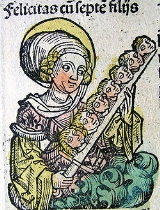
Felicitas of Rome

Encyclopedia
Felicitas of Rome is a saint
numbered among the Christian martyrs
. Apart from her name, the only thing known for certain about this martyr is that she was buried in the Cemetery of Maximus
, on the Via Salaria
on a 23 November. However, a legend presents her as the mother of the seven martyrs whose feast is celebrated on 10 July. And the Eastern Orthodox Church celebrates their martyrdom on 25 January, Old Calendar (i.e., 7 February, New Calendar).
The legend of Saint Symphorosa is very similar and their acts may have been confused. They may even be the same person. This Felicitas is not the same as the North African Felicitas who was martyred with Perpetua
.
" as celebrated on 25 January. From a very early date her feast as a martyr was solemnly celebrated in the Roman Church on that date, as shown by the fact that on that day Saint Gregory the Great delivered a homily in the Basilica
that rose above her tomb. Her body then rested in the catacomb of Maximus on the Via Salaria; in that cemetery all Roman itineraries, or guides to the burial-places of martyrs, locate her burial-place, specifying that her tomb was in a church above this catacomb. The crypt
where St Felicitas was laid to rest was later enlarged into a subterranean chapel, and was rediscovered in 1885.
In the early Middle Ages there was a chapel in honour of St Felicitas in an ancient Roman edifice near the ruins of the Baths of Titus
.
Some of her relics are in the Capuchin
church at Montefiascone
, Tuscany
. Others are in the church of Santa Susanna
in Rome
.
The earliest list of the Roman feasts of martyrs, known as the "Depositio Martyrum" and dating from the time of Pope Liberius
, in the middle of the fourth century, already mentions these seven martyrs as celebrated on 10 July in the four different catacombs
in which their bodies lay. To the name of Silvanus it adds the statement that his body was stolen by the Novatians (hunc Silvanum martyrem Novatiani furati sunt). It does not say that they were brothers.
The tomb of St Januarius in the catacomb of Prætextatus belongs to the end of the second century, to which period, therefore, the martyrdoms, if they are in fact associated with one another, must belong, under the Emperor Marcus Aurelius.
One of the seven martyrs, Saint Martialis (Martial, Marziale), is venerated as the patron saint
of Torricella Peligna
in the Abruzzo
, and Isca sullo Ionio
in Calabria
, Italy
with his feast day on 10 July.
Until it was revised in 1969, the General Roman Calendar designated these seven martyrs as "The Seven Holy Brothers", and some traditionalist Catholics continue to celebrate them under this designation.
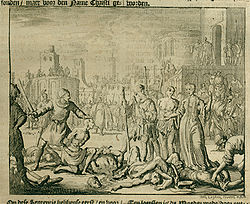 Saint Felicitas (also known as Felicity) is said to have been a rich and pious Christian
widow
who had seven sons. She devoted herself to charitable work and converted many to the Christian faith by her example. This aroused the wrath of pagan
priests who lodged a complaint against her with Emperor Marcus Aurelius. These priests asserted the fire of the gods and demanded sacrifice from Felicitas and her children. The Emperor acquiesced to their demand and Felicitas was brought before Publius, the Prefect
of Rome. Taking Felicitas aside, he used various pleas and threats in an unsuccessful attempt to get her to worship the pagan gods. He was equally unsuccessful with her seven sons who followed their mother's example.
Before the Prefect Publius they adhered firmly to their religion, and were delivered over to four judges, who condemned them to various modes of death. The division of the martyrs among four judges corresponds to the four places of their burial. She implored God only that she not to be killed before her sons, so that she might be able to encourage them during their torture and death in order that they would not deny Christ. According to God's Providence, it so happened. With joy, this wonderful mother accompanied her sons one by one until she had witnessed the death of all seven sons. We are not entirely sure as to how each of them died, but it is said that Januarius, the eldest, was scourged to death; Felix and Philip were beaten with clubs until they expired; Silvanus was thrown headlong down a precipice; and the three youngest, Alexander, Vitalis and Martialis were beheaded
. After each execution she was given the chance to denounce her faith. She refused to act against her conscience and so she too suffered martyrdom.
Certain communities around the United States still celebrate San Marziale (Saint Martialis/Saint Marshall) with a San Marziale festival typically held on July 10th or near that date. Celebrations were held this year in Philadelphia, PA & Kulpmont, PA.
They suffered and entered into eternal rest in Rome about the year 164 She was buried in the catacomb of Maximus on the Via Salaria
, beside St Silvanus. It is said that she died eight times. Once with each of her sons, and finally her own, and their feast day is held on January 25.
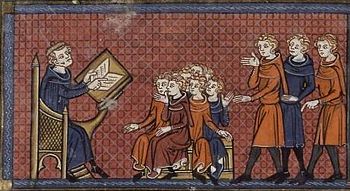 The "Acts" that give the above account of the seven martyrs as sons of Felicitas existed, in some form, in the sixth century, since Pope St Gregory I refers to them in his "Homiliæ super Evangelia, book I, homily iii." The early twentieth century Catholic Encyclopedia
reported that "even distinguished modern archæologists have considered them, though not in their present form corresponding entirely to the original, yet in substance based on genuine contemporary records." But it went on to say that investigations had shown this opinion to be hardly tenable. The earliest recension of these "Acts" does not antedate the sixth century, and appears to be based not on a Roman i.e. Latin text, but on a Greek
original. Moreover, apart from the existing form of the "Acts," various details have been called into question. If Felicitas were really the mother of the seven martyrs honoured on 10 July, it is strange that her name does not appear in the well-known fourth-century Roman calendar.
The tomb of St Silvanus, one of the seven martyrs commemorated on 10 July, adjoined that of St Felicitas; it is quite possible, therefore, that tradition soon identified the seven martyrs of 10 July as the sons of St Felicitas, and that this formed the basis for the extant "Acts."
Saint
A saint is a holy person. In various religions, saints are people who are believed to have exceptional holiness.In Christian usage, "saint" refers to any believer who is "in Christ", and in whom Christ dwells, whether in heaven or in earth...
numbered among the Christian martyrs
Christian martyrs
A Christian martyr is one who is killed for following Christianity, through stoning, crucifixion, burning at the stake or other forms of torture and capital punishment. The word "martyr" comes from the Greek word μάρτυς, mártys, which means "witness."...
. Apart from her name, the only thing known for certain about this martyr is that she was buried in the Cemetery of Maximus
Maximus
Maximus is the Latin term for "greatest" or "largest". In this connexion it is used to refer to:*Circus Maximus *Pontifex Maximus, the highest priest of the ancient Roman College of Pontiffs...
, on the Via Salaria
Via Salaria
The Via Salaria was an ancient Roman road in Italy.It eventually ran from Rome to Castrum Truentinum on the Adriatic coast - a distance of 242 km. The road also passed through Reate and Asculum...
on a 23 November. However, a legend presents her as the mother of the seven martyrs whose feast is celebrated on 10 July. And the Eastern Orthodox Church celebrates their martyrdom on 25 January, Old Calendar (i.e., 7 February, New Calendar).
The legend of Saint Symphorosa is very similar and their acts may have been confused. They may even be the same person. This Felicitas is not the same as the North African Felicitas who was martyred with Perpetua
Saints Perpetua and Felicitas
Perpetua and Felicity are Christian martyrs of the 3rd century. Perpetua was a 22-year old married noble, and a nursing mother. Her co-martyr Felicity, an expectant mother, was her slave. They suffered together at Carthage in the Roman province of Africa.The Passion of St. Perpetua, St...
.
History of Saint Felicitas
The feast of Saint Felicitas of Rome is first mentioned in the "Martyrologium HieronymianumMartyrologium Hieronymianum
The Martyrologium Hieronymianum was a medieval list of martyrs, one of the most used and influential of the Middle Ages...
" as celebrated on 25 January. From a very early date her feast as a martyr was solemnly celebrated in the Roman Church on that date, as shown by the fact that on that day Saint Gregory the Great delivered a homily in the Basilica
Basilica
The Latin word basilica , was originally used to describe a Roman public building, usually located in the forum of a Roman town. Public basilicas began to appear in Hellenistic cities in the 2nd century BC.The term was also applied to buildings used for religious purposes...
that rose above her tomb. Her body then rested in the catacomb of Maximus on the Via Salaria; in that cemetery all Roman itineraries, or guides to the burial-places of martyrs, locate her burial-place, specifying that her tomb was in a church above this catacomb. The crypt
Crypt
In architecture, a crypt is a stone chamber or vault beneath the floor of a burial vault possibly containing sarcophagi, coffins or relics....
where St Felicitas was laid to rest was later enlarged into a subterranean chapel, and was rediscovered in 1885.
In the early Middle Ages there was a chapel in honour of St Felicitas in an ancient Roman edifice near the ruins of the Baths of Titus
Baths of Titus
The Baths of Titus were public baths built in Rome in 81 by Emperor Titus.The baths sat in the base of the Esquiline hill, an area of parkland and luxury estates which had been taken over by Nero for his Golden House or Domus Aurea...
.
Some of her relics are in the Capuchin
Order of Friars Minor Capuchin
The Order of Friars Minor Capuchin is an Order of friars in the Catholic Church, among the chief offshoots of the Franciscans. The worldwide head of the Order, called the Minister General, is currently Father Mauro Jöhri.-Origins :...
church at Montefiascone
Montefiascone
Montefiascone is a town and comune of the province of Viterbo, Italy, located on a hill on the southeast side of Lake Bolsena, 95 km north of GRA .-History:...
, Tuscany
Tuscany
Tuscany is a region in Italy. It has an area of about 23,000 square kilometres and a population of about 3.75 million inhabitants. The regional capital is Florence ....
. Others are in the church of Santa Susanna
Santa Susanna
The Church of Saint Susanna at the baths of Diocletian is a Roman Catholic parish church on the Quirinal Hill in Rome, with a titulus associated to its site that dates back to about 280...
in Rome
Rome
Rome is the capital of Italy and the country's largest and most populated city and comune, with over 2.7 million residents in . The city is located in the central-western portion of the Italian Peninsula, on the Tiber River within the Lazio region of Italy.Rome's history spans two and a half...
.
Association with the seven martyrs venerated on 10 July
Seven martyrs who on that day, though perhaps in different years, were buried in four different Roman cemeteries are celebrated jointly on 10 July:- Saints Alexander, Vitalis, and Martial(is) (Cemetery of the Jordani, on the Via SalariaVia SalariaThe Via Salaria was an ancient Roman road in Italy.It eventually ran from Rome to Castrum Truentinum on the Adriatic coast - a distance of 242 km. The road also passed through Reate and Asculum...
) - Saint Januarius (Cemetery of Praetextatus, on the Via Salaria)
- Saints Felix and Philip (Cemetery of Priscilla, on the Via Salaria)
- Saint Sylvanus or Silvanus (Cemetery of Maximus, on the Via Appia)
The earliest list of the Roman feasts of martyrs, known as the "Depositio Martyrum" and dating from the time of Pope Liberius
Pope Liberius
Pope Liberius, pope from May 17, 352, to September 24, 366, was consecrated according to the Catalogus Liberianus on May 22, as the successor of Pope Julius I. He was regarded as a saint in the early Church, but his name was later removed from the Roman Martyrology, however, he is once again...
, in the middle of the fourth century, already mentions these seven martyrs as celebrated on 10 July in the four different catacombs
Catacombs
Catacombs, human-made subterranean passageways for religious practice. Any chamber used as a burial place can be described as a catacomb, although the word is most commonly associated with the Roman empire...
in which their bodies lay. To the name of Silvanus it adds the statement that his body was stolen by the Novatians (hunc Silvanum martyrem Novatiani furati sunt). It does not say that they were brothers.
The tomb of St Januarius in the catacomb of Prætextatus belongs to the end of the second century, to which period, therefore, the martyrdoms, if they are in fact associated with one another, must belong, under the Emperor Marcus Aurelius.
One of the seven martyrs, Saint Martialis (Martial, Marziale), is venerated as the patron saint
Patron saint
A patron saint is a saint who is regarded as the intercessor and advocate in heaven of a nation, place, craft, activity, class, clan, family, or person...
of Torricella Peligna
Torricella Peligna
Torricella Peligna is a comune and town in the Province of Chieti in the Abruzzo region of Italy.-External links:*...
in the Abruzzo
Abruzzo
Abruzzo is a region in Italy, its western border lying less than due east of Rome. Abruzzo borders the region of Marche to the north, Lazio to the west and south-west, Molise to the south-east, and the Adriatic Sea to the east...
, and Isca sullo Ionio
Isca sullo Ionio
Isca sullo Ionio is a comune and town in the province of Catanzaro in the Calabria region of Italy.-Sources:...
in Calabria
Calabria
Calabria , in antiquity known as Bruttium, is a region in southern Italy, south of Naples, located at the "toe" of the Italian Peninsula. The capital city of Calabria is Catanzaro....
, Italy
Italy
Italy , officially the Italian Republic languages]] under the European Charter for Regional or Minority Languages. In each of these, Italy's official name is as follows:;;;;;;;;), is a unitary parliamentary republic in South-Central Europe. To the north it borders France, Switzerland, Austria and...
with his feast day on 10 July.
Until it was revised in 1969, the General Roman Calendar designated these seven martyrs as "The Seven Holy Brothers", and some traditionalist Catholics continue to celebrate them under this designation.
Legend of Felicitas and the Seven Holy Brothers
Christian
A Christian is a person who adheres to Christianity, an Abrahamic, monotheistic religion based on the life and teachings of Jesus of Nazareth as recorded in the Canonical gospels and the letters of the New Testament...
widow
Widow
A widow is a woman whose spouse has died, while a widower is a man whose spouse has died. The state of having lost one's spouse to death is termed widowhood or occasionally viduity. The adjective form is widowed...
who had seven sons. She devoted herself to charitable work and converted many to the Christian faith by her example. This aroused the wrath of pagan
Paganism
Paganism is a blanket term, typically used to refer to non-Abrahamic, indigenous polytheistic religious traditions....
priests who lodged a complaint against her with Emperor Marcus Aurelius. These priests asserted the fire of the gods and demanded sacrifice from Felicitas and her children. The Emperor acquiesced to their demand and Felicitas was brought before Publius, the Prefect
Prefect
Prefect is a magisterial title of varying definition....
of Rome. Taking Felicitas aside, he used various pleas and threats in an unsuccessful attempt to get her to worship the pagan gods. He was equally unsuccessful with her seven sons who followed their mother's example.
Before the Prefect Publius they adhered firmly to their religion, and were delivered over to four judges, who condemned them to various modes of death. The division of the martyrs among four judges corresponds to the four places of their burial. She implored God only that she not to be killed before her sons, so that she might be able to encourage them during their torture and death in order that they would not deny Christ. According to God's Providence, it so happened. With joy, this wonderful mother accompanied her sons one by one until she had witnessed the death of all seven sons. We are not entirely sure as to how each of them died, but it is said that Januarius, the eldest, was scourged to death; Felix and Philip were beaten with clubs until they expired; Silvanus was thrown headlong down a precipice; and the three youngest, Alexander, Vitalis and Martialis were beheaded
Decapitation
Decapitation is the separation of the head from the body. Beheading typically refers to the act of intentional decapitation, e.g., as a means of murder or execution; it may be accomplished, for example, with an axe, sword, knife, wire, or by other more sophisticated means such as a guillotine...
. After each execution she was given the chance to denounce her faith. She refused to act against her conscience and so she too suffered martyrdom.
Certain communities around the United States still celebrate San Marziale (Saint Martialis/Saint Marshall) with a San Marziale festival typically held on July 10th or near that date. Celebrations were held this year in Philadelphia, PA & Kulpmont, PA.
They suffered and entered into eternal rest in Rome about the year 164 She was buried in the catacomb of Maximus on the Via Salaria
Via Salaria
The Via Salaria was an ancient Roman road in Italy.It eventually ran from Rome to Castrum Truentinum on the Adriatic coast - a distance of 242 km. The road also passed through Reate and Asculum...
, beside St Silvanus. It is said that she died eight times. Once with each of her sons, and finally her own, and their feast day is held on January 25.
Origin of the legend
Catholic Encyclopedia
The Catholic Encyclopedia, also referred to as the Old Catholic Encyclopedia and the Original Catholic Encyclopedia, is an English-language encyclopedia published in the United States. The first volume appeared in March 1907 and the last three volumes appeared in 1912, followed by a master index...
reported that "even distinguished modern archæologists have considered them, though not in their present form corresponding entirely to the original, yet in substance based on genuine contemporary records." But it went on to say that investigations had shown this opinion to be hardly tenable. The earliest recension of these "Acts" does not antedate the sixth century, and appears to be based not on a Roman i.e. Latin text, but on a Greek
Greek language
Greek is an independent branch of the Indo-European family of languages. Native to the southern Balkans, it has the longest documented history of any Indo-European language, spanning 34 centuries of written records. Its writing system has been the Greek alphabet for the majority of its history;...
original. Moreover, apart from the existing form of the "Acts," various details have been called into question. If Felicitas were really the mother of the seven martyrs honoured on 10 July, it is strange that her name does not appear in the well-known fourth-century Roman calendar.
The tomb of St Silvanus, one of the seven martyrs commemorated on 10 July, adjoined that of St Felicitas; it is quite possible, therefore, that tradition soon identified the seven martyrs of 10 July as the sons of St Felicitas, and that this formed the basis for the extant "Acts."