

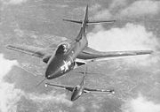
F9F Cougar

Encyclopedia
The Grumman F9F/F-9 Cougar was an aircraft carrier
-based fighter aircraft
for the United States Navy
. Based on the earlier Grumman F9F Panther, the Cougar replaced the Panther's straight wing with a more modern swept wing
. The Navy considered the Cougar an updated version of the Panther, despite having a different official name, and thus Cougars started off from F9F-6 upwards.
Mach number
was increased from 0.79 to 0.86 at sea level and to 0.895 at 35,000 ft (10,000 m), improving performance markedly over the Panther. The Cougar was too late for Korean War
service, however, and thus combat effectiveness estimates of the Cougar against potential foes such as the (likewise subsonic, but not carrier-rated) Soviet Mikoyan-Gurevich MiG-15
necessarily remain in the sphere of conjecture.
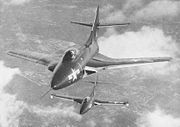
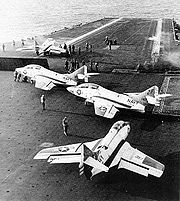 Initial production (646 airframes) was the F9F-6, delivered from mid 1952 through July 1954. Armament was four 20 mm (.79 in) M2 cannons in the nose and provision for two 1,000 lb (454 kg) bombs or 150 US gal (570 l) drop tanks under the wings. Most were fitted with a UHF homing antenna under the nose, and some were fitted with probes for inflight refuelling. Later redesignated F-9F in 1962. Sixty were built as F9F-6P reconnaissance aircraft with cameras instead of the nose cannon.
After withdrawal from active service, many F9F-6s were used as unmanned drones for combat training, designated F9F-6K, or as drone directors, designated F9F-6D. The F9F-6K and the F9F-6D were redesignated the QF-9F and DF-9F, respectively.
F9F-7 referred to the next batch of Cougars that were given the Allison J33 engine instead of the Pratt & Whitney J48. 168 were built, but the J33 proved both less powerful and less reliable than the J48. Almost all were converted to take J48s, and were thus indistinguishable from F9F-6s. These were redesignated F-9H in 1962.
The F9F-8 was the final fighter version. It featured an 8 in (20 cm) stretch in the fuselage and modified wings with greater chord and wing area, to improve low-speed, high angle of attack flying and to give more room for fuel tanks. 601 aircraft were delivered between April 1954 and March 1957; most were given inflight refuelling probes, and late production were given the ability to carry four AIM-9 Sidewinder
air-to-air missile
s under the wings. Most earlier aircraft were modified to this configuration. A number were given nuclear bombing equipment. These were redesignated F-9J in 1962.
The F9F-8B aircraft were F9F-8s converted into single-seat attack-fighters, later redesignated AF-9J.
A total of 110 F9F-8Ps were produced with an extensively modified nose carrying cameras. They were withdrawn after 1960 to reserve squadrons. In 1962, surviving F9F-6P and F9F-8P aircraft were re-designated RF-9F and RF-9J respectively.
Modifications of F9F-8 to convert to F9F-8P:
The Navy acquired 377 two-seat F9F-8T trainers between 1956 and 1960. They were used for advanced training, weapons training and carrier training, and served until 1974. They were armed with twin 20 mm (.79 in) cannon and could carry a full bombs or missiles load. In the 1962 redesignation, these were called TF-9J.
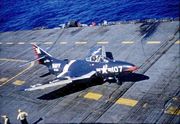 F9F-8s were withdrawn from front-line service in 1958-59, replaced by Grumman F11F Tigers and Vought F8U Crusaders
. Reserves used them until the mid-1960s, but none of the single-seat versions saw Vietnam War
service.
The only version of the Cougar to see combat was the TF-9J trainer (until 1962, F9F-8T). Four Cougars of H&MS-13 were used in the airborne command role, directing airstrikes against enemy positions in South Vietnam
during 1966 and 1967. The TF-9J had a long service with US Navy, but the Cougar evolution (with J52 engine) was defeated when US Navy selected TA-4F
instead. The last was phased out when VT-4 was re-equipped on February 1974. A F9F-8T, BuNo 14276, is displayed at the National Museum of Naval Aviation
, Pensacola.
, who used the F9F Panther
as well. Two F9F-8Ts trainers were acquired in 1962, and served until 1971. The Argentine Navy
, after several failed attempts, managed to get the two airframes delivered by taking advantage of a bureaucracy designation mistake, but the United States
refused to send spare parts during the following years. The Cougar was the first jet to break the sound barrier in Argentina.
Serial 3-A-151 is on display at the Naval Aviation Museum (MUAN) at Bahía Blanca
.
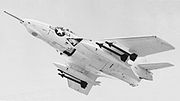
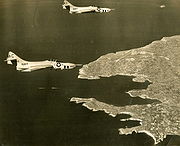
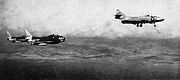 XF9F-6 : First three prototypes of the F9F Cougar
F9F-6 : 646 built; redesignated F-9F in 1962.
F9F-6P : 60 were built for reconnaissance
F9F-6D : drone directors, converted from F9F-6s; redesignated DF-9F in 1962.
F9F-6K : unmanned drones for combat training, converted from F9F-6s; redesignated QF-9F in 1962.
F9F-6PD : drone directors, converted from F9F-6Ps; redesignated DF-9F in 1962.
F9F-6K2 : an improved version of the F9F-6K target drone, converted from F9F-6s; redesignated QF-9G in 1962.
F9F-7 : 168 were built with the Allison J33 engine; most were converted to take J48s; redesignated F-9H in 1962.
F9F-8 : 601 aircraft; redesignated F-9J in 1962; they had up to 4 AIM-9 Sidewinder missiles
YF9F-8B : Prototype for a single-seat attack-fighter aircraft converted from a F9F-8; later redesignated YAF-9J.
F9F-8B : F9F-8s converted into single-seat attack-fighters; later redesignated AF-9J.
F9F-8P : 110 photo-reconnaissance versions.
YF9F-8T : one F9F-8 aircraft converted into a prototype for the F9F-8T training aircraft; later redesignated YTF-9J.
F9F-8T : 377 two-seat trainers acquired; redesignated TF-9J in 1962.
NTF-9J : Two TF-9Js used for special test duties.
YF9F-9: Original designation of the YF11F-1 Tiger prototypes. First flight was on 30 July 1954; redesignated in April 1955.
Aircraft carrier
An aircraft carrier is a warship designed with a primary mission of deploying and recovering aircraft, acting as a seagoing airbase. Aircraft carriers thus allow a naval force to project air power worldwide without having to depend on local bases for staging aircraft operations...
-based fighter aircraft
Fighter aircraft
A fighter aircraft is a military aircraft designed primarily for air-to-air combat with other aircraft, as opposed to a bomber, which is designed primarily to attack ground targets...
for the United States Navy
United States Navy
The United States Navy is the naval warfare service branch of the United States Armed Forces and one of the seven uniformed services of the United States. The U.S. Navy is the largest in the world; its battle fleet tonnage is greater than that of the next 13 largest navies combined. The U.S...
. Based on the earlier Grumman F9F Panther, the Cougar replaced the Panther's straight wing with a more modern swept wing
Swept wing
A swept wing is a wing planform favored for high subsonic jet speeds first investigated by Germany during the Second World War. Since the introduction of the MiG-15 and North American F-86 which demonstrated a decisive superiority over the slower first generation of straight-wing jet fighters...
. The Navy considered the Cougar an updated version of the Panther, despite having a different official name, and thus Cougars started off from F9F-6 upwards.
Design and development
Prototypes were quickly produced by modifying Panthers, and the first (XF9F-6) flew on 20 September 1951. The aircraft was still subsonic, but the criticalCritical Mach number
In aerodynamics, the critical Mach number of an aircraft is the lowest Mach number at which the airflow over any part of the aircraft reaches the speed of sound....
Mach number
Mach number
Mach number is the speed of an object moving through air, or any other fluid substance, divided by the speed of sound as it is in that substance for its particular physical conditions, including those of temperature and pressure...
was increased from 0.79 to 0.86 at sea level and to 0.895 at 35,000 ft (10,000 m), improving performance markedly over the Panther. The Cougar was too late for Korean War
Korean War
The Korean War was a conventional war between South Korea, supported by the United Nations, and North Korea, supported by the People's Republic of China , with military material aid from the Soviet Union...
service, however, and thus combat effectiveness estimates of the Cougar against potential foes such as the (likewise subsonic, but not carrier-rated) Soviet Mikoyan-Gurevich MiG-15
Mikoyan-Gurevich MiG-15
The Mikoyan-Gurevich MiG-15 was a jet fighter developed for the USSR by Artem Mikoyan and Mikhail Gurevich. The MiG-15 was one of the first successful swept-wing jet fighters, and it achieved fame in the skies over Korea, where early in the war, it outclassed all straight-winged enemy fighters in...
necessarily remain in the sphere of conjecture.
After withdrawal from active service, many F9F-6s were used as unmanned drones for combat training, designated F9F-6K, or as drone directors, designated F9F-6D. The F9F-6K and the F9F-6D were redesignated the QF-9F and DF-9F, respectively.
F9F-7 referred to the next batch of Cougars that were given the Allison J33 engine instead of the Pratt & Whitney J48. 168 were built, but the J33 proved both less powerful and less reliable than the J48. Almost all were converted to take J48s, and were thus indistinguishable from F9F-6s. These were redesignated F-9H in 1962.
The F9F-8 was the final fighter version. It featured an 8 in (20 cm) stretch in the fuselage and modified wings with greater chord and wing area, to improve low-speed, high angle of attack flying and to give more room for fuel tanks. 601 aircraft were delivered between April 1954 and March 1957; most were given inflight refuelling probes, and late production were given the ability to carry four AIM-9 Sidewinder
AIM-9 Sidewinder
The AIM-9 Sidewinder is a heat-seeking, short-range, air-to-air missile carried mostly by fighter aircraft and recently, certain gunship helicopters. The missile entered service with United States Air Force in the early 1950s, and variants and upgrades remain in active service with many air forces...
air-to-air missile
Air-to-air missile
An air-to-air missile is a missile fired from an aircraft for the purpose of destroying another aircraft. AAMs are typically powered by one or more rocket motors, usually solid fuelled but sometimes liquid fuelled...
s under the wings. Most earlier aircraft were modified to this configuration. A number were given nuclear bombing equipment. These were redesignated F-9J in 1962.
The F9F-8B aircraft were F9F-8s converted into single-seat attack-fighters, later redesignated AF-9J.
A total of 110 F9F-8Ps were produced with an extensively modified nose carrying cameras. They were withdrawn after 1960 to reserve squadrons. In 1962, surviving F9F-6P and F9F-8P aircraft were re-designated RF-9F and RF-9J respectively.
Modifications of F9F-8 to convert to F9F-8P:
- The modification to eliminate the guns and related equipment and incorporate the photographic equipment and automatic pilot and their controls and instruments has resulted in the following changes:
- Rearrangement of electronics equipment installed in the area enclosed by the fuselage nose section, lengthening of this section by 12 inches, and shortening of the sliding nose section.
- Rearrangement of the left and right consoles and the main instrument panel to provide space for the controls associated with the additional equipment.
- Some minor changes of the fuselage structure and equipment installations to provide for the necessary ducting control for hot air from the engine compressor, which is used for defrosting the camera windows and heating the camera compartment.
- Removal of all armament and the Armament Control System, removal of AN/APG-30 system and installation of an additional armor plate bulkhead.
The Navy acquired 377 two-seat F9F-8T trainers between 1956 and 1960. They were used for advanced training, weapons training and carrier training, and served until 1974. They were armed with twin 20 mm (.79 in) cannon and could carry a full bombs or missiles load. In the 1962 redesignation, these were called TF-9J.
Operational history
F-8 Crusader
The Vought F-8 Crusader was a single-engine, supersonic, carrier-based air superiority jet aircraft built by Vought for the United States Navy and the U.S. Marine Corps, replacing the Vought F7U Cutlass...
. Reserves used them until the mid-1960s, but none of the single-seat versions saw Vietnam War
Vietnam War
The Vietnam War was a Cold War-era military conflict that occurred in Vietnam, Laos, and Cambodia from 1 November 1955 to the fall of Saigon on 30 April 1975. This war followed the First Indochina War and was fought between North Vietnam, supported by its communist allies, and the government of...
service.
The only version of the Cougar to see combat was the TF-9J trainer (until 1962, F9F-8T). Four Cougars of H&MS-13 were used in the airborne command role, directing airstrikes against enemy positions in South Vietnam
South Vietnam
South Vietnam was a state which governed southern Vietnam until 1975. It received international recognition in 1950 as the "State of Vietnam" and later as the "Republic of Vietnam" . Its capital was Saigon...
during 1966 and 1967. The TF-9J had a long service with US Navy, but the Cougar evolution (with J52 engine) was defeated when US Navy selected TA-4F
A-4 Skyhawk
The Douglas A-4 Skyhawk is a carrier-capable ground-attack aircraft designed for the United States Navy and United States Marine Corps. The delta winged, single-engined Skyhawk was designed and produced by Douglas Aircraft Company, and later McDonnell Douglas. It was originally designated the A4D...
instead. The last was phased out when VT-4 was re-equipped on February 1974. A F9F-8T, BuNo 14276, is displayed at the National Museum of Naval Aviation
National Museum of Naval Aviation
The National Museum of Naval Aviation is a military and aerospace museum located at Naval Air Station Pensacola, Florida. The museum opened in 1962....
, Pensacola.
Argentina
The only foreign air arm to use the F9F Cougar was the Argentine Naval AviationArgentine Naval Aviation
The Argentine Naval Aviation is the naval aviation branch of the Argentine Navy and one of its four operational commands...
, who used the F9F Panther
F9F Panther
|-Popular culture:The Panther played a prominent role in the 1954 movie Men of the Fighting Lady . The F9F was featured in the flying sequences in the 1954 movie The Bridges at Toko-Ri, although in the 1953 James A...
as well. Two F9F-8Ts trainers were acquired in 1962, and served until 1971. The Argentine Navy
Argentine Navy
The Navy of the Argentine Republic or Armada of the Argentine Republic is the navy of Argentina. It is one of the three branches of the Armed Forces of the Argentine Republic, together with the Army and the Air Force....
, after several failed attempts, managed to get the two airframes delivered by taking advantage of a bureaucracy designation mistake, but the United States
United States
The United States of America is a federal constitutional republic comprising fifty states and a federal district...
refused to send spare parts during the following years. The Cougar was the first jet to break the sound barrier in Argentina.
Serial 3-A-151 is on display at the Naval Aviation Museum (MUAN) at Bahía Blanca
Bahía Blanca
Bahía Blanca is a city located in the south-west of the province of Buenos Aires, Argentina, by the Atlantic Ocean, and seat of government of Bahía Blanca Partido. It has a population of 274,509 inhabitants according to the...
.
Variants
F9F-6 : 646 built; redesignated F-9F in 1962.
F9F-6P : 60 were built for reconnaissance
F9F-6D : drone directors, converted from F9F-6s; redesignated DF-9F in 1962.
F9F-6K : unmanned drones for combat training, converted from F9F-6s; redesignated QF-9F in 1962.
F9F-6PD : drone directors, converted from F9F-6Ps; redesignated DF-9F in 1962.
F9F-6K2 : an improved version of the F9F-6K target drone, converted from F9F-6s; redesignated QF-9G in 1962.
F9F-7 : 168 were built with the Allison J33 engine; most were converted to take J48s; redesignated F-9H in 1962.
F9F-8 : 601 aircraft; redesignated F-9J in 1962; they had up to 4 AIM-9 Sidewinder missiles
YF9F-8B : Prototype for a single-seat attack-fighter aircraft converted from a F9F-8; later redesignated YAF-9J.
F9F-8B : F9F-8s converted into single-seat attack-fighters; later redesignated AF-9J.
F9F-8P : 110 photo-reconnaissance versions.
YF9F-8T : one F9F-8 aircraft converted into a prototype for the F9F-8T training aircraft; later redesignated YTF-9J.
F9F-8T : 377 two-seat trainers acquired; redesignated TF-9J in 1962.
NTF-9J : Two TF-9Js used for special test duties.
YF9F-9: Original designation of the YF11F-1 Tiger prototypes. First flight was on 30 July 1954; redesignated in April 1955.
Operators
- Argentine NavyArgentine NavyThe Navy of the Argentine Republic or Armada of the Argentine Republic is the navy of Argentina. It is one of the three branches of the Armed Forces of the Argentine Republic, together with the Army and the Air Force....
- Argentine Naval AviationArgentine Naval AviationThe Argentine Naval Aviation is the naval aviation branch of the Argentine Navy and one of its four operational commands...
- United States NavyUnited States NavyThe United States Navy is the naval warfare service branch of the United States Armed Forces and one of the seven uniformed services of the United States. The U.S. Navy is the largest in the world; its battle fleet tonnage is greater than that of the next 13 largest navies combined. The U.S...
- United States Marine CorpsUnited States Marine CorpsThe United States Marine Corps is a branch of the United States Armed Forces responsible for providing power projection from the sea, using the mobility of the United States Navy to deliver combined-arms task forces rapidly. It is one of seven uniformed services of the United States...
Specifications (F9F-8/F-9J)
Aircraft on display
- F9F-6P Cougar, bureau number unknown, is on display at The Town of Tonawanda Veterans MemorialTown of Tonawanda Veterans MemorialThe Town of Tonawanda Veterans Memorial is a public memorial in the Town of Tonawanda, New York. It is located in Walter M. Kenney Field at the northwest corner of Brighton Road and Colvin Boulevard. The memorial stands to honor the service of all veterans of the United States Armed Forces.Initial...
in the Town of TonawandaTonawanda (town), New YorkTonawanda is a town in Erie County, New York, United States. As of the 2000 census, the town had a population of 78,155. The town is at the north border of the county and is the northern suburb of Buffalo...
, New YorkNew YorkNew York is a state in the Northeastern region of the United States. It is the nation's third most populous state. New York is bordered by New Jersey and Pennsylvania to the south, and by Connecticut, Massachusetts and Vermont to the east...
. The Cougar airframe, which is on loan to the town from the U.S. government, has been on display at the site since May 1959. During the construction of the Town of Tonawanda Veterans Memorial in the summer of 2009, a local auto collision shop volunteered to refurbish the F9F-6P airframe. To refurbish the aluminum structure, volunteers removed all old paint, pounded out dents, filled in cracks and gaps, repainted all surfaces, and applied decals to the fuselage and wings. The entire process and took roughly three weeks to complete. However, the blue colour and the markings do not represent any historic U.S. Navy camouflage. Since its installation, the F9F-6P airframe had been used as a piece of playground equipment by local children. However, in February 2009, town government officials received paperwork from the National Museum of Naval AviationNational Museum of Naval AviationThe National Museum of Naval Aviation is a military and aerospace museum located at Naval Air Station Pensacola, Florida. The museum opened in 1962....
requesting that the town take full responsibility for the loaned airframe's upkeep and make an effort to prevent people from climbing on its wings and fuselage. In response to this request, the town has installed signage asking visitors to refrain from climbing on the airframe.
- F9F-7 Cougar, bureau number 130763, is on display in the Cradle of Aviation MuseumCradle of Aviation MuseumThe Cradle of Aviation Museum is an aerospace museum located in East Garden City, New York on Long Island to commemorate Long Island's part in the history of aviation. It is located on land once part of Mitchel Air Force Base which, together with nearby Roosevelt Field and other airfields on the...
in Garden City, New YorkGarden City, New YorkGarden City is a village in the town of Hempstead in central Nassau County, New York, in the United States. It was founded by multi-millionaire Alexander Turney Stewart in 1869, and is located on Long Island, to the east of New York City, from mid-town Manhattan, and just south of the town of...
on Long Island (on loan from the US Navy).
- F9F-8 Cougar, bureau number 141117, is on display at The Intrepid Sea-Air-Space MuseumIntrepid Sea-Air-Space MuseumThe Intrepid Sea-Air-Space Museum is a military and maritime history museum with a collection of museum ships in New York City. It is located at Pier 86 at 46th Street on the West Side of Manhattan. The museum showcases the World War II aircraft carrier USS Intrepid, the submarine , a Concorde...
in New York, New York. It is on loan from the National Museum of Naval AviationNational Museum of Naval AviationThe National Museum of Naval Aviation is a military and aerospace museum located at Naval Air Station Pensacola, Florida. The museum opened in 1962....
). It was built in Grummans' Bethpage factory in 1955 and retired from active service in 1965. Once restored, it will wear fighter squadron VF-61 colors, which flew from IntrepidUSS Intrepid (CV-11)USS Intrepid , also known as The Fighting "I", is one of 24 s built during World War II for the United States Navy. She is the fourth US Navy ship to bear the name. Commissioned in August 1943, Intrepid participated in several campaigns in the Pacific Theater of Operations, most notably the Battle...
in 1956.
- TF-9J Cougar, bureau number 146417, is on display at the Evergreen Aviation & Space Museum in McMinnville, OregonMcMinnville, OregonMcMinnville is the county seat and largest city of Yamhill County, Oregon, United States. According to Oregon Geographic Names, it was named by its founder, William T. Newby , an early immigrant on the Oregon Trail, for his hometown of McMinnville, Tennessee...
. It is on loan from the National Museum of Naval AviationNational Museum of Naval AviationThe National Museum of Naval Aviation is a military and aerospace museum located at Naval Air Station Pensacola, Florida. The museum opened in 1962....
and is painted to represent the narrator's aircraft for the U.S. Navy Blue Angels precision flight demonstration team.
- TF-9J Cougar, bureau number 147385 is on display in the hangar deck of the at the Patriot's PointPatriot's PointPatriots Point Naval & Maritime Museum is located in Mount Pleasant, South Carolina, at the mouth of the Cooper River on the Charleston Harbor, across from Charleston.-Museum ships and exhibits:...
Naval and Maritime Museum in Mount Pleasant, South CarolinaMount Pleasant, South CarolinaMount Pleasant is a large affluent suburban town in Charleston County, South Carolina, United States. It is a member of the Charleston–North Charleston–Summerville Metropolitan Statistical Area, for statistical purpose only, as designated by the U.S. Office of Management and Budget....
.