

Excavation

Encyclopedia
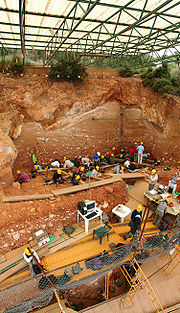
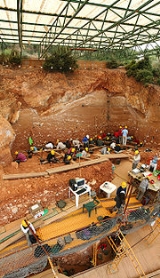
- Excavation is best known and most commonly used within the science of archaeologyArchaeologyArchaeology, or archeology , is the study of human society, primarily through the recovery and analysis of the material culture and environmental data that they have left behind, which includes artifacts, architecture, biofacts and cultural landscapes...
. In this sense it is the exposure, processing and recording of archaeological remains. - The term is also used for an example of the application of the technique to the study of a given site. In this sense, an excavation may sometimes be referred to as a "dig" by those who participate, this being a concise, if oversimplified description of the process. Such a site excavation concerns itself with a specific archaeological site or a connected series of sites, and may be conducted over as little as several weeks to over a number of years.
Overview
Within the practice of excavation, numerous specialized techniques are available for use, and each dig will have its particular features, which will determine the archaeologists' approach. Resources and other practical issues do not allow archaeologists to carry out excavations whenever and wherever they choose. These constraints mean many known sites have been deliberately left unexcavated. This is with the intention of preserving them for future generations as well as recognising the role they serve in the communities that live near them. In some cases it is also hoped that improvements in technology will enable them to be re-examined at a later date, with more fruitful results. Excavation is the digging and recording of artifacts at an archaeological site.The presence or absence of archaeological remains can often be suggested to a more or less high degree of probability, by remote sensing
Remote sensing
Remote sensing is the acquisition of information about an object or phenomenon, without making physical contact with the object. In modern usage, the term generally refers to the use of aerial sensor technologies to detect and classify objects on Earth by means of propagated signals Remote sensing...
, such as ground-penetrating radar
Ground-penetrating radar
Ground-penetrating radar is a geophysical method that uses radar pulses to image the subsurface. This nondestructive method uses electromagnetic radiation in the microwave band of the radio spectrum, and detects the reflected signals from subsurface structures...
. Indeed, grosser information about the development of the site may be drawn from this work but the understanding of finer features usually requires excavation though appropriate use of auger
Auger
An auger is a drilling device, or drill bit, that usually includes a rotating helical screw blade called a "flighting" to act as a screw conveyor to remove the drilled out material...
ing.
Historical development
The development of excavation techniques has moved over the years from a treasure hunting process to one which seeks to fully understand the sequence of human activity on a given site and that site's relationship with other sites and with the landscape in which it is set.Its history began with a crude search for treasure and for artefacts which fell into the category of 'curio
Curio
Curio may refer to:* A strange and interesting object which evokes curiosity** Curio , a predominantly glass cabinet with a metal or wood framework used to display collections of curios...
'. These curios were the subject of interest of antiquarian
Antiquarian
An antiquarian or antiquary is an aficionado or student of antiquities or things of the past. More specifically, the term is used for those who study history with particular attention to ancient objects of art or science, archaeological and historic sites, or historic archives and manuscripts...
s. It was later appreciated that digging on a site destroyed the evidence of earlier people's lives which it had contained. Once the curio had been removed from its context, most of the information it held was lost. It was from this realization that antiquarianism began to be replaced by archaeology, a process still being perfected.
Site formation
Archaeological material would, to a very large extent, have been called rubbish when it was left on the site. It tends to accumulate in events. A gardener swept a pile of soil into a corner, laid a gravel path or planted a bush in a hole. A builder built a wall and back-filled the trench. Years later, someone built a pig sty onto it and drained the pig sty into the nettle patch. Later still, the original wall blew over and so on. Each event, which may have taken a short or long time to accomplish, leaves a contextArchaeological context
In archaeology, not only the context of a discovery is a significant fact, but the formation of the context is as well. An archaeological context is an event in time which has been preserved in the archaeological record. The cutting of a pit or ditch in the past is a context, whilst the material...
. This layer cake of events is often referred to as the archaeological sequence or record
Archaeological record
The archaeological record is the body of physical evidence about the past. It is one of the most basic concepts in archaeology, the academic discipline concerned with documenting and interpreting the archaeological record....
. It is by analysis of this sequence or record that excavation is intended to permit interpretation, which should lead to discussion and understanding.
The prominent processual archaeologist
Processual archaeology
Processual archaeology is a form of archaeological theory that had its genesis in 1958 with Willey and Phillips' work Method and Theory in American Archeology, in which the pair stated that "American archaeology is anthropology or it is nothing" , a rephrasing of Frederic William Maitland's...
Lewis Binford
Lewis Binford
Lewis Roberts Binford was an American archaeologist known for his influential work in archaeological theory, ethnoarchaeology and the Paleolithic period...
highlighted the fact that the archaeological evidence left at a site may not be entirely indicative of the historical events that actually took place there. Using an ethnoarchaeological
Ethnoarchaeology
Ethnoarchaeology is the ethnographic study of peoples for archaeological reasons, usually through the study of the material remains of a society . Ethnoarchaeology aids archaeologists in reconstructing ancient lifeways by studying the material and non-material traditions of modern societies...
comparison, he looked at how hunters amongst the Nunamiut
Nunamiut
The Nunamiut people are a semi-nomadic inland Inupiaq Eskimos located in northern and northwestern Alaska, mostly around the Anaktuvuk Pass, Alaska, whose ancestors date back hundreds of years.-History:...
Eskimo
Eskimo
Eskimos or Inuit–Yupik peoples are indigenous peoples who have traditionally inhabited the circumpolar region from eastern Siberia , across Alaska , Canada, and Greenland....
of north central Alaska
Alaska
Alaska is the largest state in the United States by area. It is situated in the northwest extremity of the North American continent, with Canada to the east, the Arctic Ocean to the north, and the Pacific Ocean to the west and south, with Russia further west across the Bering Strait...
spent a great deal of time in a certain area simply waiting for prey to arrive there, and that during this period, they undertook other tasks to pass the time, such as the carving of various objects, including a wooden mold for a mask, a horn spoon and an ivory needle, as well as repairing a skin pouch and a pair of caribou skin socks. Binford notes that all of these activities would have left evidence in the archaeological record, but that none of them would provide evidence for the primary reason that the hunters were in the area; to wait for prey. As he remarked, waiting for animals to hunt "represented 24% of the total manhours of activity recorded; yet there is no recognizable archaeological consequences of this behaviour. No tools left on the site were used, and there were no immediate material "byproducts" of the "primary" activity. All of the other activities conducted at the site were essentially boredom reducers."
Excavation types
Basic types
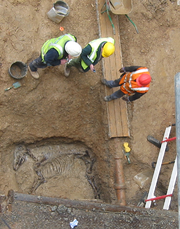
There are two basic types of modern archaeological excavation:- Research excavation - when time and resources are available to excavate the site fully and at a leisurely pace. These are now almost exclusively the preserve of academics or private societies who can muster enough volunteer labour and funds. The size of the excavation can also be decided by the director as it goes on.
- Development-led excavation - undertaken by professional archaeologists when the site is threatened by building development. Normally funded by the developer meaning that time is more of a factor as well as its being focused only on areas to be affected by building. The workforce is generally more skilled however and pre-development excavations also provide a comprehensive record of the areas investigated. Rescue archaeologyRescue archaeologyRescue archaeology, sometimes called "preventive" or "salvage" archaeology, is archaeological survey and excavation carried out in areas threatened by, or revealed by, construction or other development...
is sometimes thought of as a separate type of excavation but in practice tends to be a similar form of development-led practice. Various new forms of excavation terminology have appeared in recent years such as Strip map and sampleStrip map and sampleStrip map and sample is a method of archaeological excavation applied in the United Kingdom to preserve archaeological remains by record in the face of development threat...
some of which have been criticized within the profession as jargon created to cover up for falling standards of practice.
Trial excavations and evaluations in development led archaeology
There are two main types of trial excavation in professional archaeology both commonly associated with development-led excavation: the test pit or trench and the watching brief. The purpose of trial excavations is to determine the extent and characteristics of archaeological potential in a given area before extensive excavation work is under taken. This is usually conducted in development-led excavations as part of Project managementProject management
Project management is the discipline of planning, organizing, securing, and managing resources to achieve specific goals. A project is a temporary endeavor with a defined beginning and end , undertaken to meet unique goals and objectives, typically to bring about beneficial change or added value...
planning. the main difference between Trial trenching
Trial trenching
Trial trenching is a rapid and inexpensive method of archaeological evaluation used to estimate the archaeological potential of a site.Trenches are located at intervals across a site leaving the rest untouched. A mechanical excavator is used to dig down to archaeological features or natural...
and watching brief
Watching brief
In British archaeology a Watching Brief is a method of preserving archaeological remains by record in the face of development threat. An archaeologist is employed by the developer to monitor the excavation of foundation and service trenches, landscaping and any other intrusive work...
s is that trial trenches are actively dug for the purpose of revealing archaeological potential whereas watching brief
Watching brief
In British archaeology a Watching Brief is a method of preserving archaeological remains by record in the face of development threat. An archaeologist is employed by the developer to monitor the excavation of foundation and service trenches, landscaping and any other intrusive work...
s are cursory examination of trenches where the primary function of the trench is something other than archaeology, for example a trench cut for a gas pipe in a road. In the USA, a method of evaluation called a Shovel test pit
Shovel test pit
A shovel test pit is a standard method for Phase I of an Archaeological survey. It is usually a part of the CRM methodology and a popular form of rapid archaeological survey in the United States of America and Canada.It designates a series of A shovel test pit (STP) is a standard method for Phase...
is used which is a specified half meter square line of trial trenches dug by hand. Often, archaeology provides the only means to learn of the existence and behaviors of people of the past. Across the millennia many thousands of cultures and societies and billions of people have come and gone of which there is little or no written record or existing records are misrepresentative or incomplete. Writing as it is known today did not exist in human civilization until the 4th millennium BC, in a relatively small number of technologically advanced civilizations. In contrast, Homo sapiens has existed for at least 200,000 years, and other species of Homo for millions of years (see Human evolution). These civilizations are, not coincidentally, the best-known; they are open to the inquiry of historians for centuries, while the study of pre-historic cultures has arisen only recently. Even within a literate civilization many events and important human practices are not officially recorded. Any knowledge of the early years of human civilization – the development of agriculture, cult practices of folk religion, the rise of the first cities – must come from archaeology.
Ten Indus glyphs discovered near the northern gate of Dholavira (ca. 2500–1900 years old). Even where written records do exist, they are often incomplete and invariably biased to some extent. In many societies, literacy was restricted to the elite classes, such as the clergy or the bureaucracy of court or temple. The literacy even of aristocrats has sometimes been restricted to deeds and contracts. The interests and world-view of elites are often quite different from the lives and interests of the populace. Writings that were produced by people more representative of the general population were unlikely to find their way into libraries and be preserved there for posterity. Thus, written records tend to reflect the biases, assumptions, cultural values and possibly deceptions of a limited range of individuals, usually only a fraction of the larger population. Hence, written records cannot be trusted as a sole source. The material record is closer to a fair representation of society, though it is subject to its own inaccuracies, such as sampling bias and differential preservation.
In addition to their scientific importance, archaeological remains sometimes have political or cultural significance to descendants of the people who produced them, monetary value to collectors, or simply strong aesthetic appeal. Many people identify archaeology with the recovery of such aesthetic, religious, political, or economic treasures rather than with the reconstruction of past societies.
This view is often espoused in works of popular fiction, such as Raiders of the Lost Ark, The Mummy, and King Solomon's Mines. When such unrealistic subjects are treated more seriously, accusations of pseudoscience are invariably levelled at their proponents (see Pseudoarchaeology, below). However, these endeavours, real and fictional, are not representative of modern archaeology
Stratification
In archaeology, especially in the course of excavation, stratification is a paramount and base concept. It is largely based on the Law of SuperpositionLaw of superposition
The law of superposition is a key axiom based on observations of natural history that is a foundational principle of sedimentary stratigraphy and so of other geology dependent natural sciences:...
. When archaeological finds are below the surface of the ground (as is most commonly the case), the identification of the context of each find is vital to enable the archaeologist to draw conclusions about the site and the nature and date of its occupation. It is the archaeologist's role to attempt to discover what contexts exist and how they came to be created. Archaeological stratification or sequence is the dynamic superimposition of single units of stratigraphy or contexts. In archaeology, the context (physical location) of a discovery can be of major significance. More precisely, an archaeological context is an event in time which has been preserved in the archaeological record. The cutting of a pit or ditch in the past is a context, whilst the material filling it will be another. Multiple fills seen in section
Archaeological section
In archaeology a section is a view in part of the archaeological sequence showing it in the vertical plane, as a cross section, and thereby illustrating its profile and stratigraphy. This may make it easier to view and interpret as it developed over time....
would mean multiple contexts. Structural features, natural deposits and inhumations are also contexts. By separating a site into these basic, discrete units, archaeologists are able to create a chronology for activity on a site and describe and interpret it. Stratigraphic relationships
Relationship (archaeology)
An archaeological relationship is the position in space and by implication, in time, of an object or context with respect to another. This is determined, not by linear measurement but by determining the sequence of their deposition - which arrived before the other...
are the relationships created between contexts in time representing the chronological order they were created. An example would be a ditch and the back-fill of said ditch. The relationship of "the fill" context to the ditch "cut" context is "the fill" occurred later in the sequence, i.e., you have to dig a ditch first before you can back-fill it. A relationship that is later in the sequence is sometimes referred to as "higher" in the sequence and a relationship that is earlier "lower" though the term higher or lower does not itself imply a context needs to be physically higher or lower. It is more useful to think of this higher or lower term as it relates to the contexts position in a Harris matrix
Harris matrix
The Harris matrix is a tool used to depict the temporal succession of archaeological contexts and thus the sequence of deposition on a 'dry land' archaeological site. The matrix reflects the relative position and stratigraphic contacts of observable stratigraphic units, or contexts. The Matrix was...
, which is a two-dimensional representation of a site's formation in space and time.
Combining stratigraphic contexts for interpretation
Understanding a site in modern archaeology is a process of grouping single contexts together in ever larger groups by virtue of their relationships. The terminology of these larger clusters varies depending on practitioner but the terms interface, sub-group, group and land use are common. An example of a sub-group could be the three contexts that make up a burial; the grave cut, the body and the back-filled earth on top of the body. In turn sub-groups can be clustered together with other sub-groups by virtue of their stratigraphic relationship to form groups which in turn form "phasesArchaeological phase
Archaeological phase and phasing refers to the logical reduction of contexts recorded during excavation to near contemporary archaeological horizons that represent a distinct "phase" of previous land use. These often but not always will be a representation of a former land surface or occupation...
". A sub-group burial could cluster with other sub group burials to form a cemetery or burial group which in turn could be clustered with a building such as church to produce a "phase". A less rigorously defined combination of one or more contexts is sometimes called a feature
Feature (archaeology)
Feature in archaeology and especially excavation has several different but allied meanings. A feature is a collection of one or more contexts representing some human non-portable activity that generally has a vertical characteristic to it in relation to site stratigraphy. Examples of features are...
.
Phase and phasing
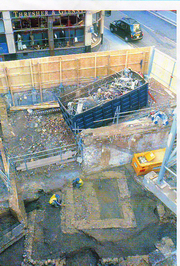
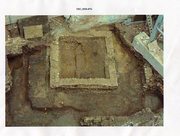
The production of phase interpretations is one of the first goals of stratigraphic interpretation and excavation. Digging "in phase" is not quite the same as phasing a site. Phasing a site represents reducing the site either in excavation or post-excavation
Post excavation
In archaeology once the archaeological record of given site has been excavated, or collected from surface surveys, it is necessary to gain as much data as possible and organize it into a coherent body of information. This process is known as post-excavation analysis, and is normally the most...
to contemporaneous horizons where as "digging in phase" is the process of stratigraphic removal of archaeological remains so as not to remove contexts that are earlier in time "lower in the sequence" before other contexts that have a latter physical stratigraphic relationship to them as defined by the law of superposition
Law of superposition
The law of superposition is a key axiom based on observations of natural history that is a foundational principle of sedimentary stratigraphy and so of other geology dependent natural sciences:...
. The process of interpretation in practice will have a bearing on excavation strategies on site so "phasing" a site is actively pursued during excavation where at all possible, and is considered good practice.
Introduction
Excavation initially involves the removal of any topsoil overburden by machine. This material may be examined by metal detectorMetal detector
A metal detector is a device which responds to metal that may not be readily apparent.The simplest form of a metal detector consists of an oscillator producing an alternating current that passes through a coil producing an alternating magnetic field...
for stray finds
Small finds
Small finds is an archaeological term for artifacts discovered on excavations which are somewhat special compared with the common finds for that type site or type phase on multi phasic sites. The special nature of the find is dictated by research agendas and the information the artifact can provide...
but unless the site has remained untouched since its abandonment there is invariably a layer of modern material on the surface of limited archaeological interest. In rural areas, any features are often visible beneath the surface as opposed to urban areas where there may be thick layers of human deposits and only the uppermost contexts will be initially visible and definable through isolation from other contexts. A strategy for sampling the contexts and features is formulated which may involve total excavation of each feature or only portions. It is preferred goal of excavation to remove all archaeological deposits and features in the reverse order they were created and construct a Harris matrix as a chronological record or "sequence" of the site. This Harris matrix is used for interpretation and combining contexts into ever larger units of understanding. This stratigraphic removal of the site is crucial for understanding the chronology of events on site. It is perhaps easier to think of this as "archaeological deposits should leave the site in the reverse order they arrived". A grid is usually set up, dividing the site into 5 m squares to better aid the positioning of the features and contexts on the overall site plan. This grid is usually tied into a national geomatic
Geomatics
Geomatics is the discipline of gathering, storing, processing, and delivering geographic information, or spatially referenced information.-Overview and etymology:...
database such as the Ordnance Survey
Ordnance Survey
Ordnance Survey , an executive agency and non-ministerial government department of the Government of the United Kingdom, is the national mapping agency for Great Britain, producing maps of Great Britain , and one of the world's largest producers of maps.The name reflects its creation together with...
in the UK. In urban archaeology
Urban archaeology
Urban archaeology is a sub discipline of archaeology specialising in the material past of towns and cities where long-term human habitation has often left a rich record of the past....
this grid becomes invaluable for implementing single context recording
Single context recording
Single context recording was initially developed by Ed Harris and Patrick Ottaway in 1976, from a suggestion by Lawrence Keene. It was further developed by the Department of Urban Archaeology from where it was then exported, in the mid 1980s by Pete Clarke to the Scottish Urban Archaeological...
.
The single context recording system
Single context recordingSingle context recording
Single context recording was initially developed by Ed Harris and Patrick Ottaway in 1976, from a suggestion by Lawrence Keene. It was further developed by the Department of Urban Archaeology from where it was then exported, in the mid 1980s by Pete Clarke to the Scottish Urban Archaeological...
was developed in the 1970s by the museum of London
Museum of London
The Museum of London documents the history of London from the Prehistoric to the present day. The museum is located close to the Barbican Centre, as part of the striking Barbican complex of buildings created in the 1960s and 70s as an innovative approach to re-development within a bomb damaged...
(as well as earlier in Winchester and York) and has become the de facto recording system in many parts of the world and is especially suited to the complexities of deep urban archaeology
Urban archaeology
Urban archaeology is a sub discipline of archaeology specialising in the material past of towns and cities where long-term human habitation has often left a rich record of the past....
and the process of Stratification.
Each excavated context is given a unique "context number" and is recorded by type on a context sheet and perhaps being drawn on a plan
Archaeological plan
An archaeological plan in an archaeological excavation, is a drawn record of features in the horizontal plane.- Overview :Archaeological plan can either take the form of...
and/or a section
Archaeological section
In archaeology a section is a view in part of the archaeological sequence showing it in the vertical plane, as a cross section, and thereby illustrating its profile and stratigraphy. This may make it easier to view and interpret as it developed over time....
. Depending on time constraints and importance contexts may also be photographed, but in this case a grouping of contexts and their associations are the purpose of the photography. Finds
Small finds
Small finds is an archaeological term for artifacts discovered on excavations which are somewhat special compared with the common finds for that type site or type phase on multi phasic sites. The special nature of the find is dictated by research agendas and the information the artifact can provide...
from each context are bagged and labeled with their context number and site code for later cross reference work carried out post-excavation. The height above sea level of pertinent points on a context, such as the top and bottom of a wall are taken and added to plans sections and context sheets. Heights are recorded with a dumpy level
Dumpy level
A dumpy level, builder's auto level, leveling instrument, or automatic level is an optical instrument used to establish or check points in the same horizontal plane...
or total station by relation to the site temporary benchmark
Benchmark (surveying)
The term bench mark, or benchmark, originates from the chiseled horizontal marks that surveyors made in stone structures, into which an angle-iron could be placed to form a "bench" for a leveling rod, thus ensuring that a leveling rod could be accurately repositioned in the same place in the future...
(abbr. T.B.M). Samples of deposits from contexts are sometimes also taken, for later environmental analysis or for scientific dating.
Stratigraphic excavation in practice
Best practice
A best practice is a method or technique that has consistently shown results superior to those achieved with other means, and that is used as a benchmark...
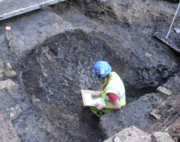
of stratigraphic excavation in its basic sense involves a cyclical process of cleaning or "troweling back" the surface of the site and isolating contexts and edges which are definable in their entirety or part as either
- Discrete discernible "edges" that form an enclosed area completely visible in plan and therefore stratigraphically later than the surrounding surface or
- Discrete, discernible "edges" that are formed by being completely separated from the surrounding surface as in 1 and have boundaries dictated by the limit of excavation.
Following this preliminary process of defining the context, the context is then assessed in relation to the wider understanding of the site, for considerations of reduction of the site in phases, and then removed and recorded by various methods.
Often, owing to practical considerations or error, the process of defining the edges of contexts is not followed and contexts are removed out of sequence and un-stratigraphically. This is called "digging out of phase". It is not good practice.
After removing a context or if practical a set of contexts such as the case would be for features, the "isolate and dig" procedure is repeated until no man made remains are left on site and the site is reduced to natural
Archaeological natural
Natural in archaeology is a term to denote a horizon in the stratigraphic record representing the point before which there is no anthropogenic activity on site and the archaeological record ends. Natural is often the underlying geological makeup of the site and is formed by geological processes...
.
Physical methodology of excavation
The process of excavation is achieved in many ways depending on the nature of the deposits to be removed and time constraints. In the main, deposits are lifted by TrowelTrowel
A trowel is one of several similar hand tools used for digging, smoothing, or otherwise moving around small amounts of viscous or particulate material.-Hand tools:...
and Mattock
Mattock
A mattock is a versatile hand tool, used for digging and chopping, similar to the pickaxe. It has a long handle, and a stout head, which combines an axe blade and an adze or a pick and an adze .-Description:...
and shovelled or carried from the site by wheel barrow and bucket. The use of many other tools including fine trowels such as the plaster's leaf trowel and brushes of various grades are used on delicate items such as human bone and decayed timber. When removing material from the archaeological record some basic guidelines are often observed.
- Work from the known to the unknown. This means that, if one is unsure of the stratigraphic boundaries of the material in question, the removal of material should start from an area where the sequence is better understood rather than less.
- Work from the top to the bottom. As well as working from the known to the unknown, also as far as possible, remove material at the physically highest level in the context and work towards the lowest. This is best practice because loose spoil will not then fall onto and contaminate the surface being worked on. In this way blurring detail that might have been instructive to the excavator is avoided.
- In archaeology, we use our eyes. Excavation of contexts correctly often relies on detailed observations of minute differences.
- If in doubt, bash it out. This rather cavalier-sounding maxim is a concise way of expressing the need to progress. There is always more to be done on a site, than there is time in which to do it. At times the next feature or context to be removed in the sequence is not clear even to an experienced archaeologist. When it is not possible to proceed in an ideal manner, the excavation must be continued in a more arbitrary way, with temporary sections, until discernible stratigraphy is again encountered. An area of the site is reduced leaving arbitrary, temporary sections as a form of stratigraphic control to provide early warning of "digging out of phase". If the arbitrary area for excavation is wisely chosen, the sequence should be revealed and excavation can return to a truly stratigraphic method. It is important to realize that "bash it out" is not a totally random act but a best guess based on logical deductions, observation and experience.
Common errors in excavation
Common errors during excavation fall into two basic categories and one or the other is almost inevitable because excavation is a destructive process that removes the information it seeks to record in real time and mistakes cannot be rectified easily.- Under-cutting. Under cutting occurs where contexts are not excavated fully and some remainder of the context is left in situ masking the nature of the underlying contexts. This is especially common among inexperienced archaeologists who have a tendency to be timid. The consequences of undercutting are quite serious as the nature of the archaeological sequence is obscured and subsequent recording and excavation is based on a flawed reading of the deposits on site. Unchecked, what follows from under-cutting is the production of false data often from the failure to spot intrusive finds and in turn, serious ramifications for the ability to interpret the sequence post-excavation. Entire sites can be "thrown out of phase" where relationships recorded in the Harris matrix bear no genuine association with any understandable phase of occupation. If a regime of under-cutting is allowed to progress its effects multiply as the site is reduced.
- Over-cutting. Over-cutting occurs when contexts are unintentionally removed along with material from other deposits and contexts. Heavy over-cutting represents reckless removal of the sequence. However some degree of over-cutting is almost impossible to avoid and is certainly preferable to unchecked under-cutting even though over-cutting represents a loss of information.
Over-cutting represents the loss of information whereas undercutting represents false information. One role of an archaeologist is to avoid false information and minimize the loss of information.
Finds and artifact retrieval
Finds and artefacts that survive in the archaeological record are retrieved in the main by hand and observation as the context they survive in is excavated. Several other techniques are available depending on suitability and time constraints. Sieving and flotation is used to maximize the recovery of small items such as small shards of pottery or flint flakes. The use of sieving is more common on research based excavations where more time is available. Some success has been achieved with the use of cement mixers and bulk sieving. This method allows the quick removal of context by shovel and mattock yet allows for a high retrieval rate. Spoil is shovelled into cement mixers and water added to form a slurry which is then poured through a large screen mesh. Flotation is a process of retrieval that works by passing spoil onto the surface of water and separating finds that float from the spoil which sinks, this is especially suited to the recovery of environmental data such as seeds and small bones. Not all finds retrieval is done during excavation and some especially flotation may take place post-excavation from samples taken during excavation.One important role of finds retrieval during excavation is the role of specialists to provide spot dating information on the contexts being removed from the archaeological record. This can provide advance warning of potential discoveries to come by virtue of residual finds redeposited in contexts higher in the sequence
Sequence (archaeological)
The archaeological sequence or sequence for short, on a specific archaeological site can be defined on two levels of rigour.# Normally it is adequate to equate it to archaeological record. However, the two terms are not exactly interchangeable...
(which should be coming offsite earlier than contexts from early eras and phases). Spot dating also forms part of a confirmation process, of assessing the validity of the working hypothesis on the phasing of site during excavation. For example the presence of an anomalous medieval pottery sherd
Sherd
In archaeology, a sherd is commonly a historic or prehistoric fragment of pottery, although the term is occasionally used to refer to fragments of stone and glass vessels as well....
in what was thought to be an Iron Age ditch feature could radically alter onsite thinking on the correct strategy for digging a site and save a lot of information being lost due to incorrect assumptions about the nature of the deposits which will be destroyed by the excavation process and in turn, limit the sites potential for revealing information for post-excavation specialists. Or anomalous information could show up errors in excavation such as "undercutting". Dating methodology
Dating methodology (archaeology)
Dating material drawn from the archaeological record can be made by a direct study of an artifact or may be deduced by association with materials found in the context the item is drawn from or inferred by its point of discovery in the sequence relative to datable contexts...
in part relies on accurate excavation and in this sense the two activities become interdependent.
Mechanical diggers
There is an increasing use of machine diggers especially in developer-led excavation due to time pressures. This is an area of controversy as their use inevitably results in less discrimination in how the archaeological sequence on a site is recorded. Machines are used primarily to remove modern overburden and for the control of spoilSpoil (archaeology)
In Archaeology, spoil is the term used for the soil, dirt and rubble that results from an excavation, and discarded off site on spoil heaps. These heaps are commonly accessed by barrow runs.-Spoil management:...
. In British archaeology mechanical diggers are sometimes nicknamed "the big yellow trowel".
Organisation of workforce
A group of archaeological excavators will generally work for a supervisor who reports to the site director or project manager. He or she will have ultimate responsibility for interpreting the site and writing the final report. Most excavations are eventually published in professional journals although this process can take years. This process takes place post-excavation and evolves a myriad of other specialists.See also
- Archaeological associationArchaeological associationAssociation in archaeology has more than one meaning and is confusing to the layman. Archaeology has been critiqued as a soft science with a somewhat poor standardization of terms.-Finds and objects:...
- Archaeological contextArchaeological contextIn archaeology, not only the context of a discovery is a significant fact, but the formation of the context is as well. An archaeological context is an event in time which has been preserved in the archaeological record. The cutting of a pit or ditch in the past is a context, whilst the material...
- Archaeological ethicsArchaeological ethicsArchaeological ethics refers to a number of moral issues raised through the study of the material past.In common with other academic disciplines, archaeologists are bound to conduct their investigations to a high standard and observe intellectual property laws, Health and Safety regulations and...
- Archaeological field surveyArchaeological field surveyArchaeological field survey is the method by which archaeologists search for archaeological sites and collect information about the location, distribution and organization of past human cultures across a large area...
- Archaeological planArchaeological planAn archaeological plan in an archaeological excavation, is a drawn record of features in the horizontal plane.- Overview :Archaeological plan can either take the form of...
- Archaeological sectionArchaeological sectionIn archaeology a section is a view in part of the archaeological sequence showing it in the vertical plane, as a cross section, and thereby illustrating its profile and stratigraphy. This may make it easier to view and interpret as it developed over time....
- Cut (archaeology)Cut (archaeology)In Archaeology and archeological stratification a cut or truncation is a context that represents a moment in time when other archaeological deposits were removed for the creation of some feature such as a ditch or pit...
- Feature (archaeology)Feature (archaeology)Feature in archaeology and especially excavation has several different but allied meanings. A feature is a collection of one or more contexts representing some human non-portable activity that generally has a vertical characteristic to it in relation to site stratigraphy. Examples of features are...
- Forensic archaeologyForensic archaeologyForensic archaeology, a forensic science, is the application of archaeological principles, techniques and methodologies in a legal context .-Overview:...
- Harris matrixHarris matrixThe Harris matrix is a tool used to depict the temporal succession of archaeological contexts and thus the sequence of deposition on a 'dry land' archaeological site. The matrix reflects the relative position and stratigraphic contacts of observable stratigraphic units, or contexts. The Matrix was...
- List of archaeological sites sorted by country
- Relationship (archaeology)Relationship (archaeology)An archaeological relationship is the position in space and by implication, in time, of an object or context with respect to another. This is determined, not by linear measurement but by determining the sequence of their deposition - which arrived before the other...
- Single context recordingSingle context recordingSingle context recording was initially developed by Ed Harris and Patrick Ottaway in 1976, from a suggestion by Lawrence Keene. It was further developed by the Department of Urban Archaeology from where it was then exported, in the mid 1980s by Pete Clarke to the Scottish Urban Archaeological...
- Spit (archaeology)Spit (archaeology)In the field of archaeology, a spit is a unit of archaeological excavation with an arbitrarily assigned measurement of depth and extent. It is a method of excavation employed without regard to the archaeological stratigraphy that may be identifiable at the archaeological site under investigation...
External links
- Adrian Chadwick - Archaeology at the Edge of Chaos: Further Towards Reflexive Excavation Methodologies
- NIOSH Safety and Health Topic: Trenching and Excavation.