

Erysiphales

Encyclopedia
Erysiphales are an order
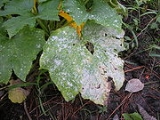
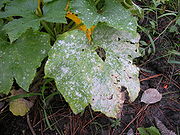
of ascomycete fungi. The order contains one family, Erysiphaceae. Many of them cause plant diseases called powdery mildew
.
(Erysiphaceae), 28 genera
and approximately 100 species. Many imperfect fungi (fungi whose sexual reproduction is unknown) belong here, especially the genus Oidium
.
Recent molecular data have revealed the existence of six main evolutionary lineages. Clade
1 consists of Erysiphe
, Microsphaera
, and Uncinula
, all of which have an Oidium subgenus Pseudoidium mitosporic state. Clade 2 consists of Erysiphe galeopsidis and Erysiphe cumminsiana (anamorphs in Oidium subgenus Striatoidium). Clade 3 consists of Erysiphe species with anamorphs in Oidium subgenus Reticuloidium. Clade 4 consists of Leveillula and Phyllactinia, which have Oidiopsis and Ovulariopsis mitosporic states, respectively. Clade 5 consists of Sphaerotheca
, Podosphaera, and Cystotheca, which have Oidium subgenera Fibroidium and Setoidium mitosporic states. Clade 6 consists of Blumeria graminis
, which has an Oidium subgenus Oidium mitosporic state. Several morphological characters have been analysed and found not to conflict with the molecular data.
The cleistothecia ( chasmothecia ) are minute, usually not much more than 0.1 mm in diameter. From the outer wall of the cleistothecium specialised hyphae (appendages) grow out. The number of asci per ascoma varies, and is important in discriminating between genera.
cells are attacked. The external mycelium gives rise to short, erect conidiophores, each of which bearing a single row of barrel-shaped spores, the youngest being at the base (the affected parts become thus covered with a forest of conidiophores assuming a white powdery appearance). The ripe spores become detached and are readily dispersed by the wind, causing fresh infection. In autumn the sexual chasmothecia are produced. The chasmothecia represent the resting (hibernating) stage of the pathogen. The ascospores remain dormant all winter to germinate in spring. When the asci expand they rupture the chasmothecia wall, throwing the ascospores into the air.
s on leaves and fruits of higher plants, causing diseases called powdery mildew
s. Most attempts to grow them in culture
have failed.
Order (biology)
In scientific classification used in biology, the order is# a taxonomic rank used in the classification of organisms. Other well-known ranks are life, domain, kingdom, phylum, class, family, genus, and species, with order fitting in between class and family...
of ascomycete fungi. The order contains one family, Erysiphaceae. Many of them cause plant diseases called powdery mildew
Powdery mildew
Powdery mildew is a fungal disease that affects a wide range of plants. Powdery mildew diseases are caused by many different species of fungi in the order Erysiphales. It is one of the easier diseases to spot, as its symptoms are quite distinctive. Infected plants display white powdery spots on the...
.
Systematics
The order contains one familyFamily (biology)
In biological classification, family is* a taxonomic rank. Other well-known ranks are life, domain, kingdom, phylum, class, order, genus, and species, with family fitting between order and genus. As for the other well-known ranks, there is the option of an immediately lower rank, indicated by the...
(Erysiphaceae), 28 genera
Genera
Genera is a commercial operating system and development environment for Lisp machines developed by Symbolics. It is essentially a fork of an earlier operating system originating on the MIT AI Lab's Lisp machines which Symbolics had used in common with LMI and Texas Instruments...
and approximately 100 species. Many imperfect fungi (fungi whose sexual reproduction is unknown) belong here, especially the genus Oidium
Oidium (genus)
Oidium is a genus of Deuteromycetes, where traditionally most anamorphs of the order Erysiphales are included. Most of them are plant pathogens causing different forms of powdery mildew, for example:*Oidium alphitoides Oidium is a genus of Deuteromycetes, where traditionally most anamorphs of the...
.
Recent molecular data have revealed the existence of six main evolutionary lineages. Clade
Clade
A clade is a group consisting of a species and all its descendants. In the terms of biological systematics, a clade is a single "branch" on the "tree of life". The idea that such a "natural group" of organisms should be grouped together and given a taxonomic name is central to biological...
1 consists of Erysiphe
Erysiphe
Erysiphe is a genus of fungi in the Erysiphaceae family. Many of the species in this genus are plant pathogens which cause powdery mildew....
, Microsphaera
Microsphaera
Microsphaera is a genus of fungi in the family Erysiphaceae.-External links:*...
, and Uncinula
Uncinula
Uncinula is a genus of fungi. Its species are plant pathogens that cause powdery mildew diseases on various plant hosts. The genus is characterized by its dark chasmothecia which bear filamentous, hyaline appendages with hooked tips. Over one hundred species have been described from mostly...
, all of which have an Oidium subgenus Pseudoidium mitosporic state. Clade 2 consists of Erysiphe galeopsidis and Erysiphe cumminsiana (anamorphs in Oidium subgenus Striatoidium). Clade 3 consists of Erysiphe species with anamorphs in Oidium subgenus Reticuloidium. Clade 4 consists of Leveillula and Phyllactinia, which have Oidiopsis and Ovulariopsis mitosporic states, respectively. Clade 5 consists of Sphaerotheca
Sphaerotheca (fungi)
Sphaerotheca is a genus of ascomycete fungi that currently includes two plant pathogen species, Sphaerotheca epilobii and Sphaerotheca castagnei, that cause forms of Powdery mildew. The original type species, Sphaerotheca pannosa, now belongs to the genus Podosphaera....
, Podosphaera, and Cystotheca, which have Oidium subgenera Fibroidium and Setoidium mitosporic states. Clade 6 consists of Blumeria graminis
Blumeria graminis
Blumeria graminis is a fungus that causes powdery mildew on grasses, including cereals . It is the only species in the genus Blumeria. It has also been called Erysiphe graminis and Oidium monilioides or Oidium tritici.-Systematics:Previously B...
, which has an Oidium subgenus Oidium mitosporic state. Several morphological characters have been analysed and found not to conflict with the molecular data.
Characteristics
- Erysiphales have superficial myceliumMyceliumthumb|right|Fungal myceliaMycelium is the vegetative part of a fungus, consisting of a mass of branching, thread-like hyphae. The mass of hyphae is sometimes called shiro, especially within the fairy ring fungi. Fungal colonies composed of mycelia are found in soil and on or within many other...
which extracts nourishment from the host plant through specialized hyphae that penetrate the epidermalEpidermis (botany)The epidermis is a single-layered group of cells that covers plants' leaves, flowers, roots and stems. It forms a boundary between the plant and the external environment. The epidermis serves several functions, it protects against water loss, regulates gas exchange, secretes metabolic compounds,...
cells of the host by means of absorbing organs called haustoriaHaustoriumIn botany, a haustorium is the appendage or portion of a parasitic fungus or of the root of a parasitic plant that penetrates the host's tissue and draws nutrients from it. Haustoria do not penetrate the host's cell membranes.Fungi in all major divisions form haustoria...
.
- The teleomorphs are usually more distinctive and diverse than the anamorphs. Whether the asciAscusAn ascus is the sexual spore-bearing cell produced in ascomycete fungi. On average, asci normally contain eight ascospores, produced by a meiotic cell division followed, in most species, by a mitotic cell division. However, asci in some genera or species can number one , two, four, or multiples...
are bitunicate or unitunicate (i.e. consisting of one or two layers), is as yet a matter of discussion.
- The cleistothecia have the asci arranged in a hymenialHymeniumThe hymenium is the tissue layer on the hymenophore of a fungal fruiting body where the cells develop into basidia or asci, which produce spores. In some species all of the cells of the hymenium develop into basidia or asci, while in others some cells develop into sterile cells called cystidia or...
layer, resembling perithecia.
The cleistothecia ( chasmothecia ) are minute, usually not much more than 0.1 mm in diameter. From the outer wall of the cleistothecium specialised hyphae (appendages) grow out. The number of asci per ascoma varies, and is important in discriminating between genera.
- Erysiphales are notable for intricateappendageAppendageIn invertebrate biology, an appendage is an external body part, or natural prolongation, that protrudes from an organism's body . It is a general term that covers any of the homologous body parts that may extend from a body segment...
s which follow fractalFractalA fractal has been defined as "a rough or fragmented geometric shape that can be split into parts, each of which is a reduced-size copy of the whole," a property called self-similarity...
geometry within Fibonacci numberFibonacci numberIn mathematics, the Fibonacci numbers are the numbers in the following integer sequence:0,\;1,\;1,\;2,\;3,\;5,\;8,\;13,\;21,\;34,\;55,\;89,\;144,\; \ldots\; ....
s and can be useful for species identification.
Life cycle
The infection of the host plant begins with the sexual ascospores, or the asexual conidia germinating on the surface of the plants leaf or stem, resulting in septate mycelium of uninucleate cells. In most powdery mildews only the epidermalEpidermis (botany)
The epidermis is a single-layered group of cells that covers plants' leaves, flowers, roots and stems. It forms a boundary between the plant and the external environment. The epidermis serves several functions, it protects against water loss, regulates gas exchange, secretes metabolic compounds,...
cells are attacked. The external mycelium gives rise to short, erect conidiophores, each of which bearing a single row of barrel-shaped spores, the youngest being at the base (the affected parts become thus covered with a forest of conidiophores assuming a white powdery appearance). The ripe spores become detached and are readily dispersed by the wind, causing fresh infection. In autumn the sexual chasmothecia are produced. The chasmothecia represent the resting (hibernating) stage of the pathogen. The ascospores remain dormant all winter to germinate in spring. When the asci expand they rupture the chasmothecia wall, throwing the ascospores into the air.
Ecology
Erysiphales are obligate parasiteObligate parasite
An obligate parasite is a parasitic organism that cannot complete its life cycle without dependence on its host.-See also:*Obligate intracellular parasite*Parasitism*Parasitic plant*Facultative parasite...
s on leaves and fruits of higher plants, causing diseases called powdery mildew
Powdery mildew
Powdery mildew is a fungal disease that affects a wide range of plants. Powdery mildew diseases are caused by many different species of fungi in the order Erysiphales. It is one of the easier diseases to spot, as its symptoms are quite distinctive. Infected plants display white powdery spots on the...
s. Most attempts to grow them in culture
Microbiological culture
A microbiological culture, or microbial culture, is a method of multiplying microbial organisms by letting them reproduce in predetermined culture media under controlled laboratory conditions. Microbial cultures are used to determine the type of organism, its abundance in the sample being tested,...
have failed.