
All Topics  
Elasmobranchii

 
Elasmobranchii

   Email Print
   Bookmark   Link


Elasmobranchii


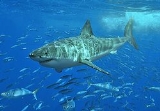
Elasmobranchii is the subclass of cartilaginous fish that includes skate
Skate

Skates are Chondrichthyes belonging to the family Rajidae in the superorder Batoidea of rays. There are more than 200 described species in 25 genera....
s, rays (batoidea)
Batoidea

Batoidea is a superorder of Chondrichthyes containing more than 500 described species in thirteen families. They are commonly known as rays, but that term is also used specifically for batoids in the order Rajiformes, the "true rays"....
, and sharks (selachii)
Shark

Sharks are a type of fish with a full Cartilage skeleton and a highly Streamlines, streaklines and pathlinesd body. They respire with the use of five to seven gill slits....
.

Evolution
Fossilised shark teeth are known from the early Devonian
Devonian

The Devonian is a geologic period of the Paleozoic era spanning from . It is named after Devon, England, where rocks from this period were first studied....
, around 400 million years ago. During the following Carboniferous
Carboniferous

The Carboniferous is a geologic period that extends from the end of the Devonian period, about 359.2 ? 2.5 annum , to the beginning of the Permian period, about 299.0 ? 0.8 Ma ...
 period, the sharks underwent a period of diversification, with many new forms evolving. Many of these became extinct during the Permian
Permian

The PermianThe term "Permian" was introduced into geology in 1841 by Sir Roderick Murchison, president of the Geological Society of London, who identified typical strata in extensive Russian explorations undertaken with Edouard de Verneuil; Murchison asserted in 1841 that he named his "Permian system" after the ancient kingdom...
, but the remaining sharks underwent a second burst of adaptive radiation during the Jurassic
Jurassic

The Jurassic is a geologic period that extends from about annum to  Ma, that is, from the end of the Triassic to the beginning of the Cretaceous....
, around which time the skates and rays first appeared.


Discussion
Ask a question about 'Elasmobranchii'
Start a new discussion about 'Elasmobranchii'
Answer questions from other users
Full Discussion Forum


Encyclopedia


Elasmobranchii is the subclass of cartilaginous fish that includes skate
Skate

Skates are Chondrichthyes belonging to the family Rajidae in the superorder Batoidea of rays. There are more than 200 described species in 25 genera....
s, rays (batoidea)
Batoidea

Batoidea is a superorder of Chondrichthyes containing more than 500 described species in thirteen families. They are commonly known as rays, but that term is also used specifically for batoids in the order Rajiformes, the "true rays"....
, and sharks (selachii)
Shark

Sharks are a type of fish with a full Cartilage skeleton and a highly Streamlines, streaklines and pathlinesd body. They respire with the use of five to seven gill slits....
.

Evolution


Fossilised shark teeth are known from the early Devonian
Devonian

The Devonian is a geologic period of the Paleozoic era spanning from . It is named after Devon, England, where rocks from this period were first studied....
, around 400 million years ago. During the following Carboniferous
Carboniferous

The Carboniferous is a geologic period that extends from the end of the Devonian period, about 359.2 ? 2.5 annum , to the beginning of the Permian period, about 299.0 ? 0.8 Ma ...
 period, the sharks underwent a period of diversification, with many new forms evolving. Many of these became extinct during the Permian
Permian

The PermianThe term "Permian" was introduced into geology in 1841 by Sir Roderick Murchison, president of the Geological Society of London, who identified typical strata in extensive Russian explorations undertaken with Edouard de Verneuil; Murchison asserted in 1841 that he named his "Permian system" after the ancient kingdom...
, but the remaining sharks underwent a second burst of adaptive radiation during the Jurassic
Jurassic

The Jurassic is a geologic period that extends from about annum to  Ma, that is, from the end of the Triassic to the beginning of the Cretaceous....
, around which time the skates and rays first appeared. Many surviving orders of elasmobranch date back to the Cretaceous
Cretaceous

The Cretaceous , usually abbreviated K for its German translation Kreide, is a geologic period from circa to million years ago . In the geologic timescale, the Cretaceous follows on the Jurassic period and is followed by the Paleogene period....
, or earlier.

Description


Elasmobranchii is one of the two subclasses of cartilaginous fishes in the class Chondrichthyes
Chondrichthyes

Chondrichthyes or cartilaginous fishes are jawed fish with paired Fins, paired nares, scales, two-chambered hearts, and skeletons made of cartilage rather than bone....
, the other being Holocephali
Holocephali

The subclass Holocephali is a taxon of cartilaginous fishes, of which the order Chimaeriformes is the only surviving group.Holocephali has an extensive fossil record that starts during the Devonian period....
 (chimaera
Chimaera

Chimaeras are Chondrichthyes in the order Chimaeriformes. They are related to the sharks and batoidea, and are sometimes called ghost sharks, ratfish , or rabbitfishes....
s). For features that distinguish Elasmobranchii from Holocephali, see those articles. This classification includes great white sharks and the extinct megalodon
Megalodon

The 'megalodon' , Carcharodon megalodon or Carcharocles megalodon , was a giant shark that lived in prehistoric times. The oldest remains of this species found are about 18 million years old and C....
.

Members of the elasmobranchii subclass have no swim bladders, five to seven pairs of gill
Gill

A gill is an anatomical structure found in many aquatic ecosystem organisms. It is a respiration organ whose function is the extraction of oxygen from water and the excretion of carbon dioxide....
 clefts opening individually to the exterior, rigid dorsal fins, and small placid scales. The teeth are in several series; the upper jaw is not fused to the cranium, and the lower jaw is articulated with the upper. The eyes have a tapetum lucidum
Tapetum lucidum

The tapetum lucidum is a layer of tissue in the eye of many vertebrate animals, that lies immediately behind or sometimes within the retina. It Reflection visible light back through the retina, increasing the light available to the Photoreceptor cell....
. The inner margin of each pelvic fin in the male fish is grooved to constitute a clasper for the transmission of sperm
Sperm

The term sperm is derived from the Greek word sperma and refers to the male reproductive Cell . In the types of sexual reproduction known as anisogamy and oogamy, there is a marked difference in the size of the gametes with the smaller one being termed the "male" or sperm cell....
. These fishes are widely distributed in tropical and temperate
Temperate

In geography, temperate or tepid latitudes of the globe lie between the tropics and the polar circles. The changes in these regions between summer and winter are generally mild, rather than extreme hot or cold....
 waters.