
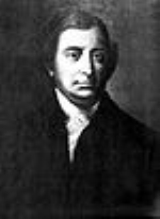
Edmund Jennings Randolph (August 10, 1753 September 12, 1813) was an
AmericanThe United States of America is a federal constitutional republic comprising fifty states and a federal district...
attorneyA lawyer, according to Black's Law Dictionary, is "a person learned in the law; as an attorney, counsel or solicitor; a person who is practicing law." Law is the system of rules of conduct established by the sovereign government of a society to correct wrongs, maintain the stability of political...
, the
seventh Governor of VirginiaThe governor of Virginia serves as the chief executive of the Commonwealth of Virginia for a four-year term. The position is currently held by Republican Bob McDonnell, who was inaugurated on January 16, 2010, as the 71st governor of Virginia....
, the second
Secretary of StateThe United States Secretary of State is the head of the United States Department of State, concerned with foreign affairs. The Secretary is a member of the Cabinet and the highest-ranking cabinet secretary both in line of succession and order of precedence...
, and the first
United States Attorney GeneralThe United States Attorney General is the head of the United States Department of Justice concerned with legal affairs and is the chief law enforcement officer of the United States government. The attorney general is considered to be the chief lawyer of the U.S. government...
.
Biography
Randolph was born on August 10, 1753 to the influential Randolph family in
Williamsburg, VirginiaWilliamsburg is an independent city located on the Virginia Peninsula in the Hampton Roads metropolitan area of Virginia, USA. As of the 2010 Census, the city had an estimated population of 14,068. It is bordered by James City County and York County, and is an independent city...
. He was educated at the
College of William and MaryThe College of William & Mary in Virginia is a public research university located in Williamsburg, Virginia, United States...
. After graduation he began
reading lawReading law is the method by which persons in common law countries, particularly the United States, entered the legal profession before the advent of law schools. This usage specifically refers to a means of entering the profession . A small number of U.S...
with his father John Randolph and uncle,
Peyton RandolphPeyton Randolph was a planter and public official from the Colony of Virginia. He served as speaker of the Virginia House of Burgesses, chairman of the Virginia Conventions, and the first President of the Continental Congress.-Early life:Randolph was born in Tazewell Hall, Williamsburg, Virginia...
. In 1775, with the start of the
American RevolutionThe American Revolution was the political upheaval during the last half of the 18th century in which thirteen colonies in North America joined together to break free from the British Empire, combining to become the United States of America...
, Randolph's father remained a
LoyalistLoyalists were American colonists who remained loyal to the Kingdom of Great Britain during the American Revolutionary War. At the time they were often called Tories, Royalists, or King's Men. They were opposed by the Patriots, those who supported the revolution...
and returned to
BritainThe United Kingdom of Great Britain and Northern IrelandIn the United Kingdom and Dependencies, other languages have been officially recognised as legitimate autochthonous languages under the European Charter for Regional or Minority Languages...
; Edmund Randolph remained in America where he joined the
Continental ArmyThe Continental Army was formed after the outbreak of the American Revolutionary War by the colonies that became the United States of America. Established by a resolution of the Continental Congress on June 14, 1775, it was created to coordinate the military efforts of the Thirteen Colonies in...
as
aide-de-campAn aide-de-camp is a personal assistant, secretary, or adjutant to a person of high rank, usually a senior military officer or a head of state...
to General
George WashingtonGeorge Washington was the dominant military and political leader of the new United States of America from 1775 to 1799. He led the American victory over Great Britain in the American Revolutionary War as commander-in-chief of the Continental Army from 1775 to 1783, and presided over the writing of...
.
Upon the death of his uncle
Peyton RandolphPeyton Randolph was a planter and public official from the Colony of Virginia. He served as speaker of the Virginia House of Burgesses, chairman of the Virginia Conventions, and the first President of the Continental Congress.-Early life:Randolph was born in Tazewell Hall, Williamsburg, Virginia...
in October of 1775 Randolph returned to
VirginiaThe Commonwealth of Virginia , is a U.S. state on the Atlantic Coast of the Southern United States. Virginia is nicknamed the "Old Dominion" and sometimes the "Mother of Presidents" after the eight U.S. presidents born there...
to act as executor of the estate, and while there was elected as a representative to the Virginia Convention. He would go on to serve as mayor of Williamsburg, and then as the first Attorney General of the United States under the newly-formed government. He was married on August 29, 1776 to Elizabeth Nicholas (daughter of
Robert C. NicholasRobert Carter Nicholas was the son of Dr. George Nicholas and Elizabeth Carter Burwell Nicholas of Williamsburg, Virginia. His father migrated to Virginia; his mother was the daughter of wealthy Virginia landowner, Robert "King" Carter of Corotoman. Born January 28, 1728/9, both parents were dead...
), and had a total of six children, including
Peyton RandolphPeyton Randolph was a Democrat-Republican politician from Virginia. Following the death of Governor George William Smith, and 68 others, in the burning of the Richmond Theater on December 26, 1811, Randolph served as the Acting Governor of Virginia, from December 26, 1811 until January 3,...
Governor of Virginia from 1811 to 1812.
Randolph died at age 60, suffering from paralysis, September 12, 1813 while visiting the home of a friend, Nathaniel Burwell of
Carter HallCarter Hall was the Millwood, Virginia, USA estate of Lt. Col. Nathaniel Burwell . He inherited a estate from his father Carter Burwell, of Carter's Grove, James City County, and had a mansion built during 1792–1800...
, near
Millwood, VirginiaMillwood is an unincorporated town located in Clarke County, Virginia, USA. Millwood is the home of many of Clarke County's most historic sites including the Burwell-Morgan Mill , Carter Hall , the Greenway Historic District, Long Branch plantation , Old Chapel , and the River House.-Google Earth...
, in
Clarke CountyClarke County is a county in the Commonwealth of Virginia. As of 2010, the population was 14,034. Its county seat is Berryville.-History:Clarke County was established in 1836 by Thomas Fairfax, 6th Lord Fairfax of Cameron who built a home, Greenway Court, on part of his 5 million acre property,...
and is buried at a nearby Burwell family cemetery "Old Chapel".
Political career
Randolph was selected as one of eleven delegates to represent Virginia at the
Continental CongressThe Continental Congress was a convention of delegates called together from the Thirteen Colonies that became the governing body of the United States during the American Revolution....
in 1779, and served as a delegate through 1782. During this period he also remained in private law practice, handling numerous legal issues for George Washington among others.
Randolph was elected Governor of Virginia in 1786, that same year leading a delegation to the
Annapolis ConventionThe Annapolis Convention was a meeting in 1786 at Annapolis, Maryland, of 12 delegates from five states that unanimously called for a constitutional convention. The formal title of the meeting was a Meeting of Commissioners to Remedy Defects of the Federal Government...
.
Constitutional Convention
The following year, as a delegate from Virginia to the Constitutional Convention, Randolph introduced the
Virginia PlanThe Virginia Plan was a proposal by Virginia delegates, for a bicameral legislative branch. The plan was drafted by James Madison while he waited for a quorum to assemble at the Constitutional Convention of 1787...
as an outline for a new national government. He argued against importation of
slaveSlavery is a system under which people are treated as property to be bought and sold, and are forced to work. Slaves can be held against their will from the time of their capture, purchase or birth, and deprived of the right to leave, to refuse to work, or to demand compensation...
s and in favor of a strong central government, advocating a plan for three chief executives from various parts of the country. The Virginia Plan also proposed two houses, where in both of them delegates were chosen based on state population. Randolph additionally proposed, and was supported by unanimous approval by the Convention's delegates, "that a Nationally Judiciary be established" (Article III of the constitution established the federal court system). The Articles of Confederation lacked a national court system for the United States.
Randolph was also a member of the "
Committee of DetailThe Committee of Detail was a committee established by the Philadelphia Convention on June 23, 1787 to put down a draft text reflecting the agreements made by the Convention up to that point, including the Virginia Plan's 15 resolutions. It was chaired by John Rutledge, and other members included...
" which was tasked with converting the Virginia Plan's 15 resolutions into a first draft of the Constitution. Randolph refused to sign the final document, however, believing it had insufficient checks and balances, and published an account of his objections in October 1787. He nevertheless reversed his position at the
Virginia Ratifying ConventionThe Virginia Ratifying Convention was a convention of 168 delegates from Virginia who met in 1788 to ratify or reject the United States Constitution, which had been drafted at the Philadelphia Convention the previous year.The Convention met and deliberated from June 2 through June 27 in Richmond...
in 1788 and voted for ratification of the Constitution because eight other states had already done so, and he did not want to see Virginia left out of the new national government.
Washington's Cabinet
Randolph was appointed as the first U.S. Attorney General in September 1789, maintaining precarious neutrality in the feud between
Thomas JeffersonThomas Jefferson was the principal author of the United States Declaration of Independence and the Statute of Virginia for Religious Freedom , the third President of the United States and founder of the University of Virginia...
(of whom Randolph was a second cousin) and
Alexander HamiltonAlexander Hamilton was a Founding Father, soldier, economist, political philosopher, one of America's first constitutional lawyers and the first United States Secretary of the Treasury...
. When Jefferson resigned as Secretary of State in 1793, Randolph succeeded him to the position. The major diplomatic initiative of his term was the
Jay TreatyJay's Treaty, , also known as Jay's Treaty, The British Treaty, and the Treaty of London of 1794, was a treaty between the United States and Great Britain that is credited with averting war,, resolving issues remaining since the Treaty of Paris of 1783, which ended the American Revolution,, and...
with Britain in 1794, but it was Hamilton who devised the plan and wrote the instructions, leaving Randolph the nominal role of signing the papers. Randolph was hostile to the resulting treaty, and almost gained Washington's ear. Near the end of his term as Secretary of State, negotiations for
Pinckney's TreatyPinckney's Treaty, also known as the Treaty of San Lorenzo or the Treaty of Madrid, was signed in San Lorenzo de El Escorial on October 27, 1795 and established intentions of friendship between the United States and Spain. It also defined the boundaries of the United States with the Spanish...
were finalized.
Resignation
A scandal involving an intercepted French message led to Randolph's resignation in August 1795. The British Navy had intercepted correspondence from the French minister, Joseph Fauchet, to the U.S. and turned it over to Washington. Washington was dismayed that the letters reflected contempt for the United States and that Randolph was primarily responsible. The letters implied that Randolph had exposed the inner debates in the cabinet to the French and told them that the Administration was hostile to France. At the very least, Elkins and McKitrick conclude, there "was something here profoundly disreputable to the government's good faith and character." Washington immediately overruled Randolph's negative advice regarding the Jay Treaty. A few days later Washington, in the presence of the entire cabinet, handed the minister's letter to Randolph and demanded he explain it. Randolph was speechless and immediately resigned. Chernow and Elkins conclude that Randolph was not bribed by the French but "was rather a pitiable figure, possessed of some talents and surprisingly little malice, but subject to self-absorbed silliness and lapses of good sense." However, Randolph's own published
Vindication illustrates his concerns regarding both public and private perceptions of his character, concerns which held great value in the 18th century.
After leaving the cabinet he returned to Virginia to practice law; in his most famous case he was defense counsel at
Aaron BurrAaron Burr, Jr. was an important political figure in the early history of the United States of America. After serving as a Continental Army officer in the Revolutionary War, Burr became a successful lawyer and politician...
's trial for treason in 1807.
See also
- U.S. Constitution, floor leader in Convention.
Archival Records
|-
|-