


Earth's shadow

Encyclopedia
The Earth's shadow or Earth shadow (also sometimes known as the dark segment) are names for the shadow
that the Earth
itself casts on its atmosphere
. This shadow is often visible from the surface of the Earth, as a dark band in the sky
near the horizon
. This atmospheric phenomenon can sometimes be seen twice a day, around the times of sunset
and sunrise
.
Whereas the phenomenon of night
(a function of being in the shadow of the Earth) is very familiar to all, the effect of the Earth's shadow on the atmosphere is quite often visible in the sky, and yet often goes unrecognized. This shadow is visible to observers as it falls on the atmosphere of the Earth during the twilight
hours. When the weather conditions and the observer's viewing point permit a clear sight of the horizon, the shadow can be seen as a dark blue or greyish-blue band.
Assuming the sky is clear, the Earth's shadow is visible in the opposite half of the sky to the sunset or sunrise, and is seen right above the horizon
as a dark blue band. A related phenomenon is the "Belt of Venus
" or "anti-twilight arch" (sometimes written as "antitwilight arch"), a pink band that is visible above the dark blue of the Earth's shadow, in the same part of the sky.
There is no clear dividing line between the Earth's shadow and the Belt of Venus; one colored band shades into the other in the sky.
, exactly opposite the sunset.
At sunrise, the Earth's shadow is seen in a similar way, but in the western sky.
The Earth's shadow is best observed when there is a low horizon (such as over the sea), and when the sky conditions are very clear. In addition, the higher up an observer is standing to view the horizon, the sharper the shadow appears.
At sunrise, the Earth's shadow can be seen to set as the sun itelf rises, and at sunset, the Earth's shadow rises as the sun sets.
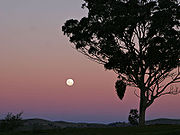 In the right viewing conditions, a pink (or orange or purple) band is visible in the twilight sky just above the dark blue band of the Earth's shadow. This pink band is called the "anti-twilight arch" or "Belt of Venus". The name "Belt of Venus" is not connected with the planet
Venus
; the Belt of Venus is part of Earth's upper atmosphere which is illuminated by the setting or rising sun. It is visible either after the sun ceases to be visible (at sunset) or before the sun becomes visible (at sunrise).
The Belt of Venus is quite a different phenomenon from the afterglow
, which appears in the geometrically opposite part of the sky.
From the viewpoint of the observer, the red sunlight directly illuminates small particles in the lower atmosphere on the other side of the sky from the sun. The red light is backscatter
ed to the observer, and that is why the Belt of Venus appears pink.
The lower the sunset sun descends, the less clearly distinguished the boundary between the Earth's shadow and Belt of Venus becomes. This is because now the setting sun illuminates a thinner part of the upper atmosphere. The red light is not scattered there because there are fewer particles, and the eye only sees the "normal" (usual) blue sky, which is due to Rayleigh scattering
from air molecules. Eventually, both the Earth's shadow and the Belt of Venus dissolve into the darkness of the night sky.
is as curved as the planet Earth is, and extends hundreds of thousands of miles into space (the antumbra, however, extends indefinitely). When the Sun
, the Earth and the Moon
are aligned perfectly (or almost perfectly), with the Earth in between the Sun and the Moon, the Earth's shadow falls onto the surface of the Moon which is facing the night side of the Earth, such that observers see the shadow gradually turn the bright full Moon dark, and then light again, creating a lunar eclipse
.
During a lunar eclipse, a very small amount of light from the sun does however still reach the Moon, even when the lunar eclipse is total; this is light which has been refracted
or bent as it passes through the Earth's atmosphere. This sunlight has been scattered
by the dust in the Earth's atmosphere, and thus that light is red, in the same way that sunset and sunrise light is red. This weak red illumination is what causes the eclipsed Moon to be dimly reddish or copper
-colored in appearance.
Shadow
A shadow is an area where direct light from a light source cannot reach due to obstruction by an object. It occupies all of the space behind an opaque object with light in front of it. The cross section of a shadow is a two-dimensional silhouette, or reverse projection of the object blocking the...
that the Earth
Earth
Earth is the third planet from the Sun, and the densest and fifth-largest of the eight planets in the Solar System. It is also the largest of the Solar System's four terrestrial planets...
itself casts on its atmosphere
Atmosphere
An atmosphere is a layer of gases that may surround a material body of sufficient mass, and that is held in place by the gravity of the body. An atmosphere may be retained for a longer duration, if the gravity is high and the atmosphere's temperature is low...
. This shadow is often visible from the surface of the Earth, as a dark band in the sky
Sky
The sky is the part of the atmosphere or outer space visible from the surface of any astronomical object. It is difficult to define precisely for several reasons. During daylight, the sky of Earth has the appearance of a pale blue surface because the air scatters the sunlight. The sky is sometimes...
near the horizon
Horizon
The horizon is the apparent line that separates earth from sky, the line that divides all visible directions into two categories: those that intersect the Earth's surface, and those that do not. At many locations, the true horizon is obscured by trees, buildings, mountains, etc., and the resulting...
. This atmospheric phenomenon can sometimes be seen twice a day, around the times of sunset
Sunset
Sunset or sundown is the daily disappearance of the Sun below the horizon in the west as a result of Earth's rotation.The time of sunset is defined in astronomy as the moment the trailing edge of the Sun's disk disappears below the horizon in the west...
and sunrise
Sunrise
Sunrise is the instant at which the upper edge of the Sun appears above the horizon in the east. Sunrise should not be confused with dawn, which is the point at which the sky begins to lighten, some time before the sun itself appears, ending twilight...
.
Whereas the phenomenon of night
Night
Night or nighttime is the period of time when the sun is below the horizon. This occurs after dusk. The opposite of night is day...
(a function of being in the shadow of the Earth) is very familiar to all, the effect of the Earth's shadow on the atmosphere is quite often visible in the sky, and yet often goes unrecognized. This shadow is visible to observers as it falls on the atmosphere of the Earth during the twilight
Twilight
Twilight is the time between dawn and sunrise or between sunset and dusk, during which sunlight scattering in the upper atmosphere illuminates the lower atmosphere, and the surface of the earth is neither completely lit nor completely dark. The sun itself is not directly visible because it is below...
hours. When the weather conditions and the observer's viewing point permit a clear sight of the horizon, the shadow can be seen as a dark blue or greyish-blue band.
Assuming the sky is clear, the Earth's shadow is visible in the opposite half of the sky to the sunset or sunrise, and is seen right above the horizon
Horizon
The horizon is the apparent line that separates earth from sky, the line that divides all visible directions into two categories: those that intersect the Earth's surface, and those that do not. At many locations, the true horizon is obscured by trees, buildings, mountains, etc., and the resulting...
as a dark blue band. A related phenomenon is the "Belt of Venus
Belt of Venus
The Belt of Venus or Venus's Girdle is the Victorian-era name for an atmospheric phenomenon seen at sunrise and sunset. Shortly after sunset or shortly before sunrise, the observer is, or is very nearly, surrounded by a pinkish glow or antitwilight arch that extends roughly 10°–20° above the horizon...
" or "anti-twilight arch" (sometimes written as "antitwilight arch"), a pink band that is visible above the dark blue of the Earth's shadow, in the same part of the sky.
There is no clear dividing line between the Earth's shadow and the Belt of Venus; one colored band shades into the other in the sky.
Appearance
The Earth's shadow (as it is cast onto the atmosphere) can be observed during the twilight hours, assuming the sky is clear and the horizon is relatively unobstructed. At sunset the Earth's shadow is visible opposite the sunset in the eastern sky, just above the horizon. The shadow shows as a dark blue band that stretches over 180º of the horizon. It is most noticeable at the antisolar pointAntisolar point
The antisolar point is the imaginary point on the celestial sphere exactly opposite the Sun. It is where anticrepuscular rays appear to converge, and on a moonless night away from city lights, it is often possible to see the gegenschein there. The apex of a rainbow will also form roughly 42...
, exactly opposite the sunset.
At sunrise, the Earth's shadow is seen in a similar way, but in the western sky.
The Earth's shadow is best observed when there is a low horizon (such as over the sea), and when the sky conditions are very clear. In addition, the higher up an observer is standing to view the horizon, the sharper the shadow appears.
At sunrise, the Earth's shadow can be seen to set as the sun itelf rises, and at sunset, the Earth's shadow rises as the sun sets.
Belt of Venus
Planet
A planet is a celestial body orbiting a star or stellar remnant that is massive enough to be rounded by its own gravity, is not massive enough to cause thermonuclear fusion, and has cleared its neighbouring region of planetesimals.The term planet is ancient, with ties to history, science,...
Venus
Venus
Venus is the second planet from the Sun, orbiting it every 224.7 Earth days. The planet is named after Venus, the Roman goddess of love and beauty. After the Moon, it is the brightest natural object in the night sky, reaching an apparent magnitude of −4.6, bright enough to cast shadows...
; the Belt of Venus is part of Earth's upper atmosphere which is illuminated by the setting or rising sun. It is visible either after the sun ceases to be visible (at sunset) or before the sun becomes visible (at sunrise).
The Belt of Venus is quite a different phenomenon from the afterglow
Afterglow
An afterglow is a broad high arch of whitish or rosy light appearing in the sky due to very fine particles of dust suspended in the high regions of the atmosphere. An afterglow may appear above the highest clouds in the hour of deepening twilight, or reflected from the high snowfields in mountain...
, which appears in the geometrically opposite part of the sky.
Color
When the sun is near the horizon at sunset or sunrise, the light from the sun is red; this is because the light is reaching the observer through an especially thick layer of the atmosphere, which works as a filter, scattering all but the red light.From the viewpoint of the observer, the red sunlight directly illuminates small particles in the lower atmosphere on the other side of the sky from the sun. The red light is backscatter
Backscatter
In physics, backscatter is the reflection of waves, particles, or signals back to the direction they came from. It is a diffuse reflection due to scattering, as opposed to specular reflection like a mirror...
ed to the observer, and that is why the Belt of Venus appears pink.
The lower the sunset sun descends, the less clearly distinguished the boundary between the Earth's shadow and Belt of Venus becomes. This is because now the setting sun illuminates a thinner part of the upper atmosphere. The red light is not scattered there because there are fewer particles, and the eye only sees the "normal" (usual) blue sky, which is due to Rayleigh scattering
Rayleigh scattering
Rayleigh scattering, named after the British physicist Lord Rayleigh, is the elastic scattering of light or other electromagnetic radiation by particles much smaller than the wavelength of the light. The particles may be individual atoms or molecules. It can occur when light travels through...
from air molecules. Eventually, both the Earth's shadow and the Belt of Venus dissolve into the darkness of the night sky.
Color of lunar eclipses
The Earth's shadow or umbraUmbra
The umbra, penumbra and antumbra are the names given to three distinct parts of a shadow, created by any light source. For a point source only the umbra is cast.These names are most often used to refer to the shadows cast by celestial bodies....
is as curved as the planet Earth is, and extends hundreds of thousands of miles into space (the antumbra, however, extends indefinitely).
Sun
The Sun is the star at the center of the Solar System. It is almost perfectly spherical and consists of hot plasma interwoven with magnetic fields...
, the Earth and the Moon
Moon
The Moon is Earth's only known natural satellite,There are a number of near-Earth asteroids including 3753 Cruithne that are co-orbital with Earth: their orbits bring them close to Earth for periods of time but then alter in the long term . These are quasi-satellites and not true moons. For more...
are aligned perfectly (or almost perfectly), with the Earth in between the Sun and the Moon, the Earth's shadow falls onto the surface of the Moon which is facing the night side of the Earth, such that observers see the shadow gradually turn the bright full Moon dark, and then light again, creating a lunar eclipse
Lunar eclipse
A lunar eclipse occurs when the Moon passes behind the Earth so that the Earth blocks the Sun's rays from striking the Moon. This can occur only when the Sun, Earth, and Moon are aligned exactly, or very closely so, with the Earth in the middle. Hence, a lunar eclipse can only occur the night of a...
.
During a lunar eclipse, a very small amount of light from the sun does however still reach the Moon, even when the lunar eclipse is total; this is light which has been refracted
Refraction
Refraction is the change in direction of a wave due to a change in its speed. It is essentially a surface phenomenon . The phenomenon is mainly in governance to the law of conservation of energy. The proper explanation would be that due to change of medium, the phase velocity of the wave is changed...
or bent as it passes through the Earth's atmosphere. This sunlight has been scattered
Scattering
Scattering is a general physical process where some forms of radiation, such as light, sound, or moving particles, are forced to deviate from a straight trajectory by one or more localized non-uniformities in the medium through which they pass. In conventional use, this also includes deviation of...
by the dust in the Earth's atmosphere, and thus that light is red, in the same way that sunset and sunrise light is red. This weak red illumination is what causes the eclipsed Moon to be dimly reddish or copper
Copper
Copper is a chemical element with the symbol Cu and atomic number 29. It is a ductile metal with very high thermal and electrical conductivity. Pure copper is soft and malleable; an exposed surface has a reddish-orange tarnish...
-colored in appearance.