

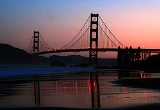
Twilight

Encyclopedia
Dawn
Dawn is the time that marks the beginning of the twilight before sunrise. It is recognized by the presence of weak sunlight, while the sun itself is still below the horizon...
and sunrise
Sunrise
Sunrise is the instant at which the upper edge of the Sun appears above the horizon in the east. Sunrise should not be confused with dawn, which is the point at which the sky begins to lighten, some time before the sun itself appears, ending twilight...
or between sunset
Sunset
Sunset or sundown is the daily disappearance of the Sun below the horizon in the west as a result of Earth's rotation.The time of sunset is defined in astronomy as the moment the trailing edge of the Sun's disk disappears below the horizon in the west...
and dusk
Dusk
Dusk is the beginning of darkness in the evening, and occurs after twilight, when the sky generally remains bright and blue. Civil dusk is when the earth has rotated enough that the center of the sun is at 6° below the local horizon...
, during which sunlight
Sunlight
Sunlight, in the broad sense, is the total frequency spectrum of electromagnetic radiation given off by the Sun. On Earth, sunlight is filtered through the Earth's atmosphere, and solar radiation is obvious as daylight when the Sun is above the horizon.When the direct solar radiation is not blocked...
scattering
Scattering
Scattering is a general physical process where some forms of radiation, such as light, sound, or moving particles, are forced to deviate from a straight trajectory by one or more localized non-uniformities in the medium through which they pass. In conventional use, this also includes deviation of...
in the upper atmosphere
Earth's atmosphere
The atmosphere of Earth is a layer of gases surrounding the planet Earth that is retained by Earth's gravity. The atmosphere protects life on Earth by absorbing ultraviolet solar radiation, warming the surface through heat retention , and reducing temperature extremes between day and night...
illuminates the lower atmosphere, and the surface of the earth
Earth
Earth is the third planet from the Sun, and the densest and fifth-largest of the eight planets in the Solar System. It is also the largest of the Solar System's four terrestrial planets...
is neither completely lit nor completely dark. The sun itself is not directly visible because it is below the horizon
Horizon
The horizon is the apparent line that separates earth from sky, the line that divides all visible directions into two categories: those that intersect the Earth's surface, and those that do not. At many locations, the true horizon is obscured by trees, buildings, mountains, etc., and the resulting...
. Owing to the distinctive quality of the ambient light at this time, twilight has long been popular with photographers and painters, who refer to it as the "blue hour
Blue hour
The blue hour comes from the French expression l'heure bleue, which refers to the period of twilight each morning and evening where there is neither full daylight nor complete darkness...
", after the French
French language
French is a Romance language spoken as a first language in France, the Romandy region in Switzerland, Wallonia and Brussels in Belgium, Monaco, the regions of Quebec and Acadia in Canada, and by various communities elsewhere. Second-language speakers of French are distributed throughout many parts...
expression l'heure bleue. Twilight is technically defined as the period between sunset and sunrise during which there is natural light provided by the upper atmosphere, which receives direct sunlight and scatters part of it towards the earth's surface.
The collateral adjective
Collateral adjective
A collateral adjective is an adjective with a similar meaning to a given noun, but derived from a different root. For example, lunar serves as an adjective to describe attributes of the Moon; moon comes from the Old English mōna and lunar from the Latin luna...
for twilight is crepuscular
Crepuscular
Crepuscular animals are those that are active primarily during twilight, that is during dawn and dusk. The word is derived from the Latin word crepusculum, meaning "twilight." Crepuscular is, thus, in contrast with diurnal and nocturnal behavior. Crepuscular animals may also be active on a bright...
; it is most frequently encountered when applied to certain insect
Insect
Insects are a class of living creatures within the arthropods that have a chitinous exoskeleton, a three-part body , three pairs of jointed legs, compound eyes, and two antennae...
s, fishes and mammal
Mammal
Mammals are members of a class of air-breathing vertebrate animals characterised by the possession of endothermy, hair, three middle ear bones, and mammary glands functional in mothers with young...
s that are most active during that time.
Definitions
Twilight is defined according to the solar elevation angleSolar elevation angle
The solar elevation angle is the elevation angle of the sun. That is, the angle between the directionof the geometric center of the sun's apparent disk and the horizon...
 , which is the position of the geometric center of the sun
Sun
The Sun is the star at the center of the Solar System. It is almost perfectly spherical and consists of hot plasma interwoven with magnetic fields...
relative to the horizon. There are three established and widely accepted subcategories of twilight: civil twilight (brightest), nautical twilight, and astronomical twilight (darkest).
| Definition | Sun's centre relative to mathematical horizon |
|---|---|
| Day | 0° ≤  |
| Sun's lower limb at horizon |  = 0° 15' = 0° 15' |
| Center of Sun's disk at horizon |  = 0° = 0° |
| Sun's upper limb at horizon |  = −0° 15' = −0° 15' |
| Solar twilight | 0° ≤  < 6° < 6° |
| Civil twilight | −6° ≤  < 0° < 0° |
| Nautical twilight | −12° ≤  < −6° < −6° |
| Astronomical twilight | −18° ≤  < −12° < −12° |
| Night |  < −18° < −18° |
(For these definitions, an ideal horizon
Horizon
The horizon is the apparent line that separates earth from sky, the line that divides all visible directions into two categories: those that intersect the Earth's surface, and those that do not. At many locations, the true horizon is obscured by trees, buildings, mountains, etc., and the resulting...
90° from the zenith
Zenith
The zenith is an imaginary point directly "above" a particular location, on the imaginary celestial sphere. "Above" means in the vertical direction opposite to the apparent gravitational force at that location. The opposite direction, i.e...
is used.)
Civil twilight
Sun
The Sun is the star at the center of the Solar System. It is almost perfectly spherical and consists of hot plasma interwoven with magnetic fields...
is 6° below the horizon
Horizon
The horizon is the apparent line that separates earth from sky, the line that divides all visible directions into two categories: those that intersect the Earth's surface, and those that do not. At many locations, the true horizon is obscured by trees, buildings, mountains, etc., and the resulting...
(civil dawn) and ends at sunrise. Evening civil twilight begins at sunset and ends when the geometric center of the sun reaches 6° below the horizon (civil dusk).
The brightest stars appear during the civil twilight, as well as planets, such as Venus
Venus
Venus is the second planet from the Sun, orbiting it every 224.7 Earth days. The planet is named after Venus, the Roman goddess of love and beauty. After the Moon, it is the brightest natural object in the night sky, reaching an apparent magnitude of −4.6, bright enough to cast shadows...
, which is known as the "morning star" or "evening star". During this period there is enough light from the sun that artificial sources of light may not be needed to carry on outdoor activities. This concept is sometimes enshrined in laws, for example, when drivers of automobiles must turn on their headlights (called lighting-up time
Lighting-up time
In the United Kingdom there is a legally enforced lighting-up time, defined as from one half-hour after sunset to one half-hour before sunrise, during which all motor vehicles on unlit public roads must use their headlights....
in the UK); when pilots may exercise the rights to fly aircraft; or if the crime of burglary
Burglary
Burglary is a crime, the essence of which is illicit entry into a building for the purposes of committing an offense. Usually that offense will be theft, but most jurisdictions specify others which fall within the ambit of burglary...
is to be treated as nighttime burglary, which carries stiffer penalties in some jurisdictions. A fixed period (most commonly 30 minutes after sunset or before sunrise) is typically used in such statutes, rather than how many degrees the sun is below the horizon. Civil twilight can also be described as the limit at which twilight illumination is sufficient, under clear weather conditions, for terrestrial objects to be clearly distinguished; at the beginning of morning civil twilight, or end of evening civil twilight, the horizon is clearly defined and the brightest stars are visible under clear atmospheric conditions.
Nautical twilight
Nautical twilight is the time when the center of the sun is between 6° and 12° below the horizon. In general, nautical twilight ends when navigation via the horizon at sea is no longer possible.During nautical twilight, sailors can take reliable star sightings of well-known stars, using a visible horizon for reference. The end of this period in the evening, or its beginning in the morning, is also the time at which traces of illumination near the sunset or sunrise point of the horizon are very difficult, if not impossible, to discern (this often being referred to as "first light" before civil dawn and "nightfall" after civil dusk). At the beginning of nautical twilight in the morning (nautical dawn), or at the end of nautical twilight in the evening (nautical dusk)—under good atmospheric conditions and in the absence of other illumination—general outlines of ground objects may be distinguishable, but detailed outdoor operations are not possible, and the horizon is indistinct.
Nautical twilight has military considerations as well. The initialisms BMNT (begin morning nautical twilight, i.e. nautical dawn) and EENT (end evening nautical twilight, i.e. nautical dusk) are used and considered when planning military operations. A military unit may treat BMNT and EENT with heightened security, e.g. by "standing to", in which everyone assumes a defensive position. This is partially due to tactics dating back to the French and Indian War
French and Indian War
The French and Indian War is the common American name for the war between Great Britain and France in North America from 1754 to 1763. In 1756, the war erupted into the world-wide conflict known as the Seven Years' War and thus came to be regarded as the North American theater of that war...
(part of the Seven Years' War
Seven Years' War
The Seven Years' War was a global military war between 1756 and 1763, involving most of the great powers of the time and affecting Europe, North America, Central America, the West African coast, India, and the Philippines...
of 1756–1763), when combatants on both sides would launch attacks at nautical dawn or dusk.
Astronomical twilight
Astronomical twilight is the time when the center of the sun is between 12° and 18° below the horizon. From the end of astronomical twilight in the evening to the beginning of astronomical twilight in the morning, the sky (away from urban light pollutionLight pollution
Light pollution, also known as photopollution or luminous pollution, is excessive or obtrusive artificial light.The International Dark-Sky Association defines light pollution as:...
) is dark enough for all astronomical observations.
Most casual observers would consider the entire sky fully dark even when astronomical twilight is just beginning in the evening or just ending in the morning, and astronomers can easily make observations of point source
Point source
A point source is a localised, relatively small source of something.Point source may also refer to:*Point source , a localised source of pollution**Point source water pollution, water pollution with a localized source...
s such as star
Star
A star is a massive, luminous sphere of plasma held together by gravity. At the end of its lifetime, a star can also contain a proportion of degenerate matter. The nearest star to Earth is the Sun, which is the source of most of the energy on Earth...
s, but faint diffuse items such as nebula
Nebula
A nebula is an interstellar cloud of dust, hydrogen gas, helium gas and other ionized gases...
e and galaxies
Galaxy
A galaxy is a massive, gravitationally bound system that consists of stars and stellar remnants, an interstellar medium of gas and dust, and an important but poorly understood component tentatively dubbed dark matter. The word galaxy is derived from the Greek galaxias , literally "milky", a...
can be properly observed only beyond the limit of astronomical twilight. In some places, especially those with sky glow, astronomical twilight may be almost indistinguishable from night. Theoretically, the dimmest stars ever visible to the naked eye
Naked eye
The naked eye is a figure of speech referring to human visual perception unaided by a magnifying or light-collecting optical device, such as a telescope or microscope. Vision corrected to normal acuity using corrective lenses is considered "naked"...
—those of the sixth magnitude
Apparent magnitude
The apparent magnitude of a celestial body is a measure of its brightness as seen by an observer on Earth, adjusted to the value it would have in the absence of the atmosphere...
—will become visible in the evening once the sun falls more than 18° below the horizon (i.e., at astronomical dusk) and become invisible when the sun moves to within 18° of the horizon in the morning (at astronomical dawn). However, because of light pollution
Light pollution
Light pollution, also known as photopollution or luminous pollution, is excessive or obtrusive artificial light.The International Dark-Sky Association defines light pollution as:...
, some localities—generally those in large cities—may never have the opportunity to view even fourth-magnitude stars, irrespective of the presence of any twilight at all.
Length
The length of twilight after sunset and before sunrise is heavily influenced by the latitudeLatitude
In geography, the latitude of a location on the Earth is the angular distance of that location south or north of the Equator. The latitude is an angle, and is usually measured in degrees . The equator has a latitude of 0°, the North pole has a latitude of 90° north , and the South pole has a...
of the observer. In the Arctic
Arctic
The Arctic is a region located at the northern-most part of the Earth. The Arctic consists of the Arctic Ocean and parts of Canada, Russia, Greenland, the United States, Norway, Sweden, Finland, and Iceland. The Arctic region consists of a vast, ice-covered ocean, surrounded by treeless permafrost...
and Antarctic
Antarctic
The Antarctic is the region around the Earth's South Pole, opposite the Arctic region around the North Pole. The Antarctic comprises the continent of Antarctica and the ice shelves, waters and island territories in the Southern Ocean situated south of the Antarctic Convergence...
regions, twilight (if there is any) can last for several hours. There is no civil twilight at the poles within a month on either side of the winter solstice. At the poles, civil twilight can be as long as two weeks, while at the equator
Equator
An equator is the intersection of a sphere's surface with the plane perpendicular to the sphere's axis of rotation and containing the sphere's center of mass....
, conditions can go from day to night in as little as twenty minutes. This is true because at low latitudes the sun's apparent movement is perpendicular
Perpendicular
In geometry, two lines or planes are considered perpendicular to each other if they form congruent adjacent angles . The term may be used as a noun or adjective...
to the observer's horizon. As one gets closer to the Arctic and Antarctic circles, the sun's disk moves toward the observer's horizon at a lower angle. The observer's earthly location will pass through the various twilight zones less directly, taking more time.
Within the polar circle
Polar circle
A polar circle is either the Arctic Circle or the Antarctic Circle. On Earth, the Arctic Circle is located at a latitude of N, and the Antarctic Circle is located at a latitude of S....
s, twenty-four hour daylight
Midnight sun
The midnight sun is a natural phenomenon occurring in summer months at latitudes north and nearby to the south of the Arctic Circle, and south and nearby to the north of the Antarctic Circle where the sun remains visible at the local midnight. Given fair weather, the sun is visible for a continuous...
is encountered in summer, and in regions very close to the poles, twilight can last for weeks on the winter side of the equinox
Equinox
An equinox occurs twice a year, when the tilt of the Earth's axis is inclined neither away from nor towards the Sun, the center of the Sun being in the same plane as the Earth's equator...
es. Outside the polar circles, where the angular distance from the polar circle is less than the angle which defines twilight (see above), twilight can continue through local midnight near the summer solstice
Summer solstice
The summer solstice occurs exactly when the axial tilt of a planet's semi-axis in a given hemisphere is most inclined towards the star that it orbits. Earth's maximum axial tilt to our star, the Sun, during a solstice is 23° 26'. Though the summer solstice is an instant in time, the term is also...
(June in the Northern Hemisphere, December in the Southern Hemisphere). The precise position of the polar circles—and thus of the regions where twilight can continue through local midnight—varies slightly from year to year with Earth's axial tilt
Axial tilt
In astronomy, axial tilt is the angle between an object's rotational axis, and a line perpendicular to its orbital plane...
. The lowest latitudes at which the various twilights can continue through local midnight are approximately 60.561° ( 60° 33’ 43” ) for civil twilight, 54.561° ( 54° 33’ 43” ) for nautical twilight and 48.561° ( 48° 33’ 43” ) for astronomical twilight.
These are the largest cities, of their respective countries, where the various twilights can continue through local solar midnight:
- Civil twilight from sunset to sunrise: ArkhangelskArkhangelskArkhangelsk , formerly known as Archangel in English, is a city and the administrative center of Arkhangelsk Oblast, Russia. It lies on both banks of the Northern Dvina River near its exit into the White Sea in the north of European Russia. The city spreads for over along the banks of the river...
, TampereTampereTampere is a city in southern Finland. It is the most populous inland city in any of the Nordic countries. The city has a population of , growing to approximately 300,000 people in the conurbation and over 340,000 in the metropolitan area. Tampere is the third most-populous municipality in...
, UmeåUmeå- Transport :The road infrastructure in Umeå is well-developed, with two European highways passing through the city. About 4 km from the city centre is the Umeå City Airport...
, TrondheimTrondheimTrondheim , historically, Nidaros and Trondhjem, is a city and municipality in Sør-Trøndelag county, Norway. With a population of 173,486, it is the third most populous municipality and city in the country, although the fourth largest metropolitan area. It is the administrative centre of...
, Mid YellMid YellMid Yell is a coastal settlement on the island of Yell, the second-largest of the Shetland Islands, Scotland.Mid Yell, the largest settlement on the island, is at the head of Mid Yell Voe on the B9081 road about a mile from its junction with the A968 road....
, TórshavnTórshavnTórshavn is the capital and largest town of the Faroe Islands. It is located in the southern part on the east coast of Streymoy. To the north west of the town lies the high mountain Húsareyn, and to the southwest, the high Kirkjubøreyn...
, ReykjavikReykjavíkReykjavík is the capital and largest city in Iceland.Its latitude at 64°08' N makes it the world's northernmost capital of a sovereign state. It is located in southwestern Iceland, on the southern shore of Faxaflói Bay...
, NuukNuukNuuk, is the capital of Greenland, the northernmost capital in North America and the largest city in Greenland. Located in the Nuup Kangerlua fjord, the city lies on the eastern shore of the Labrador Sea and on the west coast of Sermersooq. Nuuk is the largest cultural and economic center in...
, WhitehorseWhitehorse, YukonWhitehorse is Yukon's capital and largest city . It was incorporated in 1950 and is located at kilometre 1476 on the Alaska Highway in southern Yukon. Whitehorse's downtown and Riverdale areas occupy both shores of the Yukon River, which originates in British Columbia and meets the Bering Sea in...
and AnchorageAnchorage, AlaskaAnchorage is a unified home rule municipality in the southcentral part of the U.S. state of Alaska. It is the northernmost major city in the United States...
.
- Nautical twilight from civil dusk to civil dawn: PetropavlPetropavlPetropavl is a city on the Ishim River in North Kazakhstan Province of Kazakhstan close to the border with Russia, about 261 km west of Omsk along the Trans-Siberian Railway. It is capital of the North Kazakhstan Province...
, MoscowMoscowMoscow is the capital, the most populous city, and the most populous federal subject of Russia. The city is a major political, economic, cultural, scientific, religious, financial, educational, and transportation centre of Russia and the continent...
, Vicebsk, VilniusVilniusVilnius is the capital of Lithuania, and its largest city, with a population of 560,190 as of 2010. It is the seat of the Vilnius city municipality and of the Vilnius district municipality. It is also the capital of Vilnius County...
, RigaRigaRiga is the capital and largest city of Latvia. With 702,891 inhabitants Riga is the largest city of the Baltic states, one of the largest cities in Northern Europe and home to more than one third of Latvia's population. The city is an important seaport and a major industrial, commercial,...
, TallinnTallinnTallinn is the capital and largest city of Estonia. It occupies an area of with a population of 414,940. It is situated on the northern coast of the country, on the banks of the Gulf of Finland, south of Helsinki, east of Stockholm and west of Saint Petersburg. Tallinn's Old Town is in the list...
, WejherowoWejherowoWejherowo is a town in Gdańsk Pomerania, northern Poland, with 47,435 inhabitants . It has been the capital of Wejherowo County in Pomeranian Voivodeship since 1999; previously, it was a town in Gdańsk Voivodeship .-History:...
, FlensburgFlensburgFlensburg is an independent town in the north of the German state of Schleswig-Holstein. Flensburg is the centre of the region of Southern Schleswig...
, HelsinkiHelsinkiHelsinki is the capital and largest city in Finland. It is in the region of Uusimaa, located in southern Finland, on the shore of the Gulf of Finland, an arm of the Baltic Sea. The population of the city of Helsinki is , making it by far the most populous municipality in Finland. Helsinki is...
, StockholmStockholmStockholm is the capital and the largest city of Sweden and constitutes the most populated urban area in Scandinavia. Stockholm is the most populous city in Sweden, with a population of 851,155 in the municipality , 1.37 million in the urban area , and around 2.1 million in the metropolitan area...
, CopenhagenCopenhagenCopenhagen is the capital and largest city of Denmark, with an urban population of 1,199,224 and a metropolitan population of 1,930,260 . With the completion of the transnational Øresund Bridge in 2000, Copenhagen has become the centre of the increasingly integrating Øresund Region...
, OsloOsloOslo is a municipality, as well as the capital and most populous city in Norway. As a municipality , it was established on 1 January 1838. Founded around 1048 by King Harald III of Norway, the city was largely destroyed by fire in 1624. The city was moved under the reign of Denmark–Norway's King...
, Newcastle upon TyneNewcastle upon TyneNewcastle upon Tyne is a city and metropolitan borough of Tyne and Wear, in North East England. Historically a part of Northumberland, it is situated on the north bank of the River Tyne...
, GlasgowGlasgowGlasgow is the largest city in Scotland and third most populous in the United Kingdom. The city is situated on the River Clyde in the country's west central lowlands...
, BelfastBelfastBelfast is the capital of and largest city in Northern Ireland. By population, it is the 14th biggest city in the United Kingdom and second biggest on the island of Ireland . It is the seat of the devolved government and legislative Northern Ireland Assembly...
, LetterkennyLetterkennyLetterkenny , with a population of 17,568, is the largest town in County Donegal, part of the Province of Ulster in Ireland. The town is located on the River Swilly...
, EdmontonEdmontonEdmonton is the capital of the Canadian province of Alberta and is the province's second-largest city. Edmonton is located on the North Saskatchewan River and is the centre of the Edmonton Capital Region, which is surrounded by the central region of the province.The city and its census...
, Grande Prairie, Juneau, UshuaiaUshuaiaUshuaia may refer to the following:*Ushuaia, a city in Argentina.**Ushuaia Department, an administrative division**Ushuaia River**Ushuaia International Airport**Colegio Nacional de Ushuaia, National School of Ushuaia....
and Puerto WilliamsPuerto WilliamsPuerto Williams is a Chilean port, located on Isla Navarino facing the Beagle Channel. It is the capital of the Chilean Antarctic Province, one of four provinces located in the Magellan and Chilean Antartica Region...
.
- Astronomical twilight from nautical dusk to nautical dawn: Hulun Buir, ErdenetErdenetErdenet is the third-largest city in Mongolia and the capital of the aimag of Orkhon.Located in the northern part of the country, it lies in a valley between the Selenge and Orkhon rivers about 150 miles northwest of Ulan Bator, the capital...
, AstanaAstanaAstana , formerly known as Akmola , Tselinograd and Akmolinsk , is the capital and second largest city of Kazakhstan, with an officially estimated population of 708,794 as of 1 August 2010...
, SamaraSamara, RussiaSamara , is the sixth largest city in Russia. It is situated in the southeastern part of European Russia at the confluence of the Volga and Samara Rivers. Samara is the administrative center of Samara Oblast. Population: . The metropolitan area of Samara-Tolyatti-Syzran within Samara Oblast...
, KievKievKiev or Kyiv is the capital and the largest city of Ukraine, located in the north central part of the country on the Dnieper River. The population as of the 2001 census was 2,611,300. However, higher numbers have been cited in the press....
, MinskMinsk- Ecological situation :The ecological situation is monitored by Republican Center of Radioactive and Environmental Control .During 2003–2008 the overall weight of contaminants increased from 186,000 to 247,400 tons. The change of gas as industrial fuel to mazut for financial reasons has worsened...
, WarsawWarsawWarsaw is the capital and largest city of Poland. It is located on the Vistula River, roughly from the Baltic Sea and from the Carpathian Mountains. Its population in 2010 was estimated at 1,716,855 residents with a greater metropolitan area of 2,631,902 residents, making Warsaw the 10th most...
, KošiceKošiceKošice is a city in eastern Slovakia. It is situated on the river Hornád at the eastern reaches of the Slovak Ore Mountains, near the border with Hungary...
, Northernmost points of HungaryHungaryHungary , officially the Republic of Hungary , is a landlocked country in Central Europe. It is situated in the Carpathian Basin and is bordered by Slovakia to the north, Ukraine and Romania to the east, Serbia and Croatia to the south, Slovenia to the southwest and Austria to the west. The...
, ZwettlZwettlZwettl is a town and district capital in Lower Austria. It is chiefly known as the location of Zwettl Abbey, first mentioned in October 1139.- Geography :...
, PraguePraguePrague is the capital and largest city of the Czech Republic. Situated in the north-west of the country on the Vltava river, the city is home to about 1.3 million people, while its metropolitan area is estimated to have a population of over 2.3 million...
, BerlinBerlinBerlin is the capital city of Germany and is one of the 16 states of Germany. With a population of 3.45 million people, Berlin is Germany's largest city. It is the second most populous city proper and the seventh most populous urban area in the European Union...
, ParisParisParis is the capital and largest city in France, situated on the river Seine, in northern France, at the heart of the Île-de-France region...
, Luxembourg City, BrusselsBrusselsBrussels , officially the Brussels Region or Brussels-Capital Region , is the capital of Belgium and the de facto capital of the European Union...
, AmsterdamAmsterdamAmsterdam is the largest city and the capital of the Netherlands. The current position of Amsterdam as capital city of the Kingdom of the Netherlands is governed by the constitution of August 24, 1815 and its successors. Amsterdam has a population of 783,364 within city limits, an urban population...
, LondonLondonLondon is the capital city of :England and the :United Kingdom, the largest metropolitan area in the United Kingdom, and the largest urban zone in the European Union by most measures. Located on the River Thames, London has been a major settlement for two millennia, its history going back to its...
, CardiffCardiffCardiff is the capital, largest city and most populous county of Wales and the 10th largest city in the United Kingdom. The city is Wales' chief commercial centre, the base for most national cultural and sporting institutions, the Welsh national media, and the seat of the National Assembly for...
, Dublin, WinnipegWinnipegWinnipeg is the capital and largest city of Manitoba, Canada, and is the primary municipality of the Winnipeg Capital Region, with more than half of Manitoba's population. It is located near the longitudinal centre of North America, at the confluence of the Red and Assiniboine Rivers .The name...
, CalgaryCalgaryCalgary is a city in the Province of Alberta, Canada. It is located in the south of the province, in an area of foothills and prairie, approximately east of the front ranges of the Canadian Rockies...
, VancouverVancouverVancouver is a coastal seaport city on the mainland of British Columbia, Canada. It is the hub of Greater Vancouver, which, with over 2.3 million residents, is the third most populous metropolitan area in the country,...
, International FallsInternational Falls, MinnesotaInternational Falls is a city in and the county seat of Koochiching County, Minnesota, United States. The population was 6,424 at the 2010 census....
, BellinghamBellingham, WashingtonBellingham is the largest city in, and the county seat of, Whatcom County in the U.S. state of Washington. It is the twelfth-largest city in the state. Situated on Bellingham Bay, Bellingham is protected by Lummi Island, Portage Island, and the Lummi Peninsula, and opens onto the Strait of Georgia...
, Rio Gallegos and Punta Arenas.
Although Helsinki, Oslo, Stockholm, Tallinn and Saint Petersburg
Saint Petersburg
Saint Petersburg is a city and a federal subject of Russia located on the Neva River at the head of the Gulf of Finland on the Baltic Sea...
do not actually receive civil twilight from sunset to sunrise, they do have noticeably lighter skies at night (known as white nights
Midnight sun
The midnight sun is a natural phenomenon occurring in summer months at latitudes north and nearby to the south of the Arctic Circle, and south and nearby to the north of the Antarctic Circle where the sun remains visible at the local midnight. Given fair weather, the sun is visible for a continuous...
) around the summer solstice.
On other planets
Twilight on MarsMars
Mars is the fourth planet from the Sun in the Solar System. The planet is named after the Roman god of war, Mars. It is often described as the "Red Planet", as the iron oxide prevalent on its surface gives it a reddish appearance...
is longer than on Earth, lasting for up to two hours before sunrise or after sunset. Dust high in the atmosphere scatters light to the night side of the planet. Similar twilights are seen on Earth following major volcanic eruptions.
In Hinduism
Twilight is sacred in HinduismHinduism
Hinduism is the predominant and indigenous religious tradition of the Indian Subcontinent. Hinduism is known to its followers as , amongst many other expressions...
. It is called गोधूळिवेळ in Marathi
Marathi language
Marathi is an Indo-Aryan language spoken by the Marathi people of western and central India. It is the official language of the state of Maharashtra. There are over 68 million fluent speakers worldwide. Marathi has the fourth largest number of native speakers in India and is the fifteenth most...
or गोधूलिवेला godhūlivelā in Hindi—literally "cow dust time". Many ritual
Ritual
A ritual is a set of actions, performed mainly for their symbolic value. It may be prescribed by a religion or by the traditions of a community. The term usually excludes actions which are arbitrarily chosen by the performers....
s including Sandhyavandanam
Sandhyavandanam
Sandhyavandanam is a religious practice performed by Hindu men initiated into the rite by the ceremony of Upanayanam, and instructed in its execution by a Guru . Sandhyavandanam consists of excerpts from the Great Vedas that are to be recited thrice daily...
and Puja are performed at twilight. Hindus believe that this time is ideal for study and education.
See also
- BMCTBMCTBegin Morning Civil Twilight is a military term defined by the Department of Defense of USA.It is defined as the period of time at which the sun is halfway between beginning morning and nautical twilight and sunrise, when there is enough light to see objects clearly with the unaided eye.At this...
- Earth's shadowEarth's shadowThe Earth's shadow or Earth shadow are names for the shadow that the Earth itself casts on its atmosphere. This shadow is often visible from the surface of the Earth, as a dark band in the sky near the horizon...
, visible at twilight - GloomGloomGloom is a depressing darkness.People describe light conditions as gloomy when the rods in their eyes take over from the cones and so their vision becomes shades of grey as they lose their colour vision. Low light of this sort is associated with depression...
- Green flashGreen flashGreen flashes and green rays are optical phenomena that occur shortly after sunset or before sunrise, when a green spot is visible, usually for no more than a second or two, above the sun, or it may resemble a green ray shooting up from the sunset point. Green flashes are a group of phenomena...
- Polar nightPolar nightThe polar night occurs when the night lasts for more than 24 hours. This occurs only inside the polar circles. The opposite phenomenon, the polar day, or midnight sun, occurs when the sun stays above the horizon for more than 24 hours.-Description:...
External links
- Twilight Calculator Compute twilight times.
- Definition of Twilight US Naval Observatory.
- Twilight time calculator
- Formulae to calculate twilight duration by Herbert Glarner.
- The colors of twilight and sunset
- HM Nautical Almanac Office websurf Compute twilight times.
- Geoscience Australia "Sunrise and sunset times" Compute twilight times.
- An Excel workbook with VBA functions for twilight (dawn and dusk), sunrise, solar noon, sunset, and solar position (azimuth and elevation) by Greg Pelletier, translated from NOAA's online calculator for sunrise/sunset